


Didier Deschamps: ‘The Biggest Victories Can Lead to the Greatest Foolishness’

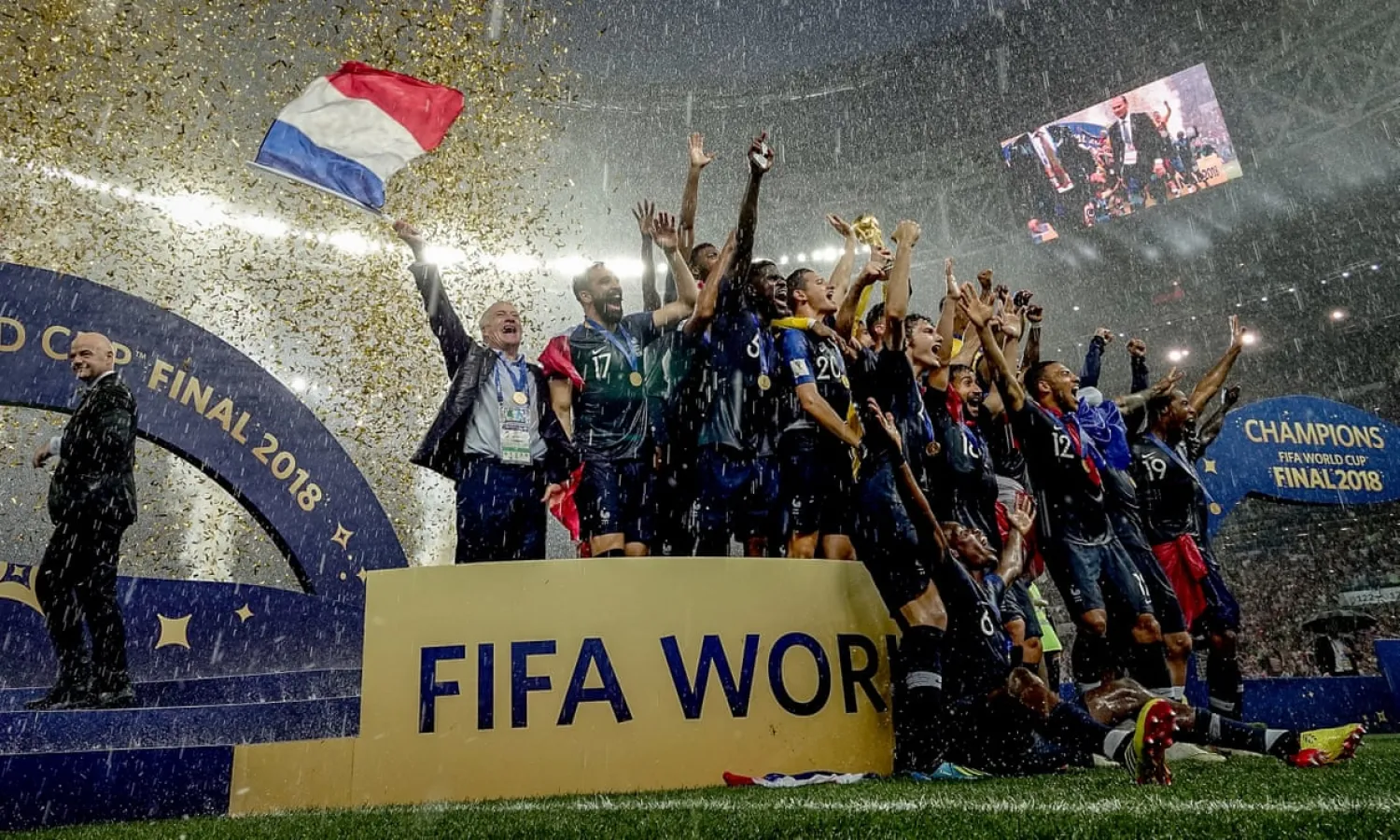
 Deschamps waves the tricolor as France celebrate beating Croatia 4-2 in the World Cup final in Moscow. Photograph: David Ramos/FIFA via Getty Images
Deschamps waves the tricolor as France celebrate beating Croatia 4-2 in the World Cup final in Moscow. Photograph: David Ramos/FIFA via Getty Images
TT

Didier Deschamps: ‘The Biggest Victories Can Lead to the Greatest Foolishness’

 Deschamps waves the tricolor as France celebrate beating Croatia 4-2 in the World Cup final in Moscow. Photograph: David Ramos/FIFA via Getty Images
Deschamps waves the tricolor as France celebrate beating Croatia 4-2 in the World Cup final in Moscow. Photograph: David Ramos/FIFA via Getty Images

The crescendo for a team that finds itself growing as it hurdles the different stages of a tournament usually hits a high note at which everything suddenly seems incandescent with possibility. For France at the World Cup that came 57 minutes into their last-16 match in Kazan. Until that moment, Les Bleus had felt – perhaps even to themselves – like a work in progress. They had been effective but uninspiring in the group stage, their progress accompanied by rumblings from the media and public about how the team could eke more out of their talent. Then Benjamin Pavard set himself and struck a piercing volley to equalize against Argentina. He careered into a group embrace with his teammates in a state of euphoric disbelief. Everything felt instantly transformed.

Didier Deschamps did not need even a millisecond to settle on that moment as the catalyst, his team’s critical click. “It was the only moment at this World Cup where for nine minutes the French were about to be eliminated,” he says. “At that point, in the knockout round of the World Cup, to do that against Argentina, with their superior experience, gave our team so much conviction and determination. When you come out of a game like that there is nothing better.”

All these weeks later Deschamps pauses, exhales deeply, as if taking in the effect of it all once again. “The truth is, it gave us wind in our sails. From that moment our belief that we could go on changed.”

It is the nature of sports analysis to look for turning points, examine finer details, detect psychological nuances that can make the difference in the life of a team. Pavard’s goal was a significant moment, although nothing feels quite as important for Deschamps as the day he settled on the group he would take to Russia.

“The biggest decision I made was not during the World Cup but before, when I had to decide on my squad of 23,” he explains. “When you make your final list for the World Cup or European Championship you don’t take the 23 best players, that is for sure. But what I did was choose the best group that could go as far as possible together. I must say playing football is not the only consideration. Of course, they are brilliant players but there are other criteria – their character, their disposition to live together with other people and get on with their teammates. It is 24 hours a day for several long weeks. The environment that they live and work in is key.”

The prioritizing of the group dynamic is at the heart of his approach to tournament football. As France captain in what he calls “his first life” as a player he was a driving force in the team that won the World Cup in 1998 and European Championship in 2000. What happened next to that team is something that has stayed with him, taught him a lesson about the fragility of success, and emphasized how and when things need refreshing even from a position of supremacy.

France went to the World Cup in South Korea and were humiliated. “We arrived at the 2002 World Cup with two titles, very calm, well organized, maybe missing a bit of concentration. But the only truth is on the pitch. The dangers are there. The biggest victories can lead to the greatest foolishness. If you think: ‘We are here, we are winners‚’ no. France went as big favorites, had the best goalscorers from major leagues in the squad – France, England and Italy – and didn’t score a single goal! Football is not an exact science. It just shows how incredibly difficult it is to maintain the highest level.”

That dismal experience began a curious trend for defending champions to unravel and exit the following World Cup early. What happened to France in 2002 then happened to Italy in 2010, Spain in 2014 and Germany in 2018. Deschamps ponders what awaits for his current winners and cracks a joke about asking him again in four years’ time – if he is still in the job.

But there is a serious point about the psychological challenge of staying at the top, and Deschamps is not afraid to tackle it. “There is such a euphoric atmosphere and everyone is on such a high you don’t automatically pay as much attention as you should to maintaining that standard. You always have to remember – how and why did we manage to win this title? You mustn’t lose that. If you go in thinking you have proved yourself so don’t have to try so hard, that’s not going to work. It is in the moments of great victory that you make the most stupid mistakes.

“People always want the same thing: to carry on winning. But there are only two titles to be won every four years and you need so many favorable circumstances to go your way. There is an anticipation, a lot of emotion. I understand that. People think that because you are world champion you should win every game. It’s not like that. That would be too easy. There is the quality of your team but also what about those of your opponent?

“The impact of winning depends upon the generation. For those between 20 and 25 it is a booster, it gives them more confidence and determination to chase for more. For those in their 30s it is different as although they have so much experience they don’t have that feeling of having improvement in front of them. They know they are near the end. The biggest difficulty in sport is when you think you can’t do better. For the older ones, they are world champions and even if it is subconscious there is naturally a feeling of relaxation. That’s the danger. That’s where you have to say: this has to change.”

That is one of the reasons why Deschamps shook up his squad for the World Cup, even though two years before his team reached the final of the European Championship (an opportunity he regrets deeply that France did not seize). “At the Euros, we had quite a few players over 30 and I took the option in this World Cup to take 14 players who had never played in a big international tournament.”

He credits the mid‑20s gang, players such as Paul Pogba and Raphaël Varane, for being particularly influential. They were able to connect with both ends of the age scale and help bring the group together. Pogba was a notable leader in the camp. “He is someone in the middle – representing something for the younger generation because he has had success and knows what you need to get there, and he is respected by the older players because he was with them for the past five years.”

Respect within the team, or the wider public, is not a guarantee in international football. Deschamps considered the scenario that prompted Mesut Özil to withdraw from representing Germany, and the subsequent debate about nationality concerning players with mixed roots. Deschamps, as a part of the iconic black-blanc-beur collective of 1998 and manager of their equally multicultural contemporaries, has strong views about what it means to be French. “I start from the principle that any player who is French or has become French is selection-worthy. Some players have dual nationality and I am not going to take that away from them, they have freedom to choose, no problem.

“I give absolutely no consideration to a player’s identity, their race, their religion. In fact, it is good for any team to have diversity in it. But they have to agree that what they are representing is France. And like England, like Germany, like many other countries, France is a multicultural society.

“It was an idea that took off in 1998 but it was also something that was taken on by politicians because football has such media presence. They made out it was the representation of an ideal France. We are represented by sportsmen of different colors, different cultures, different religions, different origins, but that’s France. Quite apart from what they do on the pitch, it is a representation of our social reality. It’s a good vehicle for integration. There is a set of basic values that come across which can be transmitted – respect for your teammates, your opponents, the referee. This educational role is essential for young people.”

Deschamps was in London last week to pick up his award as Fifa coach of the year. He made a telling observation about the issues for young prospects in England to make inroads in international football compared with those in France. “The Premier League has a specific characteristic because they have economic resources nobody else has. A lot of foreigners come over to play,” he says. “In France a young talent who is 17 plays in Ligue 1. I’ve seen that in England it is more complicated. It takes longer. So it takes longer to get to international standard. But it seems there are a young generation of players who have particular quality, winning international titles at youth levels. They have the potential to improve and do something amazing.” The advice is transparent enough: get them playing.

Not everybody is suited for the life of international coaching. The rhythms contrast so much with the frenetic relentlessness of club football with its match day routines every three or four days. Long stretches without a game, gatherings which never feel long enough to get enough deep work done – these factors can be frustrating but Deschamps also values them enormously. Why? “I have a family life, tranquillity, freedom,” he says. “I have my life as a coach, and my life as a man with my wife and my son.”

Maintaining that normality and privacy is invaluable to him, as is emphasized by his answer to the question of where he lives: “France.” He smiles. No more details necessary. “I had a life before the World Cup and I will have a life afterwards. In my personal life nothing really changes. But in my professional life, there is nothing more incredible than to win the World Cup.”

So now his mind is focused on doing his utmost to ensure the standard does not drop. If the team needs to evolve, to be refreshed, so be it. “Everyone wants things to go on forever. But in football after a while either you have to change the coach or the players and in general it is easier to change the coach! What is really important is to constantly renew. If you end up doing and saying the same things the players fall asleep. That’s important to me – always come up with surprises. There is always more.”

(The Guardian)


Sports Investment Forum Allocates Third Day to Women's Empowerment to Promote Sustainable Investment in Women’s Sports

Sports Investment Forum Allocates Third Day to Women's Empowerment to Promote Sustainable Investment in Women’s Sports
TT

Sports Investment Forum Allocates Third Day to Women's Empowerment to Promote Sustainable Investment in Women’s Sports

Sports Investment Forum Allocates Third Day to Women's Empowerment to Promote Sustainable Investment in Women’s Sports

The Sports Investment Forum announced that the third day of its 2026 edition will be dedicated to empowering women in the sports sector, in partnership with Princess Nourah bint Abdulrahman University. The move reflects the forum’s commitment to supporting the objectives of Saudi Vision 2030 and enhancing the role of women in the sports industry and sports investment.

This allocation comes as part of the forum’s program, scheduled to take place from April 20 to 22, at The Ritz-Carlton, Riyadh. The third day will feature a series of strategic sessions and specialized workshops focused on sustainable investment in women’s sports, the empowerment of female leadership, the development of inclusive sports cities, and support for research and studies in women’s sports, SPA reported.

Forum organizers emphasized that the partnership with Princess Nourah bint Abdulrahman University, recognized as the largest women’s university in the world, represents a model of integration between the academic and investment sectors. The partnership contributes to building a sustainable knowledge base that supports the growth of women’s sports and enhances investment opportunities at both local and international levels.

The dedicated day will address several strategic themes, including sustainable investment in women’s leagues and events, boosting scalable business models, empowering female leaders within federations, clubs, and sports institutions, and developing inclusive sports cities that ensure women’s participation in line with the highest international standards. It will also include the launch of research initiatives and academic partnerships to support future policies and strategies for the sector.

This approach aims to transform women’s empowerment in sports from a social framework into a sustainable investment and development pathway that enhances women’s contributions to the sports economy and reinforces Saudi Arabia’s position as a leading regional hub for advancing women’s sports.

The day is expected to attract prominent female leaders, decision-makers, investors, and local and international experts, in addition to the signing of several memoranda of understanding and joint initiatives supporting women’s empowerment in the sports sector.

The Sports Investment Forum reiterated that empowering women is a strategic pillar in developing the national sports ecosystem, contributing to economic growth objectives, enhancing quality of life, and building a more inclusive and sustainable sports community.


Liverpool Boss Slot Says Isak in 'Final Stages of Rehab'

Soccer Football -  FA Cup - Fourth Round - Liverpool v Brighton & Hove Albion - Anfield, Liverpool, Britain - February 14, 2026 Liverpool manager Arne Slot celebrates after the match REUTERS/Phil Noble
Soccer Football - FA Cup - Fourth Round - Liverpool v Brighton & Hove Albion - Anfield, Liverpool, Britain - February 14, 2026 Liverpool manager Arne Slot celebrates after the match REUTERS/Phil Noble
TT

Liverpool Boss Slot Says Isak in 'Final Stages of Rehab'

Soccer Football -  FA Cup - Fourth Round - Liverpool v Brighton & Hove Albion - Anfield, Liverpool, Britain - February 14, 2026 Liverpool manager Arne Slot celebrates after the match REUTERS/Phil Noble
Soccer Football - FA Cup - Fourth Round - Liverpool v Brighton & Hove Albion - Anfield, Liverpool, Britain - February 14, 2026 Liverpool manager Arne Slot celebrates after the match REUTERS/Phil Noble

Liverpool manager Arne Slot said on Thursday he believes striker Alexander Isak is in the "final stages of rehab" and could return by the end of next month to bolster the Reds' push for Champions League qualification.

The British record signing has been sidelined since mid-December when he fractured a bone in his lower leg and needed ankle surgery following a sliding tackle from Tottenham's Micky van de Ven.

His injury came just as 26-year-old Sweden international Isak, who joined Premier League champions Liverpool for £125 million ($169 million) from top-flight rivals Newcastle in September, was finding his form at Anfield with two goals in six matches.

"Alex has been on the pitch, not with his football boots but with his running shoes for the first time this week," Slot told reporters, according to AFP.

"The next step is doing work with the ball, which every player likes most, then the next step is to come into the group and then it takes a while before you're ready to play.

"It will be some time around there, end of March, start of April, where he is hopefully back with the group. That is not to say you are ready to play, let alone start a game.

"But it's nice that rehab goes well; that's a compliment to him and our medical staff.

"I think we all know the moment you go on the pitch it doesn't take three months but these final stages of rehab can also make it change."

Isak is one of five Liverpool first-team players currently sidelined, with only Jeremie Frimpong close to a return.

The right-back has been out since the end of last month with a hamstring injury but is expected to be available for next weekend's visit of West Ham.

Liverpool have had a rare week without a match ahead of Sunday's trip to Nottingham Forest.

"It is nice and useful as the players we are having, nine out of 10 go to the national team so for seven, eight, nine months they hardly have a time off," said Dutch boss Slot, who insisted he had no need of a rest himself.

"It was nice but I did not really need it. Last season I felt I needed it more in this period of time. I am enjoying the work I do here."

Liverpool, after a slow start to their title defense -- are now sixth and within three points of the top four with 12 games to go.

They next play three of the bottom four clubs as they look to get themselves into a Champions League position.

Premier League leaders Arsenal were left just five points clear of second-placed Manchester City after blowing a two-goal lead in a shock 2-2 draw away to rock-bottom Wolves on Wednesday.

Slot, however, said: "We didn't need yesterday to know how difficult it is to win a Premier League game. What has made the Premier League nicer this season than three, four, five, six years ago is it's more competitive."


Familiar Face Returns to Marseille where Habib Beye Takes Charge

(FILES) Rennes' French-Senegalese head coach Habib Beye looks on before the French L1 football match between Le Havre AC (HAC) and Rennes at the Oceane Stadium in Le Havre, Northwestern France, on April 13, 2025. (Photo by Lou BENOIST / AFP)
TT

Familiar Face Returns to Marseille where Habib Beye Takes Charge

(FILES) Rennes' French-Senegalese head coach Habib Beye looks on before the French L1 football match between Le Havre AC (HAC) and Rennes at the Oceane Stadium in Le Havre, Northwestern France, on April 13, 2025. (Photo by Lou BENOIST / AFP)

Marseille is looking to reignite its season with a new coach on board.

The nine-time French champion appointed Habib Beye to replace Roberto De Zerbi following a bad patch of form that saw the club exit the Champions League and drop 12 points behind Ligue 1 leader Lens.

Beye, a former Senegal international who played for Marseille, will be in charge of Friday's trip to Brest.

After leading Red Star to promotion to Ligue 2, Beye spent the last year and a half as the Rennes coach. The club sacked Beye this month.

Key matchups Marseille has failed to win its past three league games, badly damaging its title hopes. The results including a 5-0 mauling at PSG have left fans fuming. The club hopes Beye, a disciplinarian advocating ball possession and a strong attacking identity, will produce a jolt.

Beye's hiring "refocuses us on the challenges we still need to tackle between now and the end of the season,” The Associated Press quoted Marseille owner Frank McCourt as saying.

Since McCourt bought Marseille in 2016, the former powerhouse has failed to find any form of stability in a succession of coaches and crises. It hasn’t won the league title since 2010.

PSG abandoned the top spot to Lens after losing to Rennes 3-1 last week. Luis Enrique's team bounced back with a 3-2 win at Monaco in the first leg of their Champions League playoff and hosts last-placed Metz on Saturday. Lens welcomes Monaco the same day.

Third-placed Lyon, on a stunning 13-match winning run, plays at Strasbourg on Sunday.
Players to watch With the World Cup in his country looming, former Arsenal striker Folarin Balogun is hitting form at the right time. The American forward scored twice inside 18 minutes against PSG and has 10 goals and four assists this season.

At PSG, the man in form is Désiré Doué.

After his team quickly fell behind by two goals against Monaco midweek, Doué came to the rescue to turn things around. The France international was relentless and left his mark on the match after coming on as a replacement for Ousmane Dembélé. He first reduced the deficit, played a role in Achraf Hakimi’s equalizer then netted the winner.
Out of action Dembélé is expected to miss PSG's match against Metz because of an injured left calf.

Off the field PSG was sanctioned with the partial closure of the Auteuil stand for two matches and a 10,000 euros ($11,800) fine by the disciplinary committee of the French league following banners displayed and insults directed by supporters during the match against Marseille on Feb. 8. at the Parc des Princes. There were brief discriminatory chants about Marseille at the start of the game and the referee stopped play for about one minute around the 70th.
