

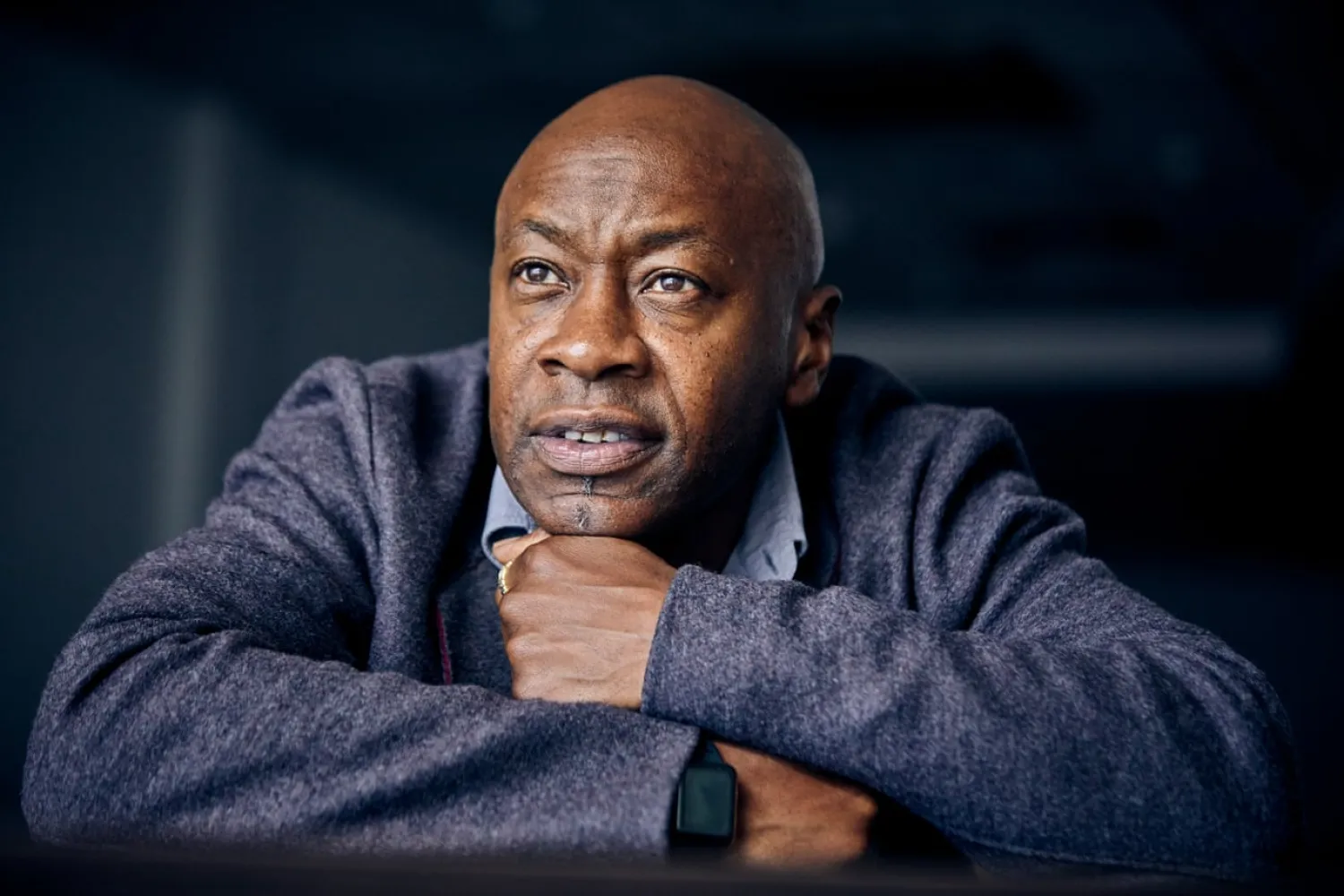

Mark Walters: The Ratio of Black Coaches Is Ridiculously Low in UK

 Mark Walters, who started his career at Aston Villa, says: ‘The ratio of black coaches to black ex-players is ridiculously low and that can’t continue.’ Photograph: Christopher Thomond for the Guardian
Mark Walters, who started his career at Aston Villa, says: ‘The ratio of black coaches to black ex-players is ridiculously low and that can’t continue.’ Photograph: Christopher Thomond for the Guardian
TT

Mark Walters: The Ratio of Black Coaches Is Ridiculously Low in UK

 Mark Walters, who started his career at Aston Villa, says: ‘The ratio of black coaches to black ex-players is ridiculously low and that can’t continue.’ Photograph: Christopher Thomond for the Guardian
Mark Walters, who started his career at Aston Villa, says: ‘The ratio of black coaches to black ex-players is ridiculously low and that can’t continue.’ Photograph: Christopher Thomond for the Guardian

Mark Walters cannot help smiling about the time Mo Johnston, his then teammate, received a bullet in the post. “I said: ‘Mo, you’ve taken the pressure right off me!” he recalls of the death threat sent to Johnston after the striker, a Catholic and former Celtic hero, joined Rangers in 1989. “We had a good laugh about it,” says Walters. “I had all sorts thrown at me – bananas, darts, a pig’s leg – and I had letters from the Ku Klux Klan telling me where I should go and what I should be doing with myself. But I never got a bullet! Unless you’ve been in a professionals’ dressing room, it’s hard to explain the humour.”

Laughing off or blocking out hatred had been Walters’ modus operandi since long before he joined Rangers in 1987, when he became the only black player in the Scottish Premier League. He encountered abuse that may seem almost unbelievable today but says it was, in one respect only, easy to ignore because racism is boring and paying attention to it would not have helped him to fulfil his ambition of becoming a successful footballer. He achieved that, playing for his hometown club Aston Villa before winning three Scottish titles with Rangers, a cap for England and the FA Cup with Liverpool.

Walters has rarely spoken publicly about much of this since retiring in 2002 but now, aged 54, he has released an autobiography, Wingin’ It, because he felt it was time to take stock. “It’s been cathartic,” he says of a book in which he addresses issues he had previously preferred not to discuss: racism, his frustration at the paucity of coaching opportunities for black former players and family matters including the lack of a relationship with his father, Lawrence Wabara, who played for Nigeria in the 1950s (“I only found out about that in my teens when I saw some pictures,” he says. “It did disappoint me, the fact he had been such a good footballer but never really did anything to help me”).

As a child, reared by his Jamaican mother, Ivy Walters, the future winger used to sneak into Villa Park. He ended up making his Villa debut aged 17 a month before the club beat Bayern Munich in the 1982 European Cup final. He was not in the squad for that match but later established himself as a key first-team player and one of the most exciting wingers in the country. Everton, then English champions, tried to buy him in 1987 but Walters chose Scotland.

“People said Rangers must have blown them out of the water financially but there was very little difference in the money,” he says. “The main reason was that English clubs were still banned from European competition, whereas Rangers had the Champions League. Lots of good English players had already gone there, like Ray Wilkins and Terry Butcher, and I had already become a bit of a fan of the club after watching them play in Europe on TV and loving the atmosphere at Ibrox.”

The atmosphere on big European nights turned out to be everything he had hoped for, but to enjoy the good times he first had to overcome an altogether more violent reception. “[Graeme] Souness [Rangers manager] did tell me I might get some stick but I had no idea there were no other black players in the Scottish league and would have been shocked if told I was going to be a pioneer, but that certainly wouldn’t have put me off,” he says. In his first appearance, away to Celtic, a large number of the 50,000 crowd made monkey noises when he touched the ball and the match had to be stopped so bananas could be cleared off the pitch.

The abuse was even worse from Hearts supporters two weeks later. This time Walters knew what to expect, partly because on the way to the game a teammate showed him a newspaper interview with a man displaying a huge batch of fruit he had bought to hurl at Walters. “The guy was standing there with his stall, very proud … so I was aware I had to be on my toes but I was shocked when the match started and I saw it wasn’t just fruit but people were also throwing darts and even a pig’s leg. That made me chuckle, but only when I got off the pitch at the end and knew I was safe.” Had he considered leaving the pitch before the end to avoid being hit? “My mentality was to play better and I can thank my mother for that,” he says. “My upbringing was to work twice as hard to achieve something if you have to. Stick it out.”

The treatment he endured provoked widespread condemnation across Scotland. After that racist abuse grew rarer. Walters even got a letter from a Hearts fan apologising for his behaviour and announcing he had imposed a lifetime stadium ban on himself. “I never had one problem in Scotland outside a stadium so I like to think [the abuse] was just an attempt to put me off my game rather than a sign that people were genuinely racist,” he says. “And that letter was good, if he really learned from it. Because education is always the answer.”

Walters provided footballing education after retiring but not as much as he would have liked. He earned all of his coaching qualifications and began what he hoped would be a long second career by taking charge of an under-nines team for Villa. “I was prepared to start at the bottom and work my way up because I had never coached before,” he says. But the highest he climbed was to be head of Villa’s Under-14s, apart from a brief stint coaching the first team at the invitation of manager David O’Leary before the Irishman was sacked in 2006. Walters spent five years coaching in schools on behalf of the Football Association. “But I never really got a chance to manage young professionals, players at the level or near the level I had played who could really benefit from my advice,” he says. “In my opinion unless you’re a manager’s son or have been playing golf with the head of academies or something, you’ll never get a job. Jobs were going to guys who had never even played professionally.

“I had all the badges and every award going – in fact, I was overqualified for every job I had. I applied for lots of others but most didn’t even bother replying. I realised it was about who you knew.

His son and daughter are now 23 and 25 respectively and he says his opportunity to coach at the highest level may have passed. But he believes measures must be introduced to ensure other black coaches can rise as high as their ability deserves: “The ratio of black coaches to black ex-players is ridiculously low and that can’t continue.”

The Guardian Sport


Shakhtar Boss Pays Ukrainian Racer $200,000 After Games Disqualification

Ukrainian President Volodymyr Zelenskiy holds helmet as he meets with a Ukrainian skeleton racer Vladyslav Heraskevych , who was disqualified from the Olympic skeleton competition over his "helmet of remembrance" depicting athletes killed since Russia's invasion and his father and coach, Mykhailo Heraskevych, amid Russia's attack on Ukraine, in Munich, Germany February 13, 2026. (Ukrainian Presidential Press Service/Handout via Reuters)
TT

Shakhtar Boss Pays Ukrainian Racer $200,000 After Games Disqualification

Ukrainian President Volodymyr Zelenskiy holds helmet as he meets with a Ukrainian skeleton racer Vladyslav Heraskevych , who was disqualified from the Olympic skeleton competition over his "helmet of remembrance" depicting athletes killed since Russia's invasion and his father and coach, Mykhailo Heraskevych, amid Russia's attack on Ukraine, in Munich, Germany February 13, 2026. (Ukrainian Presidential Press Service/Handout via Reuters)

The owner of ‌Ukrainian football club Shakhtar Donetsk has donated more than $200,000 to skeleton racer Vladyslav Heraskevych after the athlete was disqualified from the Milano Cortina Winter Games before competing over the use of a helmet depicting Ukrainian athletes killed in the war with Russia, the club said on Tuesday.

The 27-year-old Heraskevych was disqualified last week when the International Bobsleigh and Skeleton Federation jury ruled that imagery on the helmet — depicting athletes killed since Russia invaded Ukraine in 2022 — breached rules on athletes' expression at ‌the Games.

He ‌then lost an appeal at the Court ‌of ⁠Arbitration for Sport hours ⁠before the final two runs of his competition, having missed the first two runs due to his disqualification.

Heraskevych had been allowed to train with the helmet that displayed the faces of 24 dead Ukrainian athletes for several days in Cortina d'Ampezzo where the sliding center is, but the International Olympic Committee then ⁠warned him a day before his competition ‌started that he could not wear ‌it there.

“Vlad Heraskevych was denied the opportunity to compete for victory ‌at the Olympic Games, yet he returns to Ukraine a ‌true winner," Shakhtar President Rinat Akhmetov said in a club statement.

"The respect and pride he has earned among Ukrainians through his actions are the highest reward. At the same time, I want him to ‌have enough energy and resources to continue his sporting career, as well as to fight ⁠for truth, freedom ⁠and the remembrance of those who gave their lives for Ukraine," he said.

The amount is equal to the prize money Ukraine pays athletes who win a gold medal at the Games.

The case dominated headlines early on at the Olympics, with IOC President Kirsty Coventry meeting Heraskevych on Thursday morning at the sliding venue in a failed last-minute attempt to broker a compromise.

The IOC suggested he wear a black armband and display the helmet before and after the race, but said using it in competition breached rules on keeping politics off fields of play. Heraskevych also earned praise from Ukraine President Volodymyr Zelenskiy.


Speed Skating-Italy Clinch Shock Men’s Team Pursuit Gold, Canada Successfully Defend Women’s Title

 Team Italy with Davide Ghiotto, Andrea Giovannini, Michele Malfatti, celebrate winning the gold medal on the podium of the men's team pursuit speed skating race at the 2026 Winter Olympics, in Milan, Italy, Tuesday, Feb. 17, 2026. (AP)
Team Italy with Davide Ghiotto, Andrea Giovannini, Michele Malfatti, celebrate winning the gold medal on the podium of the men's team pursuit speed skating race at the 2026 Winter Olympics, in Milan, Italy, Tuesday, Feb. 17, 2026. (AP)
TT

Speed Skating-Italy Clinch Shock Men’s Team Pursuit Gold, Canada Successfully Defend Women’s Title

 Team Italy with Davide Ghiotto, Andrea Giovannini, Michele Malfatti, celebrate winning the gold medal on the podium of the men's team pursuit speed skating race at the 2026 Winter Olympics, in Milan, Italy, Tuesday, Feb. 17, 2026. (AP)
Team Italy with Davide Ghiotto, Andrea Giovannini, Michele Malfatti, celebrate winning the gold medal on the podium of the men's team pursuit speed skating race at the 2026 Winter Olympics, in Milan, Italy, Tuesday, Feb. 17, 2026. (AP)

An inspired Italy delighted the home crowd with a stunning victory in the Olympic men's team pursuit final as

Canada's Ivanie Blondin, Valerie Maltais and Isabelle Weidemann delivered another seamless performance to beat the Netherlands in the women's event and retain their title ‌on Tuesday.

Italy's ‌men upset the US who ‌arrived ⁠at the Games ⁠as world champions and gold medal favorites.

Spurred on by double Olympic champion Francesca Lollobrigida, the Italian team of Davide Ghiotto, Andrea Giovannini and Michele Malfatti electrified a frenzied arena as they stormed ⁠to a time of three ‌minutes 39.20 seconds - ‌a commanding 4.51 seconds clear of the ‌Americans with China taking bronze.

The roar inside ‌the venue as Italy powered home was thunderous as the crowd rose to their feet, cheering the host nation to one ‌of their most special golds of a highly successful Games.

Canada's women ⁠crossed ⁠the line 0.96 seconds ahead of the Netherlands, stopping the clock at two minutes 55.81 seconds, and

Japan rounded out the women's podium by beating the US in the Final B.

It was only Canada's third gold medal of the Games, following Mikael Kingsbury's win in men's dual moguls and Megan Oldham's victory in women's freeski big air.


Lindsey Vonn Back in US Following Crash in Olympic Downhill 

Milano Cortina 2026 Olympics - Alpine Skiing - Women's Downhill 3rd Official Training - Tofane Alpine Skiing Centre, Belluno, Italy - February 07, 2026. Lindsey Vonn of United States in action during training. (Reuters)
TT

Lindsey Vonn Back in US Following Crash in Olympic Downhill 

Milano Cortina 2026 Olympics - Alpine Skiing - Women's Downhill 3rd Official Training - Tofane Alpine Skiing Centre, Belluno, Italy - February 07, 2026. Lindsey Vonn of United States in action during training. (Reuters)

Lindsey Vonn is back home in the US following a week of treatment at a hospital in Italy after breaking her left leg in the Olympic downhill at the Milan Cortina Games.

“Haven’t stood on my feet in over a week... been in a hospital bed immobile since my race. And although I’m not yet able to stand, being back on home soil feels amazing,” Vonn posted on X with an American flag emoji. “Huge thank you to everyone in Italy for taking good care of me.”

The 41-year-old Vonn suffered a complex tibia fracture that has already been operated on multiple times following her Feb. 8 crash. She has said she'll need more surgery in the US.

Nine days before her fall in Cortina d'Ampezzo, Italy, Vonn ruptured the ACL in her left knee in another crash in Switzerland.

Even before then, all eyes had been on her as the feel-good story heading into the Olympics for her comeback after nearly six years of retirement.
