


Egypt: First Electric Bus Operates in Alexandria

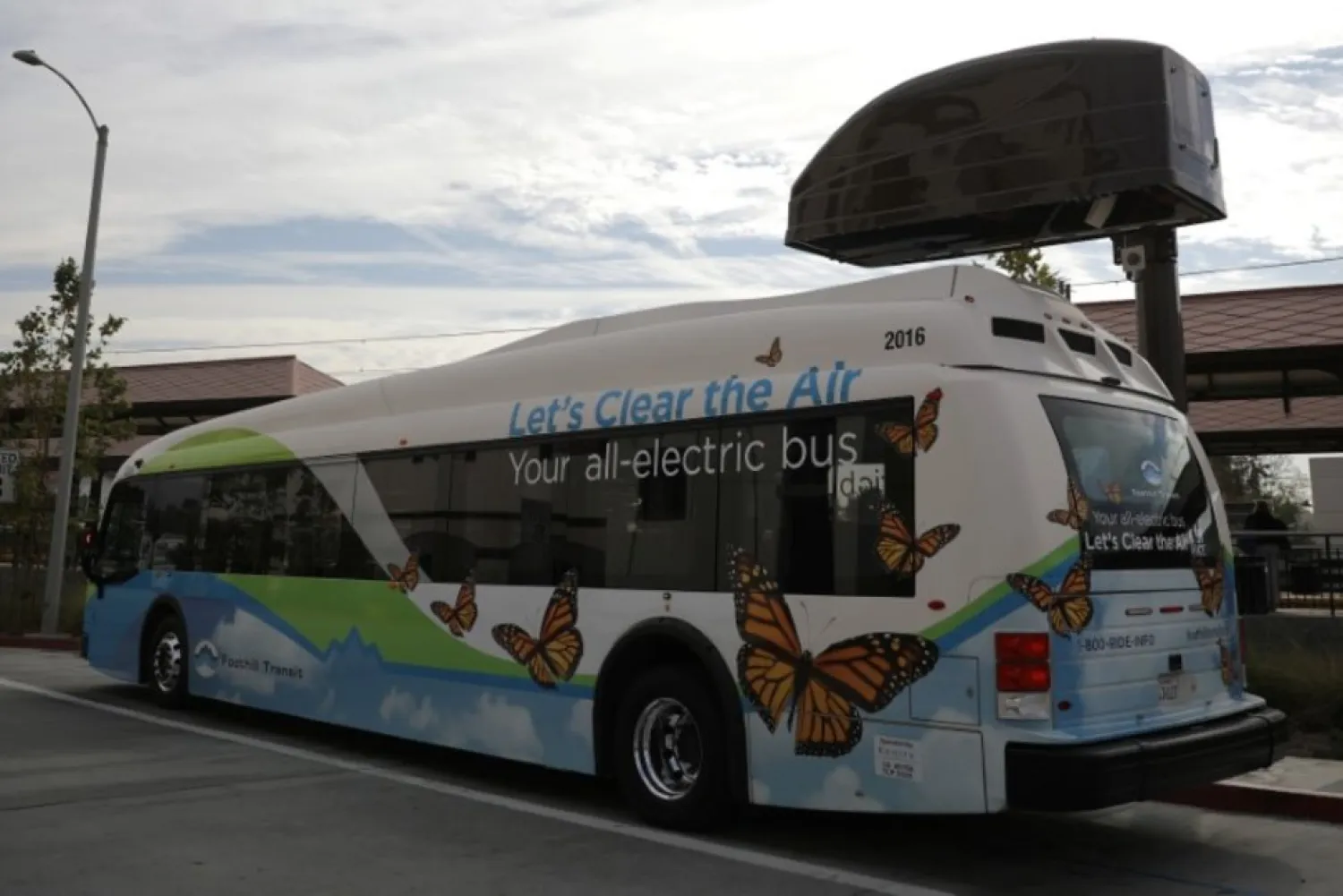
An electric bus sits under a charging station in Azusa, California U.S. November 16, 2017. REUTERS/Lucy NicholsonREUTERS
TT

Egypt: First Electric Bus Operates in Alexandria

An electric bus sits under a charging station in Azusa, California U.S. November 16, 2017. REUTERS/Lucy NicholsonREUTERS

For the first time in Egypt, the Public Transport Authority of Alexandria has launched the first electric bus to join the coastal city's public transport fleet, as a first step to replace the current vehicles with others powered with clean energy.

The bus, which was manufactured in China, kicked off its journey on the Corniche road, on the Mediterranean coast, from the park district (east) to the Ras Al-Tin area (west).

The new bus is set to work on this route for three months, before the Chinese company that designed it provides the city with 14 other buses, according to Khalid Elewa, head of the Public Transport Authority in Alexandria.

The price of the ticket is 10 pounds, and the bus, which cost over $220,000, is eco-friendly and doesn't produce any noise or emissions like the fuel-powered vehicles, Elewa told Asharq Al-Awsat.

The bus, which can accommodate up to 90 passengers, is equipped with seats for disabled people, internet access, GPS and air conditioning, and move in a maximum speed of 80 km/h. It is equipped with batteries that serve for three to four hours per charge allowing the vehicle to travel for a distance of 250 km.

The head of the Public Transport Authority in Alexandria said in a press statement that "the bus has a well-trained operating crew along with specialized workers for shipping and maintenance."

The new bus has a three-year warranty, and under the contract, the Chinese company will provide the parts required for maintenance and repair programs within 10 years."

Elewa pointed out that if the bus trial goes well, the Public Transport Authority plans to import the remaining buses and set up solar power stations for charging them.



Italian Astronaut Expects Home Flavors on Artemis III Menu

ESA (European Space Agency) astronaut pilot Luca Parmitano speaks during an interview after a press conference announcing announcing the crew for the Artemis III mission at NASA's Johnson Space Center in Houston, Texas, on June 9, 2026. (EPA)
TT

Italian Astronaut Expects Home Flavors on Artemis III Menu

ESA (European Space Agency) astronaut pilot Luca Parmitano speaks during an interview after a press conference announcing announcing the crew for the Artemis III mission at NASA's Johnson Space Center in Houston, Texas, on June 9, 2026. (EPA)

Italian astronaut Luca Parmitano is hoping to bring a taste of his homeland to the Artemis III mission he will pilot near Earth in 2027 to test two lunar modules.

The menu for the Artemis II mission in April featured Texas brisket and tortillas for the Orion spacecraft's crew -- and a jar of Italian sweet treat Nutella was also seen floating by during a live broadcast from space.

"I do expect something Italian to show up on the menu, and I don't even have to bring it up because Italian food is a treasure of UNESCO," Parmitano told AFP Tuesday, adding "everybody wants some Italian food."

That's not all the former Italian Air Force colonel brings to the table for the Artemis III -- part of a series of missions geared toward returning humans to the Moon, perhaps as soon as 2028.

Selected as an astronaut by the European Space Agency (ESA) in 2009, Parmitano has completed two missions aboard the International Space Station, where he completed complex spacewalks, including a near-fatal incident when his helmet began filling with water due to a failure in the suit's cooling system.

- Responsibility and humility -

As the mission's lead pilot, Parmitano will share responsibility with commander Randy Bresnik.

"We are both test pilots, and the spacecraft needs a crew of 2 to fly it, so we share the responsibilities," Parmitano said.

"I feel honored that I was chosen for this role," he said. "It was unexpected because I didn't know that it was in the run for that position."

Parmitano, a 49-year-old father of two daughters, added that he is "also very humbled by the task in front of us. It's a very complex mission."

He proudly wears a uniform adorned with the Italian flag and the ESA's patch, whom he calls "strong partners."

"When NASA chooses a European astronaut to be a pilot, (it) is sending a strong message that our leadership is understood, that our cooperation is valued, and that our technical expertise, both in our constructions, because Europe builds part of the spacecraft, but also our personnel, is solid," he said.

- Multicultural crew -

The crew will be rounded out by African American Andre Douglas and US astronaut of Salvadoran descent Frank Rubio.

Parmitano said he has known the mission's commander "for my entire career," but noted that for Douglas the mission will mark his first space flight.

"We immediately bonded as soon as we found out that we were assigned to this mission," Parmitano said.

He welcomes the diversity in ages and backgrounds, saying it "just enriches the crew in general."


EU Scientists: May Was World's Second-hottest on Record

FILE PHOTO: A drone view shows people using kayaks and paddle boards in the River Thames at Teddington Lock, London’s first official river bathing water site, as temperatures climb over the bank holiday weekend due to a heat dome spreading across the region, in London, Britain, May 24, 2026. REUTERS/Isabel Infantes/File Photo
TT

EU Scientists: May Was World's Second-hottest on Record

FILE PHOTO: A drone view shows people using kayaks and paddle boards in the River Thames at Teddington Lock, London’s first official river bathing water site, as temperatures climb over the bank holiday weekend due to a heat dome spreading across the region, in London, Britain, May 24, 2026. REUTERS/Isabel Infantes/File Photo

The world has just experienced the second-hottest May since records began, as climate change and the developing El Niño weather pattern conspired to push up average land and sea temperatures, the European Union's Copernicus Climate Change Service (C3S) said on Wednesday.

The hottest May on record was in 2024, in records going back to 1940, Reuters reported.

The average ⁠global temperature last ⁠month was 1.42 degrees Celsius above the average in 19th-century pre-industrial times.

Western Europe experienced one of the most severe heatwaves ever recorded so early in the year.

C3S says ⁠the extreme heat in Europe was in line with scientists' expectations of how climate change will affect the world's fastest-warming continent.

Parts of the Pacific Ocean recorded exceptionally high temperatures as it transitions towards El Nino conditions.

Extreme weather last month included fatal floods in China and Türkiye.

The El Niño ⁠weather ⁠pattern is expected to form in the coming months and to fuel extreme weather around the world.

El Niño naturally occurs every two to seven years, when weakening trade winds result in warmer waters in the eastern Pacific. The result tends to be higher global temperatures, and disrupted rainfall, meaning drought in some regions, heavy rains in others.


Woolly Mammoth Among Trove of Ancient DNA Found in Squirrel Poo

A squirrel eats on a barrier closing off the National Mall on June 8, 2026 in Washington, DC. (Photo by Brendan Smialowski / AFP)
TT

Woolly Mammoth Among Trove of Ancient DNA Found in Squirrel Poo

A squirrel eats on a barrier closing off the National Mall on June 8, 2026 in Washington, DC. (Photo by Brendan Smialowski / AFP)

A huge treasure trove of ancient DNA from animals including extinct woolly mammoths has been discovered in frozen squirrel feces in Canada's remote Yukon territory, scientists said Tuesday.

The DNA found deep inside sealed-off burrows is between 3,000 and 700,000 years old, offering a rare window into how life has changed over the millennia, AFP reported.

As well as DNA from woolly mammoths -- which the US company Colossal claims it is trying to "de-extinct" -- genetic material was also found from wolves, bison, horses, a cheetah and hundreds of plants.

Tyler Murchie, a palogenomics researcher at Canada's McMaster University and lead author of a new study, admitted that digging through squirrel poop might sound "less appealing" than discovering, say, a mammoth tusk.

However, the "spectacular" amount of information they uncovered suggests that feces is an overlooked way to see into our planet's distant past, he added.

The scientists had just been expecting to study the squirrel's microbiome before coming across the "really surprising biodiversity of organisms", Murchie said.

It turned out that arctic ground squirrels were ideal subjects for this research because of their "natural archivist behavior,” he explained.

The squirrels are only conscious for around four months a year, spending the rest of their life in hibernation.

So when they are awake, "they've got to get out there and eat as much as they can of everything," Murchie said.

The squirrels pack their burrows with nuts, seeds, leaves, bones, fur and anything else they can find.

But over time, rising permafrost permanently sealed off some of the burrows in the Yukon, creating a perfectly preserved time capsule.

Murchie said they even found a "super cute little guy" frozen in time.

"He just went to sleep one season, then he never woke up... it wasn't until some paleontologist came by investigating that they found him in there."

The scientists used the DNA to reconstruct 18 mitochondrial genomes, including for six woolly mammoths that lived in different eras.

This involves using computers to stitch together DNA fragments, like puzzle pieces, Murchie explained.

Colossal has declared its intention to resurrect the woolly mammoth, which went extinct around 4,000 years ago.

However, experts have expressed skepticism about the claim, saying the resulting animal would be more like an Asian elephant with some genetic tweaks to make it resemble a mammoth.

Murchie, who does not work for Colossal, said the genetic data they found would be made publicly available, so the company could use it.

"But they already have so much DNA to go off of -- whole genomes from different organisms -- so I'm sure ours is a drop in the bucket," he added.

The team behind the latest research, which was published in the journal Nature Communications, is working on another study describing what the DNA reveals about the woolly mammoth's evolution.

Murchie could not speak about that future research, other than to say it was "super cool.”

"I can't believe that we were able to get these insights from squirrel feces," he added.