

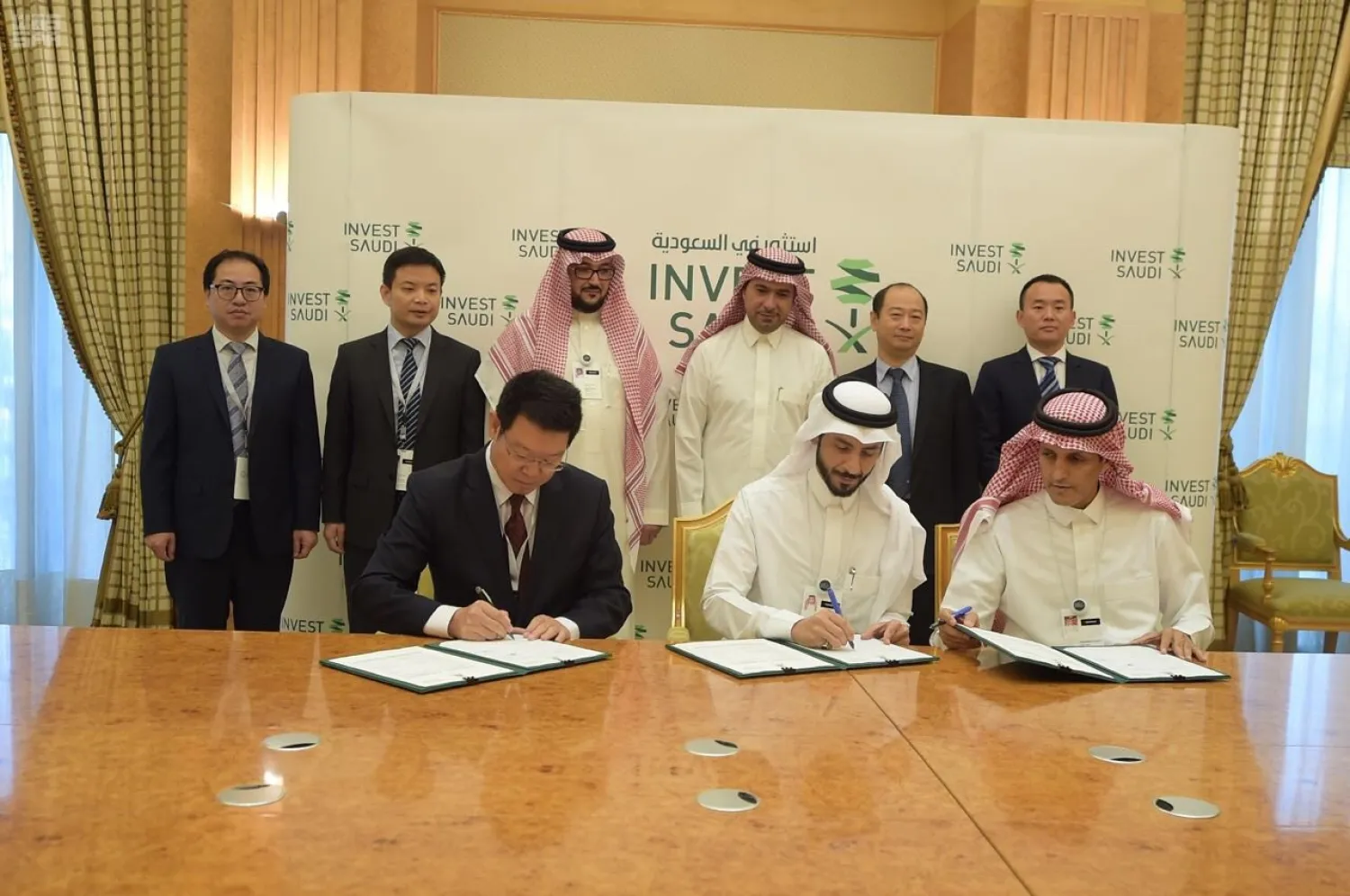

Saudi Housing Ministry Signs 3 Agreements at FII 2018

The Saudi Housing Ministry signs three deal during FII 2018. (SPA)
TT

Saudi Housing Ministry Signs 3 Agreements at FII 2018

The Saudi Housing Ministry signs three deal during FII 2018. (SPA)

The Saudi Ministry of Housing announced Thursday that the Eskan Program signed two agreements and a memorandum of understanding aiming at attracting more investments in the housing and construction sectors, reported the Saudi Press Agency. The deals were signed on the sidelines of the Future Investment Initiative (FII) 2018, held in Riyadh.

Through these agreements, the Kingdom aims to bring the best international technologies and further alliances with the best specialized companies in the field. The investments are:

- A Memorandum of cooperation between US-based Katerra and the Eskan Program to introduce modern and rapid construction methods to Saudi Arabia. The deal aims to build 50,000 housing units annually and six to eight plants specialized in modern construction technologies, in addition to creation of 15,000 jobs.

- A Memorandum of residential real estate development on the Al Asfar project, worth USD 2.7 billion. Signed between the PowerChina International Group, the Ministry of Housing and National Housing Company, it will see the construction of 17,000 housing units over the next six years. The project is expected to provide 4,000 jobs in the housing sector.

- A Memorandum of residential real estate development on the Telal Alghoroob project between the Sakani program, Alameriah and Sany (a Saudi – Chinese Partnership). This investment amounts to USD1.2 billion to build three housing projects with 9,500 housing units in Dammam and Jeddah.

Dr. Majed bin Abdullah Al-Hogail, Minister of Housing, said that these agreements will contribute to provide housing units with high quality and suitable prices, in addition to a creation of more than 15,000 jobs for the citizens through localization of these technologies in the Kingdom and building specialized plants.

The Kingdom’s investment attraction and promotion strategy is accelerating under the INVEST SAUDI initiative, in line with the objectives of Vision 2030. It seeks to support and build awareness of the significant opportunities that Saudi Arabia offers to international, regional and local investors, led by the Saudi Arabian General Investment Authority (SAGIA) in collaboration with partners across government.

Under INVEST SAUDI, FDI growth in the first half of 2018 expanded 90 percent compared to the same period last year, with the number of licenses nearly doubling by end of the third quarter.

Ash Bhardwaj Sales, Program Management, Software Development, Katerra said: “This strategic partnership will introduce modern and rapid construction methods to Saudi Arabia. We expect that there will be a high demand for these technologies in line with the government’s approach to adopt sustainable and energy-saving systems.”

Wu Wenhao, Branch General Manager and Vice-President of PowerChina International Group Ltd, said: “We are excited by the increased housing demand in the Kingdom of Saudi Arabia and the clear plan by the Ministry of Housing and Sakani Program to meet this demand in the Kingdom.”

Hejing Gao, General Manager of Sany-Alameriah, said: “The high demand for housing in Saudi Arabia and the government’s direction to initiate partnerships with the private sector and stimulate foreign investment have created an attractive environment for investment in this sector.”



Economic Shock of Mideast War to Cast Shadow over IMF, World Bank Meetings

FILE PHOTO: International Monetary Fund (IMF) logo is seen outside the headquarters building in Washington, US, September 4, 2018. REUTERS/Yuri Gripas/File Photo
TT

Economic Shock of Mideast War to Cast Shadow over IMF, World Bank Meetings

FILE PHOTO: International Monetary Fund (IMF) logo is seen outside the headquarters building in Washington, US, September 4, 2018. REUTERS/Yuri Gripas/File Photo

Top finance officials from around the world will convene in Washington this week under the shadow of the war in the Middle East, which has delivered a third major shock to the global economy after the COVID pandemic and Russia's full-scale invasion of Ukraine in 2022.

Top International Monetary Fund and World Bank officials last week said they would downgrade their forecasts for global growth and raise their inflation predictions as a result of the war, warning that emerging markets and developing countries will be hit hardest by higher energy prices and supply disruptions.

Before the Iran war broke out on February 28, both institutions had expected to lift their growth forecasts given the resilience of the global economy - even in the wake of major tariffs imposed by US President Donald Trump beginning last year. But the war has delivered a series of shocks that will slow progress on recovering growth and beating back inflation.

The World Bank's baseline estimate now projects growth in emerging markets and developing economies of 3.65% in 2026, down from 4% in October, but sees that number dropping as low as 2.6% if the war lasts longer. Inflation in those countries was now forecast to hit 4.9% in 2026, up from the previous estimate of 3%, and could spike as high as 6.7% in the worst case.

The IMF warned last week that about 45 million ⁠additional people could also ⁠face acute food insecurity if the war persists and continues to disrupt fertilizer shipments needed now.

The IMF and World Bank are racing to respond to the latest crisis and support vulnerable countries at a time when public debt levels have reached record levels and budgets are tight.

The IMF said it expects demand for $20 billion to $50 billion in near-term emergency support to low-income and energy-importing countries. The World Bank has said it could mobilize some $25 billion through crisis response instruments in the near-term, and up to $70 billion in six months, as needed.

But economists are urging governments to use only targeted and temporary steps to ease the pain of higher prices for their citizens, since broader measures could fuel inflation.

"Leadership matters, and we've come through crises in the past," World Bank President Ajay Banga told Reuters, lauding work on fiscal and monetary controls that ⁠had helped economies weather previous storms. "But this is a shock to the system."

Countries now face a tough balancing act managing inflation while keeping an eye on growth and the longer-term challenge of creating enough jobs for the 1.2 billion people who will reach working age in developing countries by 2035.

IMF and World Bank also face a far different global landscape with tensions running high between the United States and China, the world's largest economies, and the Group of 20 major economies hobbled in its ability to coordinate a response.

The United States currently holds the rotating presidency of the G20, which also includes Russia and China, but it has excluded another member - South Africa - from participation, complicating the group's ability to coordinate on this crisis.

"You're trying to operate on consensus when there's no consensus in the world right now on anything," said Josh Lipsky, chair of international economics at the Atlantic Council.

Lipsky said statements by the IMF, World Bank and other multilateral lenders about their readiness to support countries hit hard by the war were clearly aimed at reassuring markets.

"It's a signal to private creditors. This is not a time to flee countries that are in problematic waters. They will have support from the multilateral development banks and the international financial institutions. This is not going to be COVID. ⁠This is something that we can ⁠handle."

Mary Svenstrup, a former senior US Treasury official now with the Center for Global Development, said many emerging market and developing economies entered the crisis worse off than just a few years ago, with lower buffers, higher debt vulnerabilities and lower reserves.

"We need to have this crisis be a catalyst for IMF stakeholders to really rethink how the Fund supports vulnerable countries with the recognition that we're going to be seeing more global shocks," she said. "We can't ask them to sacrifice growth and development for the sake of rebuilding buffers."

Svenstrup said countries should pursue more ambitious reforms if they received fresh funds. "There probably does need to be more financial support from the (international financial institutions) but it needs to be affordable, and it needs to be in the context of reform programs and potentially broader debt relief," she said.

Martin Muehleisen, a former IMF strategy chief who is now with the Atlantic Council, agreed, saying the IMF should work with donor countries to accelerate debt restructuring for borrowers and "get them off the debt cycle."

New lending should be tied to a credible debt-reduction road map, he said.

Eric Pelofsky, vice president at the Rockefeller Foundation, said low-income and lower middle-income countries paid twice the amount to service their debts in 2025 than before COVID, limiting funds for education, health care and other critical social programs. Half were now in or near debt distress, up from a quarter, just a few years ago.

"This new conflict threatens any recovery that occurred since the pandemic or the Ukraine war, and it takes countries that have basically been treading water, trying to stay away from default, and keeps them in a long term debt-growth-investment trap," he said.


Pakistan Seeks Deeper Economic Ties with Saudi Arabia

Pakistani Prime Minister Shehbaz Sharif meets Saudi Finance Minister Mohammed al-Jadaan (Government of Pakistan)
TT

Pakistan Seeks Deeper Economic Ties with Saudi Arabia

Pakistani Prime Minister Shehbaz Sharif meets Saudi Finance Minister Mohammed al-Jadaan (Government of Pakistan)

Pakistan called for stronger economic cooperation with Saudi Arabia during a visit by Saudi Finance Minister Mohammed al-Jadaan, who held talks with the country’s top leadership in Islamabad.

The visit, the first by a senior Saudi official since a temporary ceasefire between the US and Iran, came as Islamabad was preparing to host talks between Iranian and US officials aimed at easing tensions.

Discussions focused on expanding economic cooperation and were attended by senior Pakistani officials, including Deputy Prime Minister and Foreign Minister Ishaq Dar and army chief Field Marshal Asim Munir, according to a statement posted on Prime Minister Shehbaz Sharif’s official X account.

During the meeting, Sharif conveyed greetings and appreciation to Saudi King Salman bin Abdulaziz and Crown Prince Mohammed bin Salman, praising what he described as the Kingdom’s “pivotal” economic and financial support in helping maintain Pakistan’s stability in recent years.

Sharif also referred to his recent phone call with the Crown Prince, reaffirming his government’s and people’s commitment to stand “shoulder to shoulder” with Saudi Arabia.

He said Islamabad is keen to expand partnerships in trade and high-value investment sectors, adding that the longstanding relationship between the two countries continues to deepen under the Crown Prince’s leadership in a way that serves shared interests and growth ambitions.

For his part, al-Jadaan thanked the prime minister and reiterated Saudi Arabia’s commitment to strengthening what he described as the deep-rooted and brotherly ties between the two countries, in line with the vision of Crown Prince Mohammed bin Salman.

At the conclusion of the visit, Pakistan’s Finance and Revenue Minister, Muhammad Aurangzeb, accompanied al-Jadaan to Islamabad International Airport. The two sides discussed ways to strengthen economic cooperation.


Saudi Arabia Deploys Oil ‘Central Bank’ Capacity to Cushion Hormuz Shock


Yanbu Industrial Port (SPA)
TT

Saudi Arabia Deploys Oil ‘Central Bank’ Capacity to Cushion Hormuz Shock


Yanbu Industrial Port (SPA)

Saudi Arabia has emerged as a key stabilizing force in global energy markets during the crisis triggered by the US-Israeli-Iranian war that disrupted the Strait of Hormuz, helping contain what experts describe as an unprecedented supply shock.

While pessimistic forecasts had pointed to oil prices surging toward $200 per barrel, Saudi action helped cap prices at around $112, drawing on extensive infrastructure and flexible logistics that reinforced its reputation as the world’s “central bank of oil.”

Experts told Asharq Al-Awsat that the Kingdom’s strategic East-West pipeline, known as Petroline, proved decisive in mitigating the crisis.

Fadl bin Saad al-Buainain, a member of Saudi Arabia’s Shura Council and an economic adviser, said Riyadh has cemented its role as a global oil stabilizer through active management and policies aimed at balancing markets and ensuring supply continuity.

He stressed that this role was evident during the Hormuz crisis, as Saudi Arabia rerouted exports from the Gulf to the Red Sea via Petroline, pumping about 7 million barrels per day to the port of Yanbu, with part directed to domestic refineries and most exported abroad.

Alternative routes and market confidence

Al-Buainain said Saudi Aramco’s ability to rely on secure export alternatives enabled the Kingdom to navigate the crisis and reassure markets.

He noted that this reliability reflects long-term investments in production, transport and overseas storage, which act as a buffer against disruptions. Aramco also plays a central role in contingency planning to address geopolitical risks, he added.

The disruption of the Strait of Hormuz, through which roughly one-fifth of global oil supply passes, posed a major shock to the global economy and threatened maritime security. However, Saudi alternatives helped ease the impact, including the use of global reserves to offset supply shortfalls.

Al-Buainain said Saudi Arabia’s commitment to its customers, including its decision not to declare force majeure, was key to preventing prices from rising above $150.

He warned that the crisis could worsen if no solution is found to secure navigation in the strait, given its importance to critical sectors such as agriculture and petrochemicals.

Red Sea as strategic outlet

Abdulrahman Baashen, head of the Shurooq Center for Economic Studies, said Saudi Arabia successfully leveraged its “flexible geography” by activating alternative export routes managed by Saudi Aramco, boosting global market confidence despite regional tensions.

He added that the Red Sea provided a strategic alternative to Hormuz, allowing Aramco to maintain steady flows and meet its commitments under difficult conditions.

Baashen said continued Saudi exports via the Red Sea played a crucial role in limiting price increases. Although prices rose to $112 per barrel, the strategy helped avert a worst-case scenario of a surge to $200.

Rapid response and operational flexibility

Economist Ibrahim Alomar, head of Sharah for Researches and Economic Studies, said Saudi Arabia demonstrated exceptional reliability as a major energy producer.

He pointed to a sharp rise in flows through the East-West pipeline, from an average of 770,000 barrels per day in January and February to about 2.9 million barrels, and then to more than 5 million barrels per day within weeks.

“This reflects rare operational flexibility that only a country acting as the world’s oil central bank can provide,” he stated.

Saudi preparedness helped preserve about 85 percent of its exports, making the pipeline a key safeguard against severe supply shocks, Alomar added.

He warned that a 20 percent disruption in global supply through Hormuz could have pushed prices to between $230 and $300 per barrel, triggering a severe global economic shock.

International Energy Agency chief Fatih Birol has credited Saudi Arabia’s rapid response and the redirection of roughly two-thirds of its exports with preventing the situation from spiraling out of control.

Alomar described Saudi Arabia as the “engine of the Gulf economy,” citing its production capacity, infrastructure located away from conflict zones, and logistical support in supplying essential goods across the region via sea, air and land.