


Sweida's Druze Reject Regime Call to Serve

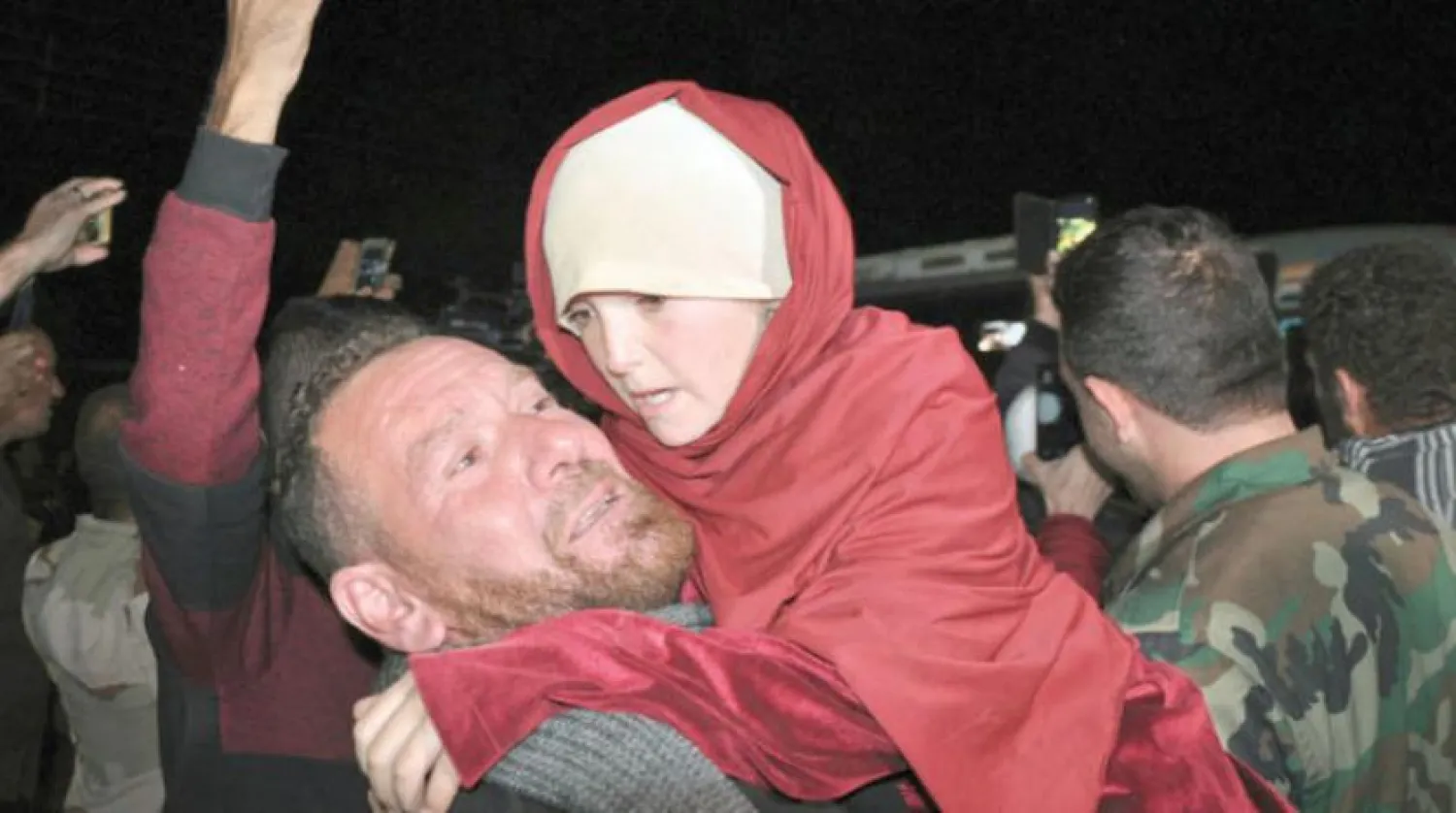
A man holds a young girl from Sweida rescued from ISIS. AP file photo
TT

Sweida's Druze Reject Regime Call to Serve

A man holds a young girl from Sweida rescued from ISIS. AP file photo

Nearly eight years into the Syrian war, Selim still refuses to perform his military service, just like many fellow Druze from Sweida province rejecting the regime's conscription call.

"I don't want to get involved in the Syrian bloodbath," said the 27-year-old, who gave a pseudonym for fear of reprisals.

Last week, the head of the regime, Bashar al-Assad, urged the minority, which accounted for around three percent of Syria's pre-war population, to send its young men to the army.

After rotating out some very long-serving conscripts, the regime is looking for fresh blood to beef up its ranks and exercise real control over the swathes of land it reconquered from insurgents.

Assad's appeal came after the government helped release, earlier this month, a large group of Druze civilians who had been taken hostage by ISIS in Sweida.

His call appeared to terminate a deal whereby the Druze were allowed to organize their own militia rather than serve in the army, but its implementation could prove tricky.

"I don't want to have to kill the people of Hama, the people of Homs or any other province, for the sake of keeping one man in power," Selim told AFP by phone from Sweida.

"The army is your grave," said the young man, explaining that the lack of a time limit on conscription during war means recruits will not be able to know when they can return home.

To be on the safe side, Selim never leaves Sweida, a province in southern Syria that borders Jordan and where the Syrian security services have a limited presence.

In July, Selim was among hundreds of other residents who took up arms to pin back ISIS after a series of attacks that left at least 260 people dead.

During the assault, the deadliest to have hit the Druze community since the start of the war, the militants kidnapped about 30 people, mainly women and children.

The last of the surviving hostages were released on November 8, leading to Assad's demand that the Druze contribute to the national war effort.

"The regime is trying to tell us: it's ISIS or the military service," said Selim.

Khattar Abu Diab, a Paris-based professor of political science and a specialist in Druze affairs, said Assad was attempting to intimidate the minority.

"He wants to use the residents of Sweida as cannon fodder for future battles," he said.

Sweida was mostly spared by the deadly Syrian conflict and only faced sporadic militant attacks they managed to repel.

Residents on several occasions in 2014 besieged detention centers to obtain the release of men who had been rounded up to join the army.

At the time the central government was at its weakest, stretched very thin on many fronts and had humored the Druze not to risk opening up another.

That level of autonomy now comes at a cost for Sweida, where security is all but guaranteed by the presence of the Syrian police.

Some residents see a deliberate government effort to maintain a level of chaos in the province.

"The regime uses other means to punish Sweida: ISIS instead of barrel bombs, crime and disorder instead of arrests," activist Hamam al-Khatib said.

According to the Britain-based Syrian Observatory for Human Rights war monitor, around 30,000 Druze men are liable for military service.

The group's head, Rami Abdel Rahman, alleged that the government told Druze leaders it would remove the ISIS threat if they promise to support the conscription drive.

ISIS militants who had been holding out in the volcanic area of Tulul al-Safa, between Damascus and Sweida, finally retreated last week after heavy regime bombardment and a government-negotiated deal.

Regardless of the agreements being cut in Damascus and by their leaders, Druze youngsters willing to serve in the national army are hard to come by.

"The war just keeps going on ... we are not killing machines," said Uday al-Khatib, a 25-year-old Sweida resident.

"Yes, the Sweida youth don't do military service, I'm one of them, but we are the ones who pushed back ISIS and the army didn't help us," he told AFP in a phone interview.



UNHCR Chief Calls for ‘Urgent’ Support to Lebanon During War

Displaced children queue to get toys at a shelter in Tyre, south Lebanon, April 14, 2026. (Reuters)
TT

UNHCR Chief Calls for ‘Urgent’ Support to Lebanon During War

Displaced children queue to get toys at a shelter in Tyre, south Lebanon, April 14, 2026. (Reuters)

United Nations refugee chief Barham Salih on Wednesday called on the international community to provide urgent support to Lebanon, with a fifth of the country's population displaced by the Israel-Hezbollah war.

"I call upon the international community to provide urgent support and relief to Lebanon," he said after meeting Lebanese Prime Minister Nawaf Salam.

"The humanitarian consequences of this war are immense, and I emphasize the need to spare civilians and civilian infrastructure from the ravages of attack. Lebanon does not deserve to be trapped in a recurring cycle of violence, it deserves support and stability."

He added that UNHCR has received "a portion" of the $61 million it had appealed for during the war to support Lebanon in its "unprecedented" displacement crisis, as more than a million people, or a fifth of the Lebanese population, are displaced by the conflict.

Of them, more than 140,000 are in government shelters.

The $61 million is part of the Lebanon Flash Appeal, launched by UN chief Antonio Guterres last month to gather $308 million to help the country.

War-ravaged Lebanon has been dealing with an unprecedented financial crisis since 2019 and was still reeling from the 2024 Israel-Hezbollah war when the Iran-backed group drew it into the Middle East conflict last month.


Israeli Army Strikes South of Beirut as Hezbollah Launches Rockets at Israel

First responders and security forces work at the site of an Israeli airstrike that targeted a vehicle the Lebanese town of Jiyyeh, south of Beirut, on April 15, 2026. (AFP)
TT

Israeli Army Strikes South of Beirut as Hezbollah Launches Rockets at Israel

First responders and security forces work at the site of an Israeli airstrike that targeted a vehicle the Lebanese town of Jiyyeh, south of Beirut, on April 15, 2026. (AFP)

Two Israeli strikes on Wednesday hit vehicles south of Beirut, state media reported, while Hezbollah launched rockets at Israel, hours after Lebanon and Israel agreed to hold direct negotiations.

Israel is continuing its strikes on southern Lebanon in its war with Iran-backed Hezbollah, but has not targeted the Lebanese capital since a series of attacks across the country on April 8 that killed more than 350 people.

Lebanon's state-run National News Agency reported two separate Israeli strikes on two vehicles, one in the seafront town of Saadiyat and another on a coastal highway in neighboring Jiyyeh, around 20 kilometers (12 miles) south of Beirut and outside Hezbollah's traditional strongholds.

NNA also reported several other strikes across southern Lebanon.

The Israeli military meanwhile said it had detected "approximately 30 launches" by Hezbollah towards Israel since the early hours, a spokesman told AFP.

Hezbollah said it launched rockets at 10 northern Israeli areas.

The attacks come a day after Lebanon and Israel's ambassadors to the United States held their first direct talks in decades in Washington and agreed to hold further direct negotiations, with the Lebanese envoy calling for a ceasefire.

Hezbollah strongly rejected the talks.

Israeli attacks on Lebanon have killed more than 2,000 people and displaced more than a million since March 2, according to Lebanese authorities.


Damascus to Take Over Prisons under SDF Control

People gather as prisoners from the Syrian Democratic Forces (SDF) arrive after being released under an agreement between the SDF and the Syrian government, in Hasakeh, Syria, April 11, 2026. (Reuters)
TT

Damascus to Take Over Prisons under SDF Control

People gather as prisoners from the Syrian Democratic Forces (SDF) arrive after being released under an agreement between the SDF and the Syrian government, in Hasakeh, Syria, April 11, 2026. (Reuters)

Syrian authorities are set to take control of prisons run by the Syrian Democratic Forces (SDF), a government official said, as part of efforts to resolve the detainee issue under an agreement reached on January 29.

Ahmad al-Hilali, spokesman for the presidential team overseeing implementation of the deal, said all SDF-run prisons would be handed over to the justice and interior ministries.

He noted that detainees held by the SDF are being released without conditions, with a new batch expected next week.

“The SDF is committed to the full release of detainees linked to the uprising,” Hilali said, adding that the Justice Ministry would review the cases of those accused of criminal offenses.

He revealed that about 1,500 detainees had already been released, while around 500 others would have their cases examined.

Hilali said the transfer of prisons, particularly in Hasakeh province, would ensure that no detentions remain outside state oversight. He described the issue as humanitarian and said the SDF is moving toward integration into state institutions.

The presidential team, headed by Brig. Gen. Ziad al-Ayesh, arrived on Saturday at the Melbiya Regiment base in the Hasakeh countryside to oversee the release of a third batch of detainees under the agreement. The process included releases by both sides.

On Monday, the SDF freed a fourth group of detainees, according to Hasakeh’s media directorate, in a move carried out under the supervision of the presidential team, Syria TV reported.

Hilali said the government is moving to take over management of SDF-run prisons to end what he described as unregulated and ad hoc releases in recent months.

In a separate development, Hilali said a convoy carrying 800 families displaced from the Afrin region set off from Hasakeh province on Wednesday toward their home areas.

He described it as the largest organized return so far, reflecting progress in preparing conditions and basic services for returns, and underscoring what he said was the state’s commitment to addressing displacement.