

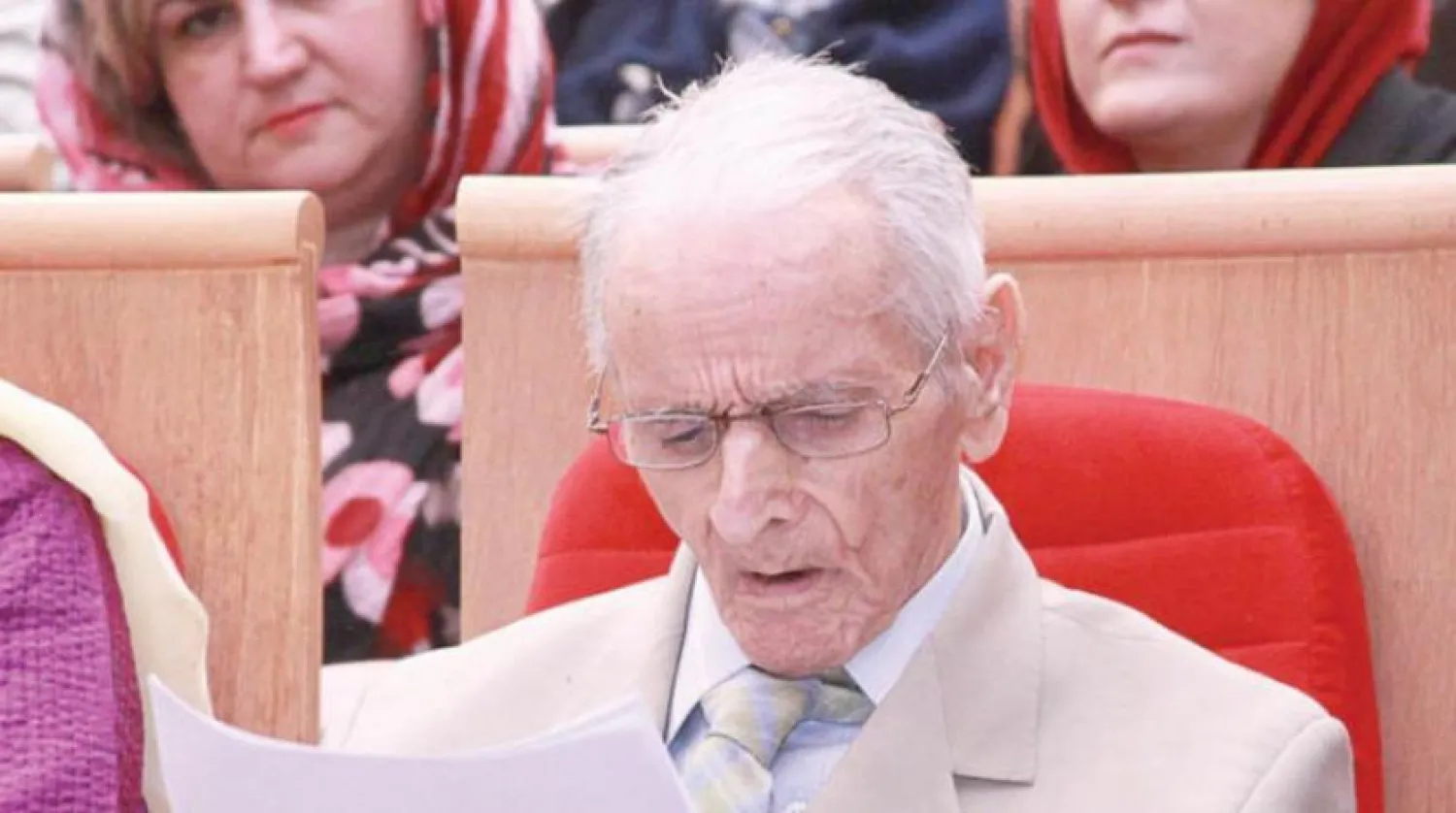

The Last Father of Iranian Communsim Passes Away

Veteran journalist, author and political leader Anwar Khamehi
TT

The Last Father of Iranian Communsim Passes Away

Veteran journalist, author and political leader Anwar Khamehi

Earlier this week, the man known in Iran intellectual circles as the last historic figure of Iranian Communism passed away aged 102. Veteran journalist, author and political leader Anwar Khamehi was one of the almost legendary “53” Iranian intellectuals who, thrown into prison at the start of the Second World War, decided to create the Tudeh (Masses) Party in 1941.

In a life spanning more than a century, Khamehi passed through many epiphanies as hardline Stalinist, Social Democrat, liberal and, eventually, a mild Iranian nationalist. In the process he also created a highly respected body of literary work consisting of 23 books and hundreds of essays and magazine articles.

I first came to know him in the late 1960s when, after more than a decade of exile, he had shed his “Utopian illusions” and was trying to focus on a new literary and journalistic career.

Like many founders of the Tudeh Party, Khamehi had a distinguished family background. On his mother's side he was a descendant of the Qajar Fatah Ali Shah, and on his father's side he was a great grandson of prominent theologian Mullah Muhammad Naraqi. His father was a leading figure in the Constitutional Revolution of 1905-6 and Editor-in-Chief of the newspaper Habl al-Matin (Firm Rope) which was dubbed as the mouthpiece of the reform movement.

After a stint in prison along with other Tudeh leaders, including his guru Dr. Taqi Arani, Anwar operated as a party cadre and assigned various missions, including a memorable one to recruit members among oil workers in Khuzestan.

However, as Stalin's cult of personality reached its peak shortly before the despot's death in March 1953, Anwar was looking for other avenues to spend his political energies.

He found it in the so-called Third Force ( Niruy-e-Sevovom) splinter group led by two Tudeh dissidents, Khalil Maleki and Ishaq Yeprem. When that party also failed to satisfy him, Anwar decided to go into exile and spent almost 16 years away from Iran, mostly in France, where, leaving his initial scientific education behind, he switched to studying politics and history obtaining a Ph.D., but ending up in Mexico.

Years later when he returned to Iran, I made his acquaintance as Editor of the mass circulation weekly Etelaat Haftegi magazine. Khamehi spoke of the "unbearable pains of exile". He claimed that, while in exile, each morning as he left home to go to university or to work, he fantasized about suddenly hearing someone speak Persian. The only way to realize that fantasy, impossible in Mexico, was to return home.

By the time he came back home, Anwar was persuaded that Communism had been little more than an illusion, if not an actual fraud concocted by power-hungry pseudointellectuals.

However, he never regretted his “Marxist years” as he believed that Marxism was an important feature of modern political life on a global scale and that it was important for Iranians to be familiar with it.

Back from exile, he was surprised when the Shah’s much dreaded secret police didn’t even bother to call him in for questioning. "They just ignored me,” he quipped. “ May be they thought that I had died long ago!”

However, thanks to his knowledge of the world and journalistic talents he was quickly reintegrated into the intellectual elite of Tehran and rose to edit some of the most influential publications in the capital. He also wrote and translated a number of books, leaving behind examples of a brilliant and highly disciplined prose.

The word I always associated with Khamehi, who, in the 1970s also wrote occasional columns for the newspaper Kayhan, was "pure heartedness." (khosh-qalbi in Persian). He was a good human being, modest but self-reliant, and, above all, respectful of everyone from the highest to the most humble.

But what most endeared him to me was his boundless love of Iran, rooted in his passion for Persian poetry. He once claimed that it was poetry that had sustained Iranian culture for over a millennium. "It is a gift to be born in our culture," he claimed. "But it is also a great responsibility."



Rare Diamond Changes Lives of Two Indian Friends

Satish Khatik and Sajid Mohammed found a 15.34-carat gem-quality diamond in Panna (Amit Rathaur)
TT

Rare Diamond Changes Lives of Two Indian Friends

Satish Khatik and Sajid Mohammed found a 15.34-carat gem-quality diamond in Panna (Amit Rathaur)

On a recent winter morning in Panna, a diamond mining region in central India, two childhood friends made a discovery that they think could change their lives forever.

Satish Khatik and Sajid Mohammed stumbled upon a large, glistening rock on a plot of land they had leased just weeks earlier, according to BBC India.

When they took the stone to the city's official diamond evaluator, they learnt they had found a 15.34-carat gem-quality diamond - one of the finest varieties of natural diamonds that exist.

“The estimated market price of the stone is around five to six million rupees [$55,000 - $66,000] and it will be auctioned soon,” Anupam Singh, the diamond evaluator, told BBC Hindi.

The government holds quarterly auctions, drawing buyers from across India and abroad to bid for the diamonds.

“Estimated prices depend on the dollar rate and benchmarks set by the Rapaport report,” Singh said. Rapaport is widely regarded as a leading authority on independent diamond and jewelry market analysis.

Khatik and Mohammed say they are over the moon. “We can now get our sisters married,” they said.

Khatik, 24, who runs a meat shop and Mohammed, 23 who sells fruits, come from poor backgrounds and are the youngest sons in their families.

For generations, their families have been trying their luck at finding diamonds, which is a common quest among the district's residents.

Panna, which is in Madhya Pradesh state, is among India's least developed districts - its residents face poverty, water scarcity and unemployment.

While most mines are run by the federal government, state authorities lease small plots to locals each year at nominal rates. With few job opportunities in the city, residents hope for a prized find to improve their fortunes - but most come up empty-handed.

Mohammed said his father and grandfather had dug through these plots for decades but discovered nothing more that “dust and slivers of quartz.”

His father Nafees said that the “gods have finally rewarded their hard work and patience.”

They leased a plot in search of diamonds partly out of desperation, as their meagre incomes could not keep pace with rising household costs - let alone pay for a wedding, Mohammed told the BBC.


SpaceX Loses Contact with Starlink Satellite after Mishap

FILE PHOTO: SpaceX logo and Elon Musk silhouette are seen in this illustration taken, December 19, 2022. REUTERS/Dado Ruvic/Illustration/File Photo
TT

SpaceX Loses Contact with Starlink Satellite after Mishap

FILE PHOTO: SpaceX logo and Elon Musk silhouette are seen in this illustration taken, December 19, 2022. REUTERS/Dado Ruvic/Illustration/File Photo

SpaceX's Starlink said one of its satellites experienced an anomaly in space on Wednesday that created a "small number" of debris and cut off communications with the spacecraft at 418 km (259.73 miles) in altitude, a rare kinetic accident in orbit for the satellite internet giant.

"The satellite is largely intact, tumbling, and will reenter the Earth's atmosphere and fully demise within weeks," Starlink said in a post on X.

The company said it was working with the US Space Force and NASA to monitor the debris pieces, the number of which SpaceX did not say.

Space Force's space-tracking unit did not immediately return a Reuters request for comment on the number of trackable debris, which could pose risks for other active satellites in orbit.

With the Starlink satellite still somewhat intact, the event seemed smaller in scale than other orbital mishaps such as the breakup of an Intelsat satellite that created more than 700 pieces, or the breakup of a Chinese rocket body last year.


Lion, Bear Kept as Pets in Albania Find New Homes in German Wildlife Sanctuaries

In this photo, released on Tuesday, Dec. 16, 2025 by Four Paws, veterinarians prepare Erion, a three-year-old lion for its transportation from Tirana to Germany after its illegal keeping in Albania. (Four Paws via AP)
TT

Lion, Bear Kept as Pets in Albania Find New Homes in German Wildlife Sanctuaries

In this photo, released on Tuesday, Dec. 16, 2025 by Four Paws, veterinarians prepare Erion, a three-year-old lion for its transportation from Tirana to Germany after its illegal keeping in Albania. (Four Paws via AP)

A lion and bear rescued from captivity in northern Albania arrived in animal sanctuaries in Germany in early December after authorities in Tirana discovered they were being illegally kept as pets on a private estate.

Erion, a 3-year-old lion, and Flora, a 2-year-old bear, are now both starting a new life.

“We are very happy that the authorities confiscated the animals and that we now have the chance to bring them to Germany, where they can start over and live in species-appropriate conditions,” said Magdalena Scherk-Trettin, a senior project manager responsible for rescues at the international animal welfare organization FOUR PAWS.

A team from FOUR PAWS carried out the rescue after Albania’s National Forestry Agency located the lion based on videos posted on TikTok by its owner.

Neither authorities nor the organization have named the person who was keeping them as pets.

Veterinarians administered anesthesia before the animals were loaded into crates for their long trip to new homes. On Dec. 13, they ended a 70-hour journey through several European countries, with Erion now housed in a wild animal sanctuary in southeast Germany and Flora in a bear sanctuary in the north of the country, FOUR PAWS said.

The organization said both animals had been in poor condition.

“An initial visual check determined that Flora is malnourished and has dental issues, so her recovery plan is already underway,” the organization said.

And when Erion was rescued, his mane had fallen out, for reasons that the veterinarians have not yet been able to determine, it said.

Despite the challenging journey, the rescue was worth it, said Scherk-Trettin. “We are delighted to see these animals begin their new lives.”

Illegal wildlife trade remains a systemic problem in Albania and across the region, where bears in particular, as well as exotic animals, are kept in cages at restaurants or on private properties with little or no expert care.

Erion's and Flora's origins remain unclear. FOUR PAWS said it believes the lion is a victim of illegal wildlife trafficking, while the bear was likely poached from the wild.

“The rescue highlights Albania’s urgent need to tackle illegal wildlife trade and private keeping,” The Associated Press quoted the organization as saying in a statement.

Weak legislation, legal loopholes and poor enforcement have contributed to the widespread private captivity and trade of wild animals in Albania, according to FOUR PAWS, which estimates that more than 60 big cats are still being kept in poor conditions in Albania.

Albanian law allows for individuals or organizations to keep specimens of wild animals if they were born in captivity – for example in a zoo or a specialized facility. Non-native species born outside of Albania can also be kept if documents can be provided proving they were acquired from specialized breeding and trade centers.

Sajmir Shehu, a project manager at Four Paws, said the law lacks a stringent framework based on which organizations like his could prevent wild animals being kept in captivity.

The law also allows for animals to be confiscated if welfare or veterinary standards are not met, but imposes no sanctions on the owners of exotic pets.