


UN Listing Gives Lifeline to Syria's Last Shadow Puppeteer

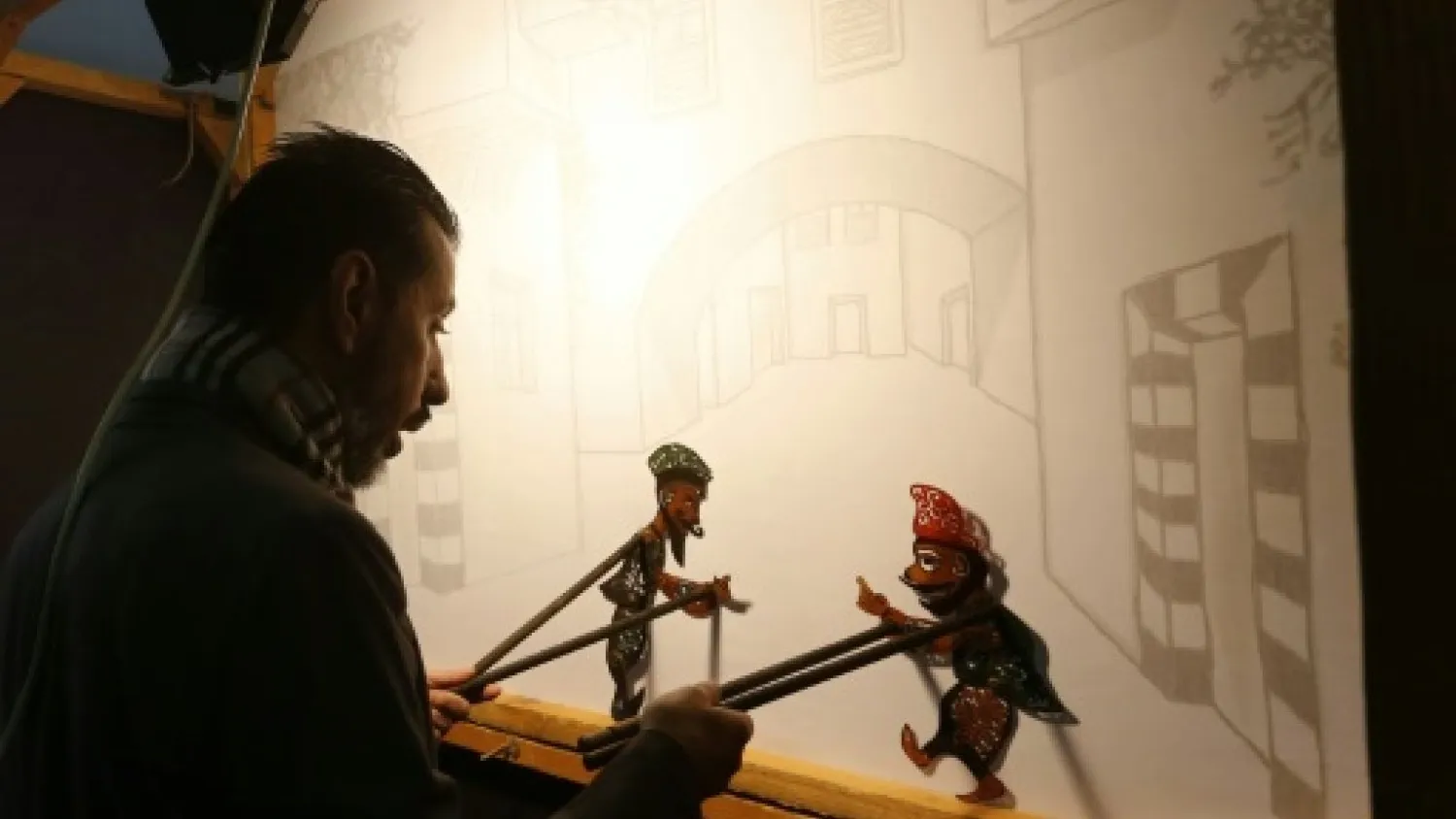
Syria's last shadow puppeteer Shadi al-Hallaq is seen moving his puppets Karakoz (R) and Eiwaz (L) from inside his booth during a presentation in Damascus | AFP
TT

UN Listing Gives Lifeline to Syria's Last Shadow Puppeteer

Syria's last shadow puppeteer Shadi al-Hallaq is seen moving his puppets Karakoz (R) and Eiwaz (L) from inside his booth during a presentation in Damascus | AFP

In a crowded dark room, Syria's last shadow puppeteer crouches on stage, holding two intricate figures against a brightly lit silk screen and voicing their animated chatter.

Hiding inside his booth and moving the silhouettes around on sticks, Shadi al-Hallaq gave a proud performance on Monday night after his disappearing art finally received international recognition.

Syrians last week received news that their war-battered country's shadow theater has secured a coveted place on the UN's list of world treasures.

"When they rang to congratulate me, it was like a daydream," said the puppeteer, a slim 43-year-old wearing a dark grey suit and warm beige scarf.

His two star characters -- the naive but charming Karakoz and clever friend Eiwaz -- would finally receive the limelight they deserved, he said.

"There's no one in Syria who masters the art except me," said Hallaq, who learned it from his late father, a famed storyteller who performed in one of the capital's oldest coffee shops.

"There are no regular shows anymore, though I have given performances in a few places over the past years," said the puppeteer, who previously worked as a taxi driver.

The advent of digital entertainment as well as mass displacement due to conflict have contributed to the gradual decline of the art in Syria, the United Nations says.

Only a few such performers existed in the country before the war broke out in 2011, and a leading shadow puppeteer has since gone missing.

Traditionally, shadow plays were held in coffee shops.

A bright light would project the silhouettes of the puppets onto a silk screen, usually accompanied by dialogue and music.

Often including humorous social commentary, they would star Karakoz and Eiwaz, as well as female characters and talking animals.

Hallaq's characters are crafted from cow leather, their clothes cut out with decorative patterns and painted with watercolors "so the light can shine through".

Karakoz is short and dons a large red hat, while Eiwaz sports an elegant mustache.

As they move around before an arched alleyway, their witty banter entertains all generations.

"My audience are old and young -- from three years old to old men in coffee shops," Hallaq said.

The art form is said to be centuries old, long before the war that has killed 360,000 people and displaced millions from their homes.

Some say Karakoz and Eiwaz are typical Syrians from Damascus, while others say they are in fact originally Turkish.

Since the United Nations cultural agency UNESCO classified his art as "in need of urgent safeguarding", Hallaq said things are looking up for his art and its two stars.

"I thought I would have to bury them away," he said. But now "a bright future awaits them in Syria. I will tour with them all over the country."



Settlers Force Re-burial of Palestinian Man in West Bank, Family Says 

Israeli settlement structuers being installed in Sanur near Jenin, in the Israeli-occupied West Bank, May 9, 2026. REUTERS/Mohamad Torokman
TT

Settlers Force Re-burial of Palestinian Man in West Bank, Family Says 

Israeli settlement structuers being installed in Sanur near Jenin, in the Israeli-occupied West Bank, May 9, 2026. REUTERS/Mohamad Torokman

Israeli settlers in the occupied West Bank forced Palestinians to exhume the body of their father from his freshly dug village grave, his family said, near a settlement re-established by Prime Minister Benjamin Netanyahu's government.

Hussein Asasa, 80, died on Friday of natural causes and was buried that evening at the cemetery of Asasa village near Jenin, with all the necessary permits from Israel's military, whose forces were at the site, his son Mohammed said.

But shortly after the burial, the family was called back by some of the villagers, who said settlers were at the grave, ordering the grave be dug up.

"They said the land was for settlement and that burial was not allowed. We told them that this is the village's cemetery, not part of the settlement," said Asasa, Reuters reported.

The settlers then threatened to dig the grave up with a bulldozer, Asasa said, so the family decided to exhume their father's body themselves.

"We found that they already dug the grave and reached the body," Asasa said. "We continued digging and got the body and buried him in another cemetery," he said.

VIDEO SHOWS PEOPLE REMOVING A BODY

Video circulating on social media appeared to show settlers watching as people dig in the ground of a hill slope. They then carry away what looks like a body as Israeli troops walk behind them. Reuters verified the location as Asasa.

The Israeli military said that the funeral had been coordinated with it and that it had not instructed the family to rebury their father. Soldiers were sent to the scene following a report about a confrontation with settlers who were "digging in the area," the military said. "The soldiers confiscated digging tools from the Israeli civilians and remained at the location in order to prevent further friction," the military said. It added that it condemns actions that violate the "dignity of the living and the deceased".

The UN Human Rights Office condemned the incident.

"This is appalling and emblematic of the dehumanisation of Palestinians that we see unfolding across the OPT (Occupied Palestinian Territories). It spares no one, dead or alive," said Ajith Sunghay, head of the OHCHR Palestinian office.

Sa-Nur was one of 19 settlements evacuated under the 2005 Israeli disengagement plan, which also included Israel's withdrawal of settlers and troops from Gaza. Netanyahu's government approved Sa-Nur's re-establishment a year ago and construction has advanced rapidly, according to Peace Now, an Israeli settlement watchdog.

The West Bank is among the territories that Palestinians seek for an independent state. Israel cites historical and biblical ties to the land, as well as security needs.

Netanyahu's government, which staunchly opposes the establishment of a Palestinian state, has been accelerating settlement building, while a rise in attacks by settlers on Palestinians has drawn international alarm. The United Nations and most countries deem Israel's settlements on West Bank land captured in the 1967 war illegal, a view that Israel disputes.


Gaza Flotilla Activists to Be Released from Israel Detention and Deported

Global Sumud Flotilla Steering Committee members Susan Abdallah, Muhammad Nadir Al-Nuri, Suemeyra Akdeniz Ordu, Maimon Herawati, Thiago Avila and Saif Abukeshek, Eva Saldana, Greenpeace Spain; Maria Serra, GSF Catalunya and Oscar Camps, Open Arms attend a press conference as humanitarian flotilla prepares to depart for Gaza, from Barcelona, Spain, April 12, 2026. REUTERS/Albert Gea
TT

Gaza Flotilla Activists to Be Released from Israel Detention and Deported

Global Sumud Flotilla Steering Committee members Susan Abdallah, Muhammad Nadir Al-Nuri, Suemeyra Akdeniz Ordu, Maimon Herawati, Thiago Avila and Saif Abukeshek, Eva Saldana, Greenpeace Spain; Maria Serra, GSF Catalunya and Oscar Camps, Open Arms attend a press conference as humanitarian flotilla prepares to depart for Gaza, from Barcelona, Spain, April 12, 2026. REUTERS/Albert Gea

Two activists arrested last month when Israeli forces intercepted the Gaza-bound flotilla they were travelling on are expected to be deported in the coming days after being released from security detention on Saturday, their lawyers said. Saif Abu Keshek, a Spanish national, and Brazilian Thiago Avila were detained by Israeli authorities on April 29 and brought to Israel. The activists were part of a second Global Sumud Flotilla launched from Spain on April 12 to try to break Israel’s blockade of Gaza by delivering aid to the enclave.

Israel's foreign ministry said Abu Keshek was suspected of affiliation with a terrorist organization and Avila was suspected of illegal activity. Both denied the allegations, Reuters reported.

BRAZIL AND SPAIN SAID THE DETENTION WAS UNLAWFUL

The governments of Spain and Brazil said Abu Keshek's and Avila's detention was unlawful, but Israel's Ashkelon Magistrate’s Court remanded them in custody until May 10.

Human rights group Adalah, which has assisted in their legal defense and also said the detention was unlawful, said that Abu Keshek and Avila were informed that they will be released from detention on Saturday and handed over to immigration authorities' custody until their deportation.

"Adalah is closely monitoring developments to make sure that the release from detention goes ahead, followed by their deportation from Israel in the coming days," the group said. Israeli officials were not immediately reachable for comment.

Israeli authorities held them under suspicion of offences that included aiding the enemy and contact with a terrorist group.

Gaza is largely run by Palestinian militant group Hamas, which is designated as a terrorist group by Israel and much of the West. The group's October 7, 2023, attack on Israel started the Gaza war that has left much of the enclave's population homeless and dependent on aid - that humanitarian agencies say is arriving too slowly.


EU Official Urges Increased Humanitarian Access in South Lebanon

Israeli troops maneuver on the Lebanese side of the border, as seen from the Upper Galilee in northern Israel, 08 May 2026, amid a ceasefire between Israel and Lebanon.  EPA/ATEF SAFADI
Israeli troops maneuver on the Lebanese side of the border, as seen from the Upper Galilee in northern Israel, 08 May 2026, amid a ceasefire between Israel and Lebanon. EPA/ATEF SAFADI
TT

EU Official Urges Increased Humanitarian Access in South Lebanon

Israeli troops maneuver on the Lebanese side of the border, as seen from the Upper Galilee in northern Israel, 08 May 2026, amid a ceasefire between Israel and Lebanon.  EPA/ATEF SAFADI
Israeli troops maneuver on the Lebanese side of the border, as seen from the Upper Galilee in northern Israel, 08 May 2026, amid a ceasefire between Israel and Lebanon. EPA/ATEF SAFADI

European Union crisis management chief Hadja Lahbib on Saturday urged increased humanitarian access in south Lebanon, where Israel has kept up strikes and Hezbollah has been launching attacks despite a ceasefire.

"Humanitarian aid is ready, but too often it cannot reach those who need it most," Lahbib told a news conference on the second day of her visit to Lebanon, ahead of an expected EU aid delivery.

A ceasefire came into effect on April 17 but Israel has kept up strikes. Its troops are operating inside an Israeli-announced "yellow line" that runs around 10 kilometres (six miles) deep inside Lebanon along the border, where Lebanese have been warned not to return.

Under the terms of the ceasefire, Israel reserves the right to act against "planned, imminent or ongoing attacks".

With both sides trading accusations of truce violations, the Iran-backed Hezbollah has also announced attacks, mainly on Israeli targets in south Lebanon.

"South of the Litani River, access is still severely restricted due to evacuation orders and Israeli military activity. And this includes 55 villages below the so-called yellow line," Lahbib said.

The Litani River runs around 30 kilometres from the border, an area where many of the attacks since the ceasefire have taken place.

She noted that key infrastructure including bridges over the Litani have been destroyed, "and that means longer routes, people waiting days and days for help".

"Even north of the Litani River, where some of these constraints have eased, it is still not enough. We need humanitarian access in full respect of international humanitarian law. Aid cannot save lives if it cannot reach people," she said.

Lahbib said that since the start of the war, the European Union had announced some 100 million euros in new humanitarian support for Lebanon and had sent six planes carrying aid, with a seventh due to arrive in the coming days.

Authorities say more than 2,750 people have been killed since March 2, including at least 104 health and emergency workers, with Israeli strikes having killed dozens since the ceasefire.

More than one million people have been displaced.

"Hospitals and ambulances targeted and journalists attacked for simply doing their job -- there is no justification for this. International humanitarian law must be respected," Lahbib said.

"This crisis is not over, so all support for the Lebanese people must continue," she said.