


UN Listing Gives Lifeline to Syria's Last Shadow Puppeteer

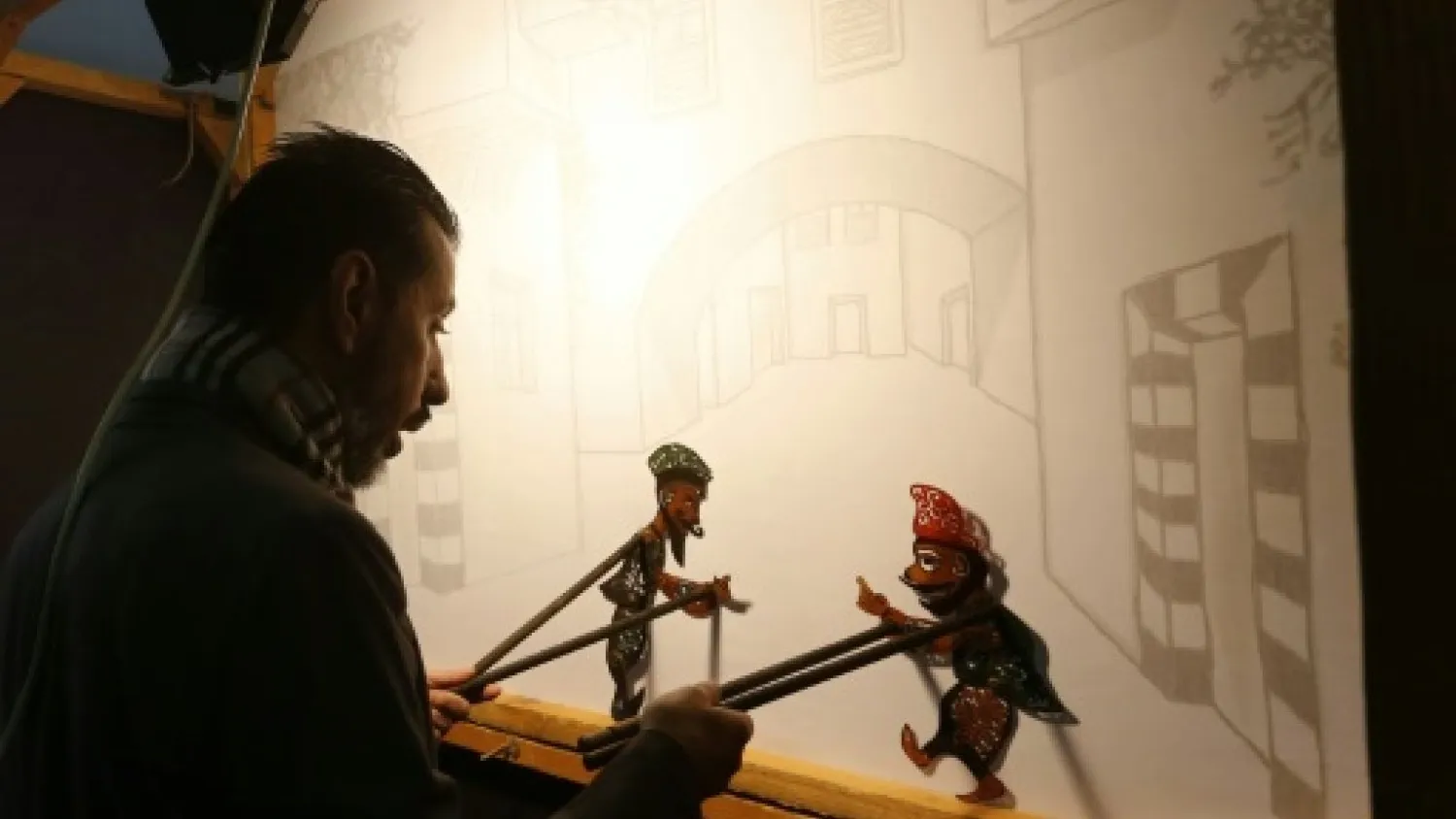
Syria's last shadow puppeteer Shadi al-Hallaq is seen moving his puppets Karakoz (R) and Eiwaz (L) from inside his booth during a presentation in Damascus | AFP
TT

UN Listing Gives Lifeline to Syria's Last Shadow Puppeteer

Syria's last shadow puppeteer Shadi al-Hallaq is seen moving his puppets Karakoz (R) and Eiwaz (L) from inside his booth during a presentation in Damascus | AFP

In a crowded dark room, Syria's last shadow puppeteer crouches on stage, holding two intricate figures against a brightly lit silk screen and voicing their animated chatter.

Hiding inside his booth and moving the silhouettes around on sticks, Shadi al-Hallaq gave a proud performance on Monday night after his disappearing art finally received international recognition.

Syrians last week received news that their war-battered country's shadow theater has secured a coveted place on the UN's list of world treasures.

"When they rang to congratulate me, it was like a daydream," said the puppeteer, a slim 43-year-old wearing a dark grey suit and warm beige scarf.

His two star characters -- the naive but charming Karakoz and clever friend Eiwaz -- would finally receive the limelight they deserved, he said.

"There's no one in Syria who masters the art except me," said Hallaq, who learned it from his late father, a famed storyteller who performed in one of the capital's oldest coffee shops.

"There are no regular shows anymore, though I have given performances in a few places over the past years," said the puppeteer, who previously worked as a taxi driver.

The advent of digital entertainment as well as mass displacement due to conflict have contributed to the gradual decline of the art in Syria, the United Nations says.

Only a few such performers existed in the country before the war broke out in 2011, and a leading shadow puppeteer has since gone missing.

Traditionally, shadow plays were held in coffee shops.

A bright light would project the silhouettes of the puppets onto a silk screen, usually accompanied by dialogue and music.

Often including humorous social commentary, they would star Karakoz and Eiwaz, as well as female characters and talking animals.

Hallaq's characters are crafted from cow leather, their clothes cut out with decorative patterns and painted with watercolors "so the light can shine through".

Karakoz is short and dons a large red hat, while Eiwaz sports an elegant mustache.

As they move around before an arched alleyway, their witty banter entertains all generations.

"My audience are old and young -- from three years old to old men in coffee shops," Hallaq said.

The art form is said to be centuries old, long before the war that has killed 360,000 people and displaced millions from their homes.

Some say Karakoz and Eiwaz are typical Syrians from Damascus, while others say they are in fact originally Turkish.

Since the United Nations cultural agency UNESCO classified his art as "in need of urgent safeguarding", Hallaq said things are looking up for his art and its two stars.

"I thought I would have to bury them away," he said. But now "a bright future awaits them in Syria. I will tour with them all over the country."


Former Syrian Regime Officer Arrested

Syrian Ministry of Interior in Damascus (Official Website)
TT

Former Syrian Regime Officer Arrested

Syrian Ministry of Interior in Damascus (Official Website)

Syria's Interior Ministry announced on Saturday the arrest of a former officer in Bashar al-Assad's regime holding the rank of major general and accused of committing crimes and violations.

In a statement, the ministry said that "based on precise monitoring and surveillance operations, Internal Security Forces carried out a special security operation that resulted in the arrest of criminal Mohammed Mohsen Nayouf."

"The criminal held the rank of major general under the former regime and occupied several prominent military and leadership positions, including service in the Third Corps, command of the 18th Tank Division, chief of staff of the 11th Division in 2020, and commander of the 105th Republican Guard Brigade in 2016."

According to the statement, the detainee was referred to the relevant authorities to complete investigations and take the necessary legal measures before being referred to the judiciary.

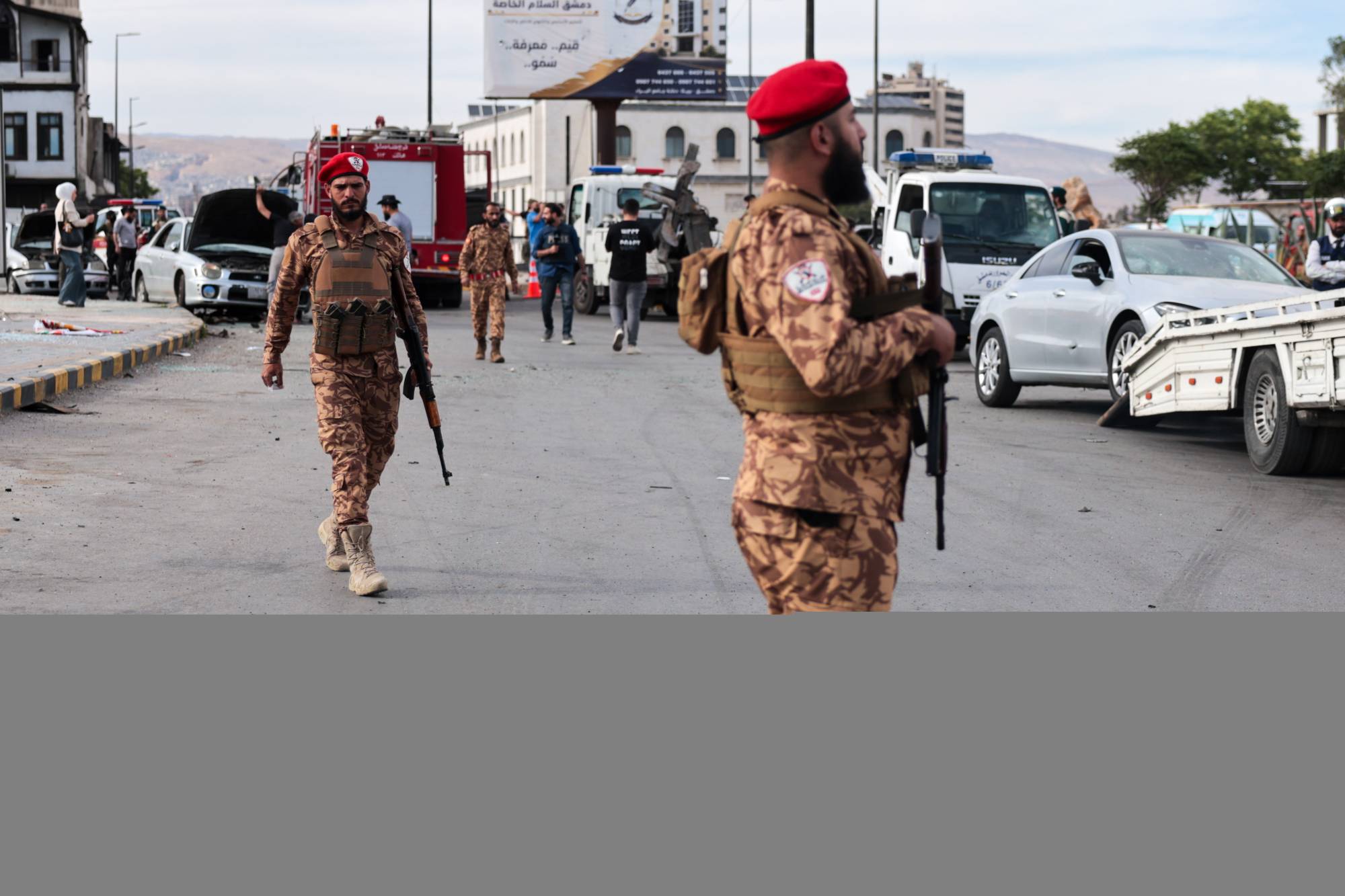
Syrian military police deployed near the explosion site in Bab Sharqi, near the headquarters of the Syrian Defense Ministry in Damascus, Syria, May 19, 2026. EPA/MOHAMMEDALRIFAI

The Syrian Arab News Agency (SANA) reported that the operation, carried out on Friday by the Salamiyah Security Directorate, which is affiliated with the Internal Security Command in Hama, comes "as part of the Interior Ministry's and relevant authorities' efforts to pursue and hold accountable those involved in crimes and violations committed against the Syrian people during the former regime, based on the principle of ending impunity, achieving transitional justice, and guaranteeing the rights of victims and their families."

Earlier on Friday, the Interior Ministry announced the arrest of Mohammed Imad Mahrez, one of the guards at Saydnaya prison during the former regime, making this the second such operation.


Hezbollah Says Message from Iran Shows it 'Will Not Give up' on Group

Displaced residents wave Hezbollah flags, including one bearing a picture of its leader, Naim Qassem, as they pass rubble of destroyed buildings in Dahiyeh, Beirut's southern suburbs, Lebanon, Friday, April 17, 2026, following a ceasefire between Israel and Hezbollah. (AP Photo/Bilal Hussein)
TT

Hezbollah Says Message from Iran Shows it 'Will Not Give up' on Group

Displaced residents wave Hezbollah flags, including one bearing a picture of its leader, Naim Qassem, as they pass rubble of destroyed buildings in Dahiyeh, Beirut's southern suburbs, Lebanon, Friday, April 17, 2026, following a ceasefire between Israel and Hezbollah. (AP Photo/Bilal Hussein)

Hezbollah said Saturday that a message from Tehran showed that Iran would not abandon the Lebanese militant group and that the Islamic republic's latest proposal to end the US-Iran war included a ceasefire in Lebanon.

Iran-backed Hezbollah said in a statement that its chief Naim Qassem had received a message from Tehran's Foreign Minister Abbas Araghchi, which indicated that Iran "will not give up its support for movements demanding justice and freedom, foremost among them Hezbollah".

In Iran's latest proposal through Pakistani mediators aimed at achieving "a permanent and stable end to the war, the demand to include Lebanon in the ceasefire was emphasised", the statement added.


South Lebanon Hospital Damaged in Israeli Strikes

Volunteers from the Lebanese Red Cross rescue a woman in the city of Nabatieh in South Lebanon (AFP)
TT

South Lebanon Hospital Damaged in Israeli Strikes

Volunteers from the Lebanese Red Cross rescue a woman in the city of Nabatieh in South Lebanon (AFP)

Israel kept up strikes on Lebanon on Saturday, hours after overnight raids on the country's south and east, including one that damaged a hospital, its chief executive told AFP.

Lebanon's state-run National News Agency (NNA) reported Israeli airstrikes on around a dozen locations in the south on Saturday including one targeting an agricultural area, "wounding several Syrian workers".

The NNA said an overnight strike in the southern city of Tyre that targeted a site near the hospital caused "severe damage" to the facility.

An AFP correspondent saw shattered glass, ceiling panels blown out and damaged medical equipment at the multi-storey Hiram hospital.

The Israeli military late on Friday night had issued evacuation warnings ahead of strikes on two locations in Tyre, saying it would target "Hezbollah facilities".

Accompanying maps advised people to leave areas within 500 metres (yards) of the target buildings, with the Hiram hospital shown within the advised evacuation area.

The hospital's CEO Dr Salman Aydibi told AFP that around 40 patients were in the facility when the warning was issued, including seven in intensive care.

"We took the patients to a safer location" elsewhere inside the hospital, he said, adding that none were harmed but some 30 staff sustained minor injuries.

He said an evaluation of the damage was ongoing and that the hospital has remained operational, though the emergency department briefly closed.

He said it was the third strike near the facility since the latest Israel-Hezbollah war erupted on March 2.

Israel's army said Saturday that it had targeted "Hezbollah infrastructure sites in Tyre" overnight where operatives from the Iran-backed group worked to "plan and execute attacks" against Israeli soldiers.

"Prior to the strike, steps were taken to mitigate harm to civilians, including the issuing of advance warnings, the use of precise munitions, and aerial surveillance," it added.

Another AFP correspondent saw heavy damage at both targeted sites in Tyre, with a man searching for his belongings among the debris at one location.

Israel's army also targeted east Lebanon overnight, saying it struck a "Hezbollah underground compound" used to manufacture weapons.

Lebanon's Hamas-aligned Islamist group Jamaa Islamiya and its armed wing the Al-Fajr Forces said Saturday in a statement that one of its members was killed in an Israeli strike in east Lebanon.

Under the terms of the ceasefire published by Washington, Israel reserves the right to act against "planned, imminent or ongoing attacks".
