


Manchester United Cannot Turn Back Clock – the Era of One-Club Rule Is Over

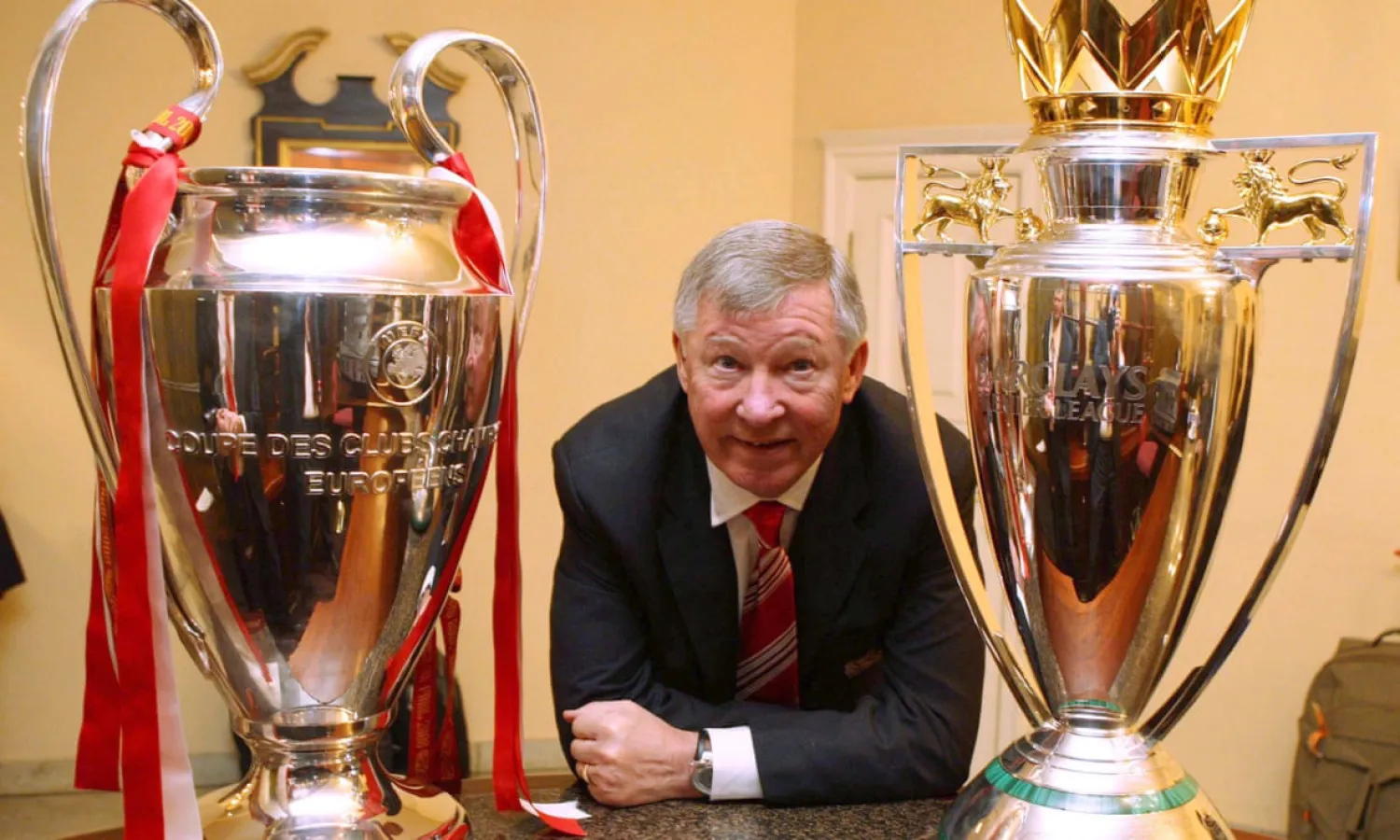
Sir Alex Ferguson is flanked by the Champions League trophy (left) and the Premier League trophy after Manchester United’s outstanding 2007-2008 season. Photograph: John Peters/Man Utd via Getty Images
TT

Manchester United Cannot Turn Back Clock – the Era of One-Club Rule Is Over

Sir Alex Ferguson is flanked by the Champions League trophy (left) and the Premier League trophy after Manchester United’s outstanding 2007-2008 season. Photograph: John Peters/Man Utd via Getty Images

A football journalist should never welcome the departure of a leading manager, particularly one as notable and quotable as José Mourinho.

The guy has been good copy over the last decade and a bit, and remained so right up to the end. Although Manchester United trail forlornly in Manchester City’s wake in most aspects of football relating to the pitch, if you could pick up points for entertaining press conferences or providing pithy replies to questions rather than attempting to defuse them the situation could well be reversed.

It was the football that caught up with Mourinho. He was found on the pitch, exposed as one-dimensional, stubborn and unimaginative, and though English football has undoubtedly lost one of its outstanding performers and truest claims to fame – many would argue the Premier League got properly going only when Chelsea arrived to get up the noses of Manchester United and Arsenal – the fact is life was getting pretty repetitive around Old Trafford and not in a good way.

United have been a stuck record since Sir Alex Ferguson stepped aside. Although Mourinho at least tried to give the impression he was either bigger than the club or better than it deserved – possibly not the smartest way to court popularity – United still ended up pulling the rug from under him in a manner similar to their brusque treatment of David Moyes and Louis van Gaal, despite backing their latest manager with expensive signings.

The only complaint Mourinho could have on that score was that United were not quite matching City in the expenditure stakes, though presumably he took the job fully cognisant of the fact a combination of Pep Guardiola’s charisma and Abu Dhabi wealth would make the neighbors much more of a threat than the noisy nuisance they proved for Ferguson.

Mourinho and Ed Woodward had been at odds all season over United’s spending and recruitment strategy, and it should not have been too difficult to foresee the upcoming transfer window potentially causing a problem when the club’s record signing had spent his last few games on the bench.

If Paul Pogba was intended as a statement signing, proof United could still attract and afford the best talent around, it ended up making the wrong sort of statement. Should Pogba leave, the statement will still be wrong but stronger. This is because, as Mourinho admitted a month ago, United are experiencing nothing but difficulty in attracting and accommodating the players they want and need.

There are wealthier clubs around, clubs that can promise a less rocky path to Champions League football, clubs with stadiums that are not full of put-upon supporters wincing at the present dross while eulogizing about the good old days, and clubs with infinitely better prospects of winning something major quite soon.

United are no longer a trophy-winning machine, no longer the sort of club that sell themselves to a player before his agent even picks up the phone. As the club have gradually fallen away in the last five years so others have risen or reinvented themselves. In the past a club such as United, or Liverpool before them, could take advantage of complete dominance by judiciously adding a striker from Tottenham here or a center-half from Leeds there, simultaneously strengthening themselves, weakening their rivals and usually making the player’s dreams come true in the process.

The era of one-club domination seems now to be over. Not even City, with all their riches, are likely to find themselves in as powerful a position as Liverpool in the 80s or United for the two decades afterwards. City may give the impression they are on their way to invincibility but they were rumbled by Liverpool and Wigan last season, have just been knocked off the top of the table through defeat at Chelsea and there is reason to suppose, given the surprising result when Guardiola was suspended for a single game against Lyon earlier in the season, that they will have a succession problem of their own to contend with when their manager moves on.

To his credit, Mourinho made this very point just before he was moved out. He said it was a little unfair for his best efforts to be compared with the impossibly illustrious past, because the two situations were quite different. United were once in a position of complete dominance, so that practically every wish could be realized, and now they are not, because no one is.

It is a good thing for English football that Premier League-generated wealth is now shared more evenly and democratically, so no one club can easily get too far ahead, though perhaps someone could pass the message along to all those clamoring for regime change or radical reform at United to bring the product back up to scratch.

The task of the next permanent manager, apparently, will be to restore United to the supremacy they enjoyed under Ferguson. Good luck with that because it may never happen. It is not part of the natural order of things that United should sit a mile or two above everyone else in the league, though goodness knows how many managers the club will get through before the penny drops.

While on the whole it is unlikely United will spend 28 years in the title wilderness, like Liverpool, it is even more improbable to envisage the Premier League elite permitting a return to the situation that pertained 10 or 15 years ago. The clock cannot be turned back, as Mourinho knew. The best United can hope for is someone may come along with an idea for a different story.

(The Guardian)


Sunderland Worst Hit by Losing Players to African Cup of Nations 

14 December 2025, United Kingdom, London: Sunderland's Habib Diarra (L) and Leeds United's Gabriel Gudmundsson battle for the ball during the English Premier League soccer match between Brentford and Leeds United at the Gtech Community Stadium. (dpa)
TT

Sunderland Worst Hit by Losing Players to African Cup of Nations 

14 December 2025, United Kingdom, London: Sunderland's Habib Diarra (L) and Leeds United's Gabriel Gudmundsson battle for the ball during the English Premier League soccer match between Brentford and Leeds United at the Gtech Community Stadium. (dpa)

Premier League Sunderland will have to do without six players over the next few weeks and are the club worst hit as the Africa Cup of Nations takes its toll on European clubs competing over the holiday season.

Sunderland, eighth in the standings, had four of their African internationals in action when they beat Newcastle United on Sunday, but like 14 other English top-flight clubs will now lose those players to international duty.

The timing of the African championship, kicking off in Morocco on Sunday and running through to January 18, has long been an irritant for coaches, with leagues in Belgium, France, Germany, Italy, Netherlands, Portugal, and Spain also affected.

Hosting the tournament in the middle of the season impacts around 58% of the players at the Cup of Nations, though the Confederation of African Football did try to mitigate the impact by moving the start to before Christmas, so it is completed before the next round of Champions League matches.

The impact on European clubs was also lessened by allowing them to release players seven days, rather than the mandatory 14 days, before the tournament, meaning they could play for their clubs last weekend.

Sunderland's Congolese Arthur Masuaku and Noah Sadiki, plus full back Reinildo (Mozambique), midfielder Habib Diarra (Mali), and attackers Chemsdine Talbi (Morocco) and Bertrand Traore (Burkina Faso) have now departed for Morocco.

Ironically, Mohamed Salah’s absence from Liverpool to play for Egypt should lower the temperature at the club after his recent outburst against manager Arne Slot, but Manchester United will lose three players in Noussair Mazraoui, Bryan Mbeumo and Amad Diallo, who scored in Monday’s 4-4 draw with Bournemouth.

France is again the country with the most players heading to the Cup of Nations, and with 51 from Ligue 1 clubs. But their absence is much less impactful than previously as Ligue 1 broke after the weekend’s fixtures and does not resume until January 2, by which time the Cup of Nations will be into its knockout stage.

There are 21 players from Serie A clubs, 18 from the Bundesliga, and 15 from LaLiga teams among the 24 squads at the tournament in Morocco.


Rodgers Takes Charge of Saudi Team Al-Qadsiah After Departure from Celtic 

Then-Celtic head coach Brendan Rodgers greets supporters after a Europa League soccer match between Red Star and Celtic at Rajko Mitic Stadium in Belgrade, Serbia, Sept. 24, 2025. (AP)
TT

Rodgers Takes Charge of Saudi Team Al-Qadsiah After Departure from Celtic 

Then-Celtic head coach Brendan Rodgers greets supporters after a Europa League soccer match between Red Star and Celtic at Rajko Mitic Stadium in Belgrade, Serbia, Sept. 24, 2025. (AP)

Brendan Rodgers has returned to football as the coach of Saudi Arabian club Al-Qadsiah, six weeks after resigning from Scottish champion Celtic.

Al-Qadsiah, whose squad includes Italian striker Mateo Retegui and former Real Madrid defender Fernandez Nacho, is in fifth place in the Saudi Pro League in its first season after promotion.

Rodgers departed Celtic on Oct. 27 and has opted to continue his managerial career outside Britain for the first time, having previously coached Liverpool, Leicester and Swansea.

In its statement announcing the hiring of Rodgers on Tuesday, Al-Qadsiah described him as a “world-renowned coach” and said his arrival “reflects the club’s ambitious vision and its rapidly growing sporting project.”

Aramco, the state-owned Saudi oil giant, bought Al-Qadsiah in 2023 in a move that has helped to transform the club’s status.

“This is a landmark moment for the club,” Al-Qadsiah chief executive James Bisgrove said. “The caliber of his experience and track record of winning reflects our ambition and long-term vision to establish Al-Qadsiah as one of Asia’s leading clubs.”

Rodgers is coming off winning back-to-back Scottish league titles with Celtic, where he won 11 major trophies across his two spells. He also won the FA Cup with Leicester.

Al-Qadsiah's last two coaches were former Liverpool striker Robbie Fowler and former Spain midfielder Michel.


Portugal to Return to F1 Calendar in 2027 and 2028 

12 July 2025, United Arab Emirates, Abu Dhabi: Red Bull driver Max Verstappen leads into turn one during the Abu Dhabi Grand Prix at the Yas Marina Circuit, Abu Dhabi. (dpa)
TT

Portugal to Return to F1 Calendar in 2027 and 2028 

12 July 2025, United Arab Emirates, Abu Dhabi: Red Bull driver Max Verstappen leads into turn one during the Abu Dhabi Grand Prix at the Yas Marina Circuit, Abu Dhabi. (dpa)

Formula One will return to Portugal's Portimao circuit in 2027 and 2028 after the Dutch Grand Prix at Zandvoort drops off the calendar.

Formula One announced a two-year deal in a statement on Tuesday.

The 4.6-km Algarve International circuit in the country's south last hosted the Portuguese Grand Prix in 2020 and 2021, both seasons impacted by the COVID-19 pandemic with stand-in venues.

In 2020, seven-times world champion Lewis Hamilton took his 92nd career win at Portimao, breaking the record previously held by Michael Schumacher. Hamilton also won in 2021.

"The interest and demand to host a Formula One Grand Prix is the highest that it has ever been," said Formula One chief executive Stefano Domenicali, thanking the Portuguese government and local authorities.

The financial terms of the deal were not announced.

"Hosting the Grand Prix in the Algarve reinforces our regional development strategy, enhancing the value of the territories and creating opportunities for local economies," said Economy Minister Manuel Castro Almeida.

Portugal first hosted a grand prix in Porto in 1958, with subsequent races at Monsanto and Estoril near Lisbon. The late Brazilian great Ayrton Senna took his first grand prix pole and win at the latter circuit in 1985.

Formula One announced last year that Zandvoort, a home race for four-times world champion Max Verstappen, would drop off the calendar after 2026.

The championship already features a record 24 races and Domenicali has spoken of European rounds alternating to allow others to come in.

Belgium's race at Spa-Francorchamps is due to be dropped in 2028 and 2030 as part of a contract extension to 2031 announced last January.
