


‘No Idea Where Money Goes’: Fifa Urged to Help Somalia’s Women Footballers

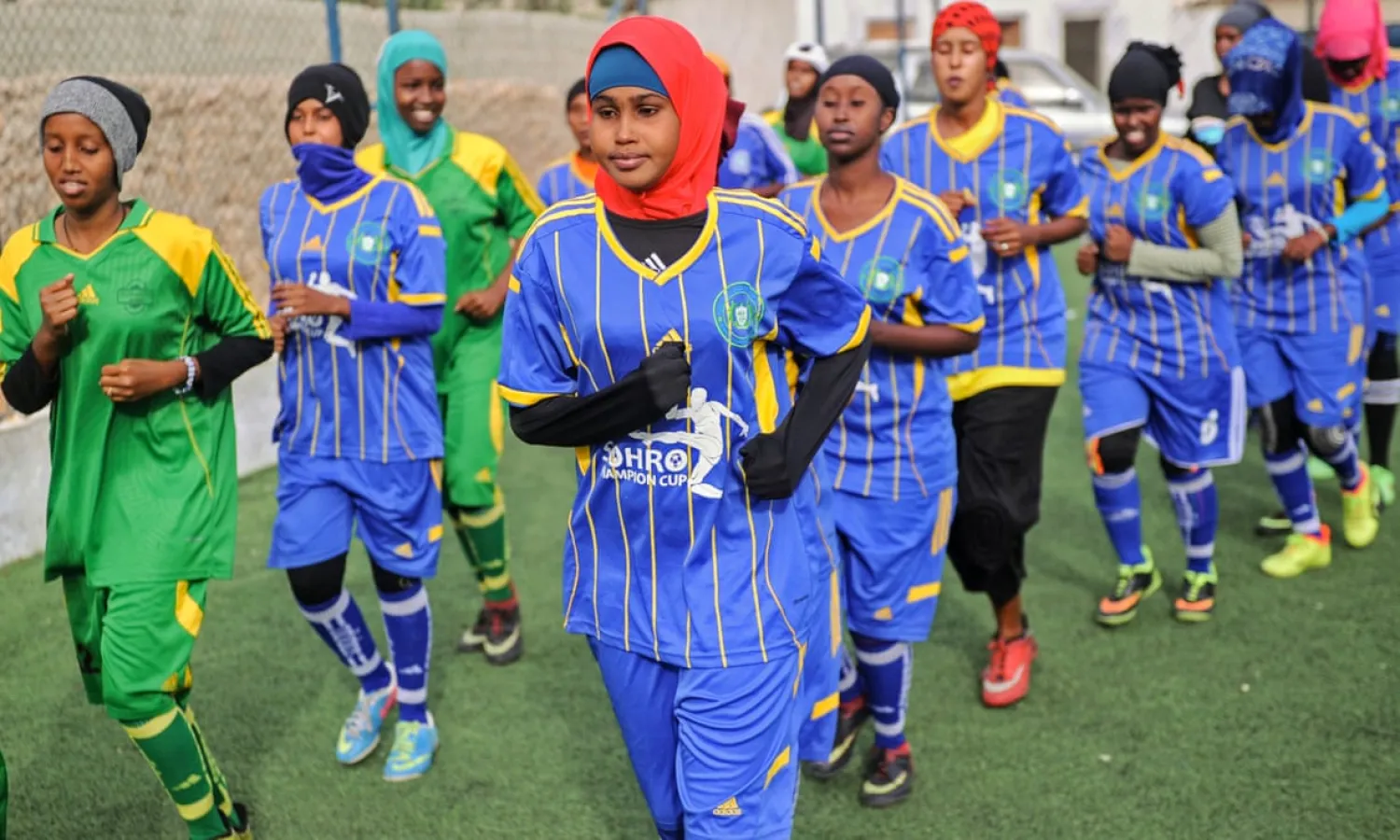
 Players train at Golden Club academy in Mogadishu. The team could not participate in a recent tournament because of a lack of funds, the founder said.
Players train at Golden Club academy in Mogadishu. The team could not participate in a recent tournament because of a lack of funds, the founder said.
TT

‘No Idea Where Money Goes’: Fifa Urged to Help Somalia’s Women Footballers

 Players train at Golden Club academy in Mogadishu. The team could not participate in a recent tournament because of a lack of funds, the founder said.
Players train at Golden Club academy in Mogadishu. The team could not participate in a recent tournament because of a lack of funds, the founder said.

The head of women’s football in Somalia has urged Fifa to take action after claiming money made available by the world governing body to support the women’s game in her country is not reaching its intended target.

Shaima Mohamed, who has been almost single-handedly pushing the cause of women’s football in one of the world’s most volatile nations, told the Guardian: “I have no idea where the money goes.”

Every national federation is entitled to money from Fifa, with $100,000 of the $500,000 available for operational costs ringfenced for women’s football, while additional money is available for travel to women’s tournaments and for special projects which can be related to women’s football. The Somali federation has not responded to requests for comment.

Mohamed believes federation members are unwilling to back the women’s game because they fear extremists who oppose it. “[They] would have sat down and talked about it and I think they are scared for their lives,” she said. “But they are also responsible to help Fifa’s vision for women’s football.”

The women’s football department at the Somali FA is in effect inactive. Mohamed said the federation gave her an official title but turned down her request for an office, equipment and a rent-free field for training. Girls and women continue to play, notably at the Golden Club academy in Mogadishu, which Mohamed founded and runs.

“We do fundraising to support the teams,” she said. “We do social media campaigns. We get contributions from the community but we don’t have a specific budget that comes to us every year. I have no idea where the money goes. I have no idea if the federation has sent details of my role and information to Fifa. We need formal recognition for Somalia women’s football.”

She called on Fifa to step in. “They should do more to ensure we are receiving our funding,” she said. “Fifa needs to do more accountability with every federation in Africa to see if the women’s funding is being spent on women’s football or something else.

“Fifa could also do more by improving direct communications with the women’s football department. I understand the federation can’t do much for women’s department since they are scared for their lives but they can give us a little support until we can stand on our feet because we are willing to take the risk and we are ready to fight for what we want.”

A Fifa source told the Guardian that it had been made aware of the issues and would be making efforts to meet Mohamed to discuss the situation.

“A small amount of the SFFs Forward funds have been used in the 2016-18 cycle for women’s football and women’s refereeing in the region,” Fifa said. “But we expect a greater commitment to be made in the new year with a dedicated Forward project for women’s football. We also understand that the SFF will appoint a new team to advance women’s football in Somalia. To that end the FIFA Regional Development Office in Addis Ababa will meet with the SFF soon to discuss the SFF’s plans.”

It said its commitment globally to women’s and girls’ football was demonstrated by a 20% increase in its Forward development fund for 2019-2022 to $6m, which includes “a total investment of at least $150,000 per year per member association dedicated exclusively to women’s football development”, in addition to funding available through infrastructure and travel budgets.

Mohamed’s frustrations were encapsulated after Golden Club were invited to send a team to the Human Rights Cup in South Africa last month to represent Somalia. “We couldn’t make it because we lacked financial support from both the federation, where the women’s department is not active, and the government. We trained for months to prepare for the cup. We were so disappointed. Discrimination holds us back.”

Mohamed, who grew up in Kenya, has been battling to establish women’s football in Somalia since she moved back in 2015, aged 19. “There were no women playing football so I decided to form a group I could play with,” she said. “It became an organization. I had to open up an academy so that more girls could be inspired and empowered.”

Initial approaches to the Somali FA for support had been promising. “At first the president of the federation welcomed me. He took me to the African football symposium on women’s football in Morocco earlier in 2018. It was the first time a woman from Somalia had attended such a conference.”

On her return she says things changed: “I was given the official title of head of the women’s department. I asked for an office, equipment, a place to work, but the president told me to focus on the academy until people get used to what I am doing.

“I approached him again and asked for a field to train the girls because there is a lack of fields or stadiums available to women. I asked him to give us time for training and he said the country is not safe enough and said we should rent another field and they will pay for it, except that didn’t last. It felt like they didn’t want to give us help.”

Golden Club continues to thrive despite the difficulties. “There are a lot of young girls that are so talented but it can be hard for them since they don’t have the self-confidence to come out and play football because they feel scared of society. After I created the first women’s football club in Somalia I learned that football can play an important role to help women and girls build their self-confidence.”

The civil war and the presence of groups such as al-Shabaab harmed men’s football too. “The extremists didn’t allow men to play football. Sometimes they used to play in a tribalism way – one tribe would play another. Now youth are engaged, there are leagues and they have even started to participate in international tournaments.”

What keeps Mohamed going is her passion for the game and determination to do something positive for girls who contact her. “But I can’t even offer the financial support in my city, let alone go to another region. The change that needs to be made is we need fields that will be secure for the girls and we need awareness.

“Women’s football is more than just sport. We use football to fight early marriage and to fight for women’s rights in society. This is important for so many girls and women in Somalia. I am fighting for their future and I will never give up.”

(The Guardian)


Tchouameni: Real Madrid Victory for 'Everyone against Racism'

Real Madrid's Aurelien Tchouameni (L) and Benfica's Vangelis Pavlidis fight for the ball during the UEFA Champions League play-offs second leg soccer match between Real Madrid and Benfica in Madrid, Spain, 25 February 2026.  EPA/Sergio Perez
Real Madrid's Aurelien Tchouameni (L) and Benfica's Vangelis Pavlidis fight for the ball during the UEFA Champions League play-offs second leg soccer match between Real Madrid and Benfica in Madrid, Spain, 25 February 2026. EPA/Sergio Perez
TT

Tchouameni: Real Madrid Victory for 'Everyone against Racism'

Real Madrid's Aurelien Tchouameni (L) and Benfica's Vangelis Pavlidis fight for the ball during the UEFA Champions League play-offs second leg soccer match between Real Madrid and Benfica in Madrid, Spain, 25 February 2026.  EPA/Sergio Perez
Real Madrid's Aurelien Tchouameni (L) and Benfica's Vangelis Pavlidis fight for the ball during the UEFA Champions League play-offs second leg soccer match between Real Madrid and Benfica in Madrid, Spain, 25 February 2026. EPA/Sergio Perez

Real Madrid midfielder Aurelien Tchouameni said his team's 2-1 win against Benfica on Wednesday to reach the Champions League last 16 was a victory for "everyone who is against racism".

The Frenchman was referring to the first leg of the play-off tie, which Madrid won 1-0 last week, which was marred by alleged racial abuse aimed at Vinicius Junior by Benfica's Gianluca Prestianni.

"We didn't play our best match of the season, that's for sure. But I think there are things more important than this match, and more important than football," Tchouameni told reporters.

Vinicius scored Madrid's second goal at the Santiago Bernabeu and Tchouameni said the result was a "victory for everyone who is against racism".

Prestianni was provisionally suspended by UEFA for the game while the incident is under investigation and Benfica had an appeal against his ban rejected earlier Wednesday.

"The dance continues," wrote Vinicius on social media afterwards, along with a photo of a big banner hung at the Bernabeu reading "no to racism".

Real Madrid said they had thrown out one of their own supporters before the game for performing a Nazi salute.

"This (club) member was identified by the club's security staff moments after appearing on the (television) broadcast and was immediately expelled from the Santiago Bernabeu stadium," AFP quoted Madrid as saying in a statement.

"Real Madrid condemns this type of gesture and expression that incites violence and hatred in sports and society."

Real Madrid coach Alvaro Arbeloa said he was happy when Vinicius found the net.

"(I reacted) with joy obviously, for the great goal he scored, and because it was him, he deserves it," said Arbeloa.

"Without (Kylian) Mbappe I think it's even more important and I am very happy for him."

Before the game Arbeloa said French superstar Mbappe would spend some time out as he recovers from a knee problem.

"After yesterday's session, we talked with the doctors, I spoke with him, and we felt the best thing was for him to stop, to recover 100 percent, and to come back in top shape, confident and without any discomfort for everything that's coming, which is obviously very important," Arbeloa told reporters after the match.

Asked if it was discomfort or an injury, he added: "I think we can call it an injury, but it seems, and I hope, that it's not a very serious injury, nothing major, and that he'll be able to come back in a few days or weeks."


Austin WTA Tournament Sets Up 'Rage Room' for Players to Blow Off Steam

Tennis - WTA 1000 - Dubai Championships - Dubai Tennis Stadium, Dubai, United Arab Emirates - February 20, 2026 Coco Gauff of the US reacts during her semi final match against Ukraine's Elina Svitolina REUTERS/Amr Alfiky
TT

Austin WTA Tournament Sets Up 'Rage Room' for Players to Blow Off Steam

Tennis - WTA 1000 - Dubai Championships - Dubai Tennis Stadium, Dubai, United Arab Emirates - February 20, 2026 Coco Gauff of the US reacts during her semi final match against Ukraine's Elina Svitolina REUTERS/Amr Alfiky

A WTA tournament in Texas has unveiled a "rage room" for players to take out their frustrations away from the cameras after Coco Gauff's racket-smashing outburst at the Australian Open last month sparked debate about privacy at tournaments.

Shortly after Gauff's 59-minute quarter-final loss to Elina Svitolina at Melbourne Park, the American went to the match call area and repeatedly smashed ‌her racket ‌on the ground, unaware that it ‌was ⁠being broadcast to ⁠viewers around the world.

Novak Djokovic and Iga Swiatek were among the players calling for more privacy off the court following the incident.

The ATX Open in Austin, Texas, has come up with a solution, Reuters reported.

"Introducing the ATX Open ⁠rage room - the first of its ‌kind - where players can ‌privately express frustration or emotion in a safe, ‌camera-free environment," the WTA 250 tournament posted ‌on its social media platforms.

The post also featured a sign with the words "don't smile" and "count to three" along with a broken racket.

While reaction online was ‌largely positive, some questioned whether the room would encourage players to vent ⁠their ⁠frustrations in a physical manner.

Dubai Tennis Championships organizers have set up a "Smash Room" truck for fans this week, with Chinese player Shang Juncheng invited to try it out in front of the cameras.

"I smashed a few items, including DVDs and big containers," he said. "It's loud and it's intense but in a good way. You get everything out of your system in there instead of taking that frustration onto the court."


Infantino Has 'Complete Confidence' in Mexico to Host World Cup Games Despite Violence

Members of the Civil Guard of Michoacan patrol a highway supported by armored vehicles after a wave of violence in the town of Aguililla, in Tierra Caliente, Mexico, on February 24, 2026. (Photo by Enrique Castro / AFP)
TT

Infantino Has 'Complete Confidence' in Mexico to Host World Cup Games Despite Violence

Members of the Civil Guard of Michoacan patrol a highway supported by armored vehicles after a wave of violence in the town of Aguililla, in Tierra Caliente, Mexico, on February 24, 2026. (Photo by Enrique Castro / AFP)

The violence that erupted in Mexico after the death of a powerful drug lord has left many questioning whether the country will be able to co-host the World Cup in just over three months.

FIFA President Gianni Infantino thinks it can.

“Of course, we are monitoring the situation in Mexico these days, but I want to say from the outset that we have complete confidence in Mexico, in its president, Claudia Sheinbaum, and in the authorities, and we are convinced that everything will go as smoothly as possible,” Infantino said late Tuesday in a press conference in Colombia.

“Mexico is a great country, like in every country in the world, things happen; we don’t live on the moon or another planet,” Infantino added. “That’s why we have governments, police, and authorities who will ensure order and security.”


FIFA President Gianni Infantino attends the inauguration of the Colombian Football Federation's hotel, where he spoke about his support for Mexico for the World Cup, in Barranquilla, Colombia, February 24, 2026. REUTERS/Jairo Cassiani

The Mexican army killed Nemesio Rubén Oseguera Cervantes, “El Mencho,” who led the Jalisco New Generation Cartel, on Sunday, sparking several days of violence. Cartel members burned cars and blocked roads in nearly a dozen Mexican states and authorities report that at least 70 people have died.

Four high-level soccer matches from the local leagues were postponed last Sunday, including one in the central city of Queretaro, where Mexico defeated Iceland 4-0 late Wednesday in a friendly match.

Before the match, a minute of silence was held in the Corregidora stadium in honor of the soldiers who died during the operation to capture Oseguera.

Thirteen World Cup matches are scheduled to be held in Mexico, including the opening game in Mexico City on June 11 between the co-host and South Africa. Guadalajara, the central hub for the Jalisco cartel, is scheduled to host four.

Colombia is set to play one game in Mexico City and one in Guadalajara.

“Our first two matches are in Mexico, but we know they will overcome this and move forward,” said Ramón Jesurún, the president of the Colombian Soccer Federation. “I have absolute and total confidence in my geopolitical thinking that this is an issue Mexico will overcome, and overcome very quickly.”

Other nations have expressed more concern. The Portuguese soccer federation said Tuesday that it was closely monitoring developments ahead of a planned friendly against Mexico in March. Jamaica is set to play New Caledonia in Guadalajara on March 26 in an intercontinental playoff semifinal, with the winner advancing to face Congo for a World Cup spot.

“The games are at the end of March, so we still have another month to see what happens; but it is making me very nervous, to be honest,” said Michael Ricketts, the president of the Jamaican Soccer Federation. "We will be listening out for CONCACAF and FIFA to give us instructions (on) whether they are playing the games or whether they are immediately looking for other options.”

Another Mexican city, Monterrey, will host a playoff where Bolivia plays Suriname and the winner faces Iraq for a spot in the tournament.

On Monday, Sheinbaum said there is “every guarantee” that the World Cup matches in Guadalajara will be played as planned and added that there was “no risk.”

“We are in regular contact with the presidency and the authorities in Mexico and we are monitoring the situation,” Infantino said. “The World Cup is going to be an incredible celebration."
