


Is Christian Pulisic the First Part of a US European Invasion?

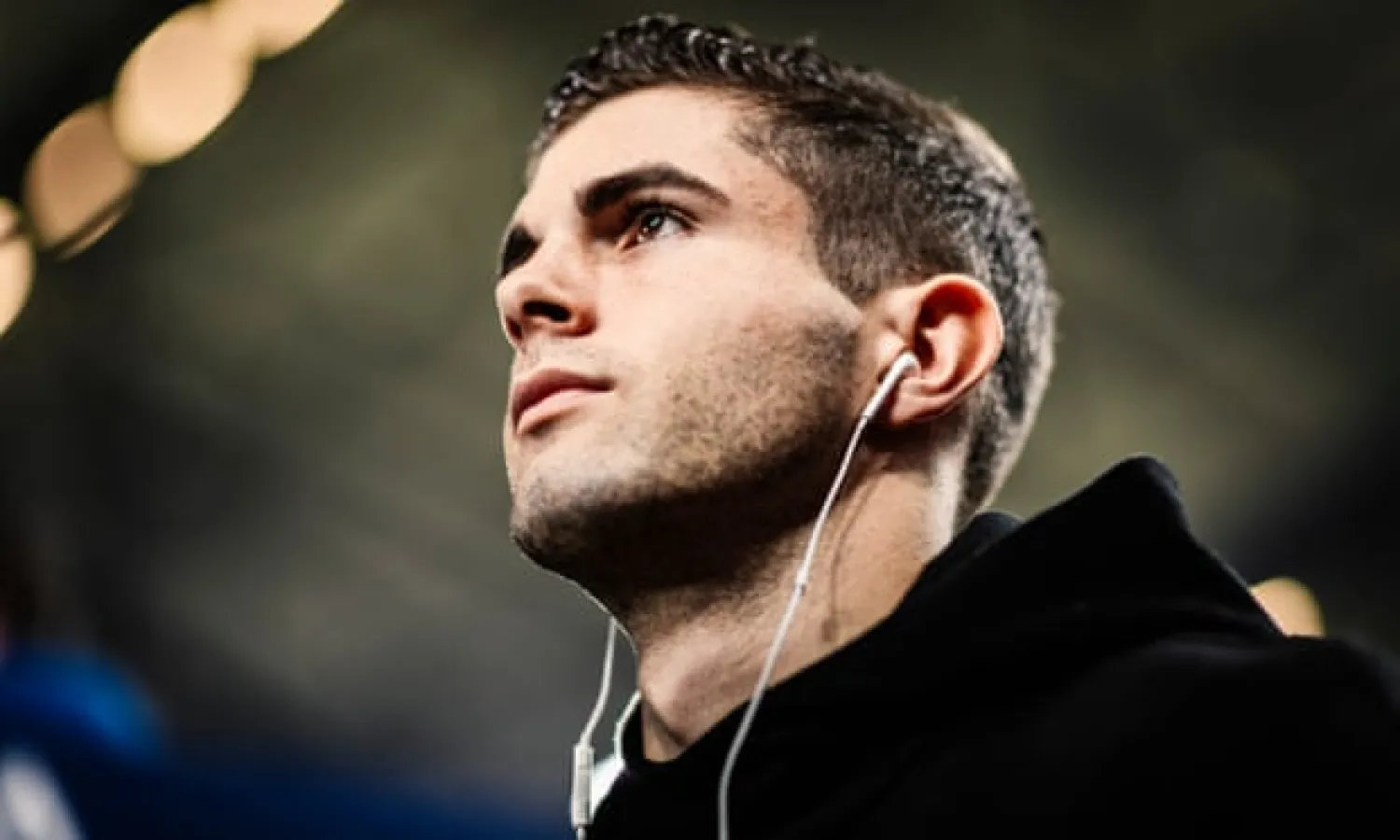
 Christian Pulisic is already an established star in Europe at the age of just 20. Photograph: Alexander Scheuber/Bundesliga/DFL via Getty Images
Christian Pulisic is already an established star in Europe at the age of just 20. Photograph: Alexander Scheuber/Bundesliga/DFL via Getty Images
TT

Is Christian Pulisic the First Part of a US European Invasion?

 Christian Pulisic is already an established star in Europe at the age of just 20. Photograph: Alexander Scheuber/Bundesliga/DFL via Getty Images
Christian Pulisic is already an established star in Europe at the age of just 20. Photograph: Alexander Scheuber/Bundesliga/DFL via Getty Images

Of all the tales told of the USA’s failure to qualify for the 2018 World Cup, the most haunting depicts Christian Pulisic, after the fateful draw away to Trinidad & Tobago, in the showers “fully clothed, with his hands in his face just crying,” as Dax McCarty described it. Only Pulisic knows what was going through his mind in that moment, but on some level he, as his country’s best player, surely felt a level of responsibility for American soccer’s biggest, most humiliating failure in a generation.

Of course, Pulisic is one of the few US players who warrant a free pass for what happened in World Cup qualification. Not to go over old ground, but he was a leader, the kind Bruce Arena’s side could have used more of. Still, Pulisic’s tears in the showers were revealing. They painted the picture of a figure burdened by expectation and the pressure that comes with being American soccer’s first male superstar.

This status was confirmed with Pulisic’s €64m move to Chelsea last week. John Brooks had previously been the most expensive player in American soccer history, joining Wolfsburg for €20m back in 2017. Pulisic’s transfer fee more than tripled that record. Never before has US soccer been so close to having the global icon it longs for.

Therein lies a paradox for the American game. The failure to qualify for the 2018 World Cup opened up chasms within US soccer, with a keenly contested, sometimes toxic, presidential election focusing on a fractured youth infrastructure. The establishment candidate, Carlos Cordeiro, ultimately won, seeing off more radical outsiders who promised fundamental change, but the debate over American soccer’s future remains.

But just how bad are American youth soccer’s problems when Chelsea have just made Pulisic the third-most expensive player in their history? On top of this, Tyler Adams, the teenage midfielder who made such an impression in MLS last season, made the move to RB Leipzig last month, US international goalkeeper Zack Steffen signed for Manchester City and US Under-20 centre-back Chris Richards joined Bayern Munich from FC Dallas this week.

Then there’s Weston McKennie, the defensive midfielder who helped Schalke to a second-place finish in his breakout season, while Timothy Weah has turned heads with some of his performances for Paris-Saint Germain, and may join Celtic. If American soccer has a youth problem, then it is doing a good job of masking it.

That’s the thing, though. Masking is exactly what these high-profiles are. They mustn’t be taken as a vindication of the ‘pay-to-play’ culture that exists at youth levels of the American game, of the divisions between organisations, associations and federations all with different aims and ambitions or of the US’s refusal to participate in Fifa’s solidarity payments scheme which would have seen Pulisic’s youth team, the PA Classics, receive around $540,000 as part of his transfer to Chelsea.

When it comes to youth development, American soccer, in general, attempts to occupy a space between the club-led grassroots philosophy favoured in Europe and the collegial approach of traditional US sports. Until soccer in the States picks one approach over the other, the same issues will recur.

American soccer could do with opening itself up, with becoming a bit more European, particularly when it comes to youth development. It’s admirable that so much faith continues to be shown in the college system, giving players an education to fall back on if they don’t make it as professionals, but that faith puts American soccer players at a disadvantage from a young age.

Some may argue, with good reason, that European soccer fails its young players as people, allowing so many to drop out of the game with few qualifications. But if American soccer wants to catch up, to close the gap at grassroots level, then it must change its entire outlook. If the objective is to produce the best soccer players possible, the current set-up is insufficient. US Soccer has become a target for those with an axe to grind over youth development in the States, but there’s more to the problem than just a fracture in governance. It’s ideological too.

European soccer’s youth approach might be wasteful, maybe even irresponsible, but it cultivates talent en masse in a way the US game doesn’t. Had Pulisic stayed in America rather than making the move to Germany as a 14-year-old, coming through the NCAA system and into the MLS draft, it’s likely he would be making his breakthrough only now. Instead, he has played three seasons in the Bundesliga, captained his country and made a mega-money move to an elite Premier League club all by the age of 20.

Pulisic bristles at the notion that he succeeded in spite of US soccer, not because of it, but there’s no denying he is an exceptional case. If he were the norm, if he was a true reflection of soccer in the States, the American game wouldn’t have suffered the existential crisis it did in 2018. The deep sense of malaise would have shifted by now. A €64m transfer to a Premier League giant might seem like cause for US soccer to celebrate. Instead, it holds up a mirror to a highly dysfunctional soccer nation that has succeeded only in producing a €64m anomaly.

The Guardian Sport


Shakhtar Boss Pays Ukrainian Racer $200,000 After Games Disqualification

Ukrainian President Volodymyr Zelenskiy holds helmet as he meets with a Ukrainian skeleton racer Vladyslav Heraskevych , who was disqualified from the Olympic skeleton competition over his "helmet of remembrance" depicting athletes killed since Russia's invasion and his father and coach, Mykhailo Heraskevych, amid Russia's attack on Ukraine, in Munich, Germany February 13, 2026. (Ukrainian Presidential Press Service/Handout via Reuters)
TT

Shakhtar Boss Pays Ukrainian Racer $200,000 After Games Disqualification

Ukrainian President Volodymyr Zelenskiy holds helmet as he meets with a Ukrainian skeleton racer Vladyslav Heraskevych , who was disqualified from the Olympic skeleton competition over his "helmet of remembrance" depicting athletes killed since Russia's invasion and his father and coach, Mykhailo Heraskevych, amid Russia's attack on Ukraine, in Munich, Germany February 13, 2026. (Ukrainian Presidential Press Service/Handout via Reuters)

The owner of ‌Ukrainian football club Shakhtar Donetsk has donated more than $200,000 to skeleton racer Vladyslav Heraskevych after the athlete was disqualified from the Milano Cortina Winter Games before competing over the use of a helmet depicting Ukrainian athletes killed in the war with Russia, the club said on Tuesday.

The 27-year-old Heraskevych was disqualified last week when the International Bobsleigh and Skeleton Federation jury ruled that imagery on the helmet — depicting athletes killed since Russia invaded Ukraine in 2022 — breached rules on athletes' expression at ‌the Games.

He ‌then lost an appeal at the Court ‌of ⁠Arbitration for Sport hours ⁠before the final two runs of his competition, having missed the first two runs due to his disqualification.

Heraskevych had been allowed to train with the helmet that displayed the faces of 24 dead Ukrainian athletes for several days in Cortina d'Ampezzo where the sliding center is, but the International Olympic Committee then ⁠warned him a day before his competition ‌started that he could not wear ‌it there.

“Vlad Heraskevych was denied the opportunity to compete for victory ‌at the Olympic Games, yet he returns to Ukraine a ‌true winner," Shakhtar President Rinat Akhmetov said in a club statement.

"The respect and pride he has earned among Ukrainians through his actions are the highest reward. At the same time, I want him to ‌have enough energy and resources to continue his sporting career, as well as to fight ⁠for truth, freedom ⁠and the remembrance of those who gave their lives for Ukraine," he said.

The amount is equal to the prize money Ukraine pays athletes who win a gold medal at the Games.

The case dominated headlines early on at the Olympics, with IOC President Kirsty Coventry meeting Heraskevych on Thursday morning at the sliding venue in a failed last-minute attempt to broker a compromise.

The IOC suggested he wear a black armband and display the helmet before and after the race, but said using it in competition breached rules on keeping politics off fields of play. Heraskevych also earned praise from Ukraine President Volodymyr Zelenskiy.


Speed Skating-Italy Clinch Shock Men’s Team Pursuit Gold, Canada Successfully Defend Women’s Title

 Team Italy with Davide Ghiotto, Andrea Giovannini, Michele Malfatti, celebrate winning the gold medal on the podium of the men's team pursuit speed skating race at the 2026 Winter Olympics, in Milan, Italy, Tuesday, Feb. 17, 2026. (AP)
Team Italy with Davide Ghiotto, Andrea Giovannini, Michele Malfatti, celebrate winning the gold medal on the podium of the men's team pursuit speed skating race at the 2026 Winter Olympics, in Milan, Italy, Tuesday, Feb. 17, 2026. (AP)
TT

Speed Skating-Italy Clinch Shock Men’s Team Pursuit Gold, Canada Successfully Defend Women’s Title

 Team Italy with Davide Ghiotto, Andrea Giovannini, Michele Malfatti, celebrate winning the gold medal on the podium of the men's team pursuit speed skating race at the 2026 Winter Olympics, in Milan, Italy, Tuesday, Feb. 17, 2026. (AP)
Team Italy with Davide Ghiotto, Andrea Giovannini, Michele Malfatti, celebrate winning the gold medal on the podium of the men's team pursuit speed skating race at the 2026 Winter Olympics, in Milan, Italy, Tuesday, Feb. 17, 2026. (AP)

An inspired Italy delighted the home crowd with a stunning victory in the Olympic men's team pursuit final as

Canada's Ivanie Blondin, Valerie Maltais and Isabelle Weidemann delivered another seamless performance to beat the Netherlands in the women's event and retain their title ‌on Tuesday.

Italy's ‌men upset the US who ‌arrived ⁠at the Games ⁠as world champions and gold medal favorites.

Spurred on by double Olympic champion Francesca Lollobrigida, the Italian team of Davide Ghiotto, Andrea Giovannini and Michele Malfatti electrified a frenzied arena as they stormed ⁠to a time of three ‌minutes 39.20 seconds - ‌a commanding 4.51 seconds clear of the ‌Americans with China taking bronze.

The roar inside ‌the venue as Italy powered home was thunderous as the crowd rose to their feet, cheering the host nation to one ‌of their most special golds of a highly successful Games.

Canada's women ⁠crossed ⁠the line 0.96 seconds ahead of the Netherlands, stopping the clock at two minutes 55.81 seconds, and

Japan rounded out the women's podium by beating the US in the Final B.

It was only Canada's third gold medal of the Games, following Mikael Kingsbury's win in men's dual moguls and Megan Oldham's victory in women's freeski big air.


Lindsey Vonn Back in US Following Crash in Olympic Downhill 

Milano Cortina 2026 Olympics - Alpine Skiing - Women's Downhill 3rd Official Training - Tofane Alpine Skiing Centre, Belluno, Italy - February 07, 2026. Lindsey Vonn of United States in action during training. (Reuters)
TT

Lindsey Vonn Back in US Following Crash in Olympic Downhill 

Milano Cortina 2026 Olympics - Alpine Skiing - Women's Downhill 3rd Official Training - Tofane Alpine Skiing Centre, Belluno, Italy - February 07, 2026. Lindsey Vonn of United States in action during training. (Reuters)

Lindsey Vonn is back home in the US following a week of treatment at a hospital in Italy after breaking her left leg in the Olympic downhill at the Milan Cortina Games.

“Haven’t stood on my feet in over a week... been in a hospital bed immobile since my race. And although I’m not yet able to stand, being back on home soil feels amazing,” Vonn posted on X with an American flag emoji. “Huge thank you to everyone in Italy for taking good care of me.”

The 41-year-old Vonn suffered a complex tibia fracture that has already been operated on multiple times following her Feb. 8 crash. She has said she'll need more surgery in the US.

Nine days before her fall in Cortina d'Ampezzo, Italy, Vonn ruptured the ACL in her left knee in another crash in Switzerland.

Even before then, all eyes had been on her as the feel-good story heading into the Olympics for her comeback after nearly six years of retirement.
