

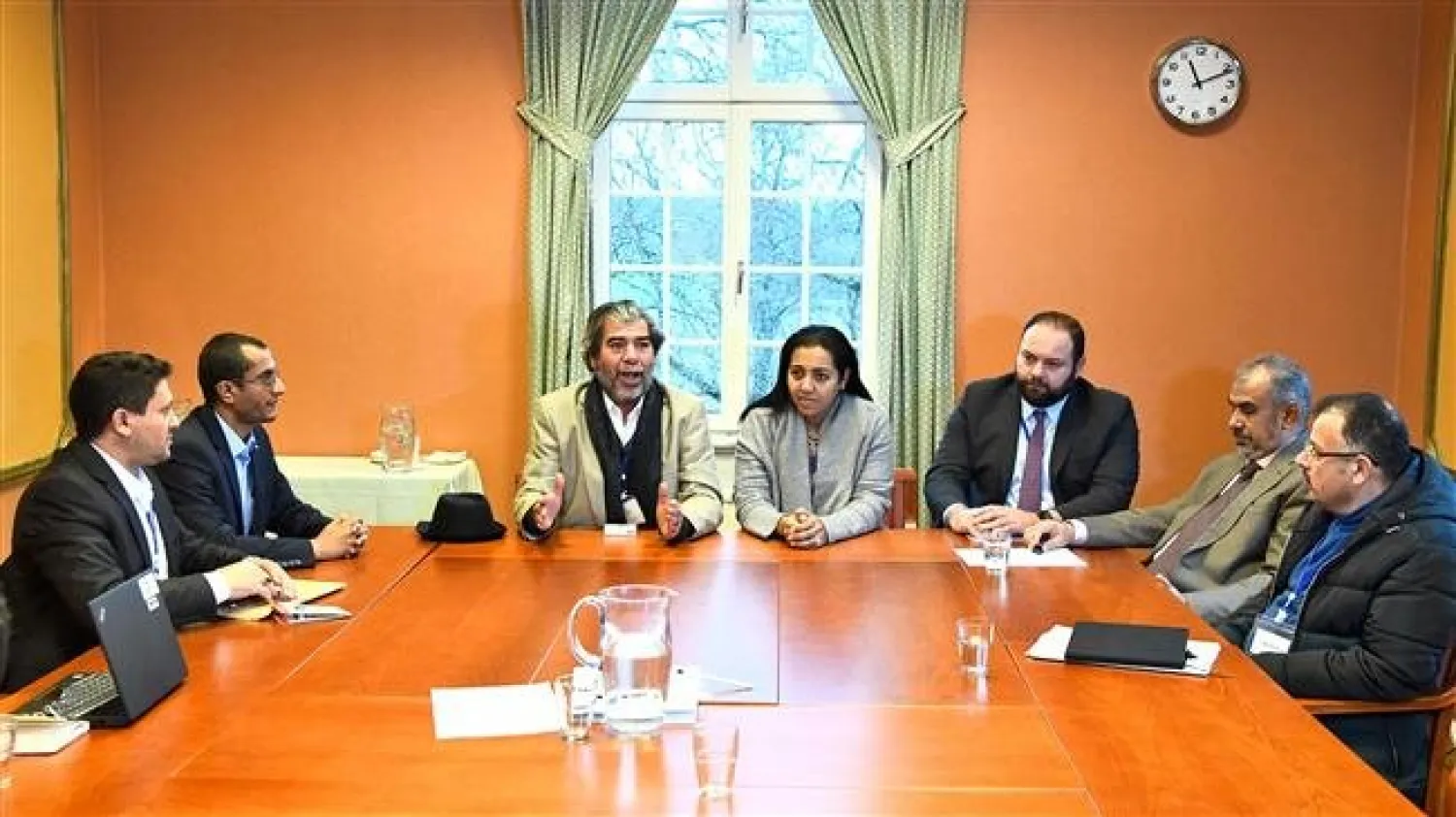

Yemeni Government Stresses Need to Fight Houthi Evasiveness with Prisoner Swap Deal

At left, Abdelqader al-Murtada and Saelem Mohammed Noman Al-Mughalles, representatives of the Ansar Allah delegation and at right, Askar Zaeil and Hadi al-Hayi representing the delegation of the Government of Yemen sit at the negotiating table together with representatives from the office of the U.N. Special Envoy for Yemen and the International Red Cross Committee (ICRC) when lists of prisoners are exchanged, a first step to implement the agreement to release all prisoners by the two parties, during the ongoing peace talks on Yemen held at Johannesberg Castle, in Rimbo, near Stockholm, Sweden, December 11, 2018. TT News Agency/Claudio Bresciani via REUTERS
TT

Yemeni Government Stresses Need to Fight Houthi Evasiveness with Prisoner Swap Deal

At left, Abdelqader al-Murtada and Saelem Mohammed Noman Al-Mughalles, representatives of the Ansar Allah delegation and at right, Askar Zaeil and Hadi al-Hayi representing the delegation of the Government of Yemen sit at the negotiating table together with representatives from the office of the U.N. Special Envoy for Yemen and the International Red Cross Committee (ICRC) when lists of prisoners are exchanged, a first step to implement the agreement to release all prisoners by the two parties, during the ongoing peace talks on Yemen held at Johannesberg Castle, in Rimbo, near Stockholm, Sweden, December 11, 2018. TT News Agency/Claudio Bresciani via REUTERS

Yemeni Foreign Ministry Khaled al-Yamani confirmed the government delegate, alongside Saudi and UAE representatives, has prepared and presented a strong letter criticizing violations committed by Iran-backed Houthi militiamen.

Houthis, despite signing to the UN-brokered Stockholm Agreement, have carried continued amassing fighters, building weapon capacities, digging trenches and looting humanitarian relief and exploiting it for the group’s apparently ongoing war effort.

“Coupists, given the group’s evasive behavior when it comes to the prisoner swap issue, seem to be practicing multi-faceted extortion against the international community,” al-Yamani told Asharq Al-Awsat on the eve of launching prisoner exchange talks in Amman, Jordan.

Yemen’s warring sides have started talks in the Jordanian capital about a deal to free thousands of prisoners as part of UN-led peace efforts.

The top diplomat said that the Yemeni government wishes for the international community and the humanitarian relief groups to weigh in and place pressure on Houthis so that they comply with commitments.

Houthis do not seem determined on fulfilling agreements, al-Yamani said while pointing out that the international community is well aware that the Iran-backed militia is unwilling to comply with peace efforts and doesn’t seriously want a solution for the conflict.

He went on to reaffirm the unquestionable support the internationally-recognized Yemeni government, headed by President Abdrabbuh Mansur Hadi, holds for UN-led peace efforts, saying that it stems from a conviction that diplomacy is the only solution to empower state institutions and to dismantle the detrimental agenda upheld by coupists.

According to al-Yamani, Houthis refusing to provide details on 232 detainees covered by the UN Security Council resolution 2216 is a grave violation that undermines confidence-building measures initiated by the Stockholm agreement.

Adressing questions on the arrival of a number of European ambassadors to Aden, al-Yamani said that this visit is meant to explore efforts undertaken by the legitimate Yemeni government.

The EU mission and a group of ambassadors will meet with the government in the interim capital of Aden.

Al-Yamani said that the visit restores clarity to confusion previously induced by understating positive efforts exerted by the Yemeni government.

The hard labors of the Yemeni government, according to al-Yamani, cannot be overlooked, especially as it first and foremost has the service of Yemenis at heart.

The Yemeni government works around the clock to strengthen the financial and administrative institutions to ensure that workers in all sectors of the country are paid, the diplomat said.

Backed by the Saudi-led Arab Coalition, al-Yamani said that the government is keen on restoring life in Yemen.



Iraq Ruling Alliance Nears Critical Constitutional Deadline

 From a Coordination Framework alliance meeting in Baghdad (INA)
From a Coordination Framework alliance meeting in Baghdad (INA)
TT

Iraq Ruling Alliance Nears Critical Constitutional Deadline

 From a Coordination Framework alliance meeting in Baghdad (INA)
From a Coordination Framework alliance meeting in Baghdad (INA)

Iraq’s Coordination Framework is set to meet on Friday, the final day of the constitutional deadline to name a prime minister-designate, as disputes persist among Shiite factions over both the selection mechanism and the final nominee, threatening to push the country into a new constitutional crisis.

In that context, the Reconstruction and Development Coalition, led by Mohammed Shia al-Sudani, denied any US objection to his serving a second term and rejected reports that Ihsan al-Awadi had been proposed as an alternative candidate to form a government, reaffirming its backing for al-Sudani as the “sole candidate.”

The Coordination Framework has postponed its decisive meeting more than once before announcing in an official statement that the session would be moved to Friday “to allow more time for dialogue and to reach a conclusion within the constitutional period.”

Hardening positions

Mushriq al-Furaiji, a member of the Reconstruction and Development Coalition, said divisions inside the Framework were marked by “hardening positions.”

He said a proposal to adopt a two-thirds vote of Framework lawmakers to choose the nominee had been rejected by Nouri al-Maliki. He added that about 114 lawmakers backed Sudani’s nomination, compared with around 50 supporting Maliki.

Firas al-Musallamawi, spokesman for the coalition, said Framework leaders had discussed adopting the principle of a two-thirds majority, but disagreement remained over whether that should be calculated from the total number of Framework leaders or from the number of their lawmakers in parliament.

By contrast, Hassan Fadam, a member of the Hikma Movement, said the final contest was likely to narrow to Sudani and Bassem al-Badri, while Zuhair al-Jalabi of the State of Law Coalition said Maliki had “not officially withdrawn,” adding that his continued candidacy was limiting the possibility of putting forward other nominees.

Saqr al-Mohammadawi, a lawmaker from the Sadiqoun bloc, said in a press statement that Framework leaders were moving to settle the nominee’s name at the upcoming meeting, adding that the option of a compromise candidate would remain on the table if differences persisted.

Fallout from the delay

The developments come after Nizar Amidi was elected president, triggering a 15-day constitutional deadline for the designation of a candidate from the largest parliamentary bloc to form a government, under Article 76 of the constitution.

During a meeting with Maliki, Amidi urged Framework forces to quickly settle on their nominee “within the constitutional timelines,” warning of the consequences of delay for political stability.

The dispute within the Framework centers on the definition of the “largest bloc” and the mechanism for choosing the nominee: either relying on a decision by Framework leaders or resorting to a vote by its roughly 185 lawmakers.

A legal debate has also emerged over what would happen if the deadline expired without a nominee being presented, given the absence of any explicit constitutional text addressing such a case.

Observers say failure to reach agreement at Friday’s meeting could return the country to political deadlock and leave the president facing complex constitutional choices, at a time when Shiite factions are confronting, for the first time since 2003, a sharp split that threatens their political cohesion.

The political crisis comes amid US pressure on Baghdad. Sources said Washington had halted a cash shipment worth about $500 million that had been headed to Iraq and had suspended parts of its security cooperation with Baghdad, in a move aimed at pressuring the Iraqi government over the actions of Iran-backed militias, according to Reuters.

Western sources also told Asharq Al-Awsat that coordination between Washington and Baghdad was currently “at its lowest level.”


Will Syria’s Parliament Meet on Sharaa’s Timeline?

President Ahmed al-Sharaa meets members of the Supreme Committee for People’s Assembly elections, July 2025 (Presidency page)
TT

Will Syria’s Parliament Meet on Sharaa’s Timeline?

President Ahmed al-Sharaa meets members of the Supreme Committee for People’s Assembly elections, July 2025 (Presidency page)

Holding the first session of Syria’s parliament, the People’s Assembly, on the timeline set by Ahmed al-Sharaa in Antalya will require faster efforts to select representatives from Hasaka, as the Supreme Elections Committee moves to resolve key issues delaying the launch.

Al-Sharaa said at the Antalya Diplomacy Forum last Friday that parliament would convene by the end of April. The new Assembly, he said, will set the course for the post-five-year transitional phase, led by drafting a constitution to define laws, state institutions, presidential powers, and the system of governance, all subject to a vote.

The president’s office is expected to name his appointees, who will fill one-third of the seats, after ratifying Hasaka’s election results, completing the quorum ahead of the first session.

Hasaka tests timeline

Al-Sharaa’s remarks point to progress on stalled issues, especially in Hasaka, but they have also raised doubts over whether elections there can be completed in time.

Analysts say the province’s ethnic, sectarian, and social diversity demands a cautious approach to a process carrying political weight. That includes how representatives are chosen, and how subcommittees and electoral bodies are formed.

Researcher Samer al-Ahmad, affiliated with the Middle East Institute, said Hasaka’s mix of Kurdish and Assyrian parties, tribal structures, revolutionary groups, and the Autonomous Administration adds complexity.

This diversity, he said, makes the elections highly sensitive, requiring Damascus to balance competing interests and limit external interference.

The vote falls under the January 29 understandings with the Syrian Democratic Forces, which may seek a dedicated share similar to the president’s quota or obstruct the process, as seen in the recent refusal to hand over the offices and the Justice Palace in Qamishli.

Hasaka Governor Nour al-Din Ahmad met a delegation from the elections committee on Saturday as preparations gathered pace.

Committee member Mohammed Wali said the process could take 15 to 21 days.

“The committee has begun preparations to resume the process based on Hasaka’s allocated seats, forming the electoral body and engaging official and social actors to ensure representation of all Syrian components in the first parliament after liberation,” he said.

Wali said the earlier delay was aimed at securing a suitable environment under state sovereignty and ensuring representation for Hasaka as part of Syria.

He added that the process effectively began with the committee’s recent visit, meetings with the governor and a presidential envoy, and steps to implement the December 29 agreement, including logistical preparations and initial lists for subcommittees.

May more likely

Syrian government sources told Asharq Al-Awsat that holding the first session within the announced timeframe will be difficult, warning of disputes similar to those seen in Raqqa’s elections.

They said authorities are unlikely to stick rigidly to the date and may allow more time, pointing to the end of the first week of May as a more likely date.

The sources said recent presidential remarks reflect a push to activate the legislative authority, given pending files requiring approval, including internal laws, the constitution, transitional justice and foreign agreements.

They stressed the need for representation from the eastern region through elections mirroring other provinces to ensure the Assembly’s legitimacy.

Raqqa, previously under SDF control, has already held elections, producing four members, with two more from Tal Abyad completing the province’s representation.

Sweida and the presidential quota

Hasaka’s file also brings attention to Sweida and the president’s one-third share, seen as key to maintaining political and social balance.

Ahmed Qarbi, director of the Syrian Dialogue Center for Studies, said a solution in Sweida remains distant as the Hijri group continues to press separatist demands, complicating efforts to hold elections there.

He said the government may compensate for Sweida’s three seats through the president’s quota of 70, under Article 24 of the constitutional declaration, to ensure fair representation, including ethnic, sectarian and gender balance, likely securing Druze representation.

Qarbi said this would not be a quota system, but a way to fill gaps, ensure broad representation and account for expertise.

“It is not possible to suspend a state parliament with 207 out of 210 members present,” he said, adding that Druze representation could be covered through figures from areas such as Jaramana and Ashrafiyat Sahnaya, as well as influential figures from Sweida who oppose separation.

Pressure to convene

Beyond its legislative role, the Assembly’s launch carries political weight.

Newly elected member Abdulaziz Maghribi said its convening is critical at home and abroad.

“For the first time in decades, after the Assembly’s role was sidelined under Assad family rule, Syrians are waiting for it to convene and exercise oversight, improve institutional performance through proposing, passing and amending laws, and approve the state budget,” he said.

The president’s office is expected to finalize its appointees after Hasaka’s results are ratified, completing the quorum ahead of the first session.

Parliamentary elections began in October under an exceptional electoral system based on electoral colleges, which selected two-thirds of the 210-member Assembly.


Gradual Escalation in South Lebanon Complicates Diplomatic Efforts

Children stand on a pickup truck as they pass damaged buildings after an Israeli airstrike in the southern Lebanese town of Mansouri (Reuters)
TT

Gradual Escalation in South Lebanon Complicates Diplomatic Efforts

Children stand on a pickup truck as they pass damaged buildings after an Israeli airstrike in the southern Lebanese town of Mansouri (Reuters)

Diplomatic efforts to resolve the crisis in southern Lebanon are running up against a gradual escalation on the ground, as fighting expands beyond the border area following four days of Israeli violations, with Hezbollah beginning limited attacks on Israeli forces deeper inside Lebanon and along the border.

Israeli operations have intensified, with homes being blown up, demolished and burned, while no-return zones are expanding. The measures appear to go beyond military objectives, pointing to an attempt to impose a new demographic and security reality.

Escalation widens, no-return zones expand

On Thursday, the Israeli army carried out operations in several towns, including Beit Lif, Hanine, Mais al-Jabal, and Khiam. Powerful explosions were reported, homes were destroyed or set ablaze, and artillery hit Wadi al-Hujeir, Wadi al-Slouqi, and Qantara.

The campaign signals a shift from remote strikes to systematic destruction of the built environment.

Hezbollah fired a rocket toward the Metula settlement, which Israel’s Iron Dome intercepted. The Israeli army also said it intercepted an aerial target launched from Lebanon.

More significant, however, was the widening of Israeli warnings, with renewed calls for residents of dozens of villages not to return or move south of set lines, resembling a “fire belt” with political and demographic implications aimed at reshaping the border area.

Displacement persists, uncertainty deepens

Local sources told Asharq Al-Awsat that many residents have yet to return to villages in the Nabatieh district, while others are holding back from returning to Beirut’s southern suburbs despite the truce, citing doubts over its durability.

They said continued exchanges of fire in the south underline the fragility of the ceasefire, warning that relative calm north of the Litani River and deeper inside Lebanon could collapse at any moment. The situation reflects a tense waiting phase rather than real stability.

The crisis is also evident administratively. Civil registry records from Mais al-Jabal have been moved from their temporary location in Nabatieh to the Interior Ministry, a step that entrenches a reality preventing the return of state institutions, mirroring administrative displacement alongside population displacement.

Testimonies cited by Haaretz, quoting Israeli soldiers, described looting of civilian property as a “routine phenomenon,” underscoring the erosion of the social and economic fabric of border villages and reinforcing what sources describe as “silent emptying.”

Diplomacy under strain

Political positions reflect the pressure. Hezbollah lawmaker Hassan Fadlallah said the group wants to respect the ceasefire, but Israel must do the same. MP Hussein Hajj Hassan said the group is no longer bound by the truce and will respond based on its assessment.

Retired brigadier general Naji Malaeb told Asharq Al-Awsat that Hezbollah’s response, described as part of deterrence, falls short given the imbalance of power and risks undermining Lebanon’s diplomatic efforts at a critical time.

He said Lebanon would have been better served by sustaining diplomatic pressure over Israeli violations without military responses, noting that even limited rocket fire weakens Lebanon’s leverage.

Double standards, shrinking leverage

Malaeb said any Hezbollah military action would be framed internationally, particularly by the United States, as a breach of the truce, while Israeli violations are largely overlooked.

That dynamic, he said, erodes Lebanon’s negotiating position as it bets on talks in Washington, turning the conflict into a “war of narratives” shaped by power rather than legal standards.

Focus on securing the truce

Malaeb said Lebanon should prioritize securing a firm ceasefire to allow the army to assert control and ensure its deployment is not obstructed. He said this aligns with the US approach but depends on Israeli compliance, which is uncertain.

He warned that any deal could leave Israel room to act under security pretexts, effectively allowing continued strikes and setting the stage for renewed escalation, with Hezbollah likely to respond.