


Leeds’ Spying Should Be Treated as a Form of Entertainment, Not Cheating

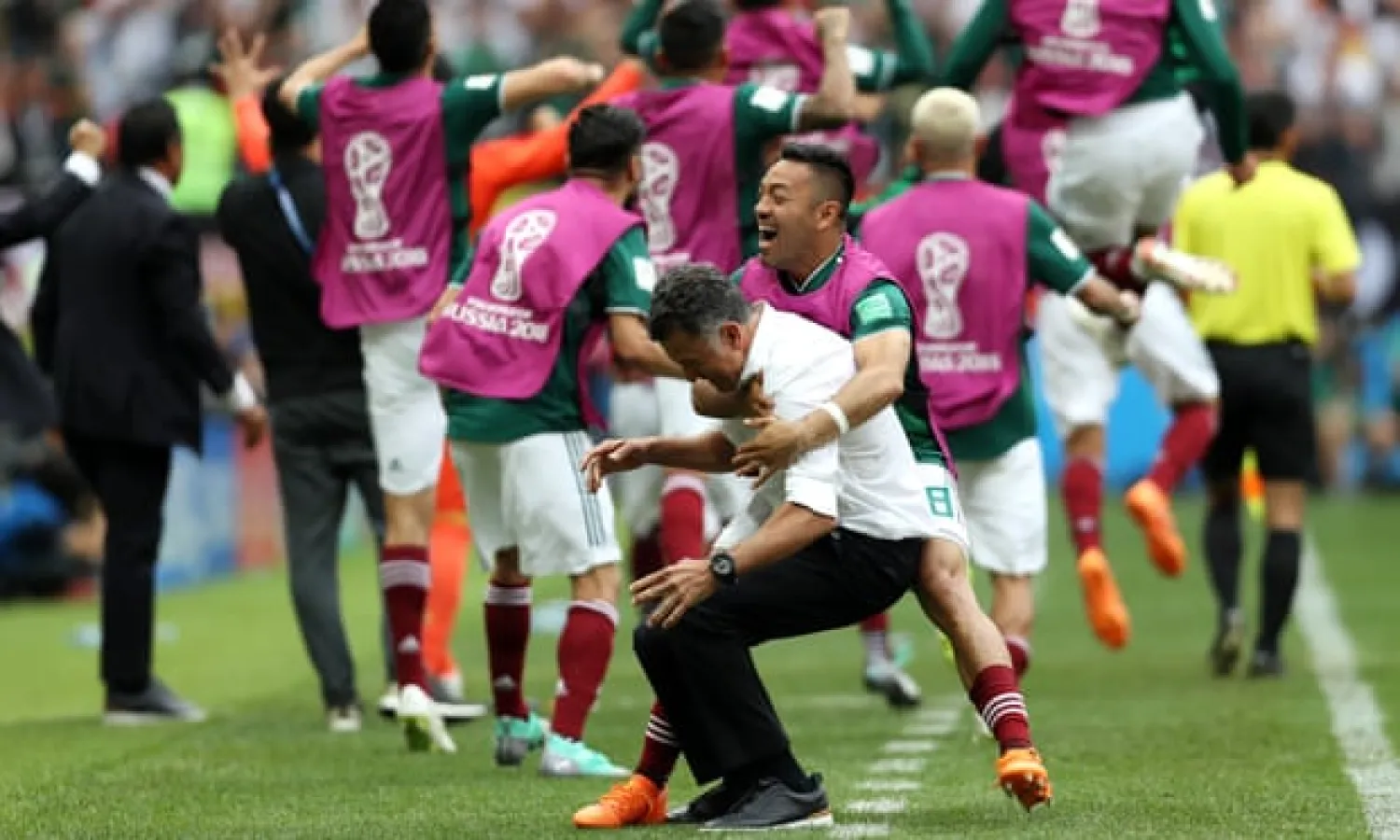
 Juan Carlos Osorio (centre) lived within sight of Liverpool’s Melwood training ground for two years. Last year his Mexico team reached the last 16 of the World Cup. Photograph: Clive Rose/Getty Images
Juan Carlos Osorio (centre) lived within sight of Liverpool’s Melwood training ground for two years. Last year his Mexico team reached the last 16 of the World Cup. Photograph: Clive Rose/Getty Images
TT

Leeds’ Spying Should Be Treated as a Form of Entertainment, Not Cheating

 Juan Carlos Osorio (centre) lived within sight of Liverpool’s Melwood training ground for two years. Last year his Mexico team reached the last 16 of the World Cup. Photograph: Clive Rose/Getty Images
Juan Carlos Osorio (centre) lived within sight of Liverpool’s Melwood training ground for two years. Last year his Mexico team reached the last 16 of the World Cup. Photograph: Clive Rose/Getty Images

One hopes Marcelo Bielsa does not get punished too severely after admitting that he spies on everyone. The Leeds United manager confessed immediately when caught blatantly watching Derby County training sessions, contacting Frank Lampard and taking responsibility for the stunt, and was reminded by his own club of Leeds’s “integrity and honesty”. That alone should have been enough to conclude this entertaining episode with the wry smile it deserved, although Bielsa gave it fresh impetus with his honesty offensive.

Such disarming frankness and willingness to cooperate with official investigations ought to be welcomed. It is certainly preferable to Lampard’s attempts to gain the moral high ground when he is aware that Chelsea used to do much the same thing under José Mourinho.

Perhaps Bielsa ought to have cottoned on a bit quicker to the possibility that what goes without comment in South America might be frowned on in England, but differences in custom and practice between footballing cultures are there to be enjoyed, not censured. Bielsa may well have acted against the spirit of the EFL clubs’ charter, whatever that is, but even if you could track such a document down you would not find anything specific about lurking in bushes to get a glimpse of rival preparations.

When the transgression was first discovered it was reported that the interloper was wearing camouflage gear and carrying bolt-cutters. That sounded exciting, borderline illegal in fact, though it was later toned down to sportswear and a pair of pliers. And the unnamed individual turned up in a Leeds United vehicle. Even more hilariously, Derby were able to work out he had done it before. A rustling in the undergrowth that had been noticed but not acted upon earlier in the season turned out to have taken place on the eve of Leeds’s 4-1 win at Pride Park back in August.

The Leeds manager should probably accept that such skulduggery is considered bad form in England, though it is worth remembering that the police who turned up at the latest incident did not make an arrest. No crime had been committed. Derby’s training ground is overlooked by private houses anyway. The Leeds spy was spotted by a resident rather than a member of the football club’s staff, and though Lampard is right to say he ought not to have to conduct a search of the perimeter fence before each training session, his point underlines the fact that not many training facilities are that private.

Manchester City, before they moved to the Etihad campus, a purpose-built city-centre location, were always complaining that they had no privacy at Carrington because a public footpath bordered their land. All any interested party – usually press but possibly opponents – would need was a stepladder or the ability to poke a lens through a hedge.

Liverpool’s Melwood training ground has a reasonably substantial wall around its perimeter, though it is hardly one of forbidding height. Again, the training ground is surrounded by private houses, and not only would residents rightly object were Liverpool to build prison-style walls around the place, those inside the facility would suffer a loss of light. Liverpool have plans to move out to a greenfield site on the outskirts eventually, but for now the sight of onlookers using wheelie bins and stepladders to gain a peek at the players in training is a familiar one during school holidays.

Just over 20 years ago in fact, a Colombian studying a degree course in football science at Liverpool’s John Moores university became so friendly with a family living alongside Melwood through borrowing a small table to see over the wall that he ended up moving in as a lodger. Juan Carlos Osorio stayed for two years, most of the time living in a bedroom that gave him an unrestricted view of Liverpool’s training routines. He is currently the manager of Paraguay but gained his greatest prominence last summer as coach of the Mexico team that defeated Germany in the World Cup in Russia.

There is an obvious difference between snooping to further one’s education and doing it to undermine an opponent in a competitive match, but the bottom line is that training grounds are not sacrosanct. If anyone wants to see what goes on badly enough, it can usually be managed, and when drone technology is developing at such a pace there is probably no point either in clubs investing in mountain hideaways with reinforced security.

Bielsa has been accused of cheating, though checking out the opposition in advance could just as easily be viewed as part of the game. Some will regard his actions more generously as obsessive attention to detail, a coach going about his work with a thoroughness that is rare. While this is clearly a grey area, at least until the EFL or the FA hands down some sort of protocol that everyone can sign up to, defenders of Bielsa might also point out that not every coach or manager would be able to interpret or act upon such snippets of information that might be gleaned from a drone or a spy in the bushes.

Equally, though some managers prefer to be as secretive as possible, others are relaxed about gameplans becoming public knowledge. Most clubs do not alter their playing styles that much from game to game, after all. A coach might adapt his formation for a particular game or opponent, switching to three at the back for instance or deploying a different striker, but he is not going to keep doing that week after week. Most gameplans are on very public view every Saturday afternoon, in front of thousands of paying spectators.

Perhaps rugby is a more straightforward game than football, but one of the best quotes on the overrated nature of gameplans came from John Monie, the Australian who was in charge of Wigan for four seasons in the early 90s and won the cup and league double in every one. “I’m sick of hearing about gameplans – ours isn’t a secret,” he said. “If any opponents are listening, I can tell you what we plan to do. We are going to run all over you for the first half hour then have a look and see what’s left.”

The Guardian Sport


Shakhtar Boss Pays Ukrainian Racer $200,000 After Games Disqualification

Ukrainian President Volodymyr Zelenskiy holds helmet as he meets with a Ukrainian skeleton racer Vladyslav Heraskevych , who was disqualified from the Olympic skeleton competition over his "helmet of remembrance" depicting athletes killed since Russia's invasion and his father and coach, Mykhailo Heraskevych, amid Russia's attack on Ukraine, in Munich, Germany February 13, 2026. (Ukrainian Presidential Press Service/Handout via Reuters)
TT

Shakhtar Boss Pays Ukrainian Racer $200,000 After Games Disqualification

Ukrainian President Volodymyr Zelenskiy holds helmet as he meets with a Ukrainian skeleton racer Vladyslav Heraskevych , who was disqualified from the Olympic skeleton competition over his "helmet of remembrance" depicting athletes killed since Russia's invasion and his father and coach, Mykhailo Heraskevych, amid Russia's attack on Ukraine, in Munich, Germany February 13, 2026. (Ukrainian Presidential Press Service/Handout via Reuters)

The owner of ‌Ukrainian football club Shakhtar Donetsk has donated more than $200,000 to skeleton racer Vladyslav Heraskevych after the athlete was disqualified from the Milano Cortina Winter Games before competing over the use of a helmet depicting Ukrainian athletes killed in the war with Russia, the club said on Tuesday.

The 27-year-old Heraskevych was disqualified last week when the International Bobsleigh and Skeleton Federation jury ruled that imagery on the helmet — depicting athletes killed since Russia invaded Ukraine in 2022 — breached rules on athletes' expression at ‌the Games.

He ‌then lost an appeal at the Court ‌of ⁠Arbitration for Sport hours ⁠before the final two runs of his competition, having missed the first two runs due to his disqualification.

Heraskevych had been allowed to train with the helmet that displayed the faces of 24 dead Ukrainian athletes for several days in Cortina d'Ampezzo where the sliding center is, but the International Olympic Committee then ⁠warned him a day before his competition ‌started that he could not wear ‌it there.

“Vlad Heraskevych was denied the opportunity to compete for victory ‌at the Olympic Games, yet he returns to Ukraine a ‌true winner," Shakhtar President Rinat Akhmetov said in a club statement.

"The respect and pride he has earned among Ukrainians through his actions are the highest reward. At the same time, I want him to ‌have enough energy and resources to continue his sporting career, as well as to fight ⁠for truth, freedom ⁠and the remembrance of those who gave their lives for Ukraine," he said.

The amount is equal to the prize money Ukraine pays athletes who win a gold medal at the Games.

The case dominated headlines early on at the Olympics, with IOC President Kirsty Coventry meeting Heraskevych on Thursday morning at the sliding venue in a failed last-minute attempt to broker a compromise.

The IOC suggested he wear a black armband and display the helmet before and after the race, but said using it in competition breached rules on keeping politics off fields of play. Heraskevych also earned praise from Ukraine President Volodymyr Zelenskiy.


Speed Skating-Italy Clinch Shock Men’s Team Pursuit Gold, Canada Successfully Defend Women’s Title

 Team Italy with Davide Ghiotto, Andrea Giovannini, Michele Malfatti, celebrate winning the gold medal on the podium of the men's team pursuit speed skating race at the 2026 Winter Olympics, in Milan, Italy, Tuesday, Feb. 17, 2026. (AP)
Team Italy with Davide Ghiotto, Andrea Giovannini, Michele Malfatti, celebrate winning the gold medal on the podium of the men's team pursuit speed skating race at the 2026 Winter Olympics, in Milan, Italy, Tuesday, Feb. 17, 2026. (AP)
TT

Speed Skating-Italy Clinch Shock Men’s Team Pursuit Gold, Canada Successfully Defend Women’s Title

 Team Italy with Davide Ghiotto, Andrea Giovannini, Michele Malfatti, celebrate winning the gold medal on the podium of the men's team pursuit speed skating race at the 2026 Winter Olympics, in Milan, Italy, Tuesday, Feb. 17, 2026. (AP)
Team Italy with Davide Ghiotto, Andrea Giovannini, Michele Malfatti, celebrate winning the gold medal on the podium of the men's team pursuit speed skating race at the 2026 Winter Olympics, in Milan, Italy, Tuesday, Feb. 17, 2026. (AP)

An inspired Italy delighted the home crowd with a stunning victory in the Olympic men's team pursuit final as

Canada's Ivanie Blondin, Valerie Maltais and Isabelle Weidemann delivered another seamless performance to beat the Netherlands in the women's event and retain their title ‌on Tuesday.

Italy's ‌men upset the US who ‌arrived ⁠at the Games ⁠as world champions and gold medal favorites.

Spurred on by double Olympic champion Francesca Lollobrigida, the Italian team of Davide Ghiotto, Andrea Giovannini and Michele Malfatti electrified a frenzied arena as they stormed ⁠to a time of three ‌minutes 39.20 seconds - ‌a commanding 4.51 seconds clear of the ‌Americans with China taking bronze.

The roar inside ‌the venue as Italy powered home was thunderous as the crowd rose to their feet, cheering the host nation to one ‌of their most special golds of a highly successful Games.

Canada's women ⁠crossed ⁠the line 0.96 seconds ahead of the Netherlands, stopping the clock at two minutes 55.81 seconds, and

Japan rounded out the women's podium by beating the US in the Final B.

It was only Canada's third gold medal of the Games, following Mikael Kingsbury's win in men's dual moguls and Megan Oldham's victory in women's freeski big air.


Lindsey Vonn Back in US Following Crash in Olympic Downhill 

Milano Cortina 2026 Olympics - Alpine Skiing - Women's Downhill 3rd Official Training - Tofane Alpine Skiing Centre, Belluno, Italy - February 07, 2026. Lindsey Vonn of United States in action during training. (Reuters)
TT

Lindsey Vonn Back in US Following Crash in Olympic Downhill 

Milano Cortina 2026 Olympics - Alpine Skiing - Women's Downhill 3rd Official Training - Tofane Alpine Skiing Centre, Belluno, Italy - February 07, 2026. Lindsey Vonn of United States in action during training. (Reuters)

Lindsey Vonn is back home in the US following a week of treatment at a hospital in Italy after breaking her left leg in the Olympic downhill at the Milan Cortina Games.

“Haven’t stood on my feet in over a week... been in a hospital bed immobile since my race. And although I’m not yet able to stand, being back on home soil feels amazing,” Vonn posted on X with an American flag emoji. “Huge thank you to everyone in Italy for taking good care of me.”

The 41-year-old Vonn suffered a complex tibia fracture that has already been operated on multiple times following her Feb. 8 crash. She has said she'll need more surgery in the US.

Nine days before her fall in Cortina d'Ampezzo, Italy, Vonn ruptured the ACL in her left knee in another crash in Switzerland.

Even before then, all eyes had been on her as the feel-good story heading into the Olympics for her comeback after nearly six years of retirement.
