

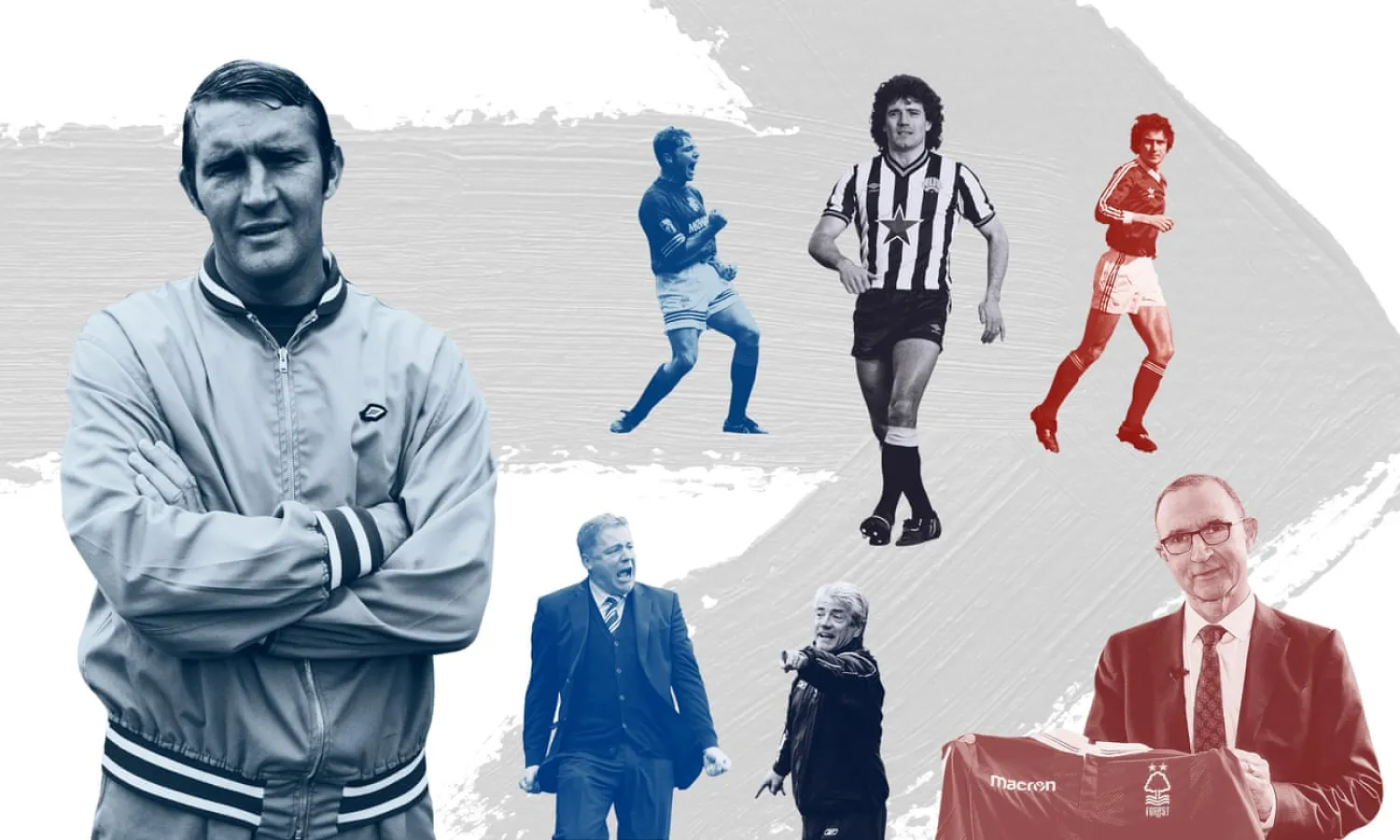

From Souness to Hoddle via Allison: Beware the Manager Returning ‘Home’

 Malcolm Allison, Ally McCoist and Kevin Keegan have returned to manage their former clubs with differing degrees of success. How will Martin O’Neill fare at Nottingham Forest? Photograph: Tom Jenkins, Getty Images, PA and Rex/Shutterstock
Malcolm Allison, Ally McCoist and Kevin Keegan have returned to manage their former clubs with differing degrees of success. How will Martin O’Neill fare at Nottingham Forest? Photograph: Tom Jenkins, Getty Images, PA and Rex/Shutterstock
TT

From Souness to Hoddle via Allison: Beware the Manager Returning ‘Home’

 Malcolm Allison, Ally McCoist and Kevin Keegan have returned to manage their former clubs with differing degrees of success. How will Martin O’Neill fare at Nottingham Forest? Photograph: Tom Jenkins, Getty Images, PA and Rex/Shutterstock
Malcolm Allison, Ally McCoist and Kevin Keegan have returned to manage their former clubs with differing degrees of success. How will Martin O’Neill fare at Nottingham Forest? Photograph: Tom Jenkins, Getty Images, PA and Rex/Shutterstock

Never go back, that’s what they say. It’s beneficial advice. But it is a warning that all too often goes unheeded. Look at them all, hooking up with their exes, visiting their hometown for the first time in years, booking the same holiday in the hope of reliving that perfect break. Don’t do it! That old flame won’t rekindle; an old foe will start a fistfight; it’ll rain all week and the hotel’s now infested with mice. No, it’s best to keep moving forward. Never go back.

They tell you this in the world of football too, but here again folk don’t always listen. History is strewn with tales of managers returning to their alma mater on a white charger in the windswept style, only to come a cropper in short order and limp off in abject defeat. It’s a state of affairs that may give Nottingham Forest pause, as they welcome back Martin O’Neill to the scene of his greatest playing successes, a managerial marriage that’s seemed inevitable for decades, but a romantic appointment fraught with danger.

Even the most giddy affairs can turn sour quicksmart. Take Graeme Souness, the greatest midfielder in Liverpool’s history, who took over at Anfield in 1991 tasked with arresting a slight slip in standards at one of England’s most successful clubs. A smash hit at Rangers, more teacup-bothering success seemed a shoo-in. But within three years, a title-winning machine had collapsed into a bang-average mid-table concern, the Boot Room having been figuratively and literally demolished. Souness’s grand refurbishment project proved so inept, you half expected jets of fire to spurt out whenever you turned on the taps.

Leeds United have questionable form here as well. They spent the bulk of the 1980s engaged in a futile battle to escape from the old Second Division, erstwhile striking hero Allan Clarke having taken them down. Two other elegant stars of the Revie-era dream team, Eddie Gray and Billy Bremner, continued the struggle to no avail.

The salvage job was left to Howard Wilkinson, a man with no professional or emotional links to the club whatsoever, who made a signal point at the start of his reign to take down all the pictures of the glory days. Within four seasons, Leeds were champions of England once more. QED. Keep your distance, legends!

The towering folly of idyllic reconciliation was also ably demonstrated by Malcolm Allison, who in a manner befitting his larger-than-life reputation, took the concept to preposterous extremes. Having masterminded Manchester City’s 1968 title win as a tyro coach under the wing of Joe Mercer, Allison left to unsuccessfully gad about in a big hat and car coat for several years before returning in 1979. The set-up was similar, with Tony Book filling the Mercer role. But the results were not. Within three weeks, City crashed out of the FA Cup at third-tier Shrewsbury. A year on, Allison found himself sacked, and immediately rejoined another of his former clubs, Crystal Palace. That particular return lasted 55 days, a reign that included being knocked out of the cup by – it couldn’t be any other way – Manchester City.

Allison’s CV also contains two stints in charge at Plymouth Argyle, the second of which being mainly memorable for his smashing of a light fitting in a police cell with his shoe. “They said I was drunk and incompetent,” he told the press after getting out of the jug, “and the only way I could prove I was not was by breaking the light.” Spectacular reasoning, and a triptych of botched returns to match.

Many other club legends should in retrospect have swerved the spiritual home: Howard Kendall in his second and third stints at Everton; the Unhappy One on his return to Chelsea; Ally McCoist at Rangers altogether. Then there’s the punchline of that ripe old Titanic groaner, Tottenham Hotspur’s Glenn Hoddle, who should never have left Southampton.

But while Spurs fell from grace with Hod – and didn’t have much luck with Ossie Ardiles either, come to that – their track record in welcoming back old pals is otherwise decent. Spurs have only won two league titles, but both were landed by former players: Arthur Rowe in 1951, and Bill Nicholson a decade later. Nicholson won his first game 10-4 against Everton in 1958, an absurd instant impact that makes Ole Gunnar Solskjær’s influence at Manchester United feel positively Mourinhoesque. “It can only get worse from here,” Danny Blanchflower informed his new boss dryly as he left the pitch. Nicholson set about proving him wrong by masterminding the 1961 Double.

Blanchflower’s fellow Double-winner Dave Mackay later played in Derby County’s promotion side of the late 60s. When boss Brian Clough eventually flounced out in 1973 because Rams chairman Sam Longson had, among other things, put a lock on the office drinks cabinet, Mackay returned from Nottingham Forest to placate an agitated squad threatening to strike. The players knew it wasn’t worth arguing, Mackay being decency incarnate. It also helped that he was still fit to give his charges a skelp around the lug if required. Mackay won the title in his first full season.

Harry Catterick didn’t hang about at Everton either. A striker at Goodison just after the war, Catterick was in the process of building something special at Sheffield Wednesday, finishing second behind Spurs in 1961. But the board balked at his request to buy Hibs striker Joe Baker, and so he chipped off to Merseyside in a huff, any old excuse to take the job he’d always coveted most. Within two seasons, he’d won Everton’s first championship since 1939. Not bad for someone whose return was greeted with underwhelmed shrugging. Much like George Graham at Arsenal in 1986, and he didn’t do too badly either.

Joe Royle, one of Catterick’s 1970 champions, doesn’t quite boast the CV of his old boss. While he’s the last Everton manager to win anything, the 1995 FA Cup, perhaps his greater legacy was the restoration of Evertonian values after the debacle of the Mike Walker era. See also Kenny Dalglish in the wake of the Roy Hodgson fiasco, and the aforementioned Solskjær, whose stint spring-cleaning Old Trafford will surely qualify as a success whatever the material outcome. Some things are worth more than mere silverware; you only have to point to Tom Finney or Matt Le Tissier to prove that.

Which naturally brings us to Kevin Keegan at Newcastle United. Yeah, yeah, so he didn’t win anything. But the man always knew how to put on a show, as evidenced by the manner in which he departed as a player in 1984, coptered up and away like Nixon. Having hauled the Magpies out of the old Second Division with his boots on, he repeated the trick eight years later from the dugout, then in 1996 oversaw one of the great doomed title tilts. A success of sorts? A success totally! After all, we’re still talking fondly about Keegan’s side today, unlike the Manchester United team that actually prevailed that year.

Newcastle’s story was a bittersweet triumph, a tearjerker that knocks Casablanca and Brief Encounter into a cocked hat full of used tissues. It wouldn’t be perfect, of course, but chances are O’Neill and Forest would settle for a similarly memorable romance.

The Guardian Sport


Salah Steers Egypt into Africa Cup Knockout Stages After VAR Denies South Africa Late Penalty

 Egypt's forward #10 Mohamed Salah shoots from the penalty spot to score the team's first goal during the Africa Cup of Nations (CAN) Group B football match between Egypt and South Africa at Adrar Stadium in Agadir on December 26, 2025. (AFP)
Egypt's forward #10 Mohamed Salah shoots from the penalty spot to score the team's first goal during the Africa Cup of Nations (CAN) Group B football match between Egypt and South Africa at Adrar Stadium in Agadir on December 26, 2025. (AFP)
TT

Salah Steers Egypt into Africa Cup Knockout Stages After VAR Denies South Africa Late Penalty

 Egypt's forward #10 Mohamed Salah shoots from the penalty spot to score the team's first goal during the Africa Cup of Nations (CAN) Group B football match between Egypt and South Africa at Adrar Stadium in Agadir on December 26, 2025. (AFP)
Egypt's forward #10 Mohamed Salah shoots from the penalty spot to score the team's first goal during the Africa Cup of Nations (CAN) Group B football match between Egypt and South Africa at Adrar Stadium in Agadir on December 26, 2025. (AFP)

Mohamed Salah scored again on Friday as Egypt's 10 men held on to beat South Africa 1-0 to reach the knockout stages of the Africa Cup of Nations.

Salah, who secured the Pharaohs’ opening win with a stoppage-time strike against Zimbabwe on Monday, did it again in Agadir and his penalty before the break secured progression from Group B.

But South Africa should arguably have been given a penalty in stoppage time when Yasser Ibrahim blocked a shot with his arm. After a long delay, the referee decided against awarding the spot kick after consulting video replays and Ibrahim sank to the ground in relief.

“We didn’t have much luck. We also had several refereeing decisions go against us,” South Africa coach Hugo Broos said.

Salah converted his penalty after he was struck in the face by the hand of the retreating South Africa forward Lyle Foster. Salah showed no ill effects from the blow and sent his shot straight down the middle while goalkeeper Ronwen Williams dived to his right.

There was still time before the break for Egypt defender Mohamed Hany to get sent off, after receiving a second yellow card for a foul on Teboho Mokoena.

Goalkeeper Mohamed El Shenawy was Egypt’s key player in the second half.

“We gave our all in this match right until the end, and we also hope for the best for what comes next,” the 37-year-old El Shenawy said.

Earlier, Angola and Zimbabwe drew 1-1 in the other group game, a result that suited neither side after opening losses.

Egypt leads with 6 points from two games followed by South Africa on 3. Angola and Zimbabwe have a point each. The top two progress from each group, along with the best third-place finishers.

Zambia drew 1-1 with Comoros in the early Group A fixture after both lost their opening games, meaning the winner of the late match could be sure of progressing.


Draper to Miss Australian Open Due to Injury

 Jack Draper, of Great Britain, reacts after defeating Federico Agustin Gomez, of Argentina, during the first round of the US Open tennis championships, Aug. 25, 2025, in New York. (AP)
Jack Draper, of Great Britain, reacts after defeating Federico Agustin Gomez, of Argentina, during the first round of the US Open tennis championships, Aug. 25, 2025, in New York. (AP)
TT

Draper to Miss Australian Open Due to Injury

 Jack Draper, of Great Britain, reacts after defeating Federico Agustin Gomez, of Argentina, during the first round of the US Open tennis championships, Aug. 25, 2025, in New York. (AP)
Jack Draper, of Great Britain, reacts after defeating Federico Agustin Gomez, of Argentina, during the first round of the US Open tennis championships, Aug. 25, 2025, in New York. (AP)

Briton Jack Draper said on Friday he will not compete in next month's Australian Open, citing ongoing recovery from an injury.

Draper, 10th in the world rankings, was forced to withdraw from the second round of ‌the US Open ‌in August ‌due ⁠to bone ‌bruising in his left arm.

"Unfortunately, me and my team have decided not to head out to Australia this year. It's a really, ⁠really tough decision," the British ‌number one said in ‍a video ‍posted on X.

The 24-year-old ‍is targeting a February return alongside preparation for the defense of his Indian Wells title in March.

"This injury has been the most difficult ⁠and complex of my career," Draper added. "It's weird, it always seems to make me more resilient. I'm looking forward to getting back out there in 2026 and competing."

The Australian Open begins on January 18 in ‌Melbourne.


Morocco Forced to Wait for AFCON Knockout Place After Mali Draw

Football - CAF Africa Cup of Nations - Morocco 2025 - Group A - Morocco v Mali - Prince Moulay Abdellah Stadium, Rabat, Morocco - December 26, 2025 Morocco's Ismael Saibari reacts after Mali's Lassine Sinayoko scored their first goal. (Reuters)
TT

Morocco Forced to Wait for AFCON Knockout Place After Mali Draw

Football - CAF Africa Cup of Nations - Morocco 2025 - Group A - Morocco v Mali - Prince Moulay Abdellah Stadium, Rabat, Morocco - December 26, 2025 Morocco's Ismael Saibari reacts after Mali's Lassine Sinayoko scored their first goal. (Reuters)

Morocco missed the chance to guarantee their spot in the last 16 of the Africa Cup of Nations after Lassine Sinayoko's second-half penalty earned Mali a 1-1 draw with the hosts on Friday.

The match was a tale of two spot-kicks, with Brahim Diaz giving Morocco the lead from a penalty deep in first-half injury time and Sinayoko replying on 64 minutes.

The stalemate at the Prince Moulay Abdellah Stadium in the capital Rabat ended Morocco's world record winning run which had been taken to 19 matches with their 2-0 victory over Comoros in the tournament's opening game.

It also means Morocco have not yet confirmed their place in the knockout phase, although they are on top of Group A with four points from two games.

Mali come next on two points alongside Zambia, who drew 0-0 with minnows Comoros earlier in Casablanca.

Morocco next face Zambia on Monday and a victory in that match against the 2012 champions will ensure that the hosts go through as group winners.

"We'll look back at the second half and see what the problem was but we didn't play the way we did in the first half. We didn't impose our game and had to drop off. The penalty changed the game a bit," Morocco midfielder Azzedine Ounahi told broadcaster beIN Sports.

"We go into the third game with the same approach, to win the game and finish top of the group."

Morocco captain Achraf Hakimi, the African player of the year, was again an unused substitute as he continues his recovery from an ankle injury suffered playing for Paris Saint-Germain at the start of November.

- Mbappe watches on -

His former PSG teammate Kylian Mbappe, the current Real Madrid superstar and France skipper, was among the spectators in the crowd of 63,844 and appeared to be wearing a Morocco shirt with Hakimi's number two on it.

With Hakimi on the sidelines, Mbappe's Real Madrid teammate Diaz was the main attraction on the pitch -- the little number 10 forced a good save from Mali goalkeeper Djigui Diarra on 17 minutes and then played a key part in the penalty which led to the opening goal just before the interval.

Mali defender Nathan Gassama brushed the ball with his hand as he tried to stop Diaz dribbling past him inside the box, and the referee eventually awarded a spot-kick following a lengthy look at the pitchside VAR monitor.

Morocco's Soufiane Rahimi had a spot-kick saved against Comoros but this time Diaz sent the goalkeeper the wrong way for his second goal of the tournament.

However, Walid Regragui's side, the best team in Africa according to the FIFA rankings, could not build on that as Mali won a penalty of their own just after the hour mark.

Sinayoko went down under a clumsy challenge by Jawad El Yamiq and 29-year-old Cameroonian referee Abdoul Abdel Mefire awarded the penalty after eventually being called over to check his screen.

Auxerre striker Sinayoko, having been booked apparently for something he said to the referee, kept his cool to stroke in the reward and restore parity.

Morocco substitute Youssef En-Nesyri was denied by a good Diarra save and Mali then held on through 10 minutes of stoppage time for a point, as the final whistle was greeted with jeers from the home fans.
