


The Rise of Aaron Wan-Bissaka: A lot of the Time I Can’t Get My Head around it

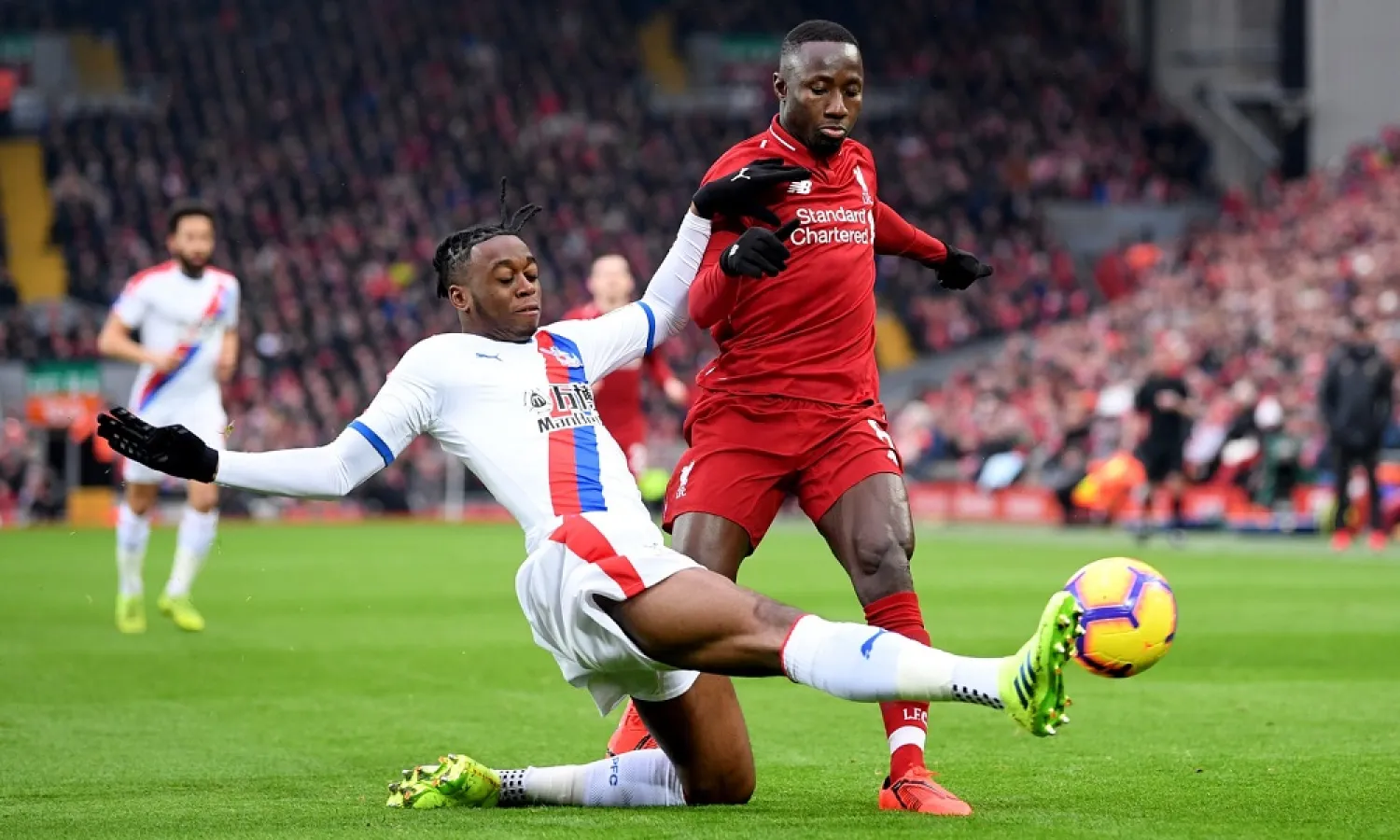
Aaron Wan-Bissaka dispossesses Liverpool’s Naby Keita at Anfield. (Getty Images)
TT

The Rise of Aaron Wan-Bissaka: A lot of the Time I Can’t Get My Head around it

Aaron Wan-Bissaka dispossesses Liverpool’s Naby Keita at Anfield. (Getty Images)

Evidence Aaron Wan-Bissaka does actually do flustered surfaced at a little after 2pm last week. The novice full-back who had confronted and contained Christian Eriksen, Alexis Sánchez and Eden Hazard on his first three senior outings and has established himself as the most prolific and cleanest tackler across Europe’s elite five leagues, was backstage at his old school, Good Shepherd, when his name was announced inside the assembly hall.

The boy from New Addington turned Crystal Palace full-back had anticipated an audience with a couple of classes at most, so the ear-splitting din summoned by the excitable throng, 250-strong, rocked him on his heels. There was a flicker of apprehension, a sheepish smile as he edged into the hall, and disbelief at the delighted bedlam. “It’s mad to see,” he offered once the Q&A and quiz had been successfully negotiated. “A lot of the time I can’t really get my head around it, but it shows I’ve come a long way. I have to be grateful.”

Wan-Bissaka is slowly coming to terms with the adulation, even if trips back to this corner of Croydon tend to labor the point. His parents still live round the corner from the school, across from the sloped field where he first ventured out with his older brother, Kevin, for a kickabout. “There’d be balls flying everywhere, a free for all. The council would cut the grass every now and then and we’d play proper 15-a-side matches, and I’d be first pick, even though I was probably the youngest. It was the skills. The free-styling. I loved watching Thierry Henry and Ronaldinho expressing themselves, so that’s what I copied.”

These days the kids tend to spot his car on his visits home, before camping outside the Wan-Bissakas’ house, taking turns to ring the doorbell and pester for an autograph. Up at the community center in nearby Fieldway, where the Palace for Life Foundation teams up with Croydon council and the Metropolitan Police to run coaching courses aimed at tackling youth violence, he is the poster boy. Wan-Bissaka is the local lad, from one of the borough’s poorest wards, made spectacularly good.

Most remarkable is the ease with which he has taken to the Premier League. At 14 there had been a debate at Palace as to whether Wan-Bissaka, a quiet, gangly kid, should be retained. By early 2017 the boyhood Arsenal supporter was still essentially striving to make his mark at a club brimming with wingers. Twelve months ago, as an unused fourth-choice right-back, he had pushed for a move to League Two. On Saturday he faced West Ham as the best one-on-one defender in the division this season having mustered more successful tackles (66 of 91) than anyone in the Premier League, Bundesliga, Serie A, Ligue Un or Primera Liga.

He is the only player in England to boast 40 or more tackles, completed take-ons (40) and interceptions (57), and only seven opponents have successfully wriggled beyond him. The raw numbers are mind-boggling. More striking still is the deflation he instills in opponents as those telescopicl legs – his nickname is “Spider” – wrest back possession. And all this from a player – his nickname is “Spider” – who has never received any formal coaching on how to tackle. “No, none. Never. I have no idea where I get it from, and I’m just as confused when I see all the stats. I’d never tackle on Walton Green. I was too busy doing the tricks, and I just didn’t like defending. I’d intercept the ball because I was quick, but I only probably started tackling in the under-23s.

“I’d always been a forward, from playing above my age group at [the local grassroots club] Junior Elite, where my brother played – he was better than me – to joining Palace at 11. I went through all the teenage stuff, where you don’t see the pathway and do things without thinking, but Palace and my dad, Ambrose, snapped me out of it. He’s always been a guiding light: ‘Keep going, work hard, things will turn.’”

The then first-team coach, Kevin Keen, had hauled him from the academy to make up the numbers and was impressed with the way he succeeded in nullifying Wilfried Zaha. Yet it was the under-23 coaches, Richard Shaw and Dave Reddington, who took the plunge by employing the tearaway winger at right-back in a 2-2 draw at Charlton. The rookie was exposed at times.

“I really didn’t enjoy it,” said Wan-Bissaka. “I couldn’t express myself going forward, the defending was all new, and I came away thinking: ‘This isn’t me.’ I never said anything, but Redders and Shawsy knew. They started working with me, doing second sessions, practicing defensive drills. That’s when it started.

“Training up against Wilf and Yannick Bolasie toughened me up. When I was younger my playing style was like Wilf’s, so that sort of gave me a heads-up, but he’s still a tricky one. As an ex-winger, you get a sense of what they’re trying to do: which way they might go, how they’re thinking. You can anticipate things easier. When Roy Hodgson changed my timetable to full-time with the first team, I knew I was making progress even if I still never played.

“Last January there was interest from League Two in a loan but towards the end of the window nothing had happened and I was panicking. I asked Brighty [Mark Bright, the club’s director of under-23s’ development] to put the question in, and he came back saying the manager wanted to see me. I went in on my day off, just before the first team were training.

“I was in the changing-room for 30 minutes, waiting, only for [Hodgson] eventually to come in and say he didn’t feel I’d benefit from the type of football I’d play at that level, and that I should stay and learn. I was a bit upset because I’d really wanted to go. I just didn’t see myself playing any time soon. But he actually made me put my kit on and train then and there.”

It would take an injury crisis four weeks later to offer an opportunity to become the first academy graduate to make his debut for the senior side for 2,148 days. “On the day before the game with Tottenham Hotspur I’d counted up there were 19 of us training, including two other under‑23s, so I was sure I’d make the bench. We all piled into the analysis meeting where they put the lineup up on the whiteboard. I’d always scan the bench first, at the bottom, because I’m realistic. But I wasn’t on it. I was gutted. I don’t know who tapped me on the shoulder first, but that made me look at the top of the list and there I was, second down, at right-back.

“Spurs, Christian Eriksen ... the first thing that went through my mind was it was going to be a long afternoon. But the manager clearly had faith in me. My aim has always been to make him proud because he gave me a chance. I went to bed earlier than usual that night, and was buzzing until I got to the ground on match day. Then, 10 minutes before kick-off, the nerves kicked in until the first tackle. It was on Ben Davies. He cut in-field away from me and kept running, but I don’t think he knew I had such long legs. I chased him down, slid in and took the ball to set up a counter. I wasn’t shy. I never looked back from that.”

The ensuing weeks brought encounters with Sánchez, Marcus Rashford and Hazard. “He [Hazard] was the toughest. He’s just busy. I’m not saying I can’t read him, but he does so much on the ball, and off it too. He doesn’t just get it and pass it on. He always does something: maybe not directly against me, but something that affects me somehow, dragging me out of position, freeing someone else up to run at me. He’s so clever, one of the best. At the same time, those are the situations you learn most from.”

Wan-Bissaka’s form has been a revelation to such an extent that, when he gave the ball away at the end of last weekend’s victory over Fulham, Hodgson admitted to being “relieved because I was starting to think he might be a robot”. Nothing has fazed Wan-Bissaka, other than possibly the plaudits. He has the episodes of Match of the Day, from the opening weekend win at Craven Cottage and the startling 3-2 success at Manchester City in December, when Alan Shearer gushed over his brilliance, performance Sky-plussed back home.

Gareth Southgate has taken notice before next month’s Euro 2020 qualifiers. Wan-Bissaka once played up front for DR Congo’s Under-17s in a friendly at St. George’s Park, but has since represented England to Under‑21 level and the Football Association, having lost Victor Moses and Zaha to Nigeria and Ivory Coast, will be anxious not to let another prospect nurtured in south London slip away. “Yannick spoke to me about Congo, and it was an option, but my parents said they’d support me either way. As a kid, playing for my country was a dream. It would be such a huge honor.”

First, though, Wan-Bissaka has progress at Palace to occupy his mind. The pupils at Good Shepherd, with whom Palace for Life hopes to work as it extends the project which has seen coaches placed in 35 primary schools, had mobbed their hero at the end of the assembly, the full-back swamped by a pile of adoring fans. Typically, he emerged unscathed: utterly unflappable after all.

The Guardian Sport


Arbeloa Vows to ‘Fight for Everything’ as Real Madrid Manager

 Real Madrid new coach Alvaro Arbeloa attends a press conference at the club's Valdebebas training ground in Madrid, Tuesday, Jan. 13, 2026. (AP)
Real Madrid new coach Alvaro Arbeloa attends a press conference at the club's Valdebebas training ground in Madrid, Tuesday, Jan. 13, 2026. (AP)
TT

Arbeloa Vows to ‘Fight for Everything’ as Real Madrid Manager

 Real Madrid new coach Alvaro Arbeloa attends a press conference at the club's Valdebebas training ground in Madrid, Tuesday, Jan. 13, 2026. (AP)
Real Madrid new coach Alvaro Arbeloa attends a press conference at the club's Valdebebas training ground in Madrid, Tuesday, Jan. 13, 2026. (AP)

Real Madrid's new manager Alvaro Arbeloa pledged to fight for everything as he stepped into the role vacated by Xabi Alonso and said he would stay in post as long as he was needed.

Real announced Alonso had left the club by mutual agreement on Monday, following a poor run of form and reports of unrest with some of his senior players.

The 42-year-old Arbeloa stepped up in his place from reserve ‌team Real Madrid ‌Castilla and inherits a side ‌trailing ⁠Barcelona by ‌four points in LaLiga and reeling from a 3-2 defeat in Sunday's Spanish Super Cup final.

"Of course, I am aware of the responsibility and the task ahead of me, and I am very excited," Arbeloa told a press conference on Tuesday. "I've found a group of ⁠players who are really eager... They share my enthusiasm to fight ‌for everything and to win."

Arbeloa, ‍who has been part ‍of Real Madrid's coaching structure since 2020, faces ‍a swift baptism of fire with only one training session before Wednesday's Copa del Rey round of 16 clash against second-division Albacete.

The former right back, who played 238 matches for Real from 2009 to 2016 and won eight trophies, including two Champions League titles, ⁠was relaxed about how long he would serve as coach.

"I've been in this house for 20 years, and I'll stay as long as they want me to," he said.

Arbeloa's immediate goal is to bridge the gap with Barcelona in LaLiga while ensuring progress in the Champions League and Copa del Rey.

"The important thing is that the players are happy, enjoy themselves on the pitch, and honor the badge. Wearing this ‌badge is the best thing that can happen to you in life," he added.


Roma Takes the Dakar Lead in Saudi Arabia as Ford Goes One-Two

 Ford Racing's Spanish driver Nani Roma and Spanish co-pilot Alex Haro compete in Stage 8 of the 48th edition of the Dakar Rally 2026, in Saudi Arabia on January 12, 2026. (AFP)
Ford Racing's Spanish driver Nani Roma and Spanish co-pilot Alex Haro compete in Stage 8 of the 48th edition of the Dakar Rally 2026, in Saudi Arabia on January 12, 2026. (AFP)
TT

Roma Takes the Dakar Lead in Saudi Arabia as Ford Goes One-Two

 Ford Racing's Spanish driver Nani Roma and Spanish co-pilot Alex Haro compete in Stage 8 of the 48th edition of the Dakar Rally 2026, in Saudi Arabia on January 12, 2026. (AFP)
Ford Racing's Spanish driver Nani Roma and Spanish co-pilot Alex Haro compete in Stage 8 of the 48th edition of the Dakar Rally 2026, in Saudi Arabia on January 12, 2026. (AFP)

Spaniard Nani Roma led compatriot Carlos Sainz in a Ford one-two at the top of the Dakar Rally car standings on Tuesday after a tough ninth stage in the Saudi Arabian desert for some frontrunners.

Dacia's previous leader and five times winner Nasser Al-Attiyah slipped to third but still only one minute 10 seconds behind Roma, with Toyota's South African Henk Lategan fourth - and with a further five minutes to make up.

"I had three punctures today, but I think everyone had problems," said Roma, who last led the Dakar 12 years ago when he won. "We are positive to be here."

Sainz said it had been hard to find the way at one point, with the cars taking ‌a different route ‌to the bikes and no longer having tracks ‌to ⁠follow.

Lategan described it ‌as a "little bit of a disaster of a day" after getting lost, suffering a puncture, broken windscreen and loss of power steering.

"I was driving with no power steering, extremely difficult in these cars because the wheels are so big so you have to have massive power to even turn the wheels," he said.

"And then we had some more punctures, got lost and we hit that bush in Seb (Loeb)'s dust ⁠that broke the windscreen. So we had to stop and kick the windscreen out because I couldn't ‌see from inside the car, put some goggles ‍on and carry on going."

The 410km ‍stage from Wadi Ad Dawasir to the overnight bivouac, first half of a ‍marathon stage, was won by 21-year-old Polish non-factory Toyota driver Eryk Goczal.

He finished seven minutes ahead of his uncle Michal, also with the Energylandia team, while father Marek was in 31st position.

Australian Toby Price, a double Dakar winner on motorcycles, was third on the stage for Toyota.

Sainz, 63, was handed a one minute 10 second penalty for speeding and finished the stage seventh but ahead ⁠of most of his rivals, including Roma in eighth.

The four times Dakar winner is now 57 seconds behind Roma, who also won on a motorcycle in 2004.

Sweden's Mattias Ekstrom, who had been second overall for Ford, lost a lot of time with a navigation error and dropped to fifth and 11 minutes and 19 seconds off the pace. Dacia's nine times world rally champion Loeb was sixth.

Spaniard Tosha Schareina won the stage in the motorcycle category for Honda, with KTM's Argentine rider Luciano Benavides losing the way and his overall lead to Australia's defending champion Daniel Sanders.

Sanders, also on a KTM, led Honda's American Ricky Brabec by six minutes ‌and 24 seconds.

The race, which ends on Saturday on the Red Sea coast, is the first round of the World Rally-Raid Championship (W2RC) season.


Sinner Seeks Australian Open ‘Three-Peat’ to Maintain Melbourne Supremacy

13 January 2026, Australia, Melbourne: Italian tennis player Jannik Sinner in action during a practice session ahead of the Australian Open tennis tournament at Melbourne Park. (dpa)
TT

Sinner Seeks Australian Open ‘Three-Peat’ to Maintain Melbourne Supremacy

13 January 2026, Australia, Melbourne: Italian tennis player Jannik Sinner in action during a practice session ahead of the Australian Open tennis tournament at Melbourne Park. (dpa)

Jannik Sinner returns to the Australian Open targeting a third straight title as the Italian seeks to impose a level of supremacy reminiscent of Novak Djokovic's stranglehold on the year's ​opening Grand Slam.

The 24-year-old will arrive at Melbourne Park under vastly different circumstances from 12 months ago when his successful title defense was partly overshadowed by a doping controversy which saw him serve a three-month ban.

With that storm firmly behind him, Sinner steps onto the blue courts unencumbered and with his focus sharpened after an outstanding 2025 in which he was only seriously challenged by world number ‌one Carlos ‌Alcaraz.

"I feel to be a better player ‌than ⁠last ​year," Sinner ‌said after beating Alcaraz to win the season-ending ATP Finals with his 58th match victory of a curtailed campaign.

"Honestly, amazing season. Many, many wins, and not many losses. All the losses I had, I tried to see the positive things and tried to evolve as a player.

"I felt like this happened in a very good way."

Sinner now sets his sights ⁠on a third straight Melbourne crown - a feat last achieved in the men's game during ‌the second of Djokovic's "three-peats" from 2019 to ‍2021 - and few would bet ‍against him pushing his overall major tally to five.

That pursuit continues ‍to be built on a game as relentless as it is precise, a metronomic rhythm from the baseline powered by near-robotic consistency and heavy groundstrokes that grind opponents into submission.

Although anchored in consistency and control, Sinner has worked ​to add a dash of magic - the kind of spontaneity best embodied by Alcaraz - and his pursuit will add intrigue ⁠to a rivalry that has become the defining duel of men's tennis.

"It's evolved in a positive way, especially the serving," Sinner said at the ATP Finals of his game.

"From the back of the court, it's a bit more unpredictable. I still have margins where I can play better at times.

"It's also difficult because you have to give a lot of credit to your opponent. Carlos is an incredible player. You have to push yourself over the limits."

The "Sincaraz" rivalry has already lit up most of the biggest tennis tournaments but Melbourne remains the missing piece, ‌and all signs point to that changing this year with the Australian Open set for a blockbuster title showdown.
