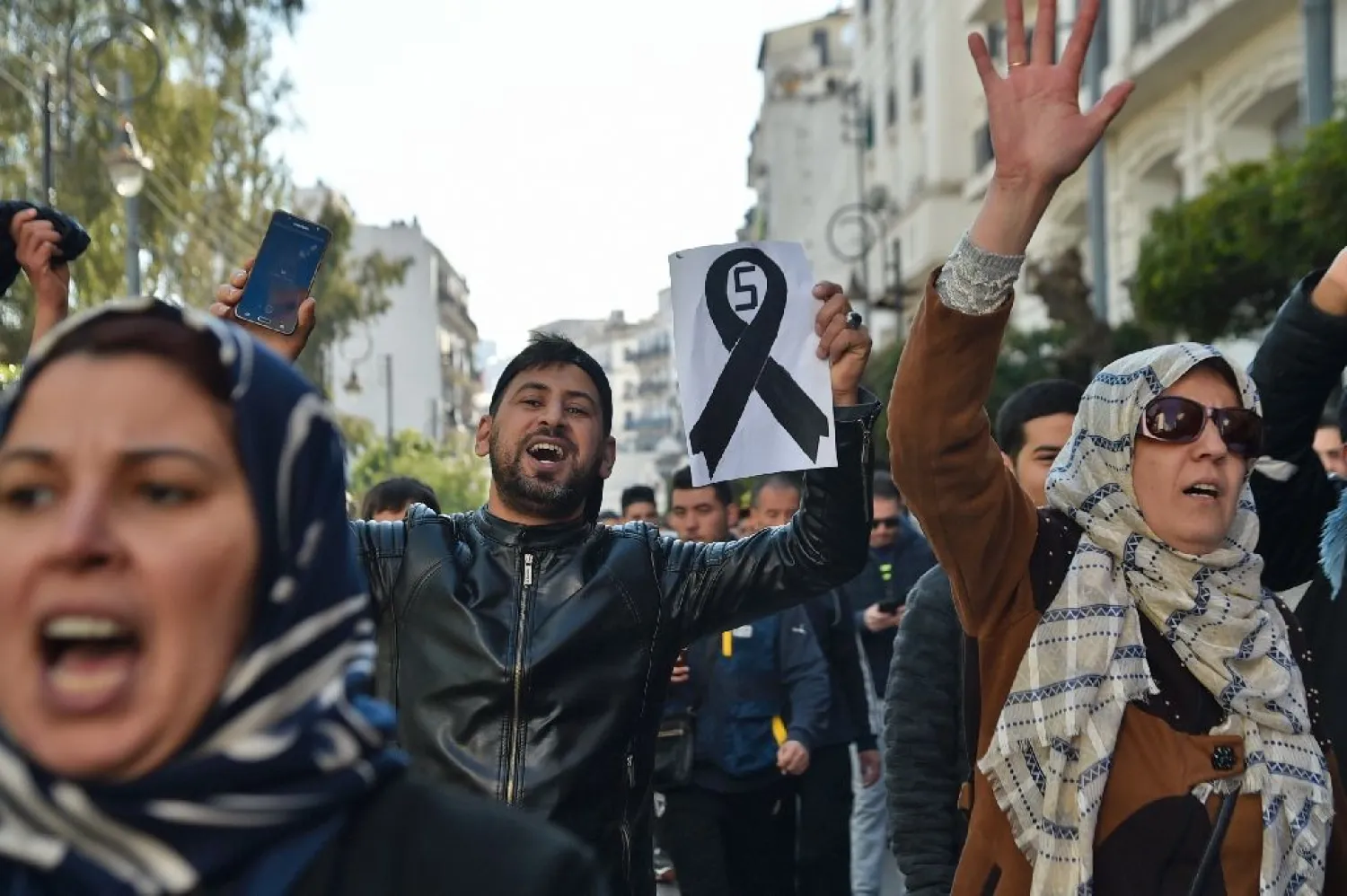
For Second Day, Hundreds Protest against Bouteflika’s Reelection

Young demonstrators take part in a protest against President Bouteflika's candidacy for a fifth term in Algiers. (AFP)
TT

For Second Day, Hundreds Protest against Bouteflika’s Reelection

Young demonstrators take part in a protest against President Bouteflika's candidacy for a fifth term in Algiers. (AFP)

Hundreds of Algerians took to the streets for the second straight day to protest against President Abdulaziz Bouteflika’s run for a fifth term in office.

The turnout was smaller than on Friday when thousands took to the streets of Algiers and other cities against the 81-year-old leader's decision to stand in the April 18 presidential election.

Bouteflika, in office since 1999, has been seen in public only a handful of times since suffering a stroke in 2013.

"There won't be a fifth term," said Said Kamel, who took part in the protest in central Algiers, according to Reuters.

Bouteflika will travel on Sunday to Switzerland for medical checks, his office said on Thursday, without giving details.

The ruling FLN party has picked him as its presidential candidate. Several political parties, trade unions and business organizations have already said they would back him as the opposition remains divided.

Strikes and protests over social and economic grievances are frequent in Algeria, but are generally localized and do not touch on national politics.

More than a quarter of Algerians under 30 are unemployed, according to official figures, and many feel disconnected from a ruling elite made up of veteran fighters from Algeria's 1954-1962 independence war with France.


US Report: Ethiopia Army Base Used to Support Sudan’s RSF

Satellite imagery taken on January 22, 2026 shows a camp with hundreds of tents and an area to the north where trucks come and go in Benishangul-Gumuz, Ethiopia. Source: Vantor
TT

US Report: Ethiopia Army Base Used to Support Sudan’s RSF

Satellite imagery taken on January 22, 2026 shows a camp with hundreds of tents and an area to the north where trucks come and go in Benishangul-Gumuz, Ethiopia. Source: Vantor

An Ethiopian military base close to the Sudanese border is lending support to the Rapid Support Forces, according to a report by a research unit at Yale University released Wednesday.

The Yale School of Public Health's Humanitarian Research Lab (HRL) said analysis of satellite imagery and open-source data shows activity "consistent with military assistance to the RSF" at an Ethiopian base in Asosa, in the Benishangul-Gumuz region, between late December 2025 and late March 2026.

The paramilitary group, which has been at war with Sudan's army since April 2023, was accused last month by the Sudanese military of launching drone attacks "from inside Ethiopian territory", the first public allegation of Ethiopian involvement in the conflict.

Ethiopia has denied the claim and has also rejected allegations that it is hosting RSF camps.
Yale's HRL has used remote sensing data and satellite imagery to monitor the war since it began.

Its researchers said their findings "represent clear visual evidence over a five-month period" that RSF attacks on Sudan's southeastern Blue Nile State were being launched from within Ethiopia.

The researchers identified repeated arrivals of commercial car carriers at the base unloading vehicles known as "technicals", light pickup trucks commonly used by armed groups.

HRL said these vehicles do not match those normally used by the Ethiopian military and have been observed supplying RSF units operating in Sudan's Blue Nile state.

According to the report, some of the vehicles were later fitted with gun mounts "capable of holding heavy machine guns".

Objects consistent with 50-calibre weapons were also observed nearby, the report said.

HRL added that similar vehicles later appeared in open-source images from fighting around Al-Kurmuk, a strategic Sudanese border town roughly 100 kilometers (62 miles) by road from Asosa.

Recent fighting has intensified around Al-Kurmuk, a key army position.

This year, an estimated 28,000 people were displaced by fighting in Blue Nile, including more than 10,000 from Al-Kurmuk alone.

Control of the state is divided between Sudan's army and RSF allies from the Sudan People's Liberation Movement-North (SPLM-N), led by Abdelaziz al-Hilu.

The paramilitaries have recently claimed victories in the area.

The Yale lab also documented increased logistical activity at the Asosa base, including the arrival of shipping containers, fuel tanks and tents capable of housing up to 150 people.

White armored vehicles inconsistent with Ethiopian military markings were also seen, alongside frequent movements of non-military transport trucks.

Separately, satellite imagery showed significant expansion at Asosa airport, including "a new hangar and concrete pad" and defensive fighting positions.

Imagery previously analyzed by AFP has shown significant development at the airport, which previously served as a drone base.

The RSF last year brought thousands of fighters into Ethiopia, an RSF source and an army source told AFP.

Separately, two UN agencies said on Thursday that more than a million Sudanese refugees face drastic cuts in life-saving aid such as food and water unless donors fill a funding shortfall of over $400 million.

Over 1.3 million Sudanese refugees are living in neighboring Chad, with most of them arriving since the start of the conflict in Sudan between the army and the RSF in April 2023. Among them are survivors of mass ⁠killings and famine from ⁠Darfur.

The World Food Programme and the UN refugee agency do not have enough funds to help them all and envisage further cuts in the coming months unless a $428 million shortfall can be met, they said in a joint statement.

"...With less than half the resources we require, we ⁠cannot deliver sufficient food to the people who need it most,” said WFP Chad Country Director Sarah Gordon-Gibson. "This will force them into devastating coping strategies and put lives at risk.”


Lebanon Maintains Exclusive Negotiations and State Control of Weapons

President Joseph Aoun chairs a cabinet session held on Thursday at the presidential palace (Presidency)
TT

Lebanon Maintains Exclusive Negotiations and State Control of Weapons

President Joseph Aoun chairs a cabinet session held on Thursday at the presidential palace (Presidency)

In Beirut, Lebanon’s leadership signaled it is moving forward with its decision to keep negotiations in official hands, alongside efforts to place all weapons under state control.

The government took a further step by ordering the army and security forces to immediately reinforce full state authority over Beirut province and limit weapons there to legitimate state forces only.

Prime Minister Nawaf Salam is set to begin a foreign tour starting in the US, where he will meet US Secretary of State Marco Rubio. He will also visit the United Nations for talks with Secretary-General Antonio Guterres.

Contacts with Washington remain limited, conducted through US Ambassador Michel Issa. Lebanese authorities are seeking to separate the domestic handling of the crisis from US-Iran negotiations.

Officials have expressed frustration at attempts by Iranian counterparts to link Lebanon to what they call the “axis of resistance.”

President Joseph Aoun underscored that position, saying, “We do not accept that anyone negotiate on our behalf,” echoing Salam.

Salam told Asharq Al-Awsat that his tour aims to strengthen Lebanon’s position, rally support to stop the war, and restore state authority over its territory and decisions of war and peace.

He said the path forward is clear: a ceasefire, Israeli withdrawal, followed by direct negotiations, alongside continued efforts to place weapons under state control. The government has taken an additional step toward that goal in Beirut, he added, stressing the need to strengthen security for residents and displaced people.

Salam said his call with Pakistani Prime Minister Shehbaz Sharif was positive. “The only way to stop the Israeli attacks begins with a ceasefire,” he said, stressing it “must include Lebanon.”

Sharif reaffirmed his country’s support for stability and condemned the attacks.

Aoun says there is international support for negotiations

Aoun said “the only solution” to the current situation is a ceasefire between Israel and Lebanon, followed by direct negotiations.

His office said he is conducting intensive international contacts, adding that the proposal has gained broad international support and is beginning to gain traction in diplomatic circles.

Aoun received calls from Jordan’s King Abdullah II and Qatar’s Emir Sheikh Tamim bin Hamad Al Thani, both of whom offered condolences for the victims of ongoing Israeli attacks and expressed solidarity with Lebanon.

Both leaders said their countries are ready to help end the escalation and support Lebanon’s position, particularly in ensuring it is included in any ceasefire agreement between the United States and Iran.

Cypriot President Nikos Christodoulides also condemned the continuing Israeli attacks, which he said have struck areas across the capital, its suburbs, the mountains, the Bekaa Valley, and the south.

Cabinet discusses weapons, international complaint

The cabinet, meeting under Aoun, stressed the urgency of including Lebanon in any ceasefire.

“We are tired of statements of condemnation,” Aoun said. “We had hoped Lebanon would be included in the ceasefire.”

He said Lebanon is pressing international partners to secure a ceasefire and ensure it is included in any agreement so negotiations can begin.

“The state is the one that negotiates,” he added. “We do not accept that anyone negotiate on our behalf.”

After the session, Salam said Lebanon would file an urgent complaint to the UN Security Council over escalating Israeli attacks, particularly in Beirut, which have caused a high number of civilian casualties.

He said the escalation defies international and regional efforts to stop the war and violates international law and international humanitarian law.

Salam also announced measures to enforce state control over weapons in Beirut, citing the Taif Agreement and cabinet decisions. The army and security forces were instructed to immediately strengthen state authority, strictly enforce the law, and take action against violators.

Hezbollah ministers object to ‘a demilitarized Beirut’

Information Minister Paul Marcos said Hezbollah ministers Rakan Nasreddine and Mohammad Haidar objected to the proposal of a “demilitarized Beirut.”

Justice Minister Adel Nassar said it is no longer acceptable to turn Lebanon into a military base for defending Iran, adding that he is preparing a legal and political file on the issue and stressing the need to protect Lebanese security.

Haidar said Hezbollah supports maintaining security and the presence of security forces, as well as tighter control over illegal or unlicensed weapons, but rejected language suggesting a fundamentally different security reality in Beirut.

Asked about resigning, he said the ministers would continue their duties and express their political stance within the cabinet.

Masnaa crossing reopens

Before the session, Telecommunications Minister Charles El Hajj said Lebanon had succeeded in preventing Israeli strikes on the Masnaa crossing, calling it a step to build on.

“Lebanon must not be an arena or a bargaining chip,” he said.

The prime minister’s office later announced the reopening of the Masnaa border crossing with Syria after several days of closure due to Israeli threats to target it.



Israel-Backed Armed Group Burns Homes in Gaza

Palestinians inspect the damage after a person was hit by an Israeli strike while riding a bicycle, according to medics, in Gaza City, April 6, 2026. REUTERS/Dawoud Abu Alkas
TT

Israel-Backed Armed Group Burns Homes in Gaza

Palestinians inspect the damage after a person was hit by an Israeli strike while riding a bicycle, according to medics, in Gaza City, April 6, 2026. REUTERS/Dawoud Abu Alkas

Residents of Maghazi camp in central Gaza said armed men linked to Israel-backed groups set fire on Thursday to land, homes, and agricultural greenhouses.

Witnesses told Asharq Al-Awsat the fires broke out in Hamas-controlled areas west of an informal “yellow line,” while Israeli forces were stationed to the east.

Several residents accused a group known as the Abu Nasira gang, led by a former security officer, of carrying out the attack.

Such groups have become a growing concern for Hamas and its security arms, as kidnapping and assassination attempts against members of the movement, its armed wing, the Qassam Brigades, and its security forces increase.

Days earlier, east of Maghazi camp, two Qassam members were lured in an attempted abduction that escalated into clashes with Israeli fire, killing 10 Palestinians.

One witness said armed men arrived shortly before noon in several four-wheel-drive vehicles, carrying weapons. They advanced dozens of meters west of the “yellow line,” near the Hosni al-Masdar mosque east of Maghazi camp, as Israeli drones flew overhead. Infantry vehicles later reinforced them amid intermittent gunfire.

The witness, who requested anonymity, said large fires broke out soon after. Residents and field sources confirmed the blazes destroyed farmland, greenhouses, and homes.

A member of a local armed faction said Abu Nasira fighters spread across the area and carried out the arson under Israeli cover, with intensified fire directed at western areas where residents and displaced people are located.

A Hamas source repeated accusations against the group, saying it is trying to assert its presence by escalating operations. The source described it as a “major threat,” carrying out kidnappings, assassinations and direct incursions under Israeli support that provides aerial cover and, at times, ground backing.

The attack coincided with Israeli escalation elsewhere in Gaza, killing a man and a child in separate incidents. An Israeli drone killed Youssef Mansour, 33, who witnesses said was bird hunting in the Mawasi area of Rafah in southern Gaza.

In northern Gaza, tank shells hit Abu Ubaida bin al-Jarrah school in Beit Lahia, killing a young girl, Retaj Rihan. She had been in a classroom tent with dozens of displaced third-grade students. She was taken in critical condition to a clinic in Jabalia al-Balad, where she died.

Gaza’s Ministry of Education condemned the attack, holding Israel responsible and saying hundreds of students have been killed during and after the war due to repeated targeting. It called for urgent international intervention.

Shortly after the school attack, Israeli fire from remotely operated cranes east of Gaza City wounded four Palestinians. The gunfire hit Ibn al-Haytham school on the western edge of Shuja’iyya, sheltering hundreds of displaced people. Others were wounded in similar fire toward Halawa camp in Jabalia al-Balad, with one reported in critical condition.

On Wednesday evening, two Palestinians were killed in separate strikes, including journalist Mohammed Washah, drawing condemnation over the killing of journalists. The strikes have killed 262 journalists since the start of the war.

The number of Palestinians killed since a ceasefire took effect on Oct. 10, 2025 has risen to more than 740, according to available figures.