

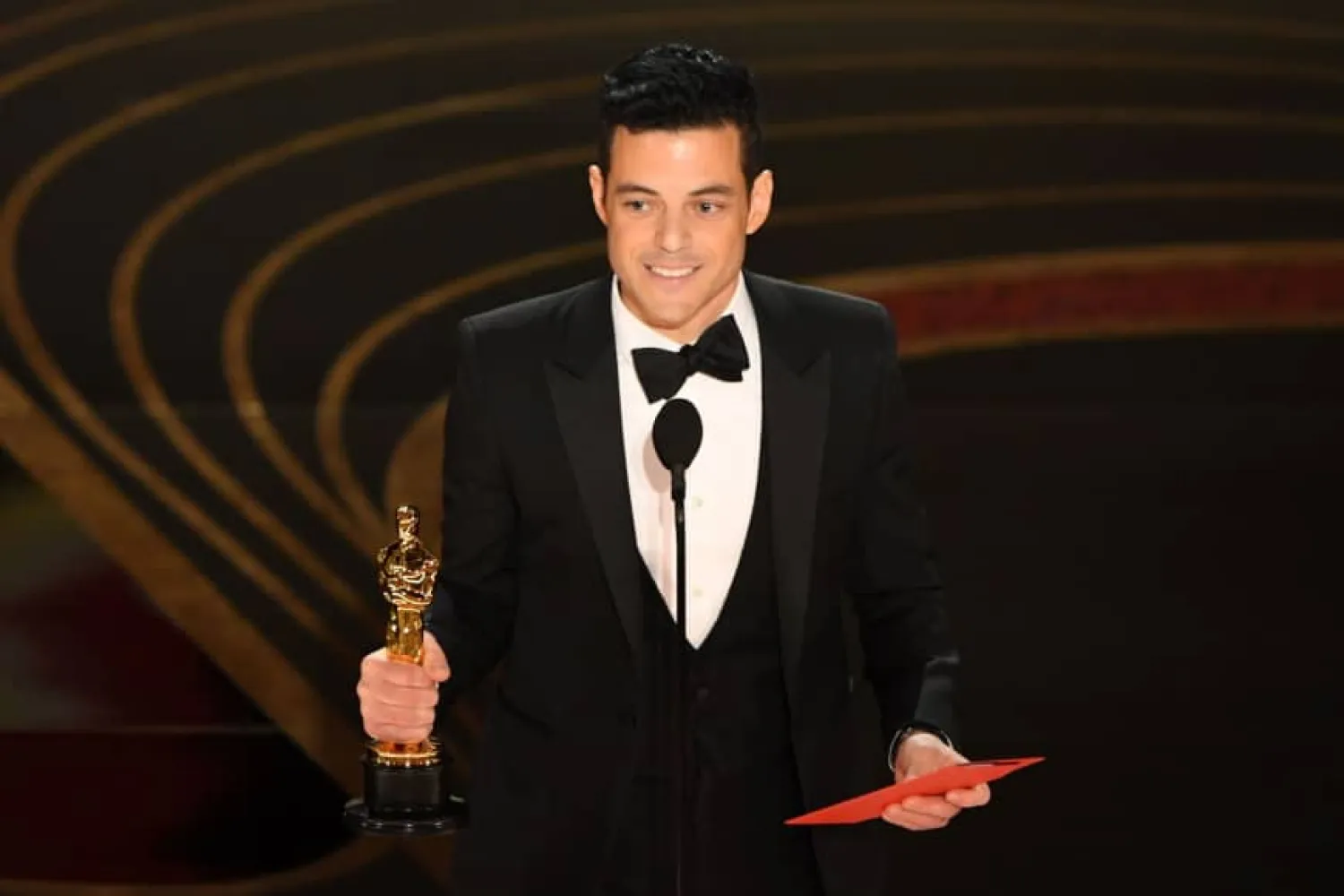

Egypt Hails Oscar Champion Rami Malek

Rami Malek accepts the best actor Oscar for his portrayal of Freddie Mercury in "Bohemian Rhapsody" | AFP
TT

Egypt Hails Oscar Champion Rami Malek

Rami Malek accepts the best actor Oscar for his portrayal of Freddie Mercury in "Bohemian Rhapsody" | AFP

Egyptians on Monday hailed Rami Malek as a new "Pharaoh" after he won the best actor Oscar for his performance as rock singer Freddie Mercury in "Bohemian Rhapsody".

Malek, 37, transformed his look, gait and accent to portray iconic Queen frontman Freddie Mercury in "Bohemian Rhapsody" -- an all-in performance that has catapulted him onto Hollywood's A-list and into Oscar history.

Malek on Sunday rode his Golden Globe and Screen Actors Guild success to the pinnacle of Tinseltown's award season, snatching the Academy Award for best actor in a showdown with Christian Bale ("Vice").

"We made a film about a gay man, an immigrant, who lived his life just unapologetically himself," Malek said.

"The fact that I'm celebrating him and this story with you tonight is proof that we're longing for stories like this," he added, noting for the audience that he is "a first-generation American" of Egyptian descent.

On social media, Egyptians highlighted a quote from his Oscar acceptance speech: "I am the son of immigrants from Egypt."

Malek's family are Coptic Christians from the Upper Egypt province of Minya.

Their "entire village was up until 5 o'clock in the morning" to watch the Oscars ceremony, said 24-year old Fady Essam, Malek's cousin.

"We called his mother to congratulate her and urged her to bring him to Egypt to hold a huge celebration for him."

Egypt's Immigration Minister Nabila Makram also congratulated Malek for his Oscar win.

Social media was filled with praise on trending hashtags carrying Malek's name in Arabic and English, while many hailed Egypt's new "Pharaoh".

Malek's win seemed unlikely at the outset, given that he was about the only constant in the film's troubled road to the big screen: stars dropping out, director Bryan Singer departing mid-production, lackluster reviews.

But he likely sealed the deal -- even despite the much-maligned prosthetic teeth he wears in the film -- with his preening, foot-stomping recreation of Mercury's electric performance at Live Aid in 1985, which audiences loved.

The film was also a commercial success, raking in more than $820 million worldwide.

"Thank you to Freddie Mercury for giving me the joy of a lifetime. I love you, you beautiful man. This is for and because of you, gorgeous," Malek said at the Golden Globes in January.

Malek also bested Bradley Cooper ("A Star Is Born"), Viggo Mortensen ("Green Book") and Willem Dafoe ("At Eternity's Gate").

Before all the attention from "BoRhap" -- as it's known in Tinseltown -- Malek was turning heads on "Mr Robot," a psychological hacker drama on which he stars with Christian Slater.

It was Malek's breakout role, after humble beginnings growing up in suburban Los Angeles, in an Egyptian Coptic Orthodox family. He has an identical twin brother named Sami, and an older sister.

He attended high school in Sherman Oaks with actresses Rachel Bilson and Kirsten Dunst, and went on to study theater at the University of Evansville in Indiana, graduating with a fine arts degree in 2003.

His television career began the following year with a guest spot on popular show "Gilmore Girls."

A variety of bit parts in television and film followed, including a role as the pharaoh Ahkmenrah in the "Night at the Museum" trilogy starring Ben Stiller and a part in the final "Twilight" movie.

Malek has spoken about challenges avoiding being typecast, saying early this month at the Santa Barbara Film Festival: "I looked at the auditions and I knew I could probably get the terrorist role. It's funny but it's sad."

He has appeared in two films directed by Oscar nominee Spike Lee: "Oldboy," a remake of an ultra-violent South Korean film, and the offbeat horror film "Da Sweet Blood of Jesus."

On "Mr Robot," Malek stars as Eliot, a young programmer who is also an unstable vigilante hacker -- who gets involved in hacking the shadowy company he works for.

Malek has won an Emmy for the role, and the fourth and final season is due to air on USA Network later this year.

But his work as Mercury -- the flamboyant Tanzania-born Farrokh Bulsara, who moved to London and became a legend before dying in 1991 at age 45 -- will likely lead to more work on the big screen.

Malek's wide, expressive eyes and devilish grin came in handy for his portrayal of Mercury, who was known for his stunning vocal range and on-stage antics.

"I said yes right away to playing Freddie Mercury," Malek said in Santa Barbara. "Moments later, I thought, 'Ok, what have you done? This is crazy.'"

"I would look at all the footage of him and see this performer that was otherworldly," he added. "He was like a superhero to me... The only way to demystify him was to look at that human being behind that superhero."

After the film wrapped, Malek had the prosthetic teeth cast -- in gold, just like the Oscar statuette he now owns.



SpaceX Loses Contact with Starlink Satellite after Mishap

FILE PHOTO: SpaceX logo and Elon Musk silhouette are seen in this illustration taken, December 19, 2022. REUTERS/Dado Ruvic/Illustration/File Photo
TT

SpaceX Loses Contact with Starlink Satellite after Mishap

FILE PHOTO: SpaceX logo and Elon Musk silhouette are seen in this illustration taken, December 19, 2022. REUTERS/Dado Ruvic/Illustration/File Photo

SpaceX's Starlink said one of its satellites experienced an anomaly in space on Wednesday that created a "small number" of debris and cut off communications with the spacecraft at 418 km (259.73 miles) in altitude, a rare kinetic accident in orbit for the satellite internet giant.

"The satellite is largely intact, tumbling, and will reenter the Earth's atmosphere and fully demise within weeks," Starlink said in a post on X.

The company said it was working with the US Space Force and NASA to monitor the debris pieces, the number of which SpaceX did not say.

Space Force's space-tracking unit did not immediately return a Reuters request for comment on the number of trackable debris, which could pose risks for other active satellites in orbit.

With the Starlink satellite still somewhat intact, the event seemed smaller in scale than other orbital mishaps such as the breakup of an Intelsat satellite that created more than 700 pieces, or the breakup of a Chinese rocket body last year.


Lion, Bear Kept as Pets in Albania Find New Homes in German Wildlife Sanctuaries

In this photo, released on Tuesday, Dec. 16, 2025 by Four Paws, veterinarians prepare Erion, a three-year-old lion for its transportation from Tirana to Germany after its illegal keeping in Albania. (Four Paws via AP)
TT

Lion, Bear Kept as Pets in Albania Find New Homes in German Wildlife Sanctuaries

In this photo, released on Tuesday, Dec. 16, 2025 by Four Paws, veterinarians prepare Erion, a three-year-old lion for its transportation from Tirana to Germany after its illegal keeping in Albania. (Four Paws via AP)

A lion and bear rescued from captivity in northern Albania arrived in animal sanctuaries in Germany in early December after authorities in Tirana discovered they were being illegally kept as pets on a private estate.

Erion, a 3-year-old lion, and Flora, a 2-year-old bear, are now both starting a new life.

“We are very happy that the authorities confiscated the animals and that we now have the chance to bring them to Germany, where they can start over and live in species-appropriate conditions,” said Magdalena Scherk-Trettin, a senior project manager responsible for rescues at the international animal welfare organization FOUR PAWS.

A team from FOUR PAWS carried out the rescue after Albania’s National Forestry Agency located the lion based on videos posted on TikTok by its owner.

Neither authorities nor the organization have named the person who was keeping them as pets.

Veterinarians administered anesthesia before the animals were loaded into crates for their long trip to new homes. On Dec. 13, they ended a 70-hour journey through several European countries, with Erion now housed in a wild animal sanctuary in southeast Germany and Flora in a bear sanctuary in the north of the country, FOUR PAWS said.

The organization said both animals had been in poor condition.

“An initial visual check determined that Flora is malnourished and has dental issues, so her recovery plan is already underway,” the organization said.

And when Erion was rescued, his mane had fallen out, for reasons that the veterinarians have not yet been able to determine, it said.

Despite the challenging journey, the rescue was worth it, said Scherk-Trettin. “We are delighted to see these animals begin their new lives.”

Illegal wildlife trade remains a systemic problem in Albania and across the region, where bears in particular, as well as exotic animals, are kept in cages at restaurants or on private properties with little or no expert care.

Erion's and Flora's origins remain unclear. FOUR PAWS said it believes the lion is a victim of illegal wildlife trafficking, while the bear was likely poached from the wild.

“The rescue highlights Albania’s urgent need to tackle illegal wildlife trade and private keeping,” The Associated Press quoted the organization as saying in a statement.

Weak legislation, legal loopholes and poor enforcement have contributed to the widespread private captivity and trade of wild animals in Albania, according to FOUR PAWS, which estimates that more than 60 big cats are still being kept in poor conditions in Albania.

Albanian law allows for individuals or organizations to keep specimens of wild animals if they were born in captivity – for example in a zoo or a specialized facility. Non-native species born outside of Albania can also be kept if documents can be provided proving they were acquired from specialized breeding and trade centers.

Sajmir Shehu, a project manager at Four Paws, said the law lacks a stringent framework based on which organizations like his could prevent wild animals being kept in captivity.

The law also allows for animals to be confiscated if welfare or veterinary standards are not met, but imposes no sanctions on the owners of exotic pets.


Saturn's Moon Titan May Not Have a Buried Ocean as Long Suspected, New Study Suggests

This image made by the Cassini spacecraft and provided by NASA on March 12, 2006, shows two of Saturn's moons, the small Epimetheus and smog-enshrouded Titan, with Saturn's A and F rings stretching across the frame. (NASA via AP)
TT

Saturn's Moon Titan May Not Have a Buried Ocean as Long Suspected, New Study Suggests

This image made by the Cassini spacecraft and provided by NASA on March 12, 2006, shows two of Saturn's moons, the small Epimetheus and smog-enshrouded Titan, with Saturn's A and F rings stretching across the frame. (NASA via AP)

Saturn's giant moon Titan may not have a vast underground ocean after all.

Titan instead may hold deep layers of ice and slush more akin to Earth’s polar seas, with pockets of melted water where life could possibly survive and even thrive, scientists reported Wednesday.

The team led by researchers at NASA's Jet Propulsion Laboratory challenged the decade-long assumption of a buried global ocean at Titan after taking a fresh look at observations made years ago by NASA’s Cassini spacecraft around Saturn.

They stress that no one has found any signs of life at Titan, the solar system’s second largest moon spanning 3,200 miles (5,150 kilometers) and brimming with lakes of liquid methane on its frosty surface, The AP news reported.

But with the latest findings suggesting a slushy, near-melting environment, “there is strong justification for continued optimism regarding the potential for extraterrestrial life,” said the University of Washington’s Baptiste Journaux, who took part in the study published in the journal Nature.

As to what form of life that might be, possibly strictly microscopic, “nature has repeatedly demonstrated far greater creativity than the most imaginative scientists," he said in an email.

JPL’s Flavio Petricca, the lead author, said Titan’s ocean may have frozen in the past and is currently melting, or its hydrosphere might be evolving toward complete freezing.

Computer models suggest these layers of ice, slush and water extend to a depth of more than 340 miles (550 kilometers). The outer ice shell is thought to be about 100 miles (170 kilometers) deep, covering layers of slush and pools of water that could go down another 250 miles (400 kilometers). This water could be as warm as 68 degrees Fahrenheit (20 degrees Celsius).

Because Titan is tidally locked, the same side of the moon faces Saturn all the time, just like our own moon and Earth. Saturn’s gravitational pull is so intense that it deforms the moon’s surface, creating bulges as high as 30 feet (10 meters) when the two bodies are closest.

Through improved data processing, Petricca and his team managed to measure the timing between the peak gravitational tug and the rising of Titan’s surface. If the moon held a wet ocean, the effect would be immediate, Petricca said, but a 15-hour gap was detected, indicating an interior of slushy ice with pockets of liquid water. Computer modeling of Titan’s orientation in space supported their theory.

Sapienza University of Rome’s Luciano Iess, whose previous studies using Cassini data indicated a hidden ocean at Titan, is not convinced by the latest findings.

While “certainly intriguing and will stimulate renewed discussion ... at present, the available evidence looks certainly not sufficient to exclude Titan from the family of ocean worlds," Iess said in an email.

NASA’s planned Dragonfly mission — featuring a helicopter-type craft due to launch to Titan later this decade — is expected to provide more clarity on the moon’s innards. Journaux is part of that team.

Saturn leads the solar system’s moon inventory with 274. Jupiter’s moon Ganymede is just a little larger than Titan, with a possible underground ocean. Other suspected water worlds include Saturn’s Enceladus and Jupiter’s Europa, both of which are believed to have geysers of water erupting from their frozen crusts.

Launched in 1997, Cassini reached Saturn in 2004, orbiting the ringed planet and flying past its moons until deliberately plunging through Saturn’s atmosphere in 2017.