


How Schalke's 'Melting Pot' Academy Produced a String of Young Players

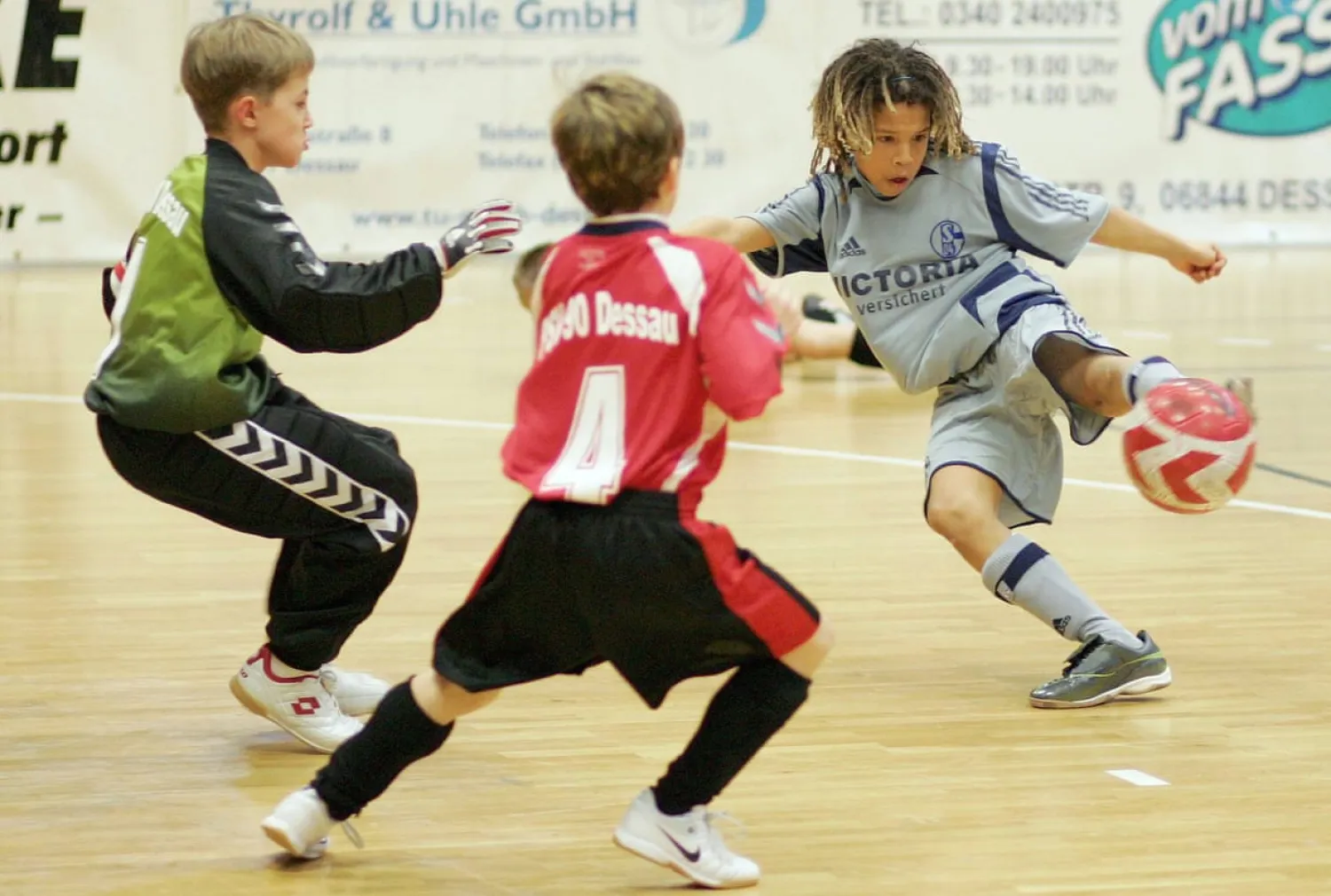
A young Leroy Sané playing for the Schalke academy in 2007. Photograph: Imago/PA Images
TT

How Schalke's 'Melting Pot' Academy Produced a String of Young Players

A young Leroy Sané playing for the Schalke academy in 2007. Photograph: Imago/PA Images

Schalke have a proud history of producing footballers. Manuel Neuer, Benedikt Höwedes, Ilkay Gündogan, Mesut Özil, Max Meyer, Julian Draxler and Leroy Sané have all emerged from the Knappenschmiede academy. To understand why the club has brought through so many young players, you need to know a little about Gelsenkirchen’s social history.

“After the second world war, a whole mixture of cultures and backgrounds arrived to work in the region’s coal mines – such as Polish, Italian and Turkish people,” says Peter Knäbel, the man in charge of the academy. “We’re now reaping the benefits of that as the children of hard-working parents with contrasting instincts and mentalities come here and we have a fantastic melting pot.”

“We’re such a fortunate generation to have lived in a period of freedom for more than 70 years now – this wasn’t the case on two occasions – because of us both times. Now, how can we talk about the stereotypical ‘German mentality’ when the player born just 200 meters away is called Ahmed Kutucu?”

Outside on the pitch, sessions for the under-nines are underway. Every player has a ball for the opening 30 minutes, before they progress to a large, possession-based game with a goal in each corner for 10 minutes. The youngsters are then beckoned into a 20-meter square and ordered to keep the ball moving in groups of four. Instructions of “two touch” are followed by “now stay on it and dribble” as players are challenged to react to the commands.

The coaches are wary of telling the young players too much. “We don’t want coaches to give too much tactical instruction to the kids under the age of 14,” says Knäbel. “We talk about timing here and want the kids to think ‘when’ and ‘what’. So 4-4-2 and 3-5-2 don’t matter until you’re 14. The kids must learn to understand the games themselves. We let them play and, trust me, the result is always a part of our education – if an under-nines coach says that winning doesn’t matter, then just look into the eyes of the kids. They’re upset when they lose but the coach should never, ever be more upset than the kids.

“The reality is: this is sport, we play to win and we want to develop winners. You can develop a winner. We want kids to know when the decisive moments are and for them to be successful in moments of pressure – whether that’s knowing what to do in defense or attack.”

For the remainder of the 90-minute training session, the players move from exercise to exercise. Each activity varies in size, intensity and the physical demand it places on the players. There is a real fun element as coaches constantly test players with conflicting demands. No single exercise lasts longer than 20 minutes.

“We educate our coaches on whether they need to give advice or an objective to players. We need sessions and coaches to be flexible, but with clear principles. Remember, we’ve had the likes of Joël Matip and also Leroy Sané come through this system. You couldn’t find two more differing people or players.

“Coaches are the key to everything. If you have one good coach, then you have 18 good players. We study the coaches as both people and professionals before we assign them to a group. Look at Barcelona, Ajax and the top academies around the world, they have the same consistent messages and philosophies right from under-nines through to under-19s. That’s what we do here.”

We watch on as the under-17 and under-19 teams are put through their paces below the misty skies tainted by the nearby power station. Sessions run like clockwork and even rest periods are timed to the millisecond. Coaches stand over an intense 4v2 rondo, glaring with intensity. They do not need to utter a word as their presence alone screams authoritative messages. Knäbel says: “This is just the same as what the young kids were doing, but without the running; no child comes here to exercise. They’re always on the ball, working on technique and decision-making when they’re physically fatigued – as that’s when decisive moments occur.”

As the rondos and sprints turn into games, the coaches now bark tactical guidance, correcting body shapes and defensive presses before falling into silence for minutes at a time before intervening again. Players are added in and taken out of sessions and pitch-sizes are regularly altered – both increasing and decreasing the intensity of play as coaches pine for flexible players who can readjust and find solutions in different scenarios.

As the sessions wrap up, under-17 coach Frank Fahrenhorst tells me how important it is that players and staff have good personal relationships. “As coaches, we are responsible for teaching the players about responsibilities and discipline. This is our duty and it requires a specific supporting programme so that the boys can develop as people and learn independence, both on and off the pitch.”

Knäbel agrees, pointing to the club’s relationship with the Gesamtschule Berger Feld school, where players are educated while they train at Knappenschmiede. “Kutucu played for the first team last night and he’ll graduate in March. We place a huge importance on education and developing good people as well as good players. If the programme is running correctly, you get both. Coaches need to have interest in kids and their wellbeing, so we have regular contact with parents and schools. You can’t just concentrate on the pitch.”

“The game has become an industry and I shouldn’t complain as it has given me this job, but new football makes it difficult to understand the world. My brother works at an amateur club in the 13th tier of German football, with only 18 kids in the youth system and just one pitch for everyone. We need to prepare our kids at Schalke to go into the real world as they’ll probably end up playing in my brother’s league, as only 0.001% can go on to play for Manchester City.”

(The Guardian)


Shakhtar Boss Pays Ukrainian Racer $200,000 After Games Disqualification

Ukrainian President Volodymyr Zelenskiy holds helmet as he meets with a Ukrainian skeleton racer Vladyslav Heraskevych , who was disqualified from the Olympic skeleton competition over his "helmet of remembrance" depicting athletes killed since Russia's invasion and his father and coach, Mykhailo Heraskevych, amid Russia's attack on Ukraine, in Munich, Germany February 13, 2026. (Ukrainian Presidential Press Service/Handout via Reuters)
TT

Shakhtar Boss Pays Ukrainian Racer $200,000 After Games Disqualification

Ukrainian President Volodymyr Zelenskiy holds helmet as he meets with a Ukrainian skeleton racer Vladyslav Heraskevych , who was disqualified from the Olympic skeleton competition over his "helmet of remembrance" depicting athletes killed since Russia's invasion and his father and coach, Mykhailo Heraskevych, amid Russia's attack on Ukraine, in Munich, Germany February 13, 2026. (Ukrainian Presidential Press Service/Handout via Reuters)

The owner of ‌Ukrainian football club Shakhtar Donetsk has donated more than $200,000 to skeleton racer Vladyslav Heraskevych after the athlete was disqualified from the Milano Cortina Winter Games before competing over the use of a helmet depicting Ukrainian athletes killed in the war with Russia, the club said on Tuesday.

The 27-year-old Heraskevych was disqualified last week when the International Bobsleigh and Skeleton Federation jury ruled that imagery on the helmet — depicting athletes killed since Russia invaded Ukraine in 2022 — breached rules on athletes' expression at ‌the Games.

He ‌then lost an appeal at the Court ‌of ⁠Arbitration for Sport hours ⁠before the final two runs of his competition, having missed the first two runs due to his disqualification.

Heraskevych had been allowed to train with the helmet that displayed the faces of 24 dead Ukrainian athletes for several days in Cortina d'Ampezzo where the sliding center is, but the International Olympic Committee then ⁠warned him a day before his competition ‌started that he could not wear ‌it there.

“Vlad Heraskevych was denied the opportunity to compete for victory ‌at the Olympic Games, yet he returns to Ukraine a ‌true winner," Shakhtar President Rinat Akhmetov said in a club statement.

"The respect and pride he has earned among Ukrainians through his actions are the highest reward. At the same time, I want him to ‌have enough energy and resources to continue his sporting career, as well as to fight ⁠for truth, freedom ⁠and the remembrance of those who gave their lives for Ukraine," he said.

The amount is equal to the prize money Ukraine pays athletes who win a gold medal at the Games.

The case dominated headlines early on at the Olympics, with IOC President Kirsty Coventry meeting Heraskevych on Thursday morning at the sliding venue in a failed last-minute attempt to broker a compromise.

The IOC suggested he wear a black armband and display the helmet before and after the race, but said using it in competition breached rules on keeping politics off fields of play. Heraskevych also earned praise from Ukraine President Volodymyr Zelenskiy.


Speed Skating-Italy Clinch Shock Men’s Team Pursuit Gold, Canada Successfully Defend Women’s Title

 Team Italy with Davide Ghiotto, Andrea Giovannini, Michele Malfatti, celebrate winning the gold medal on the podium of the men's team pursuit speed skating race at the 2026 Winter Olympics, in Milan, Italy, Tuesday, Feb. 17, 2026. (AP)
Team Italy with Davide Ghiotto, Andrea Giovannini, Michele Malfatti, celebrate winning the gold medal on the podium of the men's team pursuit speed skating race at the 2026 Winter Olympics, in Milan, Italy, Tuesday, Feb. 17, 2026. (AP)
TT

Speed Skating-Italy Clinch Shock Men’s Team Pursuit Gold, Canada Successfully Defend Women’s Title

 Team Italy with Davide Ghiotto, Andrea Giovannini, Michele Malfatti, celebrate winning the gold medal on the podium of the men's team pursuit speed skating race at the 2026 Winter Olympics, in Milan, Italy, Tuesday, Feb. 17, 2026. (AP)
Team Italy with Davide Ghiotto, Andrea Giovannini, Michele Malfatti, celebrate winning the gold medal on the podium of the men's team pursuit speed skating race at the 2026 Winter Olympics, in Milan, Italy, Tuesday, Feb. 17, 2026. (AP)

An inspired Italy delighted the home crowd with a stunning victory in the Olympic men's team pursuit final as

Canada's Ivanie Blondin, Valerie Maltais and Isabelle Weidemann delivered another seamless performance to beat the Netherlands in the women's event and retain their title ‌on Tuesday.

Italy's ‌men upset the US who ‌arrived ⁠at the Games ⁠as world champions and gold medal favorites.

Spurred on by double Olympic champion Francesca Lollobrigida, the Italian team of Davide Ghiotto, Andrea Giovannini and Michele Malfatti electrified a frenzied arena as they stormed ⁠to a time of three ‌minutes 39.20 seconds - ‌a commanding 4.51 seconds clear of the ‌Americans with China taking bronze.

The roar inside ‌the venue as Italy powered home was thunderous as the crowd rose to their feet, cheering the host nation to one ‌of their most special golds of a highly successful Games.

Canada's women ⁠crossed ⁠the line 0.96 seconds ahead of the Netherlands, stopping the clock at two minutes 55.81 seconds, and

Japan rounded out the women's podium by beating the US in the Final B.

It was only Canada's third gold medal of the Games, following Mikael Kingsbury's win in men's dual moguls and Megan Oldham's victory in women's freeski big air.


Lindsey Vonn Back in US Following Crash in Olympic Downhill 

Milano Cortina 2026 Olympics - Alpine Skiing - Women's Downhill 3rd Official Training - Tofane Alpine Skiing Centre, Belluno, Italy - February 07, 2026. Lindsey Vonn of United States in action during training. (Reuters)
TT

Lindsey Vonn Back in US Following Crash in Olympic Downhill 

Milano Cortina 2026 Olympics - Alpine Skiing - Women's Downhill 3rd Official Training - Tofane Alpine Skiing Centre, Belluno, Italy - February 07, 2026. Lindsey Vonn of United States in action during training. (Reuters)

Lindsey Vonn is back home in the US following a week of treatment at a hospital in Italy after breaking her left leg in the Olympic downhill at the Milan Cortina Games.

“Haven’t stood on my feet in over a week... been in a hospital bed immobile since my race. And although I’m not yet able to stand, being back on home soil feels amazing,” Vonn posted on X with an American flag emoji. “Huge thank you to everyone in Italy for taking good care of me.”

The 41-year-old Vonn suffered a complex tibia fracture that has already been operated on multiple times following her Feb. 8 crash. She has said she'll need more surgery in the US.

Nine days before her fall in Cortina d'Ampezzo, Italy, Vonn ruptured the ACL in her left knee in another crash in Switzerland.

Even before then, all eyes had been on her as the feel-good story heading into the Olympics for her comeback after nearly six years of retirement.
