


How Schalke's 'Melting Pot' Academy Produced a String of Young Players

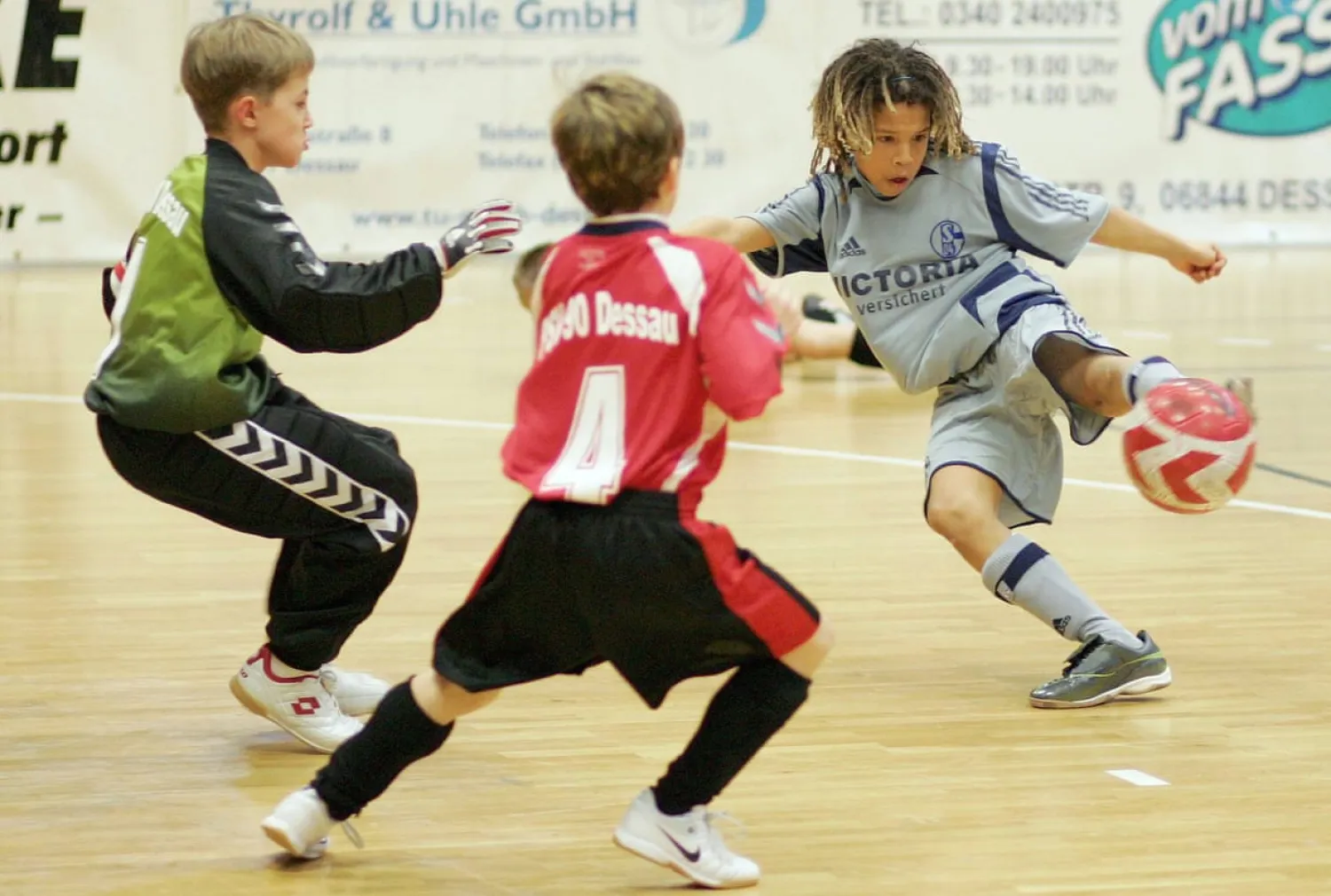
A young Leroy Sané playing for the Schalke academy in 2007. Photograph: Imago/PA Images
TT

How Schalke's 'Melting Pot' Academy Produced a String of Young Players

A young Leroy Sané playing for the Schalke academy in 2007. Photograph: Imago/PA Images

Schalke have a proud history of producing footballers. Manuel Neuer, Benedikt Höwedes, Ilkay Gündogan, Mesut Özil, Max Meyer, Julian Draxler and Leroy Sané have all emerged from the Knappenschmiede academy. To understand why the club has brought through so many young players, you need to know a little about Gelsenkirchen’s social history.

“After the second world war, a whole mixture of cultures and backgrounds arrived to work in the region’s coal mines – such as Polish, Italian and Turkish people,” says Peter Knäbel, the man in charge of the academy. “We’re now reaping the benefits of that as the children of hard-working parents with contrasting instincts and mentalities come here and we have a fantastic melting pot.”

“We’re such a fortunate generation to have lived in a period of freedom for more than 70 years now – this wasn’t the case on two occasions – because of us both times. Now, how can we talk about the stereotypical ‘German mentality’ when the player born just 200 meters away is called Ahmed Kutucu?”

Outside on the pitch, sessions for the under-nines are underway. Every player has a ball for the opening 30 minutes, before they progress to a large, possession-based game with a goal in each corner for 10 minutes. The youngsters are then beckoned into a 20-meter square and ordered to keep the ball moving in groups of four. Instructions of “two touch” are followed by “now stay on it and dribble” as players are challenged to react to the commands.

The coaches are wary of telling the young players too much. “We don’t want coaches to give too much tactical instruction to the kids under the age of 14,” says Knäbel. “We talk about timing here and want the kids to think ‘when’ and ‘what’. So 4-4-2 and 3-5-2 don’t matter until you’re 14. The kids must learn to understand the games themselves. We let them play and, trust me, the result is always a part of our education – if an under-nines coach says that winning doesn’t matter, then just look into the eyes of the kids. They’re upset when they lose but the coach should never, ever be more upset than the kids.

“The reality is: this is sport, we play to win and we want to develop winners. You can develop a winner. We want kids to know when the decisive moments are and for them to be successful in moments of pressure – whether that’s knowing what to do in defense or attack.”

For the remainder of the 90-minute training session, the players move from exercise to exercise. Each activity varies in size, intensity and the physical demand it places on the players. There is a real fun element as coaches constantly test players with conflicting demands. No single exercise lasts longer than 20 minutes.

“We educate our coaches on whether they need to give advice or an objective to players. We need sessions and coaches to be flexible, but with clear principles. Remember, we’ve had the likes of Joël Matip and also Leroy Sané come through this system. You couldn’t find two more differing people or players.

“Coaches are the key to everything. If you have one good coach, then you have 18 good players. We study the coaches as both people and professionals before we assign them to a group. Look at Barcelona, Ajax and the top academies around the world, they have the same consistent messages and philosophies right from under-nines through to under-19s. That’s what we do here.”

We watch on as the under-17 and under-19 teams are put through their paces below the misty skies tainted by the nearby power station. Sessions run like clockwork and even rest periods are timed to the millisecond. Coaches stand over an intense 4v2 rondo, glaring with intensity. They do not need to utter a word as their presence alone screams authoritative messages. Knäbel says: “This is just the same as what the young kids were doing, but without the running; no child comes here to exercise. They’re always on the ball, working on technique and decision-making when they’re physically fatigued – as that’s when decisive moments occur.”

As the rondos and sprints turn into games, the coaches now bark tactical guidance, correcting body shapes and defensive presses before falling into silence for minutes at a time before intervening again. Players are added in and taken out of sessions and pitch-sizes are regularly altered – both increasing and decreasing the intensity of play as coaches pine for flexible players who can readjust and find solutions in different scenarios.

As the sessions wrap up, under-17 coach Frank Fahrenhorst tells me how important it is that players and staff have good personal relationships. “As coaches, we are responsible for teaching the players about responsibilities and discipline. This is our duty and it requires a specific supporting programme so that the boys can develop as people and learn independence, both on and off the pitch.”

Knäbel agrees, pointing to the club’s relationship with the Gesamtschule Berger Feld school, where players are educated while they train at Knappenschmiede. “Kutucu played for the first team last night and he’ll graduate in March. We place a huge importance on education and developing good people as well as good players. If the programme is running correctly, you get both. Coaches need to have interest in kids and their wellbeing, so we have regular contact with parents and schools. You can’t just concentrate on the pitch.”

“The game has become an industry and I shouldn’t complain as it has given me this job, but new football makes it difficult to understand the world. My brother works at an amateur club in the 13th tier of German football, with only 18 kids in the youth system and just one pitch for everyone. We need to prepare our kids at Schalke to go into the real world as they’ll probably end up playing in my brother’s league, as only 0.001% can go on to play for Manchester City.”

(The Guardian)


Fans Vandalize India Stadium after Messi's Abrupt Exit

Fans throw bottles and chairs, vandalizing hoardings at Salt Lake Stadium in Kolkata, West Bengal, India, 13 December 2025. Following Messi's brief five-minute appearance, unrest broke out among fans who had paid a significant amount but were unable to see the Argentine football legend.  EPA/PIYAL ADHIKARY
Fans throw bottles and chairs, vandalizing hoardings at Salt Lake Stadium in Kolkata, West Bengal, India, 13 December 2025. Following Messi's brief five-minute appearance, unrest broke out among fans who had paid a significant amount but were unable to see the Argentine football legend. EPA/PIYAL ADHIKARY
TT

Fans Vandalize India Stadium after Messi's Abrupt Exit

Fans throw bottles and chairs, vandalizing hoardings at Salt Lake Stadium in Kolkata, West Bengal, India, 13 December 2025. Following Messi's brief five-minute appearance, unrest broke out among fans who had paid a significant amount but were unable to see the Argentine football legend.  EPA/PIYAL ADHIKARY
Fans throw bottles and chairs, vandalizing hoardings at Salt Lake Stadium in Kolkata, West Bengal, India, 13 December 2025. Following Messi's brief five-minute appearance, unrest broke out among fans who had paid a significant amount but were unable to see the Argentine football legend. EPA/PIYAL ADHIKARY

Angry spectators broke down barricades and stormed the pitch at a stadium in India after football star Lionel Messi, who is on a three-day tour of the country, abruptly left the arena.

As a part of a so-called GOAT Tour, the 38-year-old Argentina and Inter Miami superstar touched down in the eastern state of West Bengal early Saturday, greeted by a chorus of exuberant fans chanting his name, said AFP.

Hours later, thousands of fans wearing Messi jerseys and waving the Argentine flag packed into Salt Lake stadium in the state capital Kolkata, but heavy security around the footballer left fans struggling to catch a glimpse of him.

Messi walked around the pitch waving to fans and left the stadium earlier than expected.

Frustrated fans, many having paid more than $100 for tickets, ripped out stadium seats and hurled water bottles onto the track.

Many others stormed the pitch and vandalized banners and tents.

"For me, to watch Messi is a pleasure, a dream. But I have missed the chance to have a glimpse because of the mismanagement in the stadium," businessman Nabin Chatterjee, 37, told AFP.

Before the chaos erupted, Messi unveiled a 21-meter (70-foot) statue which shows him holding aloft the World Cup.

He was also expected to play a short exhibition game at the stadium.

Another angry fan told the Press Trust of India (PTI) that people had spent "a month's salary" to see Messi.

"I paid Rs 5,000 ($55) for the ticket and came with my son to watch Messi, not politicians. The police and military personnel were taking selfies, and the management is to blame," Ajay Shah, told PTI.

State chief minister Mamata Banerjee said she was "disturbed" and "shocked" at the mismanagement.

"I sincerely apologize to Lionel Messi, as well as to all sports lovers and his fans, for the unfortunate incident," she said in a post on X, adding that she had ordered a probe into the incident.

Messi will now head to Hyderabad, Mumbai and New Delhi as part of the four-city tour.

His time in India also includes a possible meeting with Prime Minister Narendra Modi.

Messi won his second consecutive Major League Soccer Most Valuable Player award this week after propelling Inter Miami to the MLS title and leading the league in goals.

The former Barcelona and Paris Saint-Germain attacker will spearhead Argentina's defence of the World Cup in June-July in North America.


No Doubting Man City Boss Guardiola’s Passion Says Toure

 Soccer Football - UEFA Champions League - Real Madrid v Manchester City - Santiago Bernabeu, Madrid, Spain - December 10, 2025 Manchester City manager Pep Guardiola reacts Action Images via Reuters/Andrew Couldridge
Soccer Football - UEFA Champions League - Real Madrid v Manchester City - Santiago Bernabeu, Madrid, Spain - December 10, 2025 Manchester City manager Pep Guardiola reacts Action Images via Reuters/Andrew Couldridge
TT

No Doubting Man City Boss Guardiola’s Passion Says Toure

 Soccer Football - UEFA Champions League - Real Madrid v Manchester City - Santiago Bernabeu, Madrid, Spain - December 10, 2025 Manchester City manager Pep Guardiola reacts Action Images via Reuters/Andrew Couldridge
Soccer Football - UEFA Champions League - Real Madrid v Manchester City - Santiago Bernabeu, Madrid, Spain - December 10, 2025 Manchester City manager Pep Guardiola reacts Action Images via Reuters/Andrew Couldridge

Pep Guardiola is as passionate and enthused as he's ever been as he looks to regain the Premier League title, according to his Manchester City deputy Kolo Toure.

City boss Guardiola is in his 10th season in charge at the Etihad Stadium and eager to get back on the trophy trail after failing to add to his vast collection of silverware last season.

But City are now just two points behind Premier League leaders Arsenal, with Toure -- who joined Guardiola's backroom staff in pre-season -- impressed by the manager's desire for yet more success despite everything he has already achieved in football.

"The manager's energy every day is incredible," Tour told reporters on Friday.

"I'm so surprised, with all the years that he's done in the league. The passion he brings to every meeting, the training sessions -- he's enjoying himself every day and we are enjoying it as well."

The former City defender added: "You can see in the games when we play. It doesn't matter what happens, we have a big spirit in the team, we have a lot of energy, we are fighting for every single ball."

Toure was standing in for Guardiola at a press conference to preview City's league match away to Crystal Palace, with the manager unable to attend due to a personal matter. City, however, expect Guardiola to be in charge as usual at Selhurst Park on Sunday.

"Pep is fine," said Toure. "It's just a small matter that didn't bring him here."

Former Ivory Coast international Toure won the Premier League with Arsenal before featuring in City's title-winning side of 2012.

The 44-year-old later played for Liverpool and Celtic before moving into coaching. A brief spell as Wigan boss followed. Toure then returned to football with City's academy before being promoted by Guardiola.

"For me, to work with Pep Guardiola was a dream," said Toure. "To work with the first team was a blessing for me.

"Every day for me is fantastic. He loves his players, he loves his staff, his passion for the game is high, he's intense. We love him. I'm very lucky."


Vonn Dominates Opening Downhill as Oldest World Cup Winner

United States' Lindsey Vonn competes in an alpine ski, women's World Cup downhill in St. Moritz, Switzerland, Friday, Dec.12, 2025.  (Jean-Christophe Bott/Keystone via AP)
United States' Lindsey Vonn competes in an alpine ski, women's World Cup downhill in St. Moritz, Switzerland, Friday, Dec.12, 2025. (Jean-Christophe Bott/Keystone via AP)
TT

Vonn Dominates Opening Downhill as Oldest World Cup Winner

United States' Lindsey Vonn competes in an alpine ski, women's World Cup downhill in St. Moritz, Switzerland, Friday, Dec.12, 2025.  (Jean-Christophe Bott/Keystone via AP)
United States' Lindsey Vonn competes in an alpine ski, women's World Cup downhill in St. Moritz, Switzerland, Friday, Dec.12, 2025. (Jean-Christophe Bott/Keystone via AP)

American great Lindsey Vonn dominated the opening women's downhill of the season on Friday to become the oldest winner of an Alpine skiing World Cup race in a sensational boost for her 2026 Olympic comeback bid.

The 2010 Olympic downhill champion took the 83rd World Cup win of her career - and first since a downhill in Are, Sweden, in March 2018 - by 0.98 of a second in the Swiss resort of St Moritz.

The 41-year-old was fastest by an astonishing 1.16 seconds ahead of Mirjam Puchner of Austria. Even wilder was that Vonn trailed by 0.61 after the first two time checks.

Vonn then was faster than anyone through the next speed checks, touching 119 kph (74 mph), and posted the fastest time splits for the bottom half of the sunbathed Corviglia course.

She skied through the finish area and bumped against the inflated safety barrier, lay down in the snow and raised her arms on seeing her time.

Vonn got up, punched the air with her right fist and shrieked with joy before putting her hands to her left cheek in a sleeping gesture.

She was the No. 16 starter with all the pre-race favorites having completed their runs.

Vonn now races with a titanium knee on her comeback, which started last season after five years of retirement.

The Olympic champion is targeting another gold medal at the Milan Cortina Winter Games in February.
