

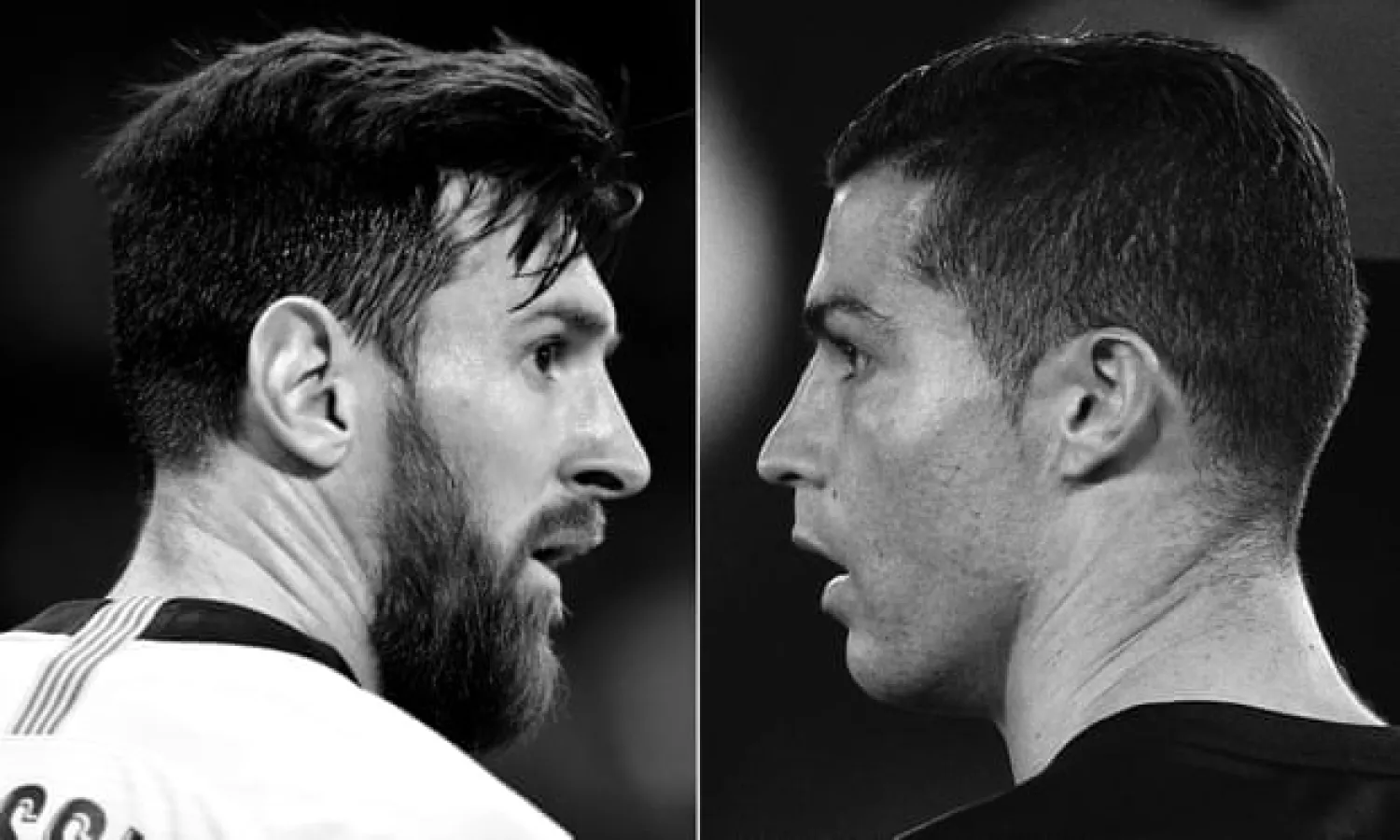

Catch Them While You Can: Messi, Ronaldo Will Not Be Around for Ever

 Lionel Messi will be 32 in June and Ronaldo, right, is 34. Composite: Getty Images; Fifa via Getty Images
Lionel Messi will be 32 in June and Ronaldo, right, is 34. Composite: Getty Images; Fifa via Getty Images
TT

Catch Them While You Can: Messi, Ronaldo Will Not Be Around for Ever

 Lionel Messi will be 32 in June and Ronaldo, right, is 34. Composite: Getty Images; Fifa via Getty Images
Lionel Messi will be 32 in June and Ronaldo, right, is 34. Composite: Getty Images; Fifa via Getty Images

To a 70s kid the sense of awe even to meet anyone who had seen Pelé or Eusébio or Johan Cruyff play was overwhelming. Just imagine that … watching such players in the flesh … in front of their own eyes. Some people of my parents’ generation had attended the 1966 World Cup in England, so every now and again a football conversation would turn in the direction of the greats and these lucky souls would not be able to contain their welling satisfaction as they piped up: “I saw Pelé play.”

It was jaw-dropping stuff. For us kids Pelé’s legend mainly existed in books and magazines, short clips on a football programme every now and again, or a montage every four years when it was World Cup time. The mystique about his genius shimmered in a particular way because so much was left to our imagination. Names like Garrincha, Puskas, Di Stéfano somehow felt more fantastical than real.

The other day, as Lionel Messi seduced a stadium full of Real Betis fans with an explosively beautiful hat-trick, coming so soon after Cristiano Ronaldo carried Juventus onwards in the Champions League fuelled by his own theatrical charge, it was only natural to think about how lucky we are to love football at the same point in history that these two are playing, especially as so much is accessible, in real time, to be watched by anyone anywhere.

Even so, the idea of seeing them play, not through a screen but with the naked eye, retains that elemental magic that made anyone who had seen Pelé on the pitch seem like a special person. The clock is ticking. Messi and Ronaldo have been the centre of football’s universe for around 15 years and, however much their brilliance seems superhuman, however convincingly they appear to play in a different zone of time and space from anyone else, well, it is not realistically going to go on forever.

It is a scary and somehow discomforting thought. What will the football landscape look like without them? How will we manage? It feels like a necessity to savour the spells they continue to cast. Ronaldo is 34. Messi will be 32 in June. The compulsion to go and see them while you can, if you have not already, is powerful.

A group of eagle-eyed parents recently provided their offspring with the opportunity of a lifetime when they spotted one of the Champions League sponsors offering a mascot experience for the quarter-finals. Two English boys were selected to attend Juventus v Atlético Madrid, and one for Lyon v Barcelona. The cost for this chance to brush ridiculously close to greatness was €350 (£303). It might sound on the steep side but it turned out to be bargain. Two face-value prime tickets for parent and child, at €220 each, already more than pays back the outlay.

The mascots in Turin met up at 4.30pm on the day of the match, got a training session and snacks at a nearby sport centre, went to their dressing room to be handed their kit to keep (you had to supply your own black boots; Adidas was requested but black tape was available to mask any non-official manufacturer).

Then came the big moment, to meet the players in the tunnel and march hand in hand into the spotlight. Apparently the player each mascot is appointed is random, but when Ronaldo noticed a kid with CR7 shaved into his hairstyle, there was a last moment switch as to which mascot got the best gig. While most of the other mascots were Italian a girl flew in from Indonesia who did not really seem to know what was going on but her father was very happy.

The boy who travelled to Lyon against Barcelona, a nervous eight-year-old from London, had the ridiculous luck to land Messi as his hand to hold. “I was more excited than him to be honest,” his father said.

I remember a considerably less glitzy experience in my youthful attempt to pay homage to Arrigo Sacchi’s legendary Milan team, the most glamorous thing in football at the age when it was suddenly possible to go off on footballing travels. Clapping eyes on Milan’s Dutch trio, Marco van Basten, Ruud Gullit and Frank Rijkaard, with the masterful defender Franco Baresi patrolling behind, felt like an obligation, a pilgrimage.

After travelling by rail to Italy, 29 September 1991 was the date of destiny, having secured a ticket outside San Siro for Milan v Genoa. What happened next made the moment memorable if not in the ideal way. A biblical storm broke. Three minutes and 12 seconds into a second half that resembled more of a water sport than football, with Milan leading 1-0, the referee called it off. Some 69,909 spectators were infuriated and had little option but to wade off.

There were some kerfuffles outside at the Piazzale Axum, the area where the buses and trams ferry supporters to and from the stadium. Everywhere was ankle deep in water. L’Unita newspaper the following day would describe San Siro forlornly as a “barca”, a boat.

It is funny the details that stick in the mind for decades. Some pathetically made espadrilles disintegrated in this sudden urban lake, so I ended up walking away from my dream visit to watch the team I most admired in the world, barefoot. It might not have gone entirely to plan but still, I had seen Van Basten, Gullit, Rijkaard, Baresi et al.

It is not an uncommon sentiment to ponder how or when it might be possible to see Messi or Ronaldo, to be able to go through life and say: “I saw him play.” It is strange to ponder how the game may feel in the probably not too distant future when they are no longer the protagonists, no longer on stage and under the lights, no longer active players.

Messi has been in Barcelona’s first team since 2005. Ronaldo became the world’s most expensive teenager, a leap to propel him into the international consciousness, in 2003. Any football lover on the planet under the age of roughly 21 will not remember a time when football’s constellation did not revolve around these two most luminous stars. And maybe, when all is said and done, that is what has made this era so extraordinary. People craw or wince at the who is better or who is your favourite nonsense.

But what brilliant luck to have these two somehow pushing themselves as well as each other. It would not have been the same had there been a Messi era and a Ronaldo era without them constantly overlapping.

Catch it, catch as much of it as you possibly can.

The Guardian Sport


Shakhtar Boss Pays Ukrainian Racer $200,000 After Games Disqualification

Ukrainian President Volodymyr Zelenskiy holds helmet as he meets with a Ukrainian skeleton racer Vladyslav Heraskevych , who was disqualified from the Olympic skeleton competition over his "helmet of remembrance" depicting athletes killed since Russia's invasion and his father and coach, Mykhailo Heraskevych, amid Russia's attack on Ukraine, in Munich, Germany February 13, 2026. (Ukrainian Presidential Press Service/Handout via Reuters)
TT

Shakhtar Boss Pays Ukrainian Racer $200,000 After Games Disqualification

Ukrainian President Volodymyr Zelenskiy holds helmet as he meets with a Ukrainian skeleton racer Vladyslav Heraskevych , who was disqualified from the Olympic skeleton competition over his "helmet of remembrance" depicting athletes killed since Russia's invasion and his father and coach, Mykhailo Heraskevych, amid Russia's attack on Ukraine, in Munich, Germany February 13, 2026. (Ukrainian Presidential Press Service/Handout via Reuters)

The owner of ‌Ukrainian football club Shakhtar Donetsk has donated more than $200,000 to skeleton racer Vladyslav Heraskevych after the athlete was disqualified from the Milano Cortina Winter Games before competing over the use of a helmet depicting Ukrainian athletes killed in the war with Russia, the club said on Tuesday.

The 27-year-old Heraskevych was disqualified last week when the International Bobsleigh and Skeleton Federation jury ruled that imagery on the helmet — depicting athletes killed since Russia invaded Ukraine in 2022 — breached rules on athletes' expression at ‌the Games.

He ‌then lost an appeal at the Court ‌of ⁠Arbitration for Sport hours ⁠before the final two runs of his competition, having missed the first two runs due to his disqualification.

Heraskevych had been allowed to train with the helmet that displayed the faces of 24 dead Ukrainian athletes for several days in Cortina d'Ampezzo where the sliding center is, but the International Olympic Committee then ⁠warned him a day before his competition ‌started that he could not wear ‌it there.

“Vlad Heraskevych was denied the opportunity to compete for victory ‌at the Olympic Games, yet he returns to Ukraine a ‌true winner," Shakhtar President Rinat Akhmetov said in a club statement.

"The respect and pride he has earned among Ukrainians through his actions are the highest reward. At the same time, I want him to ‌have enough energy and resources to continue his sporting career, as well as to fight ⁠for truth, freedom ⁠and the remembrance of those who gave their lives for Ukraine," he said.

The amount is equal to the prize money Ukraine pays athletes who win a gold medal at the Games.

The case dominated headlines early on at the Olympics, with IOC President Kirsty Coventry meeting Heraskevych on Thursday morning at the sliding venue in a failed last-minute attempt to broker a compromise.

The IOC suggested he wear a black armband and display the helmet before and after the race, but said using it in competition breached rules on keeping politics off fields of play. Heraskevych also earned praise from Ukraine President Volodymyr Zelenskiy.


Speed Skating-Italy Clinch Shock Men’s Team Pursuit Gold, Canada Successfully Defend Women’s Title

 Team Italy with Davide Ghiotto, Andrea Giovannini, Michele Malfatti, celebrate winning the gold medal on the podium of the men's team pursuit speed skating race at the 2026 Winter Olympics, in Milan, Italy, Tuesday, Feb. 17, 2026. (AP)
Team Italy with Davide Ghiotto, Andrea Giovannini, Michele Malfatti, celebrate winning the gold medal on the podium of the men's team pursuit speed skating race at the 2026 Winter Olympics, in Milan, Italy, Tuesday, Feb. 17, 2026. (AP)
TT

Speed Skating-Italy Clinch Shock Men’s Team Pursuit Gold, Canada Successfully Defend Women’s Title

 Team Italy with Davide Ghiotto, Andrea Giovannini, Michele Malfatti, celebrate winning the gold medal on the podium of the men's team pursuit speed skating race at the 2026 Winter Olympics, in Milan, Italy, Tuesday, Feb. 17, 2026. (AP)
Team Italy with Davide Ghiotto, Andrea Giovannini, Michele Malfatti, celebrate winning the gold medal on the podium of the men's team pursuit speed skating race at the 2026 Winter Olympics, in Milan, Italy, Tuesday, Feb. 17, 2026. (AP)

An inspired Italy delighted the home crowd with a stunning victory in the Olympic men's team pursuit final as

Canada's Ivanie Blondin, Valerie Maltais and Isabelle Weidemann delivered another seamless performance to beat the Netherlands in the women's event and retain their title ‌on Tuesday.

Italy's ‌men upset the US who ‌arrived ⁠at the Games ⁠as world champions and gold medal favorites.

Spurred on by double Olympic champion Francesca Lollobrigida, the Italian team of Davide Ghiotto, Andrea Giovannini and Michele Malfatti electrified a frenzied arena as they stormed ⁠to a time of three ‌minutes 39.20 seconds - ‌a commanding 4.51 seconds clear of the ‌Americans with China taking bronze.

The roar inside ‌the venue as Italy powered home was thunderous as the crowd rose to their feet, cheering the host nation to one ‌of their most special golds of a highly successful Games.

Canada's women ⁠crossed ⁠the line 0.96 seconds ahead of the Netherlands, stopping the clock at two minutes 55.81 seconds, and

Japan rounded out the women's podium by beating the US in the Final B.

It was only Canada's third gold medal of the Games, following Mikael Kingsbury's win in men's dual moguls and Megan Oldham's victory in women's freeski big air.


Lindsey Vonn Back in US Following Crash in Olympic Downhill 

Milano Cortina 2026 Olympics - Alpine Skiing - Women's Downhill 3rd Official Training - Tofane Alpine Skiing Centre, Belluno, Italy - February 07, 2026. Lindsey Vonn of United States in action during training. (Reuters)
TT

Lindsey Vonn Back in US Following Crash in Olympic Downhill 

Milano Cortina 2026 Olympics - Alpine Skiing - Women's Downhill 3rd Official Training - Tofane Alpine Skiing Centre, Belluno, Italy - February 07, 2026. Lindsey Vonn of United States in action during training. (Reuters)

Lindsey Vonn is back home in the US following a week of treatment at a hospital in Italy after breaking her left leg in the Olympic downhill at the Milan Cortina Games.

“Haven’t stood on my feet in over a week... been in a hospital bed immobile since my race. And although I’m not yet able to stand, being back on home soil feels amazing,” Vonn posted on X with an American flag emoji. “Huge thank you to everyone in Italy for taking good care of me.”

The 41-year-old Vonn suffered a complex tibia fracture that has already been operated on multiple times following her Feb. 8 crash. She has said she'll need more surgery in the US.

Nine days before her fall in Cortina d'Ampezzo, Italy, Vonn ruptured the ACL in her left knee in another crash in Switzerland.

Even before then, all eyes had been on her as the feel-good story heading into the Olympics for her comeback after nearly six years of retirement.
