


Turkey Ruling Party Submits Request to Rerun Istanbul Elections

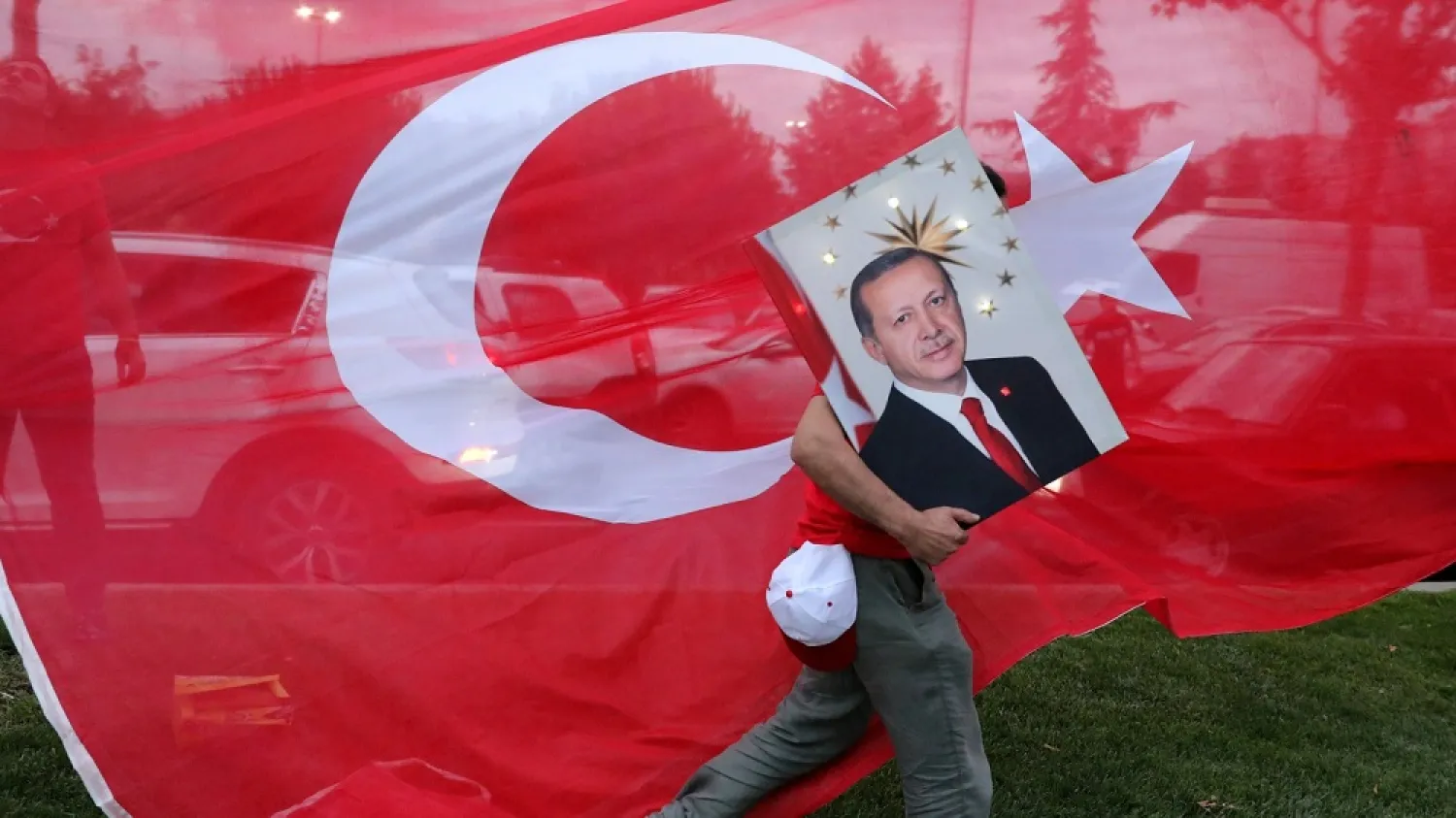
A supporter of President Erdogan holds his picture in front of a Turkish flag, in front of the ruling AK Party headquarters in Istanbul, June 24, 2018. (Reuters)
TT

Turkey Ruling Party Submits Request to Rerun Istanbul Elections

A supporter of President Erdogan holds his picture in front of a Turkish flag, in front of the ruling AK Party headquarters in Istanbul, June 24, 2018. (Reuters)

Turkish President Recep Tayyip Erdogan’s ruling party submitted on Tuesday a formal request to annul and rerun municipal elections in Istanbul.

The AK Party cited irregularities in the vote, prompting the main opposition to accuse it of damaging democracy.

Initial results from the March 31 vote showed the main opposition Republican People’s Party (CHP) narrowly won control of Turkey’s largest city, thereby ending 25 years of control of a key power center by the AKP and its predecessors.

The loss of Istanbul, Turkey’s financial hub, would be a blow to Erdogan, who campaigned hard ahead of the vote. The post-vote uncertainty has kept financial markets on edge and contributed to a nearly 5 percent slide in the lira.

In the 16 days since the election, the AKP has filed numerous appeals for vote recounts across Istanbul. The High Election Board (YSK) has approved some of those objections, ordering partial or full recounts in several districts. Some are still underway.

Submitting his party’s appeal for the annulment and renewal of the vote to the YSK on Tuesday, AKP Deputy Chairman Ali Ihsan Yavuz said thousands of votes had been impacted by the irregularities.

“There is clearly an organized unlawfulness, an election fraud here. The only authority that can end this controversy is the YSK,” Yavuz told reporters in the capital Ankara.

The AKP has already lost control of Ankara and other key cities. Defeat in Istanbul, where Erdogan was mayor in the 1990s, would be an even greater setback to the president.

The AKP urged electoral officials to block the YSK from giving CHP candidate Ekrem Imamoglu his mayoral mandate after the Istanbul recounts are completed and a final result emerges.

CHP spokesman Faik Oztrak branded the AKP appeal for renewed elections as a “plot” and called on the YSK to mandate Imamoglu as the elected mayor of the city.

“The authority that will put a stop to this exploitation, who will hand the right the people gave to the person who earned it is the High Election Board,” Oztrak told reporters.

“If there is security and predictability of the law in this country, then the YSK’s decision should already be clear.”

The board is expected to rule on the ruling party's request after all recounts are complete. If it accepts the AKP's objection, Istanbul could repeat the election on June 2.

The AKP’s Yavuz said 16,884 votes were marked as either invalid or added to the tallies of other parties in the elections. He said the AKP had submitted three suitcases of documents to the YSK to prove the irregularities.

If the appeal is approved, a second election would take place on June 2. If rejected, the results would be finalized and the CHP’s Ekrem Imamoglu would receive his mandate as mayor.

Yavuz said the gap between Imamoglu and his AKP rival, former prime minister Binali Yildirim, had fallen to 13,900 votes from around 28,000 as a result of the recounts.

On Monday, Yildirim said the elections were tarnished with "irregularities, mistakes, stains, vote thievery, among others."

Prior to the elections, his party had said the safety of ballot boxes was guaranteed.

If all votes had been recounted across the city the AKP would have won, Yavuz added.

Speaking on Tuesday to supporters chanting “give Imamoglu the mandate” in Istanbul, Imamoglu said the AKP actions harmed the credibility of Turkey’s democracy.

“To those who said they carried what they call evidence in suitcases, I say: I think you are experiencing an eclipse of reasoning. Stop this, don’t harm this nation, these people,” he said.

Istanbul, with its 15 million residents and strategic location straddling Europe and Asia, is Turkey's financial and cultural heart. It made up 31 percent of Turkey's GDP of $851 billion in 2017 and draws millions of tourists.



Iran to Consider Lifting Internet Ban; State TV Hacked

People walk past a burnt-out building destroyed during public protests in the Iranian capital Tehran on January 19, 26. (AFP)
TT

Iran to Consider Lifting Internet Ban; State TV Hacked

People walk past a burnt-out building destroyed during public protests in the Iranian capital Tehran on January 19, 26. (AFP)

Iran may lift its internet blackout in a few days, a senior parliament member said on Monday, after authorities shut communications while they used massive force to crush protests in the worst domestic unrest since ​the 1979 revolution.

In the latest sign of weakness in the authorities' control, state television appeared to be hacked late on Sunday, briefly showing speeches by US President Donald Trump and the exiled son of Iran's last shah calling on the public to revolt.

Iran's streets have largely been quiet for a week since anti-government protests that began in late December were put down in three days of mass violence.

An ‌Iranian official ‌told Reuters on condition of anonymity that the ‌confirmed ⁠death ​toll ‌was more than 5,000, including 500 members of the security forces, with some of the worst unrest taking place in ethnic Kurdish areas in the northwest. Western-based Iranian rights groups also say thousands were killed.

Opponents accuse the authorities of opening fire on peaceful demonstrators to crush dissent. Iran's clerical rulers say armed crowds egged on by foreign enemies attacked hospitals and mosques.

The death tolls dwarf ⁠those of previous bouts of anti-government unrest put down by the authorities in 2022 and 2009. ‌The violence drew repeated threats from Trump ‍to intervene militarily, although he has backed ‍off since the large-scale killing stopped.

INTERNET TO RETURN WHEN 'CONDITIONS ARE APPROPRIATE'

Ebrahim ‍Azizi, the head of parliament's National Security and Foreign Policy Committee, said top security bodies would decide on restoring internet in the coming days, with service resuming "as soon as security conditions are appropriate".

Another parliament member, hardliner Hamid Rasaei, said authorities should ​have listened to earlier complaints by Supreme Leader Ali Khamenei about "lax cyberspace".

Iranian communications including internet and international phone lines were ⁠largely stopped in the days leading up to the worst unrest. The blackout has since partially eased, allowing accounts of widespread attacks on protesters to emerge.

During Sunday's apparent hack into state television, screens broadcast a segment lasting several minutes with the on-screen headline "the real news of the Iranian national revolution".

It included messages from Reza Pahlavi, the US-based son of Iran's last shah, calling for a revolt to overthrow rule by the clerics who have run the country since the 1979 revolution that toppled his father.

Pahlavi has emerged as a prominent opposition voice and has said he plans ‌to return to Iran, although it is difficult to assess independently how strong support for him is inside Iran.


12 Schoolchildren Killed in South Africa Crash

File photo: A general view of the scene of a bus accident in Ekurhuleni on March 11, 2025. (AFP)
TT

12 Schoolchildren Killed in South Africa Crash

File photo: A general view of the scene of a bus accident in Ekurhuleni on March 11, 2025. (AFP)

A minibus carrying school students collided with a truck south of Johannesburg on Monday, killing 12 pupils, police said.

It was the latest in a string of deadly crashes in a country whose modern road network is undermined by rampant speeding, reckless driving and poorly maintained vehicles.

The crash happened near the industrial city of Vanderbijlpark, about 60 kilometers (40 miles) south of Johannesburg.

Police said the driver of the minibus appeared to have lost control while attempting to overtake other vehicles.

Eleven students died at the scene and another in hospital, provincial education minister Matome Chiloane told reporters at the scene.

He did not know the ages of the children involved but said they were from primary schools, where pupils are aged from six years, and also high schools.

Images on social media showed the crushed minibus on the roadside with distraught parents gathered behind the police tape. Some broke down in wails when they were allowed to see the bodies.

"It is a terrible scene," Gauteng premier Panyaza Lesufi said.

More than 11,400 lives were lost on South African roads in 2025, according to the latest data from the transport ministry.

Many South African parents have to rely on private minibuses to get their children to school.

In October, 18 children were badly hurt when their minibus lost control and overturned on a highway in KwaZulu-Natal.

At least five students were killed and eight others injured in September when a school minibus ploughed into a creche in a KwaZulu-Natal township.


Glitch Delays Restart of World's Biggest Nuclear Plant in Japan

Local Japanese authorities have approved the restart of the world's biggest nuclear power facility, the Kashiwazaki-Kariwa Nuclear Power Plant, for the first time since the 2011 Fukushima disaster. STR / JIJI Press/AFP
TT

Glitch Delays Restart of World's Biggest Nuclear Plant in Japan

Local Japanese authorities have approved the restart of the world's biggest nuclear power facility, the Kashiwazaki-Kariwa Nuclear Power Plant, for the first time since the 2011 Fukushima disaster. STR / JIJI Press/AFP

A technical glitch pushed back the restart of the world's biggest nuclear reactor in Japan, its operator said on Monday, a day before local media reported it would go online.

Tokyo Electric Power Company (TEPCO) said it would need another day of two to check the equipment at the Kashiwazaki-Kariwa plant, which media reports said was set to restart on Tuesday.

The plant was taken offline when Japan pulled the plug on nuclear power after a colossal earthquake and tsunami sent three reactors at the Fukushima plant into meltdown in 2011.

The Kashiwazaki-Kariwa facility would be the first nuclear plant that Fukushima operator TEPCO restarts since the disaster.

The company has never publicly announced a date to switch on the plant.

TEPCO has decided to run more checks after detecting a technical issue on Saturday related to an alarm linked to one of the reactors at Kashiwazaki-Kariwa, company spokesman Isao Ito told AFP.

The alarm issue had been fixed by Sunday, he added.

After the final checks, the utility will explain to nuclear authorities what had happened and proceed to restart the plant, the spokesman said, without providing an exact timeline.

More than a decade since the Fukushima accident, Japan now wants to revive atomic energy to reduce its dependence on fossil fuels, achieve carbon neutrality by 2050 and meet growing energy needs from artificial intelligence.

But it is a divisive issue, with many residents worried about nuclear safety.

About 50 people gathered Monday outside TEPCO's headquarters in the capital Tokyo, chanting "No to the restart of Kashiwazaki-Kariwa!"

"TEPCO only mentions a possible delay. But that's not enough," said Takeshi Sakagami, president of the Citizens' Nuclear Regulatory Watchdog Group.

"A full investigation is needed, and if a major flaw is confirmed, the reactor should be permanently shut down," he said at the rally.

The reactor has cleared the nation's nuclear safety standard.

Prime Minister Sanae Takaichi has voiced her support for the use of nuclear power.

Japan is the world's fifth-largest single-country emitter of carbon dioxide, and is heavily dependent on imported fossil fuels.