


Football Cannot Be Picky About When Var Is Applied – but Is One Angle Enough?

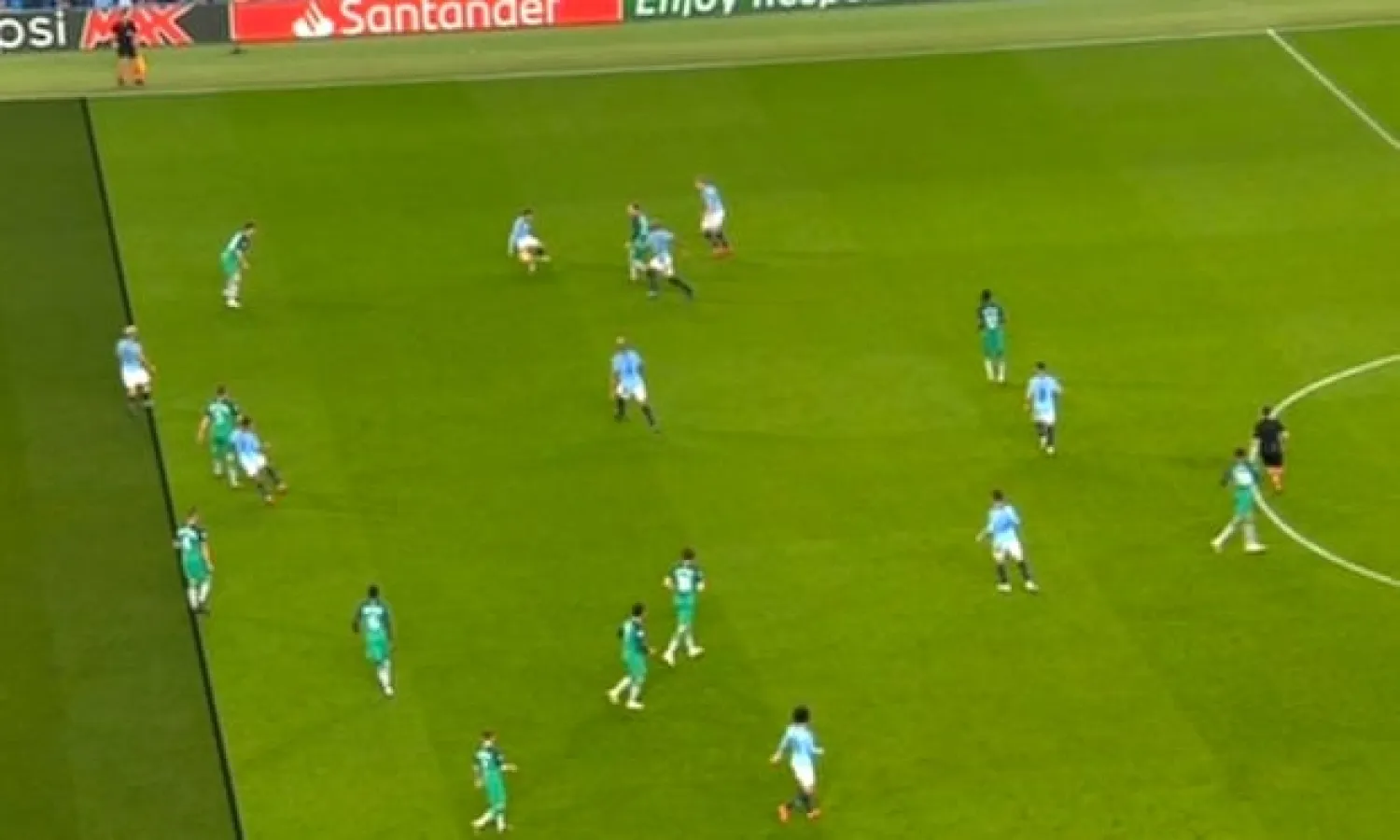
 Sergio Aguero is seen to be marginally offside as ball is loops through to him off Bernardo Silva’s leg. The decision meant that Sterling’s ‘hat-trick goal’ was disallowed and Spurs went through on the away-goals rule. Photograph: BT Sport
Sergio Aguero is seen to be marginally offside as ball is loops through to him off Bernardo Silva’s leg. The decision meant that Sterling’s ‘hat-trick goal’ was disallowed and Spurs went through on the away-goals rule. Photograph: BT Sport
TT

Football Cannot Be Picky About When Var Is Applied – but Is One Angle Enough?

 Sergio Aguero is seen to be marginally offside as ball is loops through to him off Bernardo Silva’s leg. The decision meant that Sterling’s ‘hat-trick goal’ was disallowed and Spurs went through on the away-goals rule. Photograph: BT Sport
Sergio Aguero is seen to be marginally offside as ball is loops through to him off Bernardo Silva’s leg. The decision meant that Sterling’s ‘hat-trick goal’ was disallowed and Spurs went through on the away-goals rule. Photograph: BT Sport

There is always the chance, when English clubs meet in European knockout football, that players who know each other so well will treat it as a pumped-up Premier League encounter rather than showing the respect and caution they might have afforded continental opponents, and the memorably frenetic showdown between Manchester City and Tottenham was an instant classic of the genre.

Never mind the woeful defending in the first 20 minutes, the inability of either side to hold on to an advantage or manage the game professionally, this was English football at its most appealing because both teams were going for goals and glory. Cagey it was not; it was simply a question of who could score more, and when the dust has settled on a thrilling and often controversial ding-dong between two of the best teams in the country it will be seen that the much-maligned away-goals rule had a lot to do with that.

Put simply, City went out because they failed to score at Tottenham. Spurs went through because they scored twice at the Etihad in the first 10 minutes, and from that point on there could never be equilibrium, one side or the other would always be winning. Many would like to scrap the away-goals rule, now regarded as an anachronism in modern, no-expense-spared football, but it was originally introduced in an attempt to avoid the awkwardness of replays in ties featuring teams from different countries, and it now functions just as well as a means of avoiding extra time and penalties.

What’s wrong with extra time and penalties? Well, nothing in theory, apart from the fact a shootout is an arbitrary and unsatisfactory way to separate evenly matched sides. In practice the main problem over the years has been the emergency tie-break tacked on to the end has tended to loom too large over the actual event, with teams settling for unadventurous, risk-free football in the knowledge they would be in with at least a 50-50 chance after the final whistle. City v Spurs was anything but risk free and unadventurous, it was glorious, and the away-goals rule deserves at least part of the credit.

Not that the Etihad quarter-final thriller has any chance of being remembered for that. Not when VAR was involved in two crucial decisions, awarding a goal to one side and cruelly robbing the other of what looked a winner. Pep Guardiola was not completely satisfied with the goal awarded to Fernando Llorente, arguing that from one camera angle the ball appeared to have gone in off his right arm. This is the question for football in 2019: is a single camera angle enough, when most others appeared to show nothing wrong?

Even VAR will not settle all disputes – to hear some City fans complaining you would think Llorente had punched the ball into the net – but what can be said is that the referee and the remote scrutineers examined plenty of replays before concluding there were no grounds for disallowing the goal. Llorente had not used his hand to propel the ball over the line, there was nothing in particular to see, and rather than blaming the review system City would have been better advised to look at their defending when a far from prolific striker went up for a header and scored with his hip.

On the second VAR decision of the match it was possible to feel much more sympathy for City. It looked as though Raheem Sterling had scored a winning goal, and with barely seconds remaining his third of the game had been celebrated as such. No offside flag had been raised against the scorer or Sergio Agüero, and the referee had not been besieged by Spurs players complaining about the latter’s position.

The reason for all that was that Agüero had been only marginally offside, and his transgression was difficult to see in real time. This is where VAR either comes into its own, or takes on a sinister aspect, depending on your point of view. The referee was told he may like to take another look before awarding the goal, and on doing so he spotted Agüero’s fractional infringement in the buildup.

Welcome to the modern world. The debate about whether VAR was simply doing its job and working as expected or sticking its nose in to undermine the referee’s authority on the pitch is sure to be a feature of next season, when it will be introduced in the Premier League. There is also a debate about whether goals should be disallowed for narrow offsides when the attacker was more or less in line and not obviously seeking to gain an illegal advantage, because there are more such borderline cases than may be imagined and VAR has the ability to spot them all.

Christian Eriksen had it exactly right when he said he felt like the luckiest man in the world when VAR overturned the goal decision. It was his mistake that had presented City with the ball at a stage in the game when Spurs were defending too deep without an outlet upfield to relieve the pressure, and he was lucky because he knew a less avoidable error by Agüero had come to his rescue. It therefore follows that City were unlucky, which minus the swearwords was what Fernandinho had to say about VAR after the game.

Yet technology is not only here, it is here to stay and the game cannot be picky about where and when it is applied. Without VAR City would be through to a Champions League semi-final, and rather than dancing on the pitch at the end Mauricio Pochettino would be pointing to a replay of the winning goal and claiming Spurs had been robbed, which they demonstrably would have been. That would not have been just unlucky, it would have been unsatisfactory.



Shakhtar Boss Pays Ukrainian Racer $200,000 After Games Disqualification

Ukrainian President Volodymyr Zelenskiy holds helmet as he meets with a Ukrainian skeleton racer Vladyslav Heraskevych , who was disqualified from the Olympic skeleton competition over his "helmet of remembrance" depicting athletes killed since Russia's invasion and his father and coach, Mykhailo Heraskevych, amid Russia's attack on Ukraine, in Munich, Germany February 13, 2026. (Ukrainian Presidential Press Service/Handout via Reuters)
TT

Shakhtar Boss Pays Ukrainian Racer $200,000 After Games Disqualification

Ukrainian President Volodymyr Zelenskiy holds helmet as he meets with a Ukrainian skeleton racer Vladyslav Heraskevych , who was disqualified from the Olympic skeleton competition over his "helmet of remembrance" depicting athletes killed since Russia's invasion and his father and coach, Mykhailo Heraskevych, amid Russia's attack on Ukraine, in Munich, Germany February 13, 2026. (Ukrainian Presidential Press Service/Handout via Reuters)

The owner of ‌Ukrainian football club Shakhtar Donetsk has donated more than $200,000 to skeleton racer Vladyslav Heraskevych after the athlete was disqualified from the Milano Cortina Winter Games before competing over the use of a helmet depicting Ukrainian athletes killed in the war with Russia, the club said on Tuesday.

The 27-year-old Heraskevych was disqualified last week when the International Bobsleigh and Skeleton Federation jury ruled that imagery on the helmet — depicting athletes killed since Russia invaded Ukraine in 2022 — breached rules on athletes' expression at ‌the Games.

He ‌then lost an appeal at the Court ‌of ⁠Arbitration for Sport hours ⁠before the final two runs of his competition, having missed the first two runs due to his disqualification.

Heraskevych had been allowed to train with the helmet that displayed the faces of 24 dead Ukrainian athletes for several days in Cortina d'Ampezzo where the sliding center is, but the International Olympic Committee then ⁠warned him a day before his competition ‌started that he could not wear ‌it there.

“Vlad Heraskevych was denied the opportunity to compete for victory ‌at the Olympic Games, yet he returns to Ukraine a ‌true winner," Shakhtar President Rinat Akhmetov said in a club statement.

"The respect and pride he has earned among Ukrainians through his actions are the highest reward. At the same time, I want him to ‌have enough energy and resources to continue his sporting career, as well as to fight ⁠for truth, freedom ⁠and the remembrance of those who gave their lives for Ukraine," he said.

The amount is equal to the prize money Ukraine pays athletes who win a gold medal at the Games.

The case dominated headlines early on at the Olympics, with IOC President Kirsty Coventry meeting Heraskevych on Thursday morning at the sliding venue in a failed last-minute attempt to broker a compromise.

The IOC suggested he wear a black armband and display the helmet before and after the race, but said using it in competition breached rules on keeping politics off fields of play. Heraskevych also earned praise from Ukraine President Volodymyr Zelenskiy.


Speed Skating-Italy Clinch Shock Men’s Team Pursuit Gold, Canada Successfully Defend Women’s Title

 Team Italy with Davide Ghiotto, Andrea Giovannini, Michele Malfatti, celebrate winning the gold medal on the podium of the men's team pursuit speed skating race at the 2026 Winter Olympics, in Milan, Italy, Tuesday, Feb. 17, 2026. (AP)
Team Italy with Davide Ghiotto, Andrea Giovannini, Michele Malfatti, celebrate winning the gold medal on the podium of the men's team pursuit speed skating race at the 2026 Winter Olympics, in Milan, Italy, Tuesday, Feb. 17, 2026. (AP)
TT

Speed Skating-Italy Clinch Shock Men’s Team Pursuit Gold, Canada Successfully Defend Women’s Title

 Team Italy with Davide Ghiotto, Andrea Giovannini, Michele Malfatti, celebrate winning the gold medal on the podium of the men's team pursuit speed skating race at the 2026 Winter Olympics, in Milan, Italy, Tuesday, Feb. 17, 2026. (AP)
Team Italy with Davide Ghiotto, Andrea Giovannini, Michele Malfatti, celebrate winning the gold medal on the podium of the men's team pursuit speed skating race at the 2026 Winter Olympics, in Milan, Italy, Tuesday, Feb. 17, 2026. (AP)

An inspired Italy delighted the home crowd with a stunning victory in the Olympic men's team pursuit final as

Canada's Ivanie Blondin, Valerie Maltais and Isabelle Weidemann delivered another seamless performance to beat the Netherlands in the women's event and retain their title ‌on Tuesday.

Italy's ‌men upset the US who ‌arrived ⁠at the Games ⁠as world champions and gold medal favorites.

Spurred on by double Olympic champion Francesca Lollobrigida, the Italian team of Davide Ghiotto, Andrea Giovannini and Michele Malfatti electrified a frenzied arena as they stormed ⁠to a time of three ‌minutes 39.20 seconds - ‌a commanding 4.51 seconds clear of the ‌Americans with China taking bronze.

The roar inside ‌the venue as Italy powered home was thunderous as the crowd rose to their feet, cheering the host nation to one ‌of their most special golds of a highly successful Games.

Canada's women ⁠crossed ⁠the line 0.96 seconds ahead of the Netherlands, stopping the clock at two minutes 55.81 seconds, and

Japan rounded out the women's podium by beating the US in the Final B.

It was only Canada's third gold medal of the Games, following Mikael Kingsbury's win in men's dual moguls and Megan Oldham's victory in women's freeski big air.


Lindsey Vonn Back in US Following Crash in Olympic Downhill 

Milano Cortina 2026 Olympics - Alpine Skiing - Women's Downhill 3rd Official Training - Tofane Alpine Skiing Centre, Belluno, Italy - February 07, 2026. Lindsey Vonn of United States in action during training. (Reuters)
TT

Lindsey Vonn Back in US Following Crash in Olympic Downhill 

Milano Cortina 2026 Olympics - Alpine Skiing - Women's Downhill 3rd Official Training - Tofane Alpine Skiing Centre, Belluno, Italy - February 07, 2026. Lindsey Vonn of United States in action during training. (Reuters)

Lindsey Vonn is back home in the US following a week of treatment at a hospital in Italy after breaking her left leg in the Olympic downhill at the Milan Cortina Games.

“Haven’t stood on my feet in over a week... been in a hospital bed immobile since my race. And although I’m not yet able to stand, being back on home soil feels amazing,” Vonn posted on X with an American flag emoji. “Huge thank you to everyone in Italy for taking good care of me.”

The 41-year-old Vonn suffered a complex tibia fracture that has already been operated on multiple times following her Feb. 8 crash. She has said she'll need more surgery in the US.

Nine days before her fall in Cortina d'Ampezzo, Italy, Vonn ruptured the ACL in her left knee in another crash in Switzerland.

Even before then, all eyes had been on her as the feel-good story heading into the Olympics for her comeback after nearly six years of retirement.