



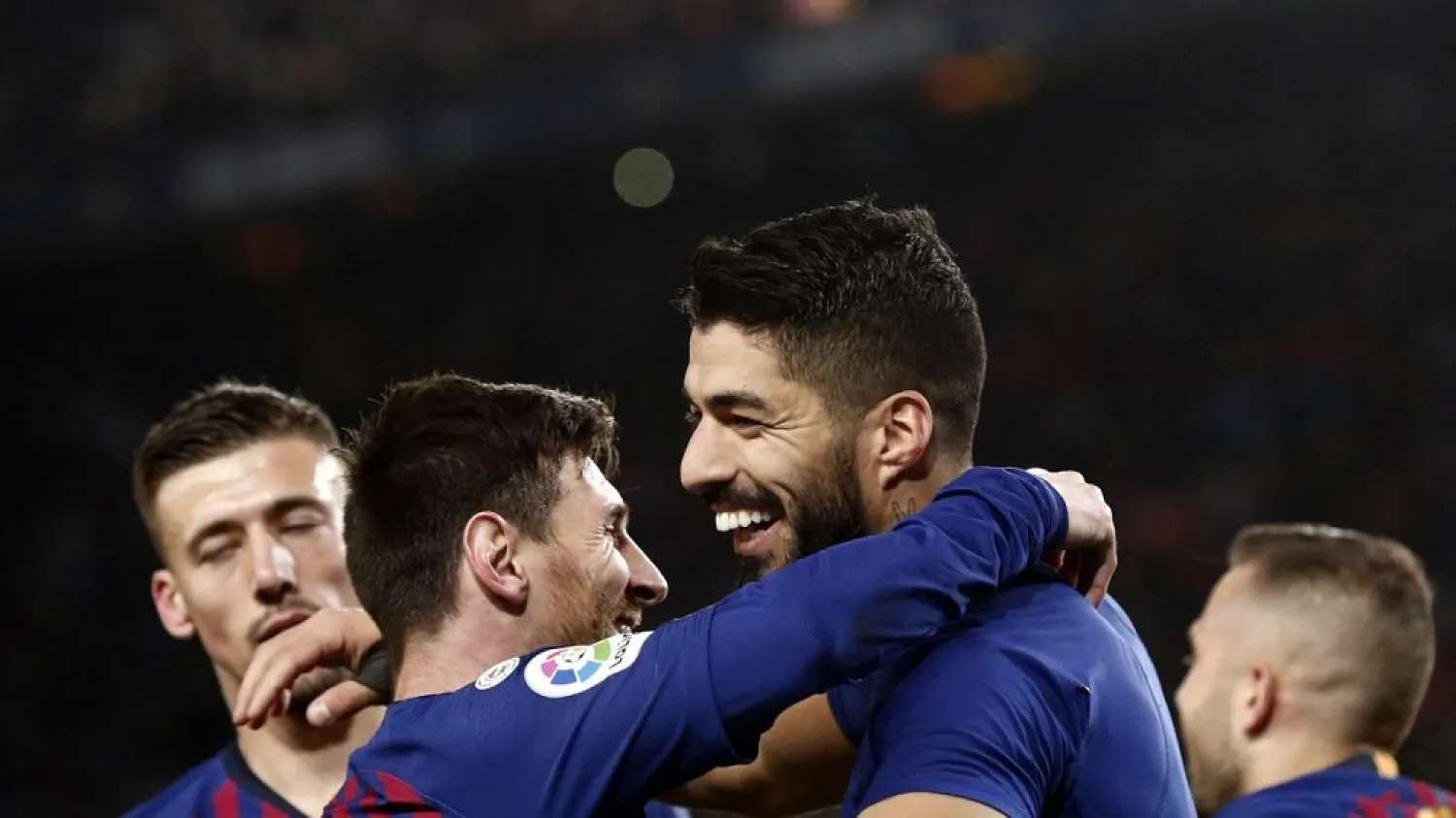

Before Wednesday’s Champions League semi-final the Barcelona forward talks to the Guardian about his Anfield days, the joy of playing alongside Messi and why he does not mind being called fat.
It is the morning after the night Barcelona virtually won the league and Luis Suárez has not slept much but he is grinning again, easing into a sofa, mate in hand. He has been busy lately: looking at flights, tickets too, and making history. As he strolls across in the sunshine, he is told the goal he scored the previous night, his 21st in the league this season, did not just take Barcelona to the verge of a fourth title in five years but also made him the club’s third highest league goalscorer of all time, level with László Kubala, the Hungarian whose statue stands alone outside the Camp Nou. But there is more to do.
Barcelona would go on to win the league on Saturday with a victory against Levante.
Although it is less than 10 hours since the final whistle at Alavés and Barcelona’s players did not get back until past 3am, Suárez arrives before another training session. There are games to prepare for. The Copa del Rey final is a month away but on Wednesday there is the match against Liverpool in the Champions League semi-final. It is the tie that will take Suárez back to Anfield, the place he says defined his career. The tie that will take the whole Suárez family back, in fact.
“My kids never go to Champions League games but they want to go to this one,” Suárez says, stirring hot water into the yerba, the names of his wife Sofia and his children Delfina, eight, Benjamín, six, and baby Lautaro embossed on the mate cup, their photos on his flask. “I was talking to Sofi about Anfield and they said: ‘We’re going too.’ We’ll all go, except maybe Lauti, six months yesterday. Benja was very small but he was born in Liverpool and knows it’s his first stadium; he’s seen photos. Part of Delfi’s childhood is there: when she first started to get excited by football, it was there. She remembers what it was like, singing You’ll Never Walk Alone, so imagine what this means for her.
“It’s going to be a strange feeling but lovely, too. I saw Carra [Jamie Carragher] at Old Trafford and he was excited. Jordan [Henderson] is still there; some friends of his came for the clásico. It’ll be nice to see the staff, like Ray [Haughan], who used to handle everything. And I’ve been getting messages from the lady in the canteen [at Melwood]; she wants to see the kids: she’d always look after Delfi, taking her into the kitchen with her. It’ll be nice to go back.”
But then there will be a game to play, a battle to be fought. “You see me here and I’m calm, relaxed but then when I play, I’m totally different,” Suárez says, smiling. He is on good form. There are two of him, he knows, and at times they can be hard to reconcile. “I’m so grateful but I’m there to play for Barcelona, knowing what our targets are. Once we’re playing there’ll be no friendship, no mates, none of those lovely memories. That’s the way I am as a player, everyone knows.”
Oh, they know. At Liverpool, they were fond of that fight and will recognize the relentlessness, the man who took them so close to the league and ended sobbing under his shirt at Selhurst Park five years ago. Suárez insists that while he has adapted, while the responsibility is different, he has not changed much. What has changed, he believes, is Liverpool – for the better.
Suárez’s perfect scenario now is another former club – Ajax – in the final (“incredible”, he calls them) a Barcelona treble and a Liverpool league title. “Ojalá,” he says: God willing. This is the nearest they have been to the title since he departed and he knows why they are the only team for whom domestic success takes priority over Europe, 29 years on. He has lived that: the excitement, the hope, the need. Yet if he sees a little of his side in them, it may only be a little. And not just because only Henderson, Simon Mignolet and Daniel Sturridge are left.
“I understand what they’re going through and it can’t be easy but I think with us it was different because it was: ‘now or never’, a one-off. When I was there, it was very different. We were on the verge of the Premier League with a squad nowhere near as good. They didn’t spend as much as they’re doing now. Any player would like to go to Liverpool now. It was different then. If we’d won the league, I think it would have been an even bigger achievement than if this team do.
“The front three are very quick, technically gifted, so much talent; they’re players who make the difference and Liverpool’s results depend on them. The kind of players you’d love to play with, with the level you’d expect for a club like Liverpool, built to win the Premier League and the Champions League. They also know how to approach games. Maybe we didn’t handle that so well. What happened with Stevie was bad luck, but take Crystal Palace: these days, you’d say: ‘No, play calmly, we’re 3-0 up, City have to win in midweek and the weekend.’ But we felt that urge to score, we went forward thinking we could be champions on goal difference. That was the mistake of being ‘too young’.”
Could this Liverpool learn from that one, then? From those mistakes? “Maybe, but it’s more about their own experience: this is the second season they’re strong, last year they reached the Champions League final.”
That night at Selhurst Park in 2014, the chance was virtually gone and, fearing there might not be another, soon so was Suárez. He was 27, the Premier League’s player of the year, but had won surprisingly little in his club career: one Dutch league, secured after departing Ajax, medal arriving in the post; one Dutch cup; one Uruguayan league; and the English League Cup. At Barcelona he has won three league titles, four cups and a Champions League, and there could yet be three more trophies to add. He has scored 176 goals.
There is a pause, and Suárez interrupts: 176? He thinks it is more, but he is not sure. He is claiming that one at Old Trafford, for a start: “It was going in,” he says, laughing. “I don’t know how they can take that away, but they’re just statistics.”
They are serious statistics, though. Where he used to beat up on Norwich, now it is Real Madrid – he has scored 11 clásico goals – and, over the past four seasons he has scored more league goals even than Cristiano Ronaldo. No one in Europe has more, except Lionel Messi. Yet at a time when statistics build water-tight cases for some, he is rarely in the conversation. Why?
“Maybe there are players who are better with marketing,” he suggests. Maybe he should make more of it? “I don’t have a big enough ego to go around, chest out, saying: ‘I’m the best No. 9’, ‘Barcelona have never had a No. 9 like me’, or anything like that. The numbers are there. I know I’m the only player who has taken the Golden Shoe off Messi and Ronaldo in five years.”
Actually, it is a decade and he did it twice. Only four players have scored more competitive goals than him in the club’s history and it seems likely that by the time he retires – and he is in no hurry – only one man will be ahead of him: Messi.
“It’s not just what you see watching him; I see it playing with him: I start running with my head down and the ball appears there,” Suárez says. He stops, looks at his feet, imaginary ball between them, and pulls a face. “And you think: ‘How did he put it there?’ ‘How did he know that I would end up there?’ Sometimes you’re there, waiting to receive and you’ve got three players between you and him and you think: ‘No, no, I’ll go [somewhere else] because how’s he going to get it through there?’ and he does but you’ve gone. The pass hasn’t worked but it’s my fault for not thinking he can do that. There are thousands of moves like that.”
Suárez’s understanding with Messi has made them the perfect pair, best friends off the pitch too: next-door neighbors, their kids go to the same school, their wives have set up in business, and most days they drive to training together. When Suárez scored a hat-trick against Madrid in October, Messi babysat his kids, watching from the front row with them. “It will be difficult [when he retires], because he gives people pleasure: you go to play away and their fans applaud him; it’s spectacular,” Suárez says. “The nice thing for us is that we get to live through this, and there are years left to keep enjoying the things Leo can do.”
All of which only adds to the sense that Suárez’s success was somehow inevitable, easy. But if it seems obvious now – and that might help explain why it is sometimes taken for granted – it was not always. His first season, 2014-15, ended with Barcelona claiming a treble, Suárez scoring in the European Cup final, but it had begun with him forced to train alone, banned until October for biting Giorgio Chiellini during the World Cup in Brazil. Some wondered if he would fit and in those early months so did he. A shift inside in January changed things, but there were no guarantees and the demands were huge – something on which he has sought to counsel his former Liverpool teammate Philippe Coutinho, who responded to whistles from fans by sticking his fingers in his ears after scoring the third against United.
“Barcelona players have to live with constant criticism: you have to have the internal mental strength to overcome bad moments,” Suárez says. He is talking about himself, but he applies that to Barcelona’s other former Liverpool player.
“Philippe is a friend, he’s young and I try to advise him. At Liverpool he proved the player he is. It was hard for me and I told him it would be the same. You have to accept criticism but the most important thing is that he’s comfortable, happy, his teammates trust in him, the manager trusts in him.
“Players are exposed. The smallest thing you do – tiny, like Philippe did – is made bigger. The manager said it: ‘I’m surprised that you’re talking about the gesture and not the great goal he scored,’ a goal that would have given him confidence. Sometimes you have to understand him. If fans want a player to perform, be on his side, support him, because a player out on the pitch – and it happens to me – is not stupid. He hears it when he loses a ball and there’s this ‘zzzzzhhhhhiiii’, he hears that buzzing, that murmur, and that affects him. He thinks: ‘Ay, the fans, ay, if I lose another ball.’ No. The fans have to support our players. If they want to win the Champions League and everything, they have to be with the player.”
In that sense is Anfield different? “Yes, very different,” Suárez says. “English football in general is a different culture. What you have to do is learn to live with that.”
It is not the only thing that is different. “I don’t think I have changed how I play but you have to adapt to what the team needs, what certain players need. When I came here, I knew I had Ney [Neymar] on one side and Leo on the other and that I had to do, let’s say, the dirty work. I had to run, escape my marker, and that was an advantage for them to have me there because when I was there with two center‑backs, when I made a move towards space, one didn’t know what to do and the other one followed me. So, they [Messi and Neymar] were left one on one. And in one-on-ones they’re the best. That’s how a team works.”
There is something in that analysis that perhaps helps to disguise Suárez’s contribution. As if the dirty work was just that: dirty, as if it is others who are talented. And even goals are “only” goals. Even the compliments for his work can feel a little backhanded, as if that is all it is – and anyone can run around a lot. “We’re at Barcelona and you’re not only at Barcelona to fight, to press, to chase down defenders, to argue, to score a goal every now and then. You’re also here because of the quality you have,” he says.
There is something in his style that does not attract aesthetes, in his body shape that means when he plays badly the judgments appear even more damning, more definitive. Time waits for no man, either. He is 32 now. At the start of the season some suggested Barcelona might need a change. Suárez, rarely the fastest to get started, looked a little slow, a little … “‘Fat,’” he says, and then he cracks up again. “Everything … I laugh at it, I laugh. They throw everything at you. You go a couple of games and it’s: ‘Oh, a bad run …’ That’s the demands of playing at Barcelona.”
Over the past couple of months, his form superb, no one is questioning Suárez anymore, but there is still one thing and it is the thing for this team: in Europe, the run is bad. Suárez might be counting the goal at Old Trafford but Uefa did not; if he was to score on his Anfield return, it would be his first away goal in the competition since September 2015. “People talk, highlight the fact that I haven’t scored in three, four years. But I don’t lose any sleep over that, nor am I at all worried.”
He knows that the Champions League has hurt, though. Knocked out of the quarter-finals three years in a row, Barcelona have watched Real Madrid win it in their absence each time, leaving their domestic dominance feeling diminished.
If Liverpool are more about the league, Barcelona are more about Europe: it was a breakthrough to get this far but it is not enough. At the start of this season, Messi announced, from the Camp Nou pitch, mic in hand, that the priority this year was clear – that “lovely, desired cup”.
If anyone knew it was coming, it was Suárez, right? “No.” And what did you think? Talk about putting pressure on. Suárez bursts out laughing again. “We joked: ‘You said it, it’s up to you to do it, then!’
“He surprised us but if the captain wants to win the cup so much, why wouldn’t we? It was a clear message. It’s not an obligation but we want to win it. It’s not easy, that’s for sure. It’s very hard, very difficult – like the leagues are.
“Sometimes people don’t appreciate the leagues Barcelona have won. It’s as if it was easy, no one thinks much of it. But then you go and lose to Alavés or Valladolid: ‘Buah, what a disaster they are!’ You have to appreciate all those titles. You have to win those games, like last night.”
The Guardian Sport


