Mastering Momentum: Exploring the Anatomy of Amazing Comebacks

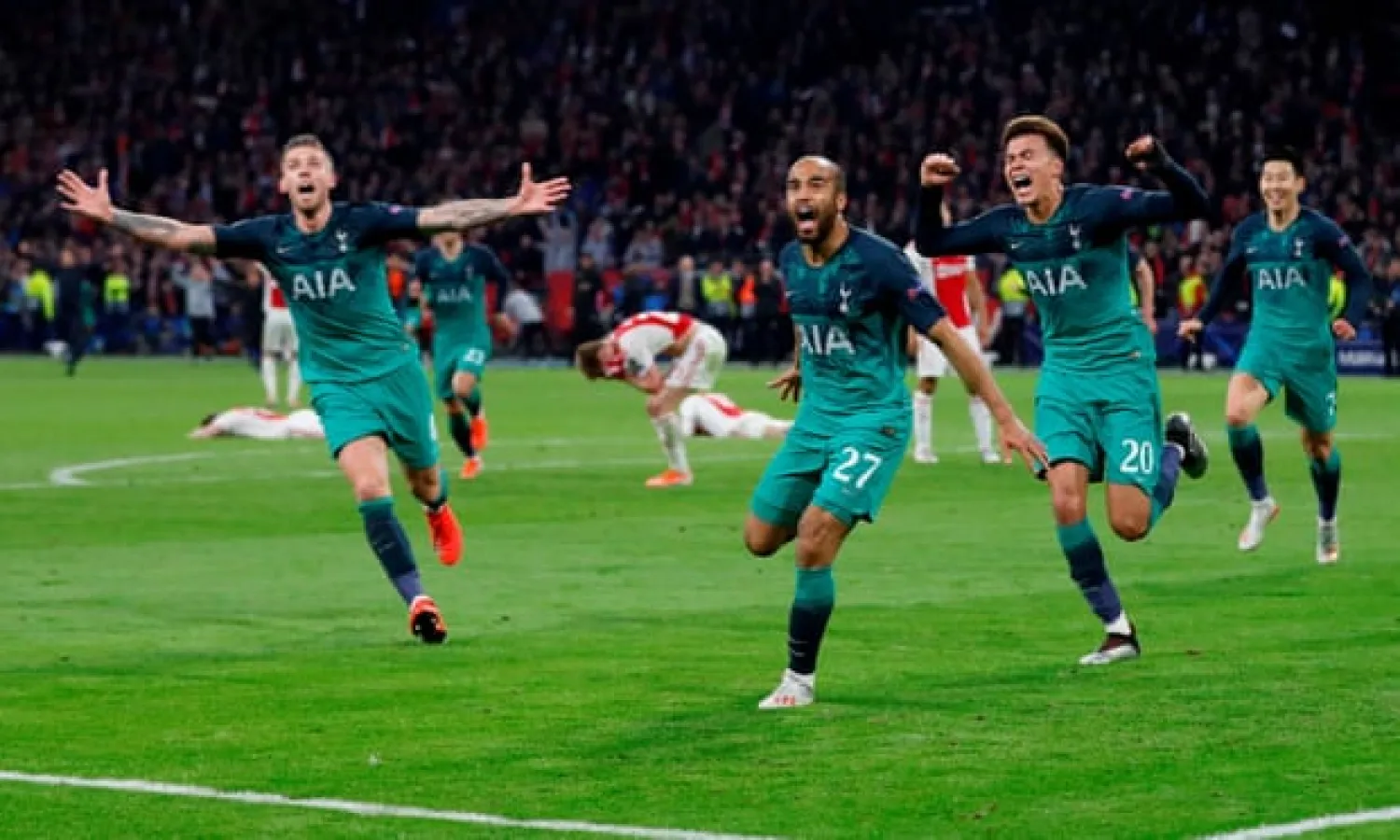
 Lucas Moura (centre) scored in the 96th minute to complete a miraculous comeback for Tottenham against Ajax. Photograph: Matthew Childs/Action Images via Reuters
Lucas Moura (centre) scored in the 96th minute to complete a miraculous comeback for Tottenham against Ajax. Photograph: Matthew Childs/Action Images via Reuters
TT

Mastering Momentum: Exploring the Anatomy of Amazing Comebacks

 Lucas Moura (centre) scored in the 96th minute to complete a miraculous comeback for Tottenham against Ajax. Photograph: Matthew Childs/Action Images via Reuters
Lucas Moura (centre) scored in the 96th minute to complete a miraculous comeback for Tottenham against Ajax. Photograph: Matthew Childs/Action Images via Reuters

Whatever you think about José Mourinho, most would agree he knows a thing or two about football. Surveying the two epic semi-final second legs of the Champions League, he came to two very different conclusions about Liverpool’s and Tottenham’s unlikely victories.

In the first case, he said, Liverpool’s 4-0 defeat of Barcelona at Anfield had nothing to do with strategy. Instead he attributed the remarkable turnaround – after losing 3-0 in the first leg – to “mentality”, specifically the mentality instilled in the team by Jürgen Klopp. In the second, he thought Spurs’ three second-half goals to snatch the tie against Ajax were all down to tactics, namely playing long balls up to Fernando Llorente.

Both analyses have their merits but they miss out another critical factor. Beyond all the microdramas of luck and near misses that never make it into the final result, there lies a feature of all great comeback stories: psychological momentum.

The Oxford Dictionary of Sports Science and Medicine defines psychological momentum as “the positive or negative change in cognition, affect, physiology, and behaviour caused by an event or series of events that affects either the perceptions of the competitors or, perhaps, the quality of performance and the outcome of the competition”.

That may sound like pure psychobabble and in fact there is a lot of research that suggests psychological momentum has no notable effect on overall results. However this research, in particular Thomas Gilovich’s classic study of “streak shooting” in basketball, really only looks at how periods of hot form are just misleading clusters in the random sequences of any season. In other words, it’s not momentum but a meaningless pattern, in much the same way throwing heads four times does not change the 50-50 probability in an individual coin tossing.

But what about psychological momentum within a single match? You can see it clearly in tennis, because the scoring system of discrete sets encourages dramatic swings in impetus. A 2012 study of a decade’s grand slams showed the most common variant of five-set matches was the one in which the winner lost the first two sets – ie, where momentum is most clearly divided.

Last week’s matches were the football equivalent of, say, the semi-final of the 2011 US Open, when Novak Djokovic lost the first two sets and saved two match points before defeating Roger Federer. Except the football versions were even more startling, because whole teams were involved and vast crowds of deafening fans. Of the two semi-finals, the most extreme momentum reversal came in the Spurs-Ajax match. To be sure, Liverpool had to beat Barcelona, with the peerless Lionel Messi, by four goals without conceding. That is a simply astonishing feat but they had several factors in their favour.

First, they played well in the first leg and were unfortunate to lose 3-0. Second, rather like a new set in tennis, the second leg was a fresh start. Third, they were playing at Anfield, where the crowd is renowned for driving on the home team. And finally, Barcelona had thrown away a three-goal lead in last year’s competition.

By contrast Spurs had played poorly in the first leg, losing 1-0 at home. And to compound matters they conceded two goals in the first half in the second leg, where it was Ajax who were roared on by their home support. This year in the Champions League Spurs have made more comebacks than Frank Sinatra. They were almost out of the competition before the knockout stages – gaining just a single point in their first three matches – and were saved by a series of late goals. Then there was that extraordinary quarter-final against Manchester City, in which just about everything that could happen in a game of football did happen.

But they had to find momentum from nowhere against Ajax, who looked more assured and astute in every department. That, paradoxically, is where the psychology reversed itself: in Ajax’s superiority. So far ahead were the Dutch they could not help but be aware the future was theirs. They had already all but won the game, so all they had to do was not lose it. And that is when they began to play as though losing was a possibility. Or if you prefer, they experienced a “negative change in cognition”.

By the same token, Spurs had nothing to lose because they were effectively already out. Yes, Llorente made a difference but it was as if clear sight of impending defeat liberated the Spurs players to start playing as if nothing else mattered. The words used by their managers to describe the Liverpool and Spurs comebacks were “belief” and “faith”. Commentators spoke about “coming back from the dead”. We live in secular times in which empirical science provides endless performance metrics and players are monitored for every last sign of physical fitness.

Yet when Lucas Moura scored the winner in the 96th minute, few people wondered what his data sets would look like. Rather it seemed like a moment of transcendence, a miracle, a morality tale of salvation or redemption played out on the hallowed turf of the Johan Cruyff Arena. No wonder Moura thanked God.

Of course, all of that is a trick of perception, a means of making sense of the incredible. But it was nevertheless a night that was all about belief. Tottenham did not possess it at the start, no matter what they said afterwards. They did not believe they were good enough. They did not believe they could win and they played as if they did not believe in themselves. Then they did believe. They say goals change games, and it’s true. But the momentum was already heading in a new direction before Moura scored his first goal. And it gathered pace thereafter.

The emotions displayed by both sides at the end paid testament to the stunning change in outcome. However, for Spurs, they were the outpouring of an intense buildup of mental resolve. As a Spurs fan of half a century’s standing my psyche is decorated like a Renaissance church with scenes of torment. Yet as the clocked ticked away and the sixth minute of injury time arrived, deep in my bones I believed Spurs were going to do it. That was not fan loyalty. At half-time I was ready to turn off the TV to staunch the familiar feelings of dejection. Yet such was the feverish commitment with which Spurs fought their way back, they shifted my psychology, too. Gradually it seemed an historical inevitability that somehow they would score that third goal.

“This type of emotion,” said a tearful Mauricio Pochettino after the game, “without football is I think impossible.” He is right. Football dares you to believe and, for all the pain that comes with that, sometimes it can trigger a gloriously unstoppable momentum.

The Guardian Sport


Irish Boxer Lee Reeves Dies at Age 31, Three Months after Dublin Title Fight Injury

Irish boxer Lee Reeves. Reuters
TT

Irish Boxer Lee Reeves Dies at Age 31, Three Months after Dublin Title Fight Injury

Irish boxer Lee Reeves. Reuters

Irish boxer Lee Reeves has died more than three months after being injured during a fight in Dublin, promoter Queensberry said Tuesday. He was 31.

"Everyone at Queensberry is devastated to learn of the passing of Lee Reeves," Queensberry Promotions said in a statement.

Reeves was hospitalized after being knocked out by compatriot Gary Cully in the 10th and final round of their Boxing Union of Ireland Celtic super-lightweight title fight on Aug. 1.

Reeves was carried from the ring on a stretcher after receiving initial treatment.

Queensberry had said after the fight that his condition was critical but stable.

“Lee was an immensely talented boxer, as well as a true role model and inspiration to his community,” the statement added Tuesday, according to The Associated Press. “Our deepest condolences go to Lee’s family, friends and all those who loved him. We ask that their privacy be respected at this incredibly difficult time. Rest in peace, Lee.”


Alonso to Enter Dakar Rally with Loeb and Aston Martin Team

November 5, 2026 Aston Martin's Fernando Alonso during a press conference ahead of the F1 Sao Paulo Grand Prix. (Reuters)
TT

Alonso to Enter Dakar Rally with Loeb and Aston Martin Team

November 5, 2026 Aston Martin's Fernando Alonso during a press conference ahead of the F1 Sao Paulo Grand Prix. (Reuters)

Double Formula One champion Fernando Alonso will compete in next January's Dakar Rally in an Aston Martin Dreadnought entry run by engineering partner Prodrive.

The 45-year-old Spaniard, a 32-time Grand Prix winner and two-time Le Mans 24 Hours winner, will be racing in the annual event for the second time after competing with Toyota in 2020, finishing 13th.

France's nine-time world rally champion Sebastien Loeb and Brazil's reigning world rally-raid champion Lucas Moraes will be his teammates in a three-car entry.

The 49th edition of the Dakar Rally will ‌be held in ‌Morocco from January 9 to 23, with a prologue and first ‌stage ⁠in Portugal, after ⁠being moved from Saudi Arabia due to security concerns.

The 24-round Formula One season is due to start in Bahrain in March after testing in late February.

Alonso, who will again have compatriot and five-time motorcycle Dakar winner Marc Coma as co-driver, is racing in the Las Vegas Grand Prix this weekend. He said he had turned his thoughts to Dakar after deciding to continue in Formula One with Aston Martin.

“In the end, the decision became simple. I wanted to embrace ⁠the challenge completely and take on both Formula One and the ‌Dakar Rally in the same year," he explained in ‌a statement.

"In 2020, Dakar was one of the most challenging and enjoyable experiences of my career. ‌I have enormous respect for this race and the specialists who have mastered it.

"Formula One ‌remains my priority. But I am a racing driver, and challenges like this are why I love competing. I’m looking forward to seeing what we can achieve."

LOEB CHASES FIRST DAKAR WIN

In October, Alonso told reporters at the Singapore Grand Prix that he felt the desert endurance race would be physically ‌incompatible with his Formula One commitments.

Loeb, 52, will also be chasing a first Dakar win after 10 previous attempts that have brought ⁠him 28 stage ⁠wins to date.

“Winning the Dakar is very important to me,” said the Frenchman, who will be partnered by Belgian Fabian Lurquin. “We have come close several times, and the motivation is there to keep working until we achieve it."

The Dreadnought is a digital-only tactical SUV created exclusively for gamers playing "Call of Duty: Modern Warfare 4" that will now be brought into the real world by Prodrive, Aston Martin's partners in endurance GT racing.

The Dakar will be Aston Martin Racing’s debut in the world rally-raid championship.

"Aston Martin's ambition for this program has been clear from the outset: to create a car capable of competing at the front of the world's toughest motorsport event," said Prodrive Chairman David Richards.

"By combining Aston Martin's vision with Prodrive's experience in rallying, endurance racing and Dakar competition, we have built a strong foundation. With an exceptional driver line-up and a highly capable engineering team, we look forward to seeing Dreadnought take on this remarkable challenge."


Owono Does Not Deserve 12-Match Ban Over De Miguel Death, Says Andorra Owner Pique

Equatorial Guinea's goalkeeper #01 Jesus Owono leaves the pitch at half time during the Africa Cup of Nations (CAN) Group E football match between Equatorial Guinea and Algeria at Moulay Hassan Stadium in Rabat on December 31, 2025. (AFP)
TT

Owono Does Not Deserve 12-Match Ban Over De Miguel Death, Says Andorra Owner Pique

Equatorial Guinea's goalkeeper #01 Jesus Owono leaves the pitch at half time during the Africa Cup of Nations (CAN) Group E football match between Equatorial Guinea and Algeria at Moulay Hassan Stadium in Rabat on December 31, 2025. (AFP)

FC Andorra owner Gerard ‌Pique said goalkeeper Jesus Owono did not deserve the 12-match suspension he received following the challenge that led to the death of Tenerife forward Jesus de Miguel.

Owono and De Miguel collided during a Spanish second-tier match on November 2. De Miguel was taken to intensive care and died the following day.

The disciplinary committee of the Spanish football federation (RFEF) banned Owono for violent conduct which resulted in serious ‌injury last week.

"Players, ‌former players, coaches, goalkeepers, everyone has ‌called ⁠it an accident," ⁠Pique said in a video posted on social media late on Monday.

"I truly believe that imposing the maximum sanction on Jesus for this action puts him in a situation he does not deserve, because he is not to blame for all of ⁠this having happened."

Former Barcelona player Pique ‌pointed to the three-match ‌ban handed to Albacete's Jose Corpas for accidentally kicking Sabadell ‌player Quadri Liameed in the head during a ‌recent match in Spain.

"Fortunately Quadri is fine, the consequences in this case were not fatal, and the committee decided to sanction Corpas with three matches," Pique added.

"With ‌all this, my reflection is: what is being sanctioned, the action or the ⁠consequences?"

The RFEF ⁠did not immediately respond to a request for comment outside regular business hours in Spain.

Owono, 25, has withdrawn from Equatorial Guinea's squad for Africa Cup of Nations qualifiers against Zimbabwe this month and Pique said it was unlikely the goalkeeper would return to action as soon as his suspension is up.

"Jesus is going to need far more than 12 matches before he is available and able to compete," he added. "No sanction is going to bring Demi (De Miguel) back to us."