


Pleasure of Promotion is Potent Despite Likelihood of Pain to Follow

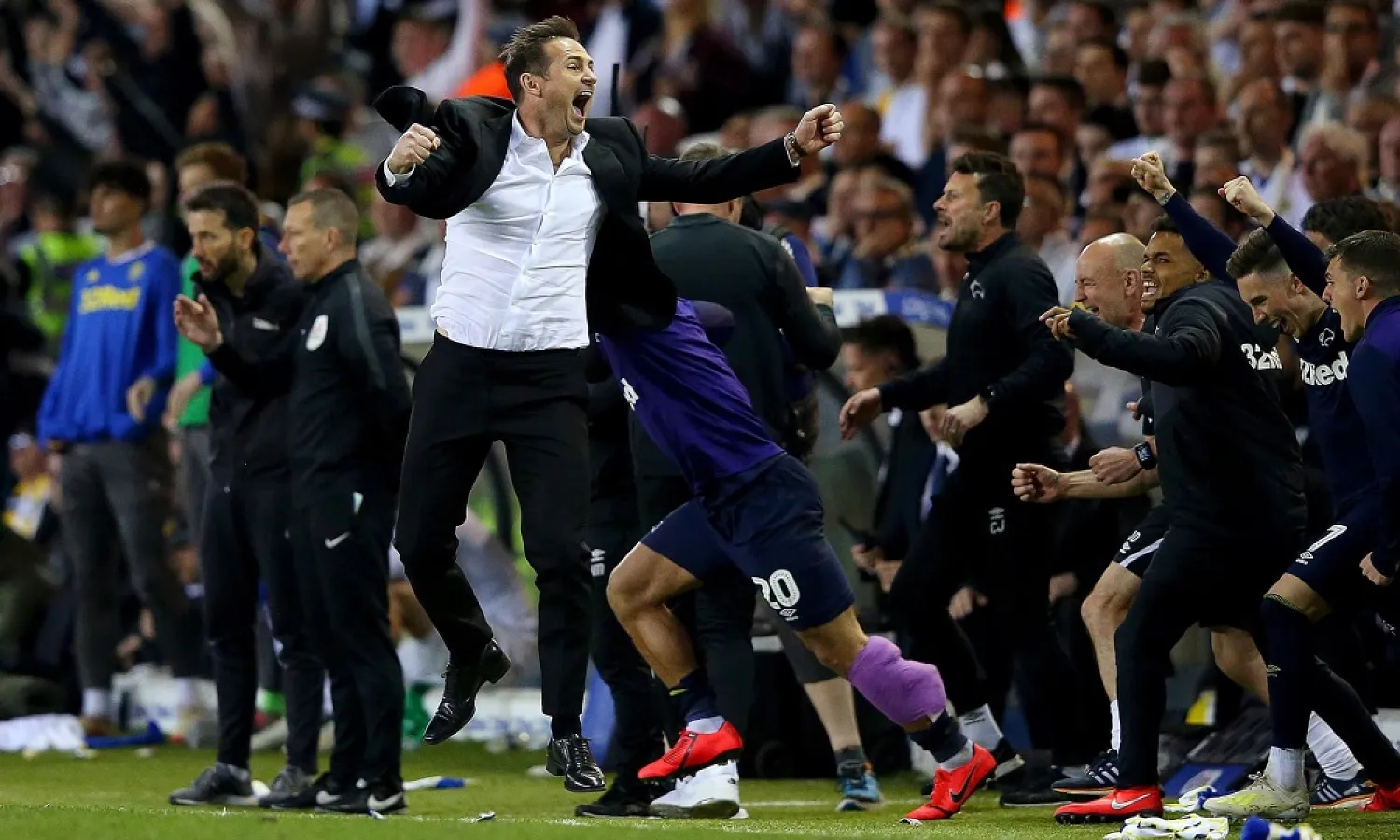
Derby manager Frank Lampard leads the celebrations as his side pipped Leeds to a place in the play-off final. (Getty Images)
TT

Pleasure of Promotion is Potent Despite Likelihood of Pain to Follow

Derby manager Frank Lampard leads the celebrations as his side pipped Leeds to a place in the play-off final. (Getty Images)

It was a privilege to be at Elland Road for the play-off second leg between Leeds and Derby, not only because it was one of the most grippingly exciting Championship games of the season but because it was a throwback to a rawness and immediacy that is gradually disappearing from football at the top level.

Walking in to the ground late along with hundreds of others affected by an M62 closure in late afternoon, it was impossible not to be struck by the raucousness and sheer volume that could be created by 36,000 inside a boxy old stadium.

Even from outside the distinctive roar at kick-off could be discerned and when the home fans began chanting at the opposition it was easy to pick out the words they were using. This was the sound of football, faithfully represented in several films and television features from a few decades ago as black and white moved into color.

Granted, it was an end-of-season climax with a lot at stake and it would be wrong to suggest the Premier League is incapable of creating passion and fervor but for the most part crowds in the top flight are more genteel and subdued. Waiting for a Premier League game to kick off, for instance, the impressionable youngster of today would be less likely to be struck by the intoxicating sensation of being part of a crowd that supporters of a certain age remember so well, than by the fact many seats only fill up five minutes before kick-off.

This is not exactly an exclusive: it has been pointed out before but Premier League atmospheres tend to be on the safe, sedate and sanitized side. When all-seat stadiums were being introduced post-Hillsborough, the unnecessary and alarming price rises that accompanied them were defended by risible comparisons with a theater-going experience that cost broadly the same. Risible because most theater-goers do not go week in week out, or follow the same play around the country. That battle was lost, inflated prices attracted a slightly older, more affluent breed of spectator, and you know the rest.

Many football crowds these days are about as noisy as theater audiences. A TV film crew wishing to make a documentary capturing the sound of present-day football would be unwise to set up microphones outside Old Trafford, the Etihad or the Emirates, even though they regularly host crowds of up to twice the size of the one at Elland Road.

Leeds lost to Derby, so Yorkshire’s only representatives in the top flight next season will be Sheffield United, who also happen to possess a famous old ground capable of generating genuine, old-fashioned atmosphere. Here is the rub, though. Will the Blades’ joy at gaining automatic promotion be tempered in six months or so by the reality of losing most weeks, struggling for survival at the foot of the division and generally wondering whether it was a good thing for their dreams to come true?

That may not happen. Teams as diverse as Wigan, Brighton, Bournemouth, Watford and Wolves have prospered in recent seasons after gaining a foothold in the Premier League and there is no reason why Sheffield United – or Norwich for that matter – should not do the same. Yet the record books show that most seasons one or more promoted teams go straight back down, with the team who come up through the play-offs usually the most vulnerable.

Fulham are the most recent example and, leaving the club’s financial situation aside, it is debatable whether many supporters will have found this past season enjoyable. Huddersfield came up through the play-offs the year before and, though they lasted a season longer than anyone expected – mainly due to Stoke, Swansea and West Brom performing abysmally at the same time – the campaign just completed was nothing less than an ordeal for all concerned.

Just about the only achievement Huddersfield could boast about in the end was not being relegated with a record-low number of points. That dubious Premier League honor still belongs to Derby, the same Derby who are now thrilled to be at Wembley fighting Aston Villa for the chance to do it all again.

This is not to suggest Frank Lampard’s side, should they make it, will perform as woefully in the top flight as Paul Jewell’s did in 2007‑08. But no one is expecting Derby or Villa to find Premier League life easy either, and one cannot help but marvel at the massive suspension of disbelief – sorry to use another theatrical term – necessary to allow such rampant optimism from fans at the play-off stage when the prize on offer is potentially so bleak.

In many ways the Championship is a healthier competition than the Premier League – some excellent teams, proper stadiums and no top-six ceiling to break through or Manchester City to outperform – but good luck telling a Leeds or a West Brom supporter that at the moment.

In play-off terms, Championship status amounts to failure, which is the way it has to be. For most promoted teams, if not their accountants, being in the Premier League will amount to failure, too, though this is not the time of year for rationality.

Three promoted sides will at least enjoy a blissful summer of Premier League status. If they are willing to ignore the fact that pain will most likely come later, so can we all.

The Guardian Sport


Shakhtar Boss Pays Ukrainian Racer $200,000 After Games Disqualification

Ukrainian President Volodymyr Zelenskiy holds helmet as he meets with a Ukrainian skeleton racer Vladyslav Heraskevych , who was disqualified from the Olympic skeleton competition over his "helmet of remembrance" depicting athletes killed since Russia's invasion and his father and coach, Mykhailo Heraskevych, amid Russia's attack on Ukraine, in Munich, Germany February 13, 2026. (Ukrainian Presidential Press Service/Handout via Reuters)
TT

Shakhtar Boss Pays Ukrainian Racer $200,000 After Games Disqualification

Ukrainian President Volodymyr Zelenskiy holds helmet as he meets with a Ukrainian skeleton racer Vladyslav Heraskevych , who was disqualified from the Olympic skeleton competition over his "helmet of remembrance" depicting athletes killed since Russia's invasion and his father and coach, Mykhailo Heraskevych, amid Russia's attack on Ukraine, in Munich, Germany February 13, 2026. (Ukrainian Presidential Press Service/Handout via Reuters)

The owner of ‌Ukrainian football club Shakhtar Donetsk has donated more than $200,000 to skeleton racer Vladyslav Heraskevych after the athlete was disqualified from the Milano Cortina Winter Games before competing over the use of a helmet depicting Ukrainian athletes killed in the war with Russia, the club said on Tuesday.

The 27-year-old Heraskevych was disqualified last week when the International Bobsleigh and Skeleton Federation jury ruled that imagery on the helmet — depicting athletes killed since Russia invaded Ukraine in 2022 — breached rules on athletes' expression at ‌the Games.

He ‌then lost an appeal at the Court ‌of ⁠Arbitration for Sport hours ⁠before the final two runs of his competition, having missed the first two runs due to his disqualification.

Heraskevych had been allowed to train with the helmet that displayed the faces of 24 dead Ukrainian athletes for several days in Cortina d'Ampezzo where the sliding center is, but the International Olympic Committee then ⁠warned him a day before his competition ‌started that he could not wear ‌it there.

“Vlad Heraskevych was denied the opportunity to compete for victory ‌at the Olympic Games, yet he returns to Ukraine a ‌true winner," Shakhtar President Rinat Akhmetov said in a club statement.

"The respect and pride he has earned among Ukrainians through his actions are the highest reward. At the same time, I want him to ‌have enough energy and resources to continue his sporting career, as well as to fight ⁠for truth, freedom ⁠and the remembrance of those who gave their lives for Ukraine," he said.

The amount is equal to the prize money Ukraine pays athletes who win a gold medal at the Games.

The case dominated headlines early on at the Olympics, with IOC President Kirsty Coventry meeting Heraskevych on Thursday morning at the sliding venue in a failed last-minute attempt to broker a compromise.

The IOC suggested he wear a black armband and display the helmet before and after the race, but said using it in competition breached rules on keeping politics off fields of play. Heraskevych also earned praise from Ukraine President Volodymyr Zelenskiy.


Speed Skating-Italy Clinch Shock Men’s Team Pursuit Gold, Canada Successfully Defend Women’s Title

 Team Italy with Davide Ghiotto, Andrea Giovannini, Michele Malfatti, celebrate winning the gold medal on the podium of the men's team pursuit speed skating race at the 2026 Winter Olympics, in Milan, Italy, Tuesday, Feb. 17, 2026. (AP)
Team Italy with Davide Ghiotto, Andrea Giovannini, Michele Malfatti, celebrate winning the gold medal on the podium of the men's team pursuit speed skating race at the 2026 Winter Olympics, in Milan, Italy, Tuesday, Feb. 17, 2026. (AP)
TT

Speed Skating-Italy Clinch Shock Men’s Team Pursuit Gold, Canada Successfully Defend Women’s Title

 Team Italy with Davide Ghiotto, Andrea Giovannini, Michele Malfatti, celebrate winning the gold medal on the podium of the men's team pursuit speed skating race at the 2026 Winter Olympics, in Milan, Italy, Tuesday, Feb. 17, 2026. (AP)
Team Italy with Davide Ghiotto, Andrea Giovannini, Michele Malfatti, celebrate winning the gold medal on the podium of the men's team pursuit speed skating race at the 2026 Winter Olympics, in Milan, Italy, Tuesday, Feb. 17, 2026. (AP)

An inspired Italy delighted the home crowd with a stunning victory in the Olympic men's team pursuit final as

Canada's Ivanie Blondin, Valerie Maltais and Isabelle Weidemann delivered another seamless performance to beat the Netherlands in the women's event and retain their title ‌on Tuesday.

Italy's ‌men upset the US who ‌arrived ⁠at the Games ⁠as world champions and gold medal favorites.

Spurred on by double Olympic champion Francesca Lollobrigida, the Italian team of Davide Ghiotto, Andrea Giovannini and Michele Malfatti electrified a frenzied arena as they stormed ⁠to a time of three ‌minutes 39.20 seconds - ‌a commanding 4.51 seconds clear of the ‌Americans with China taking bronze.

The roar inside ‌the venue as Italy powered home was thunderous as the crowd rose to their feet, cheering the host nation to one ‌of their most special golds of a highly successful Games.

Canada's women ⁠crossed ⁠the line 0.96 seconds ahead of the Netherlands, stopping the clock at two minutes 55.81 seconds, and

Japan rounded out the women's podium by beating the US in the Final B.

It was only Canada's third gold medal of the Games, following Mikael Kingsbury's win in men's dual moguls and Megan Oldham's victory in women's freeski big air.


Lindsey Vonn Back in US Following Crash in Olympic Downhill 

Milano Cortina 2026 Olympics - Alpine Skiing - Women's Downhill 3rd Official Training - Tofane Alpine Skiing Centre, Belluno, Italy - February 07, 2026. Lindsey Vonn of United States in action during training. (Reuters)
TT

Lindsey Vonn Back in US Following Crash in Olympic Downhill 

Milano Cortina 2026 Olympics - Alpine Skiing - Women's Downhill 3rd Official Training - Tofane Alpine Skiing Centre, Belluno, Italy - February 07, 2026. Lindsey Vonn of United States in action during training. (Reuters)

Lindsey Vonn is back home in the US following a week of treatment at a hospital in Italy after breaking her left leg in the Olympic downhill at the Milan Cortina Games.

“Haven’t stood on my feet in over a week... been in a hospital bed immobile since my race. And although I’m not yet able to stand, being back on home soil feels amazing,” Vonn posted on X with an American flag emoji. “Huge thank you to everyone in Italy for taking good care of me.”

The 41-year-old Vonn suffered a complex tibia fracture that has already been operated on multiple times following her Feb. 8 crash. She has said she'll need more surgery in the US.

Nine days before her fall in Cortina d'Ampezzo, Italy, Vonn ruptured the ACL in her left knee in another crash in Switzerland.

Even before then, all eyes had been on her as the feel-good story heading into the Olympics for her comeback after nearly six years of retirement.
