Hezbollah Cautiously Monitoring US Move to Launch Border Demarcation With Israel

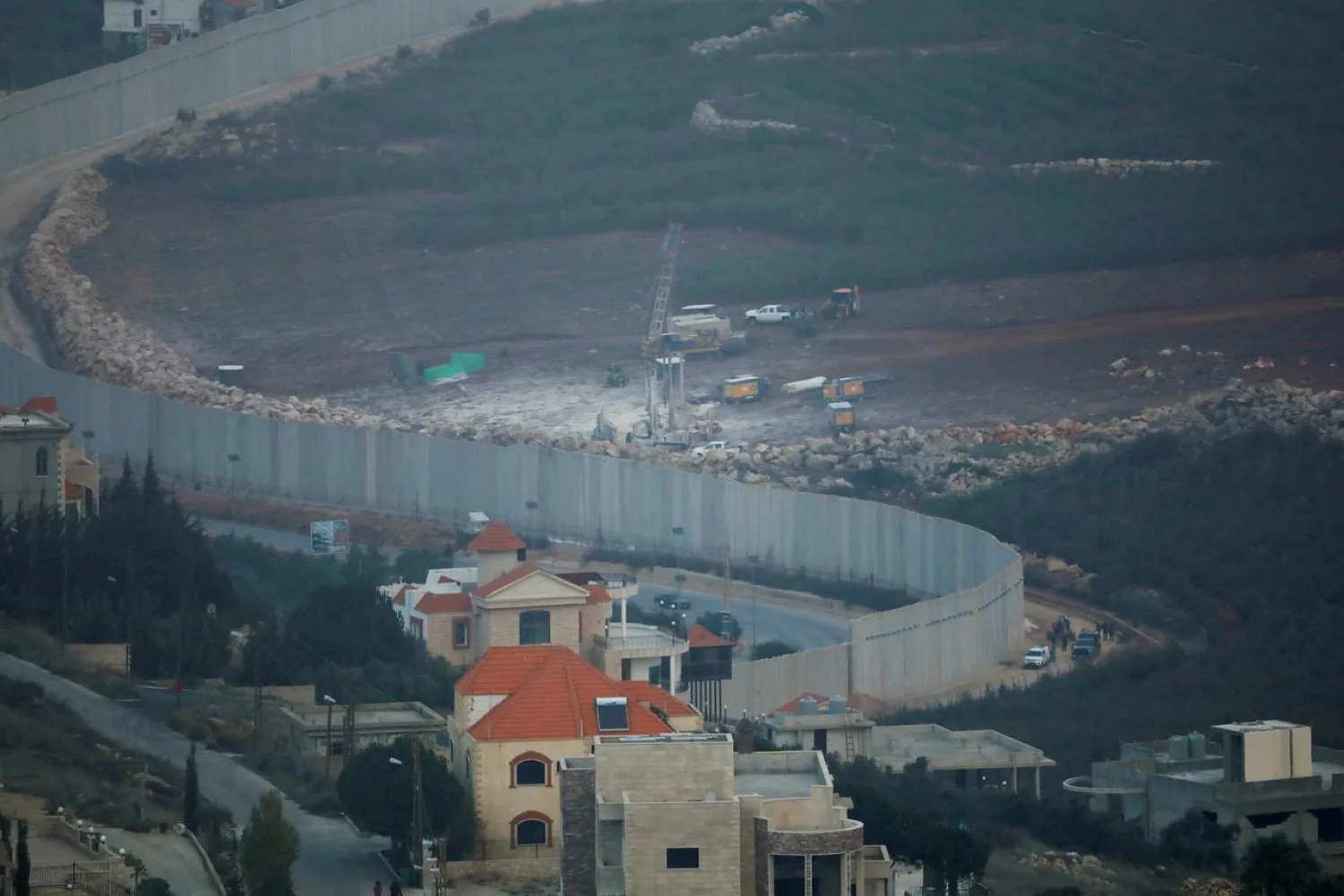
Israeli drilling equipment is seen next to the border with Lebanon, near the Lebanese village of Kfar Kila on December 4, 2018. REUTERS/Ronen Zvulun/File Photo
TT

Hezbollah Cautiously Monitoring US Move to Launch Border Demarcation With Israel

Israeli drilling equipment is seen next to the border with Lebanon, near the Lebanese village of Kfar Kila on December 4, 2018. REUTERS/Ronen Zvulun/File Photo

Hezbollah is cautiously monitoring the US move to mediate between Lebanon and Israel on border demarcation negotiations currently underway by Acting US Assistant Secretary of State for Near Eastern Affairs Ambassador David Satterfield.

The party appears to have succumbed to the government’s decision to proceed with the new US mediation, although it is still likely to be dealing with the US as an “impartial mediator” in the demarcation negotiations, as declared by Secretary-General Hassan Nasrallah last year when he said that America was “Israel’s lawyer” in this battle.

However, in a recent statement, Nasrallah stressed that the “resistance supports the position of the State and stands behind it.”

The party insists that the Lebanese State should deal with any negotiations from a position of strength, arguing that if the Israelis could prevent Lebanon from obtaining oil and gas, Lebanon could also stop them from accessing this wealth.

According to sources in March 8 forces, Hezbollah maintains that the demarcation of the land and maritime borders should be completed simultaneously. Lebanese negotiators have conveyed this demand to Satterfield. In addition, Hezbollah categorically rejects any compromise on the Lebanese territories, as Western sources have circulated proposals that Lebanon will abandon five out of 13 points of disputed land, over which the country had stressed its sovereignty.

The sources added that Hezbollah was absolutely against any proposal that would lead to abandoning an inch of Lebanese territories, whether at sea or land.

The head of the Institute for Near East and Gulf Military Analysis – INEGMA, Riad Kahwaji, said that Lebanon today had a unique opportunity to demarcate its borders.

“Therefore, any party that will try to sabotage what is happening means that it does not seek Lebanon’s supreme interest,” he noted.

“The good and wise Lebanese option is to deal positively with the issue,” Kahwaji told Asharq Al-Awsat.

Kahwaji said that the main question that arises at this stage is “whether Tehran is ready to abandon the tension in southern Lebanon or it will continue to exploit it for its own geopolitical purposes.”


Last Australians Leave Syria Camp Holding Suspected Militant Relatives

Zeinab Ahmad, one of two women linked to alleged ISIS militants, is seen being taken away in an armored police vehicle outside the Melbourne Magistrates’ Court in Melbourne on May 8, 2026, following her court appearance. (Photo by Martin KEEP / AFP)
TT

Last Australians Leave Syria Camp Holding Suspected Militant Relatives

Zeinab Ahmad, one of two women linked to alleged ISIS militants, is seen being taken away in an armored police vehicle outside the Melbourne Magistrates’ Court in Melbourne on May 8, 2026, following her court appearance. (Photo by Martin KEEP / AFP)

The last Australian women and children held in a northeast Syria camp housing relatives of suspected foreign militants left the site this week seeking to return home, a camp official told AFP on Saturday.

"Twenty-one Australians left Roj camp" on Thursday -- seven women and 14 children, aged eight to 14 -- the Kurdish administrative official said, speaking on condition of anonymity.

Syrian Kurdish forces control the Roj camp, where relatives of suspected foreign militants including Westerners have been held for years.

"They were handed over to the Syrian government and transferred to the Syrian capital with the aim of sending them to Australia," the official said, adding: "There are no more Australians remaining in Roj."

Earlier this month, 13 more Australians -- four women and their nine children -- flew home from Syria.

Two of the women, a mother and a daughter, were arrested on arrival, with police accusing them of having kept a female slave after travelling to Syria in 2014 to support the ISIS, and of crimes against humanity.

They had been detained by Kurdish forces in 2019.

A third woman was also arrested on arrival in Australia and charged with entering a restricted area and joining a "terrorist organization.”

The fourth woman was not arrested.

Small groups of women and children flew back to Australia in 2019, 2022 and 2025.


Tunisia Jails Former Head of Anti-graft Body for 10 Years

Former head of National Anti-Corruption Authority Chawki Tabib (Getty)
TT

Tunisia Jails Former Head of Anti-graft Body for 10 Years

Former head of National Anti-Corruption Authority Chawki Tabib (Getty)

A Tunisian court sentenced the former head of the national anti-graft body to 10 years in prison over charges including forging documents, his lawyer said on Friday.

Chawki Tabib, who is also a prominent lawyer and the former head of the Tunisian bar association, was arrested last April.

Defense lawyer Samir Dilou said Tabib, 62, was convicted on Thursday of "forging documents" and "possessing and using forged documents.”

The charges came after a complaint lodged against him following a report by the National Anti-Corruption Authority, which Tabib headed from 2016 to 2020, accusing former prime minister Elyes Fakhfakh of a conflict of interest during his tenure.

According to AFP, Fakhfakh then sacked Tabib, who called the measure "unconstitutional" and an "abuse of power.”

The anti-graft body was dissolved in 2021 after a sweeping power grab by President Kais Saied, which rights groups have said precipitated a major rollback in freedoms in Tunisia.

Tabib has defended several political opponents of Saied in court.

He is currently facing other judicial cases, including over alleged money laundering and other violations during his tenure as head of the anti-graft body.


Sudan War: Is A Settlement Drawing Closer?

 A child sits on a hill overlooking a refugee camp near Sudan’s border with Chad in November 2023 (Reuters)
A child sits on a hill overlooking a refugee camp near Sudan’s border with Chad in November 2023 (Reuters)
TT

Sudan War: Is A Settlement Drawing Closer?

 A child sits on a hill overlooking a refugee camp near Sudan’s border with Chad in November 2023 (Reuters)
A child sits on a hill overlooking a refugee camp near Sudan’s border with Chad in November 2023 (Reuters)

After more than three years of war, Sudan is facing a different political and humanitarian moment. The fighting has not stopped, and neither side has won. But the cost of prolonging the war now appears to have outgrown what Sudan, its neighbors, and the wider international community can bear.

As international pressure builds, regional diplomacy gathers pace and the humanitarian collapse deepens, one question is echoing through political and media circles: Is Sudan’s war nearing a settlement, or is the country slipping into another long conflict like those that scarred its past?

Sudan’s history offers little comfort. Its major wars have often lasted decades. The first civil war in the South ran for 17 years, from 1955 to 1972. The second lasted 22 years, from 1983 to 2005. The Darfur war continued for about 17 years, from 2003 to 2020. All ended only after a return to dialogue, understanding, and peace. That history leaves many Sudanese fearing that the current conflict could become a new chapter in the country’s long, open-ended wars.

But others argue this war is different.

Since fighting erupted between the army and the Rapid Support Forces in April 2023, both sides have bet on a swift military victory. As the war enters its fourth year, the limits of that bet are clear. Battles have spread from Khartoum to Port Sudan, Darfur, Kordofan, and Blue Nile.

They have not delivered a decisive victory for either side. Instead, they have plunged Sudan into one of the world’s worst humanitarian crises.

As the battlefield grows more complex, the international community increasingly sees Sudan’s war as a threat beyond Sudan itself. Rising tensions in the Red Sea, fears that chaos could spread through the Horn of Africa, and growing displacement and illegal migration have pushed Western and regional capitals to intensify pressure for a political settlement.

In that context, the recent Berlin conference marked an important milestone. Dozens of countries and international organizations agreed that Sudan’s crisis “cannot be resolved militarily” and voiced clear support for a comprehensive negotiating track.

The United States and the European Union have also stepped up diplomatic efforts to push for a ceasefire, amid growing fears that instability could spread across the region.

One of the clearest signs of this shift came from Massad Boulos, senior adviser to the US president for Arab and African affairs. He said there was “no military solution” to the conflict in Sudan and pointed to an “international consensus” on pushing the parties toward negotiations and a ceasefire.

He also cited US efforts to support humanitarian truces that could pave the way for a permanent halt to the fighting.

The shift does not mean a settlement is imminent. But it does show a growing conviction among influential powers that continued war could lead to the full collapse of the Sudanese state, a scenario feared by many regional and international actors, especially Sudan’s neighbors.

Recent months have also brought more active regional diplomacy than in the war’s early years, when the conflict was often described as the “forgotten war.”

Coordination has grown among the African Union, the Intergovernmental Authority on Development and the Arab League, alongside Gulf, Egyptian and African moves aimed at preventing Sudan’s disintegration or its slide into an open arena for regional conflict.

Those actors know the war will not threaten Sudan alone. It could directly affect Red Sea security, international trade and the stability of neighboring states. That makes a political settlement a regional necessity, not only a Sudanese demand.

Inside Sudan, the army still speaks the language of continued military operations. Yet it has left the door ajar to political solutions. In remarks carrying clear political weight, Burhan recently said that “anyone who reaches conviction and lays down arms, the homeland’s embrace is open to him.”

Observers saw the message as an attempt to open the way for possible settlements, or to encourage defections from the Rapid Support Forces by offering implicit guarantees to those ready to return and join new arrangements.

Still, Burhan continues to say the army is “moving ahead with restoring the state and its institutions.”

That reflects the military establishment’s firm political and military ceiling in any future negotiations, and shows that the path to a comprehensive settlement remains highly complicated, despite mounting pressure to end the war.

Humanitarian pressure

The strongest pressure on all sides may no longer be military or political. It is humanitarian.

The United Nations and international food agencies have warned that Sudan is facing one of the world’s largest hunger crises. According to the Integrated Food Security Phase Classification, or IPC, report issued in May 2026, about 20 million Sudanese are suffering acute food insecurity, while tens of thousands face the risk of famine.

Several areas could face a humanitarian catastrophe if the war continues.

World Food Program Executive Director Cindy McCain said hunger and malnutrition threaten the lives of millions, urging swift action to stop the crisis from becoming a “major tragedy.”

UNICEF Executive Director Catherine Russell said the humanitarian situation had reached a tragic stage, with children arriving at health facilities “too weak to cry.”

Inside Sudanese circles, calls to end the war are widening, even as divisions persist over what a settlement should look like. Some analysts close to the army say falling public support for continued war does not mean accepting the Rapid Support Forces as a force parallel to the state. Any future settlement, they argue, must be tied to rebuilding a unified military institution.

Observers say rising international pressure, military exhaustion and humanitarian deterioration could push the warring parties toward a political settlement in the coming phase.

Sharif Mohamed Osman, political secretary of the Sudanese Congress Party, said there was “no military solution and no peace without genuine civilian leadership,” arguing that ending the war requires a comprehensive settlement that rebuilds the state and its institutions.

Other observers say Sudan now stands at a delicate balance point between peace and continued war. Political analyst Mohamed Latif says international conditions, external pressure, and civilian suffering make peace “closer than ever.”

But he also says new fighting fronts and regional complexities continue to prolong the conflict, leaving all options open.

From a security and strategic perspective, military expert Brig. Gen. Dr. Jamal al-Shaheed says Sudan is at an extremely dangerous crossroads. One path leads to a political settlement forced by military exhaustion and international pressure.

The other leads to an “extended war,” where neither side can achieve total victory while state institutions slowly erode under military, economic and humanitarian attrition.

Al-Shaheed warns that time is no longer on Sudan’s side, and that every additional day of war doubles the future cost of peace.

Despite all these signals, the biggest questions remain unanswered: Has the war reached the point of exhaustion that usually precedes settlements? Or is Sudan still at the start of a long conflict whose end has yet to take shape?