


Özil, Emery Clearly Do Not Have a Connection but Will Arsenal Act?

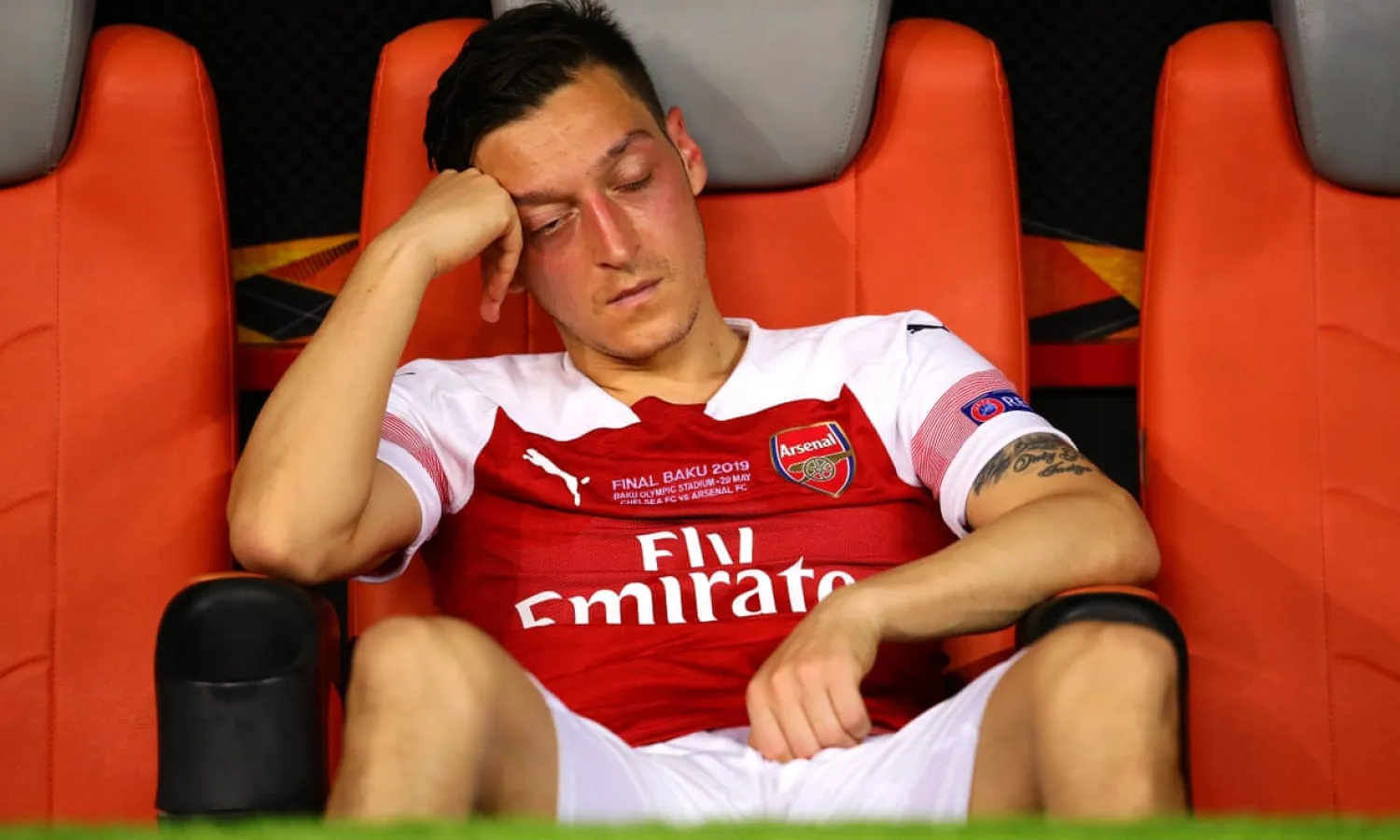
Mesut Özil sits in Arsenal’s dugout after being substituted by Unai Emery during their Europa League final defeat by Chelsea. Photograph: Chris Brunskill/Fantasista/Getty Images
TT

Özil, Emery Clearly Do Not Have a Connection but Will Arsenal Act?

Mesut Özil sits in Arsenal’s dugout after being substituted by Unai Emery during their Europa League final defeat by Chelsea. Photograph: Chris Brunskill/Fantasista/Getty Images

As Mesut Özil trudged, head bowed, around the pitch at the end of it all in Baku it was pertinent to wonder what has become of him and where it all goes from here. He is the lost playmaker. His once proud joy in the assist, his once delicate ability to be the subtle architect of a game, has dwindled to the point where it is really worth revisiting a highlights reel from previous years to remember how – even with that idiosyncratic languid style which means he seldom looks keen for a battle – his gifts had so much more presence.

If being replaced on the night by a teenager who spent most of this season playing for Arsenal Under-23s yet managed to involve himself in the game more in a cameo felt like an indignity, the greater affront should be a broader question. What has happened to Özil? Why do the passes not come any more? What has dulled his vision? The questions were put into even sharper focus as the Chelsea player in his role demanded and dominated the final. Eden Hazard has earned the opposite journey Özil made a few years ago, from the Premier League to Real Madrid.

When Arsenal signed Özil in 2013 he arrived as a game-changer on and off the pitch. In many ways he turned out to be just that – a symbol that the club wanted to compete for eye-catching talent, reflective of refreshed ambition which led to Alexis Sánchez joining a year later. For a while the pair were outstanding together.

Everything took a turn when Ivan Gazidis felt panicked into handing Özil a gargantuan new deal in January 2018 to avoid losing both their grandest stars at the same time with contracts running down, as has happened in damaging fashion this season with Aaron Ramsey. Of course Gazidis walked out a few months later but his parting gift has turned out to be something Arsenal do not know what to do with. It is a major problem going forward.

This is a deal, worth £350,000 per week, Arsenal cannot afford while they are not getting enough return on their bucks. Özil has been involved in nine goals this season, delivering either the strike or assist. In the previous three campaigns the numbers were 19, 26 and 28. It is quite the reduction. He has made a mere three assists in 2018-19, and that with two skilled marksmen in front of him in Pierre-Emerick Aubameyang and Alexandre Lacazette who have scored regularly.

And here is the extra problem: Arsenal’s highest earner and their current head coach evidently do not have a connection that works for either of them. One year into a difficult job but with little exciting evidence of improvement or new direction, and with Champions League qualification – the main aim of the season – unachieved, a recently divided fanbase has started to question whether Unai Emery is the right man.

It is easy to slip into those thoughts in a modern football culture where Maurizio Sarri’s position is far from secure despite finishing third and winning the Europa League –two aims Emery had a month ago before watching his team flail in both.

Some wags on the internet have started to call Emery “Bruce Rioja”. It is a clever pun, and the inference is a comparison with an Arsenal manager who took over from a powerful and successful predecessor and, despite his best efforts, was ousted after one season. Bruce Rioch was the fall guy in 1996 when the star player of the day, Ian Wright, could not connect with him and Arsenal decided to go down a different road by appointing Arsène Wenger. Those were different times, though. Back then Arsenal had an ambitious board ready to be dynamic and take difficult decisions.

It does not look as if it will be healthy for Arsenal to go into next season with Emery trying to make the best of it while Özil hangs around picking up such a high proportion of the wage bill. But it would be a surprise if there turns out to be enough conviction from on high to do something about that one way or the other, to clean a slate somehow.

Emery had tried quite hard to inspire Özil when he arrived in London. That seemed particularly important because the player had gone through a personal crisis in his career, scapegoated for Germany’s woeful World Cup. Özil felt pushed to step away from the international stage with grievances about racist undertones in how he felt perceived as a German with Turkish heritage. Emery tried to put the metaphorical arm around him, told him he was valued at Arsenal, that he wanted to see him enjoy his best football. Özil was given a share of the captaincy and the No 10 shirt, symbols to make him feel valued. But then reality set in.

These two men exist at different ends of the spectrum when it comes to the idea of hard work being central to football. It began to grate on both of them. After a period when Özil was dropped and hard words were said as one last throw of the motivational dice, he was reintegrated into the side. But he has seldom sparked in the Emery era. His Baku non-event of a performance typified that.

He is 30 now. The Özil question matters profoundly to Arsenal. But it comes with no simple answers.

(The Guardian)


Shakhtar Boss Pays Ukrainian Racer $200,000 After Games Disqualification

Ukrainian President Volodymyr Zelenskiy holds helmet as he meets with a Ukrainian skeleton racer Vladyslav Heraskevych , who was disqualified from the Olympic skeleton competition over his "helmet of remembrance" depicting athletes killed since Russia's invasion and his father and coach, Mykhailo Heraskevych, amid Russia's attack on Ukraine, in Munich, Germany February 13, 2026. (Ukrainian Presidential Press Service/Handout via Reuters)
TT

Shakhtar Boss Pays Ukrainian Racer $200,000 After Games Disqualification

Ukrainian President Volodymyr Zelenskiy holds helmet as he meets with a Ukrainian skeleton racer Vladyslav Heraskevych , who was disqualified from the Olympic skeleton competition over his "helmet of remembrance" depicting athletes killed since Russia's invasion and his father and coach, Mykhailo Heraskevych, amid Russia's attack on Ukraine, in Munich, Germany February 13, 2026. (Ukrainian Presidential Press Service/Handout via Reuters)

The owner of ‌Ukrainian football club Shakhtar Donetsk has donated more than $200,000 to skeleton racer Vladyslav Heraskevych after the athlete was disqualified from the Milano Cortina Winter Games before competing over the use of a helmet depicting Ukrainian athletes killed in the war with Russia, the club said on Tuesday.

The 27-year-old Heraskevych was disqualified last week when the International Bobsleigh and Skeleton Federation jury ruled that imagery on the helmet — depicting athletes killed since Russia invaded Ukraine in 2022 — breached rules on athletes' expression at ‌the Games.

He ‌then lost an appeal at the Court ‌of ⁠Arbitration for Sport hours ⁠before the final two runs of his competition, having missed the first two runs due to his disqualification.

Heraskevych had been allowed to train with the helmet that displayed the faces of 24 dead Ukrainian athletes for several days in Cortina d'Ampezzo where the sliding center is, but the International Olympic Committee then ⁠warned him a day before his competition ‌started that he could not wear ‌it there.

“Vlad Heraskevych was denied the opportunity to compete for victory ‌at the Olympic Games, yet he returns to Ukraine a ‌true winner," Shakhtar President Rinat Akhmetov said in a club statement.

"The respect and pride he has earned among Ukrainians through his actions are the highest reward. At the same time, I want him to ‌have enough energy and resources to continue his sporting career, as well as to fight ⁠for truth, freedom ⁠and the remembrance of those who gave their lives for Ukraine," he said.

The amount is equal to the prize money Ukraine pays athletes who win a gold medal at the Games.

The case dominated headlines early on at the Olympics, with IOC President Kirsty Coventry meeting Heraskevych on Thursday morning at the sliding venue in a failed last-minute attempt to broker a compromise.

The IOC suggested he wear a black armband and display the helmet before and after the race, but said using it in competition breached rules on keeping politics off fields of play. Heraskevych also earned praise from Ukraine President Volodymyr Zelenskiy.


Speed Skating-Italy Clinch Shock Men’s Team Pursuit Gold, Canada Successfully Defend Women’s Title

 Team Italy with Davide Ghiotto, Andrea Giovannini, Michele Malfatti, celebrate winning the gold medal on the podium of the men's team pursuit speed skating race at the 2026 Winter Olympics, in Milan, Italy, Tuesday, Feb. 17, 2026. (AP)
Team Italy with Davide Ghiotto, Andrea Giovannini, Michele Malfatti, celebrate winning the gold medal on the podium of the men's team pursuit speed skating race at the 2026 Winter Olympics, in Milan, Italy, Tuesday, Feb. 17, 2026. (AP)
TT

Speed Skating-Italy Clinch Shock Men’s Team Pursuit Gold, Canada Successfully Defend Women’s Title

 Team Italy with Davide Ghiotto, Andrea Giovannini, Michele Malfatti, celebrate winning the gold medal on the podium of the men's team pursuit speed skating race at the 2026 Winter Olympics, in Milan, Italy, Tuesday, Feb. 17, 2026. (AP)
Team Italy with Davide Ghiotto, Andrea Giovannini, Michele Malfatti, celebrate winning the gold medal on the podium of the men's team pursuit speed skating race at the 2026 Winter Olympics, in Milan, Italy, Tuesday, Feb. 17, 2026. (AP)

An inspired Italy delighted the home crowd with a stunning victory in the Olympic men's team pursuit final as

Canada's Ivanie Blondin, Valerie Maltais and Isabelle Weidemann delivered another seamless performance to beat the Netherlands in the women's event and retain their title ‌on Tuesday.

Italy's ‌men upset the US who ‌arrived ⁠at the Games ⁠as world champions and gold medal favorites.

Spurred on by double Olympic champion Francesca Lollobrigida, the Italian team of Davide Ghiotto, Andrea Giovannini and Michele Malfatti electrified a frenzied arena as they stormed ⁠to a time of three ‌minutes 39.20 seconds - ‌a commanding 4.51 seconds clear of the ‌Americans with China taking bronze.

The roar inside ‌the venue as Italy powered home was thunderous as the crowd rose to their feet, cheering the host nation to one ‌of their most special golds of a highly successful Games.

Canada's women ⁠crossed ⁠the line 0.96 seconds ahead of the Netherlands, stopping the clock at two minutes 55.81 seconds, and

Japan rounded out the women's podium by beating the US in the Final B.

It was only Canada's third gold medal of the Games, following Mikael Kingsbury's win in men's dual moguls and Megan Oldham's victory in women's freeski big air.


Lindsey Vonn Back in US Following Crash in Olympic Downhill 

Milano Cortina 2026 Olympics - Alpine Skiing - Women's Downhill 3rd Official Training - Tofane Alpine Skiing Centre, Belluno, Italy - February 07, 2026. Lindsey Vonn of United States in action during training. (Reuters)
TT

Lindsey Vonn Back in US Following Crash in Olympic Downhill 

Milano Cortina 2026 Olympics - Alpine Skiing - Women's Downhill 3rd Official Training - Tofane Alpine Skiing Centre, Belluno, Italy - February 07, 2026. Lindsey Vonn of United States in action during training. (Reuters)

Lindsey Vonn is back home in the US following a week of treatment at a hospital in Italy after breaking her left leg in the Olympic downhill at the Milan Cortina Games.

“Haven’t stood on my feet in over a week... been in a hospital bed immobile since my race. And although I’m not yet able to stand, being back on home soil feels amazing,” Vonn posted on X with an American flag emoji. “Huge thank you to everyone in Italy for taking good care of me.”

The 41-year-old Vonn suffered a complex tibia fracture that has already been operated on multiple times following her Feb. 8 crash. She has said she'll need more surgery in the US.

Nine days before her fall in Cortina d'Ampezzo, Italy, Vonn ruptured the ACL in her left knee in another crash in Switzerland.

Even before then, all eyes had been on her as the feel-good story heading into the Olympics for her comeback after nearly six years of retirement.
