



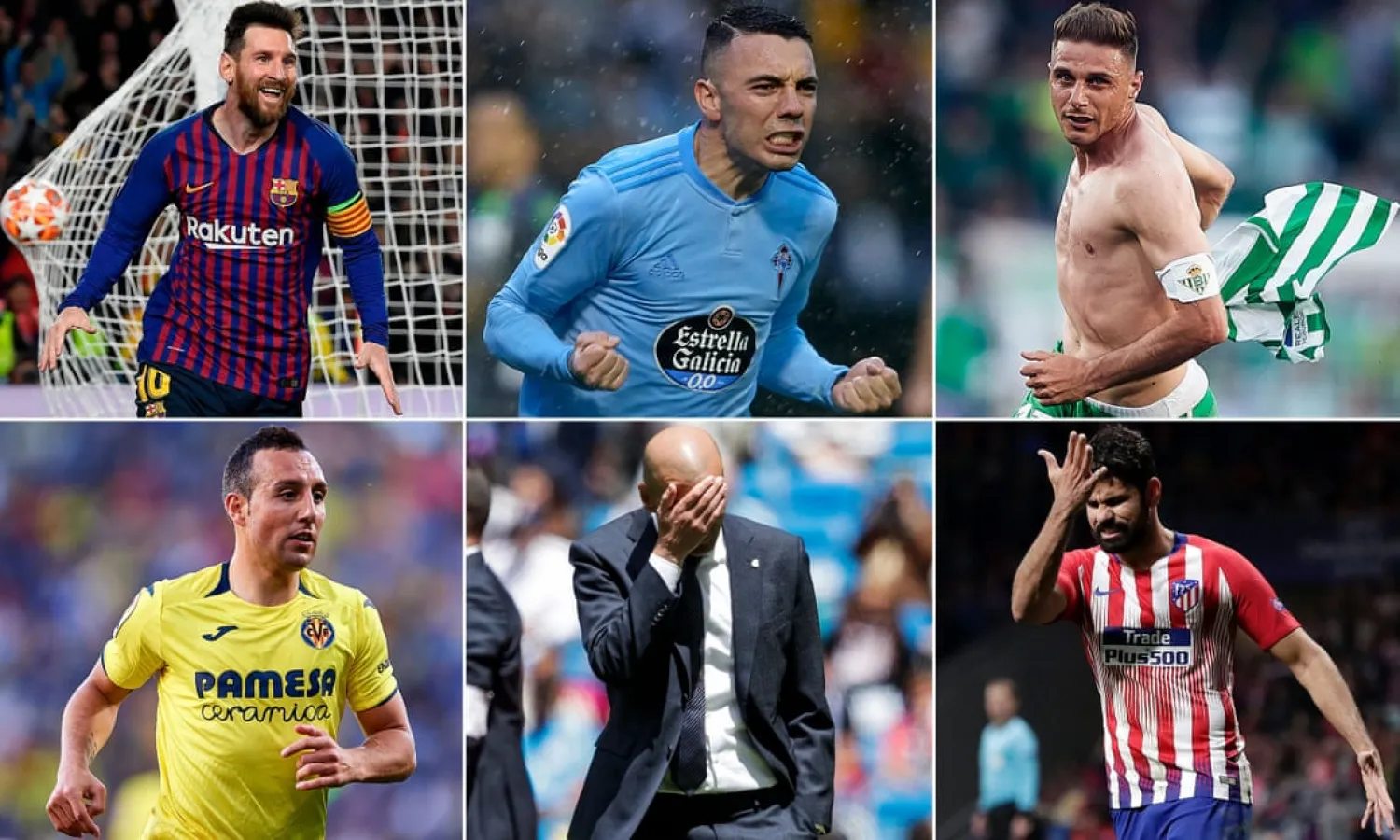

Spain organized the biggest party in European football but didn’t bother turning up. The Champions League final is supposed to be Real Madrid’s place, it’s being held at Atlético’s place, and it’s the place Barcelona were desperate to go to, but none of them will be there on Saturday night. In August, Leo Messi took the mic and vowed to do everything to win that “lovely and longed-for cup”. They were close, but Liverpool scored, Anfield erupted and Rome came rushing back, invading their thoughts. Seventeen days later, Messi admitted it was still on their minds and the following night Barcelona lost the Copa del Rey final, leaving “only” the league title, tossed on the pile.
Barcelona had reached the Champions League semi-final; the others had long gone. Valencia didn’t get out of the group and, in the knockout rounds, Madrid fell first, their season effectively ending in the worst week ever at the Bernabéu: six days, three games, three defeats, three competitions, aggregate score 8-1, and six months to wait for the next meaningful match. Still, at least they got Zinedine Zidane back and all was well. For a few days at least.
Atlético went seven days later, beaten in Turin. Their season was built towards Saturday night but all that was left for any of them was the league. A club from La Liga won’t win the Champions League and this is only the third time in 15 years that a Spanish team won’t win a European trophy.
The league was Barcelona’s again and was always likely to be, Ernesto Valverde’s side finishing 11 points above Atlético, 19 over Madrid – their biggest ever margin over their rivals. “We can’t have a cock-up every game,” Luka Modric said, summing up Madrid’s season. When Marcelo scored against Levante in October, it was Madrid’s first goal in eight hours and one minute and the next week they lost 5-1 to Barcelona at the Camp Nou. Julen Lopetegui, a dead man walking before he’d even walked in, got the sack the next day. All that for this?
There was a brief improvement with Santi Solari, but then came those six days. Beaten in the second league clásico, their title challenge was over, reinforcing Barcelona’s decade of dominance. They’ve won eight of the last 11 leagues, Madrid two. Atlético’s challenge, if it was one, came to an end the moment Diego Costa “shat on” the referee’s “prostitute mother”. There were still a few weeks to go, but it was done. Asked when he’d like to win the league, Ernesto Valverde replied: “What I like is that you can ask that.”
On the final day there was only the final Champions League place, a little European business and one relegation slot to play for, and the latter wasn’t really in doubt: Girona, who lost nine of their last 10, already knew they were gone. Valladolid, the team with the smallest budget, had already climbed to safety along with Levante and Villarreal and only Celta could take Girona’s place in the second division but that was almost impossible. Besides, they had Iago Aspas – the single most important player for any team in La Liga, repeatedly saving Celta from themselves – and he scored twice.
2018-2019 was the season of VAR, week after week spent waiting, watching and wondering as referees stood there, fingers in their ears, while in a room they looked at replays. Or didn’t. It was also the season of the comeback, football fans waking up to find Bobby Ewing in the shower as clubs everywhere acted like the last few months hadn’t happened: At Sevilla Caparrós returned, Monchi returned, and at Madrid Zidane returned, walking back in 284 days after walking out. Over at struggling Villarreal, meanwhile, they really jumped the shark, sacking Luis García after 49 days and replacing him with the coach he had replaced – the same coach they’d sacked just 50 days before. “I know it’s not normal, but Fernando Roig does the opposite of everyone else,” president Fernando Roig said.
At the end, then, there was a familiar, slightly predictable look to the table and to some of the teams. But things hadn’t always looked inevitable and certainly hadn’t seemed uncompetitive, that old trope lazily levelled at the league (even if the concerns are real). Barcelona were beaten by then-bottom Leganés. Rayo, who went down, beat Madrid. Girona, who dropped too, drew at the Camp Nou, knocked Atlético out of the cup at the Wanda and won at the Bernabéu. In October, it was reported that Madrid and Barcelona had not had such a poor start in 17 years. The “bad old days”, El Mundo called it, but everyone else thought it was good. “The best don’t always win, and that’s something to celebrate,” the Leganés manager, Mauricio Pellegrino, said.
Things changed, though. Sevilla led the league early, but then lost at Barcelona. “If we’re in a Champions League place at the end, I’ll be clapping with my ears,” the coach, Pablo Machín, had said but they didn’t get there and he’d already been sacked by then, probably prematurely. Amazingly, Alavés led the league in week 10 but slipped away, which was as natural as it was disappointing. Espanyol had begun up there too, but went from joint top to fifth within 20 minutes in week 12 and started to fall, only to climb back again and take seventh on the final day, players in their pants amid a proper pitch invasion. Betis went to the Camp Nou and tore Barcelona to bits, ending the season winning at the Bernabéu for the second year running, but results had deserted them, fans chanted for Quique Setién to “go now!” and that day he did. Athletic won only one of their first 15 games, but the new coach, Gaizka Garitano, carried them within a point of a European place on the final day, the shot that would have given it to them bouncing off the bar in the 92nd minute.
Their opponents, Sevilla, took sixth instead, but relief was laced with disappointment at having missed out on fourth and the Sevilla Cup. Getafe – the outstanding story of the season, ultimately unable to hold a position which might just have been the achievement of the century – finished fifth, having been in a Champions League place for 23 minutes on the final day. Above them were Valencia, which would be unremarkable enough except that at halfway they’d been four points above relegation and the coach, Marcelino García Toral, thought he was about to get sacked. But they backed him, and here they were again.
Valencia hadn’t finished either. A week later, they defeated Barcelona in the cup final, bringing the Spanish season to an end in Seville, seven days earlier than everyone hoped. It was Valencia’s first trophy in 11 years, back where they’re supposed to be. For their captain, Dani Parejo, 30, it was a first-ever winner’s medal, despite having played at QPR. For Marcelino, 53, it was too – a quarter of a century into his career. “We won!” he cheered, smile engulfing him.
The celebrations went on all night and it felt right. The cup had gone to someone who cared. Someone really, really wanted it. Which is more than can be said for these awards …
Safest ground
The Estadio Vallecas, thanks to a handful of heroic men. Rayo’s first home game of the season was postponed because this crumbling shaking mess of a ground was declared dangerous so work began on making it fit for purpose and one day a video emerged of a bunch of workmen in hi-vis bouncing up and down in the top tier to test everything was OK – all of it caught on camera in footage that screamed opening-scene-of-Casualty at you. The stand didn’t collapse, so that was OK. It also gave us this neat parody.
Best protest
Alavés’s requiem for football, coffin carried round the stands and left alone in an empty end on another Monday night at Mendizorroza.
Best projectiles
It was raining cats and dogs and bears and rabbits and SpongeBobs and Pokemons and dinosaurs and Smurfs and Tellytubbies. At half time in Betis-Eibar, fans threw thousands of cuddly toys on the pitch, gathered up and taken to children’s centers.
Best losing bet
Javier Tebas, the president of the league, gambling $10,000 on Girona-Barcelona getting played in Miami.
Most impressive ability to spectacularly miss the point
Advertisement
Tebas saying the one-legged Copa del Rey format had failed because Mallorca and Recreativo once got to the final.
Best red card
Franco “Mute One” Vazquez, sent off for talking too much.
Best excuse
Diego Costa: I shat on my prostitute mother, not yours.
Best moment
Thirty-seven-year-old Joaquín, scoring the winner in the Seville derby and declaring he could “leave football a happy man”. Diego Godín scoring the winner against Athletic Bilbao. In the last minute. In the pouring rain. With a diving header. Injured. “I tried to help,” he said. The winner, though, is that guy. Iago Aspas sobbing in the storm.
Best moment that lasted an entire season (and hopefully beyond)
Santi Cazorla has a bit of his forearm grafted on his right ankle, a piece of thigh in its place, part of his calf in his heel, and some rolled-up hamstring for an achilles. His bone went squidgy, his tendon had rotted away, he could have lost his leg, and was told to settle for strolling round the garden with his son, but he didn’t. Six hundred and thirty-six days since his last game, he returned against a team appropriately called Herculés – and he didn’t stop there, applauded at every ground in Spain. Still unemployed, no one convinced he would be back, in July he played at a tiny little municipal ground in Canet-en-Roussillon before 100 people and a brown dog, where the advertising boards announce local companies – brasserie l’Escale, Alliance nautical, the painter and decorator on Boulevard Archimedes – and a bar sells chips and wine; the next time he plays will be in front of 80,000 at the Bernabéu, recalled to the national team four years on.
Best match
Always Watch Betis stopped being a rule to live by, but Often Watch Betis worked: the second Seville derby was a cracking game, as were Betis 3-3 Celta, Barcelona 3-4 Betis, and Betis 1-4 Barcelona, although that belongs in Best Goal. Eibar 4-4 Levante was wild. None were as good a Villarreal 4-4 Barcelona: “We could say a thousand barbaric things,” Vicente Iborra said and even then they’d have only just got started.
Worst match
“Horror was made football at Butarque. En Nesyri scored an own goal with the only shot in the middle of a storm almost as ugly as the game. Absolute nothingness. No football. No chances. No tension. Nothing. An ode to anti-football about as much fun as hugging barbed wire. Eyes bled and the mouths of 4,155 brave souls yawned through a storm of tedium.” AS’s Javier Martin didn’t much enjoy Leganés against Athletic.
Best match report
Sport’s preview of Ontinyent against Teruel, a game that never happened. Ontinyent had gone out of business, but that didn’t stop it packing its piece with stats and grand words declaring how significant this was. No one noticed they’d “lost” the last two games 1-0 without a goalscorer or that kick-off was at 00.00. When people started laughing, the article was quietly taken down. “Oh, sorry! That page doesn’t exist,” the message says. Nor did the game.
Best goal
The season started with the first of many runs from José Luis Morales. Two days later Alex Gallar joined in: you’ve never scored in the first division before, never even played there, and on your debut you go and do this. You could choose any of Leo Messi’s many free-kicks but Rubén Alcaraz’s might even have been better.
Iñaki Williams got faster and faster and faster until he was at one end of San Mamés roaring, scorer of a wonderful goal. His teammate, Aritz Aduriz, scored a penalty that wasn’t just a penalty.
Staying at San Mamés, Pablo Fornals scored from somewhere outside Bilbao. He also did this.
In the second division, Málaga’s Jack Harper scored the goal his manager wanted shown at the club’s academy and Luis Milla scored a corner.
Sidnei went all Messi against Rayo, Aspas bamboozled Huesca as if he was out on the playground and flicked in a backheel on the final day, while Fornals scored a rabona against Huesca. OK, so he didn’t hit it that well, but still: rabona. “Cheeky,” Jose Luis Mendilibar called Inui after he did this against Eibar. Rosales belted in against Real Madrid. And how about this for a one-two?
Watch this Betis goal twice, because the first view doesn’t do the move justice. The assist on this, scored by Etxeita, is something special. So was one from Villarreal, a neat move culminating in a Carlos Bacca backheel that left goalkeeper and defender crashing into each other and Toto Ekambi free to score.
Luis Suárez’s shot against Atlético couldn’t have been more precise and effectively won the league. His best, though, came against Betis– a 90-minute goal of the season competition, an absurd collection of crackers. Including, of course, Messi’s hat-trick as good as the one he got across the city at Sevilla and remembered for the ball gently orbiting into the net to leave Pau wearing a face that said “did you see that?!” and Betis’s fans handing him a standing ovation. Given the reaction, the touch, the silliness of it, it’s hard to look beyond that as the best goal this year even if it might not have been the best that night.
But the winner is Chimy Avila of Huesca. The only question is, which Chimy Avila? This one? Or this? Woof!
Best manager
Gaizka Garitano, Rubi, Mauricio Pellegrino, José Luis Mendilibar, Abelardo, Sergio at Valladolid, and Marcelino finish behind the obvious winner. “Bordalás, I love you!” they chant at the Coliseum, and how could they not? Pepe Bordalás took Getafe from potential relegation from the second division to the gates of the Champions League.
Player of the year
“It’s bloody brilliant that Messi’s here with us,” Valverde said and, well, you don’t really need to say anything else.
(The Guardian)
