


Argentina Are Floundering, Messi Problem Is Not the Biggest One

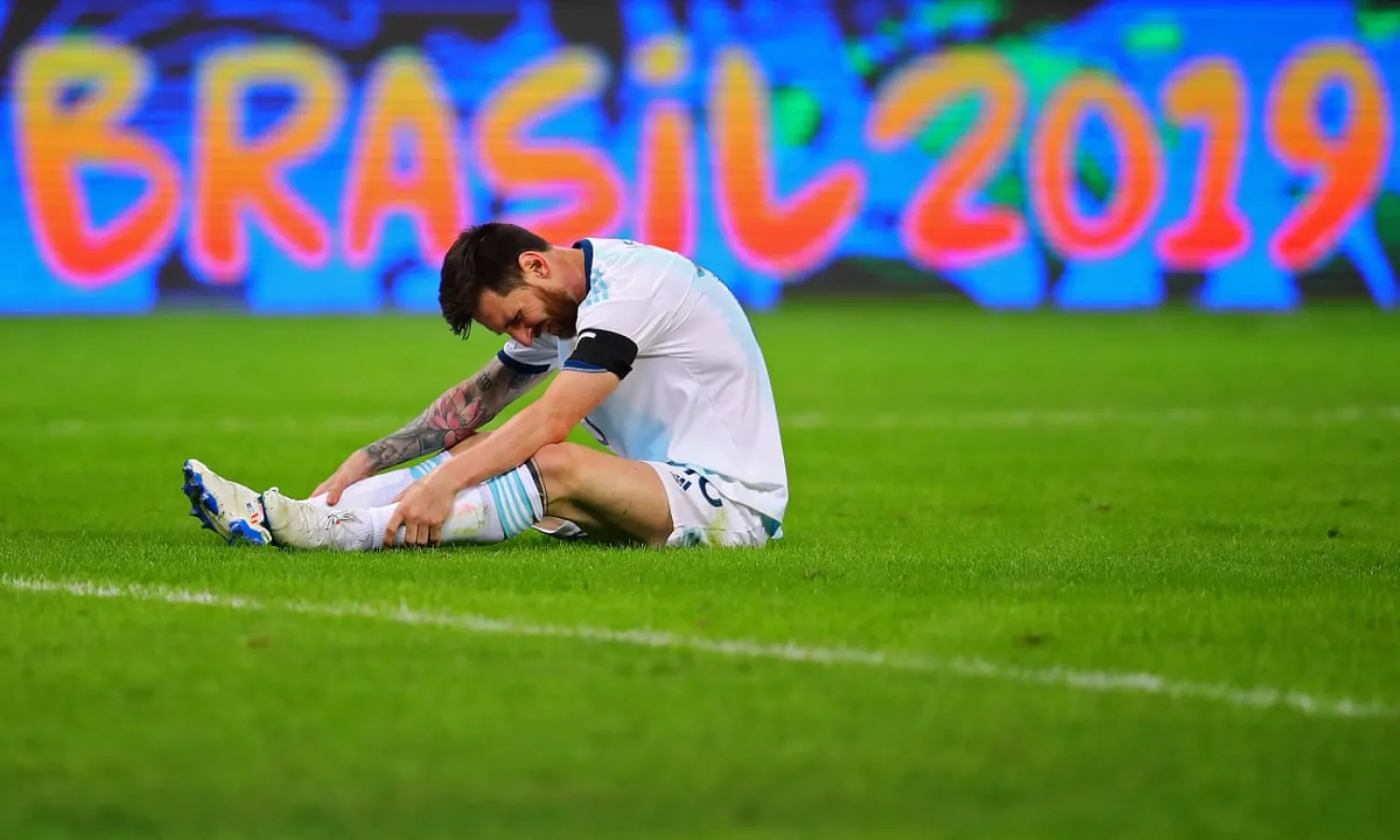
 Lionel Messi looks pained during Argentina’s Copa América draw against Paraguay, which followed a defeat by Colombia. Photograph: Chris Brunskill/Fantasista/Getty Images
Lionel Messi looks pained during Argentina’s Copa América draw against Paraguay, which followed a defeat by Colombia. Photograph: Chris Brunskill/Fantasista/Getty Images
TT

Argentina Are Floundering, Messi Problem Is Not the Biggest One

 Lionel Messi looks pained during Argentina’s Copa América draw against Paraguay, which followed a defeat by Colombia. Photograph: Chris Brunskill/Fantasista/Getty Images
Lionel Messi looks pained during Argentina’s Copa América draw against Paraguay, which followed a defeat by Colombia. Photograph: Chris Brunskill/Fantasista/Getty Images

The only positive for Argentina, and it is a dubious one, is that it could have been worse. A draw against Paraguay means they will probably advance to the quarter-final of the Copa América if they beat Qatar on Sunday – but there are no guarantees either that four points will be enough even for a best third-placed finish or, on current form, that they will beat the Asian champions. This was an extremely fortuitous point after another dismal performance.

Again, Argentina were painfully disjointed. Again, it was almost impossible to discern a plan. Again, there was little attacking flair and panic at every counter. Little wonder Sergio Agüero and Nicolás Otamendi have gone grey with the stress.

That Argentina did not repeat their opening defeat was down largely to two moments of fortune. First, the very modern penalty they were awarded, and that Lionel Messi converted, after Lautaro Martínez’s shot brushed an arm of Iván Piris before striking the crossbar, an offence so meagre not a single Argentinian appealed and most looked bewildered as the referee stopped them taking a corner to check the replay. If HotSpot or Snicko haven’t yet been added to the VAR toolkit, it can only be a matter of time.

Then, Derlis González saw his penalty saved by Franco Armani. It’s not the most significant detail, but it was mystifying that whereas Piris was booked for having an arm, Otamendi got away without a yellow card for chopping down González as the forward spun away from him in the box. That became significant in the 83rd minute as Otamendi was booked for a wild lunge; Paraguay should have had 14 minutes (thanks to the VAR-induced stoppage time) with an extra man. The result may have been better but this was arguably a worse Argentina performance than in the 2-0 defeat by Colombia.

It would be absurd to blame the caretaker coach Lionel Scaloni, the latest patsy to be shoved into the spotlight. If he is not grimly sweating on the touchline as his predecessor, Jorge Sampoli, did, watching in helpless horror as his reputation collapses around him, it is probably only because he doesn’t have a reputation to collapse.

What manner of shambles is it that has allowed a country that in the past year has produced the managers of both Copa Libertadores finalists and one of the Champions League finalists, the manager of the previous season’s Europa League and Copa Sudamericana winners and five managers at last summer’s World Cup to go into this tournament with someone who had never taken charge of a competitive fixture? Scaloni may develop but at the moment he is probably only the third-best Argentinian coach at this Copa América.

And then there is the awkward issue of Messi, whose quest to end Argentina’s 26 years of drought and win a senior international trophy has become the defining narrative of his national side. He is brilliant, clearly, and has dragged Argentina to what heights they have reached recently. Last time Argentina faced Paraguay in the Copa América, in the semi-final four years ago, he played a part in the buildup to all six Argentina goals and, at one point, left three defenders neatly stacked on top of each other after a body swerve.

Yet he also is a complication. He has followed the path beaten by Cristiano Ronaldo in doing less and less as his career has gone on to become a player far removed from the willing presser of a decade ago (in 2009-10 he won the ball back through tackles and interceptions 2.1 times per game in the league; last season it was 0.5). Perhaps that is only reasonable as age begins to drag at his 31-year-old legs; perhaps the lack of other responsibilities enhances his creative output. But as with Ronaldo, such focus comes at a cost to the rest of the side.

It’s not just that the psychological urge to give the ball to the star – as outlined by Paulo Dybala – becomes a tactical imperative that leads to predictability, it’s that his lack of defensive work inhibits everybody else as they pick up the slack, which can lead to rigidity and tentativeness. A club as good as Barcelona, for whom domination of possession is habitual, can, to an extent, cater for that, although as Liverpool showed even Barça can flounder against teams who call their bluff, don’t sit deep and don’t devote multiple players to trying to stop Messi.

But what can Argentina do? Whatever difficulties Messi poses, he is not the fundamental problem. Rather the inability to resolve the Messi conundrum highlights all the other issues around the squad: the lack of leadership, the lack of financial resources, the sense that other countries are benefiting from their coaching expertise and the diminishing pool of high-class players.

And that, perhaps, is the biggest worry for Argentina. For a quarter of a century the question has been why, when they had so many gifted players, have they never won anything. That has now subtly changed: how, when they have so few gifted players, can they ever win anything?

The Guardian Sport


Shakhtar Boss Pays Ukrainian Racer $200,000 After Games Disqualification

Ukrainian President Volodymyr Zelenskiy holds helmet as he meets with a Ukrainian skeleton racer Vladyslav Heraskevych , who was disqualified from the Olympic skeleton competition over his "helmet of remembrance" depicting athletes killed since Russia's invasion and his father and coach, Mykhailo Heraskevych, amid Russia's attack on Ukraine, in Munich, Germany February 13, 2026. (Ukrainian Presidential Press Service/Handout via Reuters)
TT

Shakhtar Boss Pays Ukrainian Racer $200,000 After Games Disqualification

Ukrainian President Volodymyr Zelenskiy holds helmet as he meets with a Ukrainian skeleton racer Vladyslav Heraskevych , who was disqualified from the Olympic skeleton competition over his "helmet of remembrance" depicting athletes killed since Russia's invasion and his father and coach, Mykhailo Heraskevych, amid Russia's attack on Ukraine, in Munich, Germany February 13, 2026. (Ukrainian Presidential Press Service/Handout via Reuters)

The owner of ‌Ukrainian football club Shakhtar Donetsk has donated more than $200,000 to skeleton racer Vladyslav Heraskevych after the athlete was disqualified from the Milano Cortina Winter Games before competing over the use of a helmet depicting Ukrainian athletes killed in the war with Russia, the club said on Tuesday.

The 27-year-old Heraskevych was disqualified last week when the International Bobsleigh and Skeleton Federation jury ruled that imagery on the helmet — depicting athletes killed since Russia invaded Ukraine in 2022 — breached rules on athletes' expression at ‌the Games.

He ‌then lost an appeal at the Court ‌of ⁠Arbitration for Sport hours ⁠before the final two runs of his competition, having missed the first two runs due to his disqualification.

Heraskevych had been allowed to train with the helmet that displayed the faces of 24 dead Ukrainian athletes for several days in Cortina d'Ampezzo where the sliding center is, but the International Olympic Committee then ⁠warned him a day before his competition ‌started that he could not wear ‌it there.

“Vlad Heraskevych was denied the opportunity to compete for victory ‌at the Olympic Games, yet he returns to Ukraine a ‌true winner," Shakhtar President Rinat Akhmetov said in a club statement.

"The respect and pride he has earned among Ukrainians through his actions are the highest reward. At the same time, I want him to ‌have enough energy and resources to continue his sporting career, as well as to fight ⁠for truth, freedom ⁠and the remembrance of those who gave their lives for Ukraine," he said.

The amount is equal to the prize money Ukraine pays athletes who win a gold medal at the Games.

The case dominated headlines early on at the Olympics, with IOC President Kirsty Coventry meeting Heraskevych on Thursday morning at the sliding venue in a failed last-minute attempt to broker a compromise.

The IOC suggested he wear a black armband and display the helmet before and after the race, but said using it in competition breached rules on keeping politics off fields of play. Heraskevych also earned praise from Ukraine President Volodymyr Zelenskiy.


Speed Skating-Italy Clinch Shock Men’s Team Pursuit Gold, Canada Successfully Defend Women’s Title

 Team Italy with Davide Ghiotto, Andrea Giovannini, Michele Malfatti, celebrate winning the gold medal on the podium of the men's team pursuit speed skating race at the 2026 Winter Olympics, in Milan, Italy, Tuesday, Feb. 17, 2026. (AP)
Team Italy with Davide Ghiotto, Andrea Giovannini, Michele Malfatti, celebrate winning the gold medal on the podium of the men's team pursuit speed skating race at the 2026 Winter Olympics, in Milan, Italy, Tuesday, Feb. 17, 2026. (AP)
TT

Speed Skating-Italy Clinch Shock Men’s Team Pursuit Gold, Canada Successfully Defend Women’s Title

 Team Italy with Davide Ghiotto, Andrea Giovannini, Michele Malfatti, celebrate winning the gold medal on the podium of the men's team pursuit speed skating race at the 2026 Winter Olympics, in Milan, Italy, Tuesday, Feb. 17, 2026. (AP)
Team Italy with Davide Ghiotto, Andrea Giovannini, Michele Malfatti, celebrate winning the gold medal on the podium of the men's team pursuit speed skating race at the 2026 Winter Olympics, in Milan, Italy, Tuesday, Feb. 17, 2026. (AP)

An inspired Italy delighted the home crowd with a stunning victory in the Olympic men's team pursuit final as

Canada's Ivanie Blondin, Valerie Maltais and Isabelle Weidemann delivered another seamless performance to beat the Netherlands in the women's event and retain their title ‌on Tuesday.

Italy's ‌men upset the US who ‌arrived ⁠at the Games ⁠as world champions and gold medal favorites.

Spurred on by double Olympic champion Francesca Lollobrigida, the Italian team of Davide Ghiotto, Andrea Giovannini and Michele Malfatti electrified a frenzied arena as they stormed ⁠to a time of three ‌minutes 39.20 seconds - ‌a commanding 4.51 seconds clear of the ‌Americans with China taking bronze.

The roar inside ‌the venue as Italy powered home was thunderous as the crowd rose to their feet, cheering the host nation to one ‌of their most special golds of a highly successful Games.

Canada's women ⁠crossed ⁠the line 0.96 seconds ahead of the Netherlands, stopping the clock at two minutes 55.81 seconds, and

Japan rounded out the women's podium by beating the US in the Final B.

It was only Canada's third gold medal of the Games, following Mikael Kingsbury's win in men's dual moguls and Megan Oldham's victory in women's freeski big air.


Lindsey Vonn Back in US Following Crash in Olympic Downhill 

Milano Cortina 2026 Olympics - Alpine Skiing - Women's Downhill 3rd Official Training - Tofane Alpine Skiing Centre, Belluno, Italy - February 07, 2026. Lindsey Vonn of United States in action during training. (Reuters)
TT

Lindsey Vonn Back in US Following Crash in Olympic Downhill 

Milano Cortina 2026 Olympics - Alpine Skiing - Women's Downhill 3rd Official Training - Tofane Alpine Skiing Centre, Belluno, Italy - February 07, 2026. Lindsey Vonn of United States in action during training. (Reuters)

Lindsey Vonn is back home in the US following a week of treatment at a hospital in Italy after breaking her left leg in the Olympic downhill at the Milan Cortina Games.

“Haven’t stood on my feet in over a week... been in a hospital bed immobile since my race. And although I’m not yet able to stand, being back on home soil feels amazing,” Vonn posted on X with an American flag emoji. “Huge thank you to everyone in Italy for taking good care of me.”

The 41-year-old Vonn suffered a complex tibia fracture that has already been operated on multiple times following her Feb. 8 crash. She has said she'll need more surgery in the US.

Nine days before her fall in Cortina d'Ampezzo, Italy, Vonn ruptured the ACL in her left knee in another crash in Switzerland.

Even before then, all eyes had been on her as the feel-good story heading into the Olympics for her comeback after nearly six years of retirement.
