

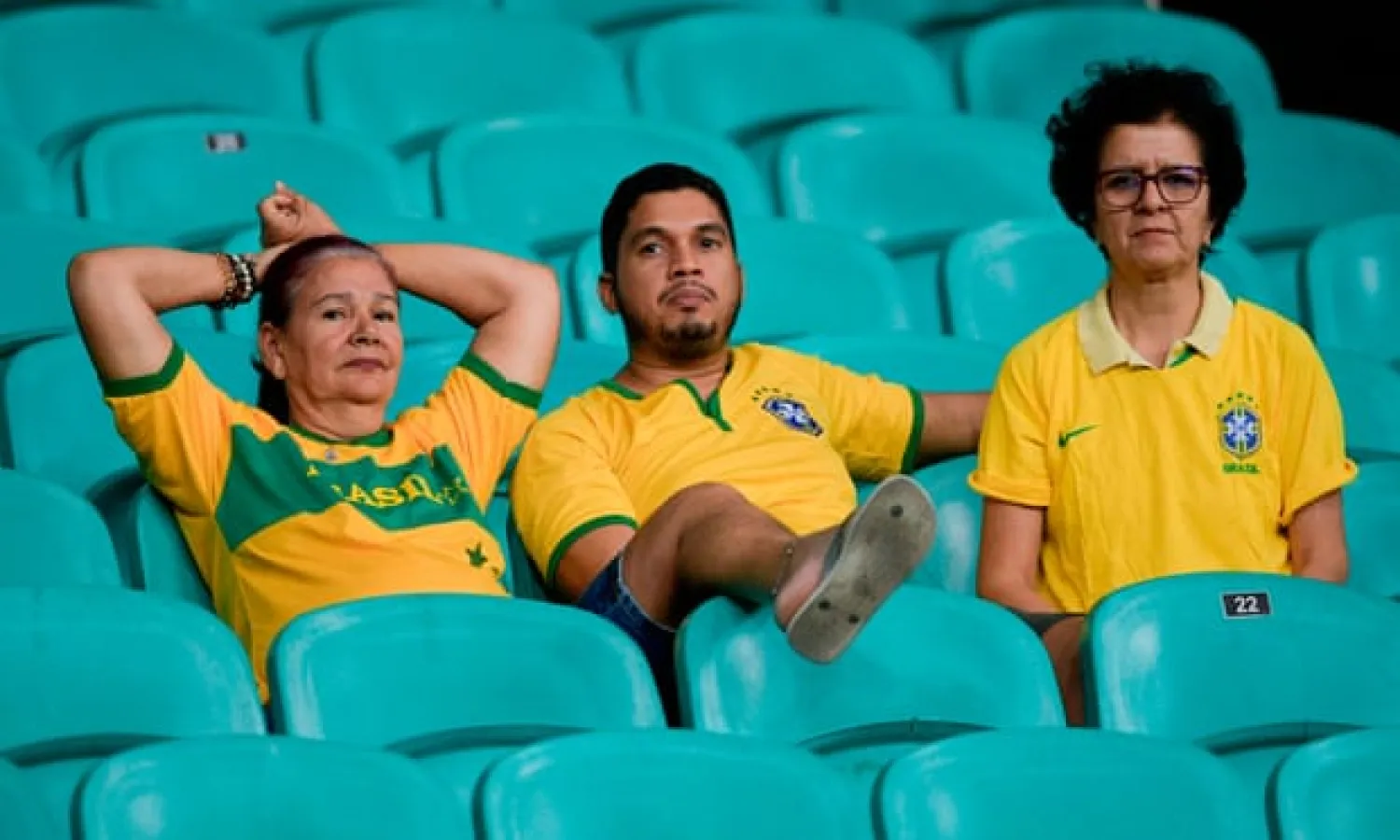

Brazilians Are Falling out of Love With Their Distant, Expensive Football Team

 Brazil fans reflect on a goalless draw with Venezuela at the Copa América. Photograph: Raúl Arboleda/AFP/Getty
Brazil fans reflect on a goalless draw with Venezuela at the Copa América. Photograph: Raúl Arboleda/AFP/Getty
TT

Brazilians Are Falling out of Love With Their Distant, Expensive Football Team

 Brazil fans reflect on a goalless draw with Venezuela at the Copa América. Photograph: Raúl Arboleda/AFP/Getty
Brazil fans reflect on a goalless draw with Venezuela at the Copa América. Photograph: Raúl Arboleda/AFP/Getty

The organisers of the Copa América insisted the opening match between Brazil and Bolivia on Friday evening would sell out the 67,000-capacity Morumbi stadium in São Paulo. It didn’t. Just 46,342 fans paid for tickets, leaving the ground just 70% full. With the game still goalless at half-time, the deafening silence turned to boos as Tite’s men trudged off the pitch. Two goals from Philippe Coutinho and a superb solo strike from Everton Soares gave Brazil a 3-0 win, but much of the debate after the game was about the crowd’s antipathy to their own team.

Manager Tite said he “expected” a negative reaction given the way his team played. “We need to understand. If we get forward and create chances they will applaud. Having been at big clubs, when you sometimes don’t produce, then don’t expect the fans to understand. They will boo. When you pass the ball along the back, from full-back to central defender to goalkeeper, the first thing you hear is boo.”

Dani Alves put the poor reception down to São Paulo’s clubismo tribalism and a lack of unity between fans of its three main teams. “Whenever we come here to Sao Paulo, that happens,” said Alves. “The people cannot separate their clubs from the Brazilian national team. In Bahia the energy is different. People miss the Brazil team, that energy the Seleção takes wherever it goes. Surely there will be more excitement than here.”

Alves was less forthcoming about the swathes of empty seats. “I don’t know if it was the price,” he pondered. His teammate, Thiago Silva, was more emphatic: “A lot of the time the ticket prices should be lower. It’s very expensive for our people. First of all, for us to create a greater spectacle, I think we need to be more sensible.”

Mauro Cezar, who covers the national team for ESPN in Brazil, agrees. “There’s a lack of sense from South American football directors when it comes down to economic reality. If you measure the Women’s World Cup against the average wage of French people, it’s completely disproportionate. The prices of tickets for the Copa are much higher. And remember we are talking about a World Cup here in comparison.”

Things hardly improved over the weekend. Just 11,107 fans paid to attend the second match of the tournament – the goalless draw between Venezuela and Peru on Saturday – leaving the Arena do Grêmio in Porto Alegre just 20% full. As Martín Fernandez pointed out in O Globo, the average attendance for the five games over the opening weekend of the tournament (25,034) is lower than six Brasileiro Série A clubs have attracted this season – and they have their own fair share of problems when it comes to attracting punters.

With tickets for the Peru v Venezuela game costing an average of R$216 (£44.30), it is little surprise so few people attended. Lance columnist Valdomiro Neto says the organisers of the tournament have shown “poor common sense” and “excessive greed”. “In a country with serious socioeconomic problems”, Neto explained to us, “it is very likely that more palatable prices would fill more spaces and make the competition capable of competing against popular forms of entertainment.”

Though the prices may not appear excessive to people outside Brazil, it is worth noting that the local currency, the real, has almost halved in value since the start of a recession in 2015. When the minimum wage pays R$1,000 a month (£205), tickets are beyond the reach of most people. Brazil games are the most expensive of all. The average cost of a ticket for the opening game was R$485 (£100), half a month’s pay to some fans.

A home Copa América could have brought together the Brazilian people and their once-cherished national team, but the extortionate prices are making that disconnect even worse. The Seleção was once a source of pride on the global stage, but it is now laden with stars who leave Brazil at such a young age that Brasileiro Série A supporters are unable to develop an affinity for them.

On top of that, most of Brazil’s fixtures, apart from World Cup qualifiers, are played in other continents. Since their exit from the World Cup last summer Brazil have played two friendlies in the US, two in Saudi Arabia, two in England, one in Portugal and one in the Czech Republic. Local fans are rarely considered.

“Nothing is being done to bring the Seleção closer to the Brazilian fan,” says Cezar. “They’re not trying and they’re not worried about that. So, those who end up going to the stadium are a concert audience. They’re financially healthy and can afford to pay R$600. Sometimes they might not even like who’s playing, but it’s something they can put on social media. Lots of people bought tickets thinking they would see Neymar.”

Despite Alves’ hope that things would be “different” in Salvador for Brazil’s match against Venezuela, the team were booed off after a lacklustre 0-0 draw. “We have to understand the supporters,” said manager Tite after the match. “They want to see goals and if I had been in the crowd I also would have wanted to boo us.”

Brazil’s next fixture – a group decider against Peru on Saturday night – will be played at the Arena Corinthians, the home of the fervently supported São Paulo club. The Gaviões da Fiel fangroup fill the north stand of the stadium every time Corinthians play, but their leader, José Cláudio Moraes, does not expect that fervent support to translate to the Seleção. “Today it’s no longer a Brazilian national team,” says Moraes. “With players playing far from here, identification with the people is difficult. There’s a select audience, an elite that participates when considering those orbiting prices.”

“I haven’t been to Brazil games for a long time. Formerly there was a bond with Corinthians supporters, when players like Rivellino, Sócrates and others represented us in the national team and we went to games. Over time, this connection has faded and it’s no longer the people’s team. I identify myself more as a Corinthiano. I’m passionate, but I also used to cheer for the national team until a few years back. Until 2006 you saw Ronaldinho, Romário, Ronaldo, Kaká and others. Nowadays I don’t even know the squad. I’m Brazilian, but currently I’m not going to support them in the stadium”

There is another factor to consider in all this. “The Copa América is the third international event in the space of five years in Brazil, meaning there is likely to be saturation,” says Neto. “São Paulo, Rio de Janeiro, Salvador, Belo Horizonte and Porto Alegre had the opportunity to receive football’s biggest in the World Cup and, to a lesser extent, in the Olympic Games. The Copa América is on a plateau below these other two tournaments. The organisation only cared about high incomes and never took into account disinterest and a lack of social sensitivity that empty seats would provoke. The damage has already been inflicted.”

If the organisers are motivated by gate receipts, they may not be too concerned about the low attendances. The opening game of the tournament brought in more than R$22.5m, a record for any game ever held in Brazil. This financial success has been trumpeted in Brazil, says Cezar, who believes the media have been complicit in the way profit has become more important than people. “There’s negligence from the press, which stands out in bold letters, with excitement, whenever million-dollar revenue rolls in from a match. You end up pushing the most common fans out of pocket. You lose people. In the long run it’s a dangerous thing.”

The Guardian Sport


Morocco Hosting AFCON will Help Algeria, Chaibi Says

Soccer Football - Friendly - Fulham v Eintracht Frankfurt - Craven Cottage, London, Britain - August 9, 2025 Eintracht Frankfurt's Fares Chaibi Action Images via Reuters/Paul Childs
TT

Morocco Hosting AFCON will Help Algeria, Chaibi Says

Soccer Football - Friendly - Fulham v Eintracht Frankfurt - Craven Cottage, London, Britain - August 9, 2025 Eintracht Frankfurt's Fares Chaibi Action Images via Reuters/Paul Childs

Algeria hope to use the familiarity of Morocco's climate to land a third Africa Cup of Nations title, midfielder Fares Chaibi said despite his dismay that the upcoming tournament was not being held in the summer.

The Eintracht Frankfurt player, capped 22 times, also believed the proximity would make it easier for Algerian fans to rally behind the team when AFCON begins on December 21, according to Reuters.

The French-born Chaibi expressed his excitement about the tournament, although it means he will miss crucial games for his club.

"We're eagerly waiting for this Cup," Chaibi told Reuters in a Zoom interview.

"It will undoubtedly be a fantastic tournament. Our Moroccan brothers have excellent infrastructure and know how to organise events.

"We have no doubt about the quality of the stadiums. I think all teams are happy to play in Morocco, and I hope it will be a great tournament," he added.

"Morocco has the same climate as Algeria, we won't feel like strangers, we'll almost be at home. We have everything to deliver a big tournament, and we're going there to make it happen."

Algeria's AFCON triumphs have come in North Africa. First as hosts in 1990, then in Egypt in 2019.

Chaibi believes summer is the ideal time for AFCON, but playing in winter won't stop him from trying to erase the disappointment of Algeria's early group-stage exit in Ivory Coast in 2024.

"It was supposed to be in summer... As professional players, we'll always be there and answer the call of the homeland, no matter the timing. But in my view, summer is better," he said.

"It doesn't disrupt the season. We are focused at the end of the campaign, then get some rest. Now we break the season in half and miss club games, which isn't ideal. But as I said, we'll adapt."

ALGERIAN ROOTS

Born in Lyon to Algerian parents, the 23-year-old never considered waiting for a France call-up, unlike peers such as Rayan Cherki and Maghnes Akliouche, who earned their first caps for Les Bleus this year.

"It was a natural choice. Algeria is my country. France is also my country because I was born there, but I feel more Algerian. It wasn't a hard decision, and it wasn’t disrespectful to France. it's a great football nation," Chaibi said.

"But my culture has always been Algerian, and I wanted to make my family proud."

Chaibi helped Algeria return to the World Cup after a 12-year absence, fulfilling his childhood dream of joining the team he watched at Brazil 2014.

Algeria, making their fifth finals appearance, will face holders Argentina, Jordan, and Austria in Group J of the expanded 48-team tournament in North America next summer.

"I think it's every kid's dream. When you watch the World Cup, you say, 'Wow, this is huge'. And when you are from Africa, it's not easy. Things are better now with more slots, but before, few African nations made it," Chaibi said.


Argentina and Spain to Face off in 2026 'Finalissima' in Qatar

Spain and Argentina have met 14 times, with both teams winning six times each. - Reuters File Photo
TT

Argentina and Spain to Face off in 2026 'Finalissima' in Qatar

Spain and Argentina have met 14 times, with both teams winning six times each. - Reuters File Photo

European Championship winners Spain will face Copa America champions Argentina in the 'Finalissima' game in Qatar in March next year, European soccer body UEFA announced on Thursday.

The contest between the two continental champions was revived in 2021 when UEFA and South American confederation CONMEBOL strongly opposed FIFA's plans for a biennial World Cup, Reuters reported.

Lionel Messi's Argentina outclassed Italy 3-0 in the 2022 contest and the South American side will return to the Lusail Stadium in Qatar where they were crowned world champions three years ago.

The match will be held on March 27, 2026, with the game kicking off at 9 p.m. local time.

Spain and Argentina have met 14 times, with both teams winning six times each.


Salah and Mbeumo Lead the List of Premier League Players Heading to the AFCON

Football - Premier League - Brighton & Hove Albion v Liverpool - The American Express Community Stadium, Brighton, Britain - May 19, 2025 Liverpool's Mohamed Salah looks dejected after the match. (Action Images via Reuters)
TT

Salah and Mbeumo Lead the List of Premier League Players Heading to the AFCON

Football - Premier League - Brighton & Hove Albion v Liverpool - The American Express Community Stadium, Brighton, Britain - May 19, 2025 Liverpool's Mohamed Salah looks dejected after the match. (Action Images via Reuters)

Mohamed Salah has gone for up to a month, costing Liverpool its all-time leading goal-scorer in the Premier League.

Manchester United has lost its most potent attacking force in Bryan Mbeumo, along with two more key figures.

They're nothing compared to Sunderland, a promoted team punching above its weight in England's top flight. It has been decimated by the loss of six players.

The Africa Cup of Nations is taking a toll on the Premier League, with some of its biggest stars heading off to the tournament situated right in the middle of the season, according to The AP news.

It is unfortunate that AFCON can be cast as a nuisance for many clubs in Europe — though international soccer in general can be viewed like that when pitted against club ambitions of winning titles. But at least the World Cup, European Championship or Copa America are staged during the offseason of Europe's top leagues.

AFCON is traditionally held in January-February but has been brought forward this year — from Sunday to Jan. 18 — meaning less disruption for leagues in Spain, Germany and France, which have winter breaks of varying periods in December-January.

The Premier League, however, plays through the Christmas and New Year holidays, with the added strain of the FA Cup thrown into one of the busiest periods of the campaign.

The likes of Liverpool and United should have deep enough squads to cope with the loss of key players such as Salah and Mbeumo. But it could have a major impact on Sunderland, which is just two points off the top four after an outstanding start to the season.

Arthur Masuaku, Noah Sadiki, Bertrand Traore, Habib Diarra, Chemsdine Talbi and Reinildo Mandava are all taking part in the Africa Cup in Morocco.

Sunderland is an outlier with so many going to the tournament but for Crystal Palace the loss of just one player — Ismaila Sarr — is potentially significant, given his importance to the team. Likewise, Brighton is losing key midfielder Carlos Baleba.

Burnley, second to bottom in the standings, is losing three players and so is Fulham.

Notably, at the top of the table, Arsenal has no players in the AFCON, likewise title-challenging Aston Villa and Chelsea, which could be telling over the next month.

Premier League players going to AFCON Brentford: Dango Ouattara (Burkina Faso), Frank Onyeka (Nigeria)

Brighton: Carlos Baleba (Cameroon)

Burnley: Axel Tuanzebe (DR Congo), Hannibal Mejbri (Tunisia), Lyle Foster (South Africa)

Crystal Palace: Ismaila Sarr (Senegal)

Everton: Idrissa Gana Gueye (Senegal), Iliman Ndiaye (Senegal)

Fulham: Calvin Bassey (Nigeria), Samuel Chukwueze (Nigeria), Alex Iwobi (Nigeria)

Liverpool: Mohamed Salah (Egypt)

Manchester City: Rayan Ait-Nouri (Algeria), Omar Marmoush (Egypt)

Manchester United: Bryan Mbeumo (Cameroon), Amad Diallo (Ivory Coast), Noussair Mazraoui (Morocco)

Nottingham Forest: Willy Boly (Ivory Coast), Ibrahim Sangare (Ivory Coast)

Sunderland: Arthur Masuaku (DR Congo), Noah Sadiki (DR Congo), Bertrand Traore (Burkina Faso), Habib Diarra (Senegal), Chemsdine Talbi (Morocco), Reinildo Mandava (Mozambique)

Tottenham Hotspur: Yves Bissouma (Mali), Pape Matar Sarr (Senegal)

West Ham United: Aaron Wan-Bissaka (DR Congo), El Hadji Malik Diouf (Senegal)

Wolverhampton Wanderers: Emmanuel Agbadou (Ivory Coast), Tawanda Chirewa (Zimbabwe)

Key matchups On Saturday, first-place Arsenal travels to Everton, while City in second is at home against West Ham. Liverpool will look to win back-to-back league games for the first time since September when the defending champion heads to Tottenham.

Aston Villa and United meet on Sunday.

Players to watch Hugo Ekitike has scored four goals in his last two league games. With Salah off to the AFCON, Liverpool's other forwards can establish themselves without the noise that has surrounded the Anfield icon in recent weeks when his future has been placed in doubt.

Out of action United States international Tyler Adams suffered suspected left knee MCL damage in Bournemouth's 4-4 draw with United on Monday. Chelsea forward Estevao has a small muscle issue, coach Enzo Maresca said. Everton was monitoring a potential hamstring complaint for Jack Grealish.

Off the field Expect more protests at last-place Wolves.

Bottom of the standings and looking certain to be relegated, Wolves will equal Sheffield United's 2020-21 record of 17 games without a win from the start of a Premier League season if they fail to beat Brentford at home on Saturday.

There were protests at Wolves' last home match against Manchester United this month and, despite a spirited performance at Arsenal last week, Rob Edwards' team is 14 points adrift of safety.
