


Maradona Film Reminds That Untamables Were Not Always Untouchable

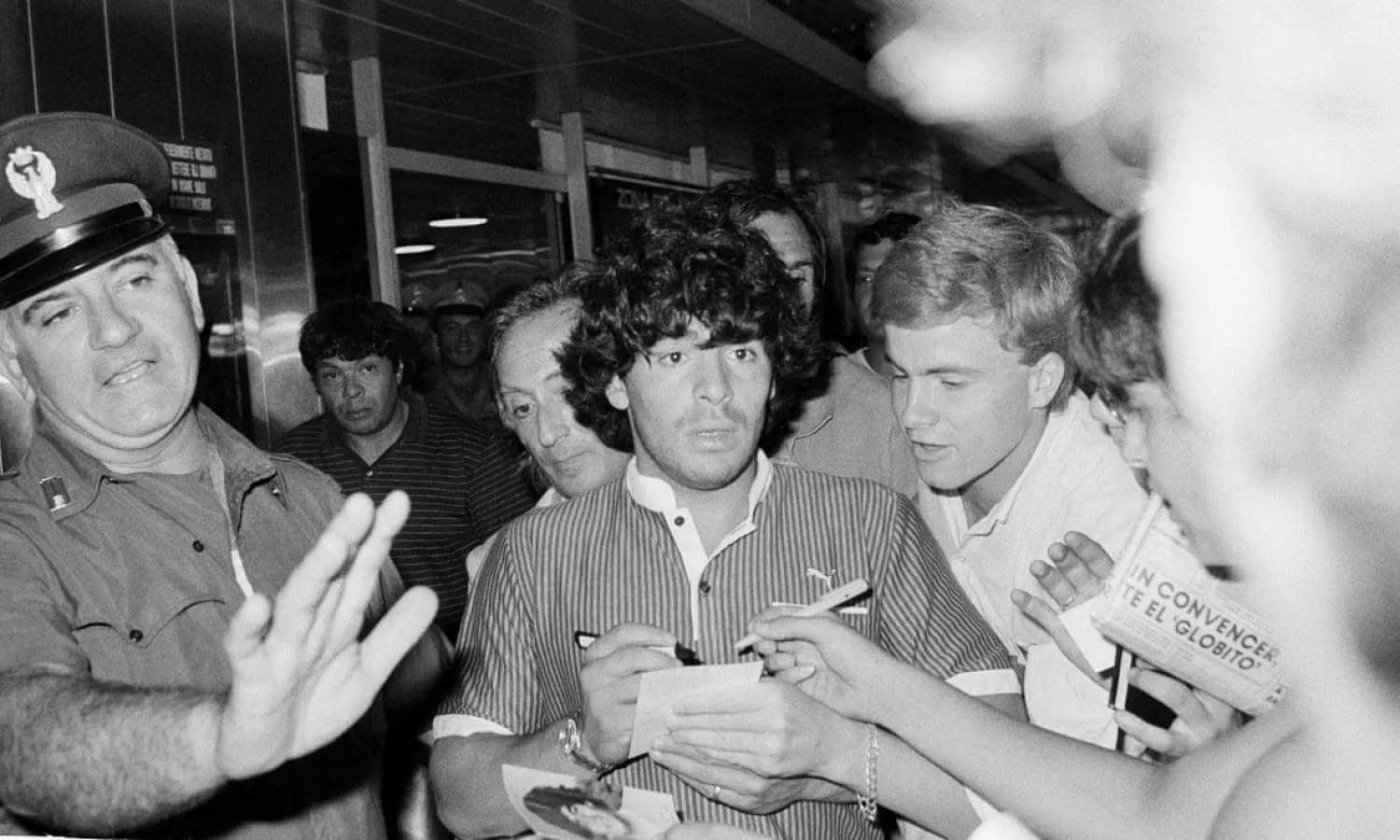
Diego Maradona thronged by fans after landing at Rome airport in July 1984, the month he signed for Napoli. Photograph: Bruno Mosconi/AP
TT

Maradona Film Reminds That Untamables Were Not Always Untouchable

Diego Maradona thronged by fans after landing at Rome airport in July 1984, the month he signed for Napoli. Photograph: Bruno Mosconi/AP

When I sat down in a cinema to watch Emir Kusturica’s documentary about Diego Maradona a decade or so ago, I still thought of myself as a Pelé man. The Brazilian was the footballer who had dominated my adolescence, which is usually the time of life at which we acquire the heroes to whom we remain in thrall. Kusturica’s film made me reconsider that loyalty. He made me think that those who believed Maradona was the greatest footballer of all time might have a point.

It was a mad film about a mad life, starting with a quote from Jorge Luis Borges and finishing with a song from Manu Chao. There was a lot of weird stuff in between. But the Serbian director also included enough football to persuade me that Maradona bent matches to his will in the way no one had done before, and that if we were trying to decide on the very greatest, a stupid but fun thing to do, then this might be the truest measure.

Asif Kapadia’s new film about Maradona, which opened last week, makes me think again. The director of documentaries about Ayrton Senna and Amy Winehouse chooses to concentrate on a particular period of the player’s career, his years with Napoli, which included the 1986 World Cup in which he led Argentina to victory. The before and the after – from the childhood in a Buenos Aires slum and the ill‑fated arrival in Europe with Barcelona to the bitter defeat against West Germany at San Siro in 1990 and the pathos of his late middle age – are also included. But what happened to him from 1984 to 1991, between the ages of 23 and 30, is the only real focus, and Kapadia makes it seem brutally short.

As an admirer of the director’s immersive approach to documentary-making, I found it a little overcooked. A film that begins with a lunatic car journey through the streets of Naples seldom takes its foot off the throttle. You could argue that Maradona’s life was like that, but it wouldn’t be entirely true. Nor was the football he played a constant barrage of thud and crunch, as Kapadia and his sound-effects team make it seem. There was poetry as well as percussion in there, although the director is right to link the two goals against England in the Azteca to the appalling smash to Maradona’s face delivered by Terry Fenwick – did he really play for England, or was it just a bad dream? – earlier in the match.

Kusturica found some poetry when he led the footballer out of a people-carrier and confronted him with Manu Chao leaning against a storefront, strumming a guitar and singing a song about his life: “If I were Maradona, I would live like him …” Maradona’s eyes are hidden, but you can sense the play of emotions behind his wraparound shades as he listens to Chao sing about a life of “a thousand rockets, a thousand friends”.

That life is Kapadia’s subject, and what he captures quite brilliantly is the unsustainable pressure exerted by the sort of adulation Maradona encountered in Naples, an endless physical assault by people wanting to touch him, to be in a photograph with him, to take away a piece of him. Those people crowd the frames of the film, eroding his soul almost as effectively as the Camorra bosses who spotted his weaknesses.

His swift and premature downfall has never held back those to whom he ranks highest in a list including not just Pelé but Ferenc Puskás, Alfredo di Stéfano, Franz Beckenbauer, George Best, Johan Cruyff, Lionel Messi, and Cristiano Ronaldo. Each has, or had, his own special story. Puskás crossed the iron curtain at the height of the cold war. Di Stéfano represented a certain regal presence. Pelé expressed the triumph of individual invention. Beckenbauer showed us how a defender could construct the play of the entire team. Best – the closest in several ways to Maradona – was untameable. Cruyff saw the whole thing, and knew how to reshape it.

And now we have the two stars whose decade‑long duel has offered such a study in contrast: Messi expressing his virtuosity with a unique air of humility, taking a goal of breathtaking execution with the air of a servant swigging a glass of vintage champagne, Ronaldo deploying his ego as an extra piece of technical equipment, forcing opponents to shrivel in the heat of his personal spotlight. For me, now, it is Ronaldo, inventing new ways of striking the ball while triumphing in England, Spain, and Italy and with his national team, who stands supreme. And you don’t have to like him to acknowledge that.

Ronaldo, Messi, and others of their generation know all about what happened to Maradona, how fame devoured him. His example, burnt into every frame of Kapadia’s film, is the reason they are now such remote figures. No footballer earning upwards of a quarter of a million pounds a week is short of instruction on how to build the walls, physical and psychological, with which to protect themselves against their worshippers.

A few hours after seeing the new film, I read an interview in these pages in which Phil Foden, a 19‑year‑old Manchester City and England star in the making, talked about his first experience of celebrity. “People are always watching you,” he said. “It’s what happens. I was walking down the road after one of my first games and people were asking for a picture. From that moment I knew it was going to be hard.” Already he probably understands the meaning of Maradona’s most poignant words in Kapadia’s film: “When you’re on the pitch, life goes away. Everything goes away.”

(The Guardian)


Salah and Mbeumo Lead the List of Premier League Players Heading to the AFCON

Football - Premier League - Brighton & Hove Albion v Liverpool - The American Express Community Stadium, Brighton, Britain - May 19, 2025 Liverpool's Mohamed Salah looks dejected after the match. (Action Images via Reuters)
TT

Salah and Mbeumo Lead the List of Premier League Players Heading to the AFCON

Football - Premier League - Brighton & Hove Albion v Liverpool - The American Express Community Stadium, Brighton, Britain - May 19, 2025 Liverpool's Mohamed Salah looks dejected after the match. (Action Images via Reuters)

Mohamed Salah has gone for up to a month, costing Liverpool its all-time leading goal-scorer in the Premier League.

Manchester United has lost its most potent attacking force in Bryan Mbeumo, along with two more key figures.

They're nothing compared to Sunderland, a promoted team punching above its weight in England's top flight. It has been decimated by the loss of six players.

The Africa Cup of Nations is taking a toll on the Premier League, with some of its biggest stars heading off to the tournament situated right in the middle of the season, according to The AP news.

It is unfortunate that AFCON can be cast as a nuisance for many clubs in Europe — though international soccer in general can be viewed like that when pitted against club ambitions of winning titles. But at least the World Cup, European Championship or Copa America are staged during the offseason of Europe's top leagues.

AFCON is traditionally held in January-February but has been brought forward this year — from Sunday to Jan. 18 — meaning less disruption for leagues in Spain, Germany and France, which have winter breaks of varying periods in December-January.

The Premier League, however, plays through the Christmas and New Year holidays, with the added strain of the FA Cup thrown into one of the busiest periods of the campaign.

The likes of Liverpool and United should have deep enough squads to cope with the loss of key players such as Salah and Mbeumo. But it could have a major impact on Sunderland, which is just two points off the top four after an outstanding start to the season.

Arthur Masuaku, Noah Sadiki, Bertrand Traore, Habib Diarra, Chemsdine Talbi and Reinildo Mandava are all taking part in the Africa Cup in Morocco.

Sunderland is an outlier with so many going to the tournament but for Crystal Palace the loss of just one player — Ismaila Sarr — is potentially significant, given his importance to the team. Likewise, Brighton is losing key midfielder Carlos Baleba.

Burnley, second to bottom in the standings, is losing three players and so is Fulham.

Notably, at the top of the table, Arsenal has no players in the AFCON, likewise title-challenging Aston Villa and Chelsea, which could be telling over the next month.

Premier League players going to AFCON Brentford: Dango Ouattara (Burkina Faso), Frank Onyeka (Nigeria)

Brighton: Carlos Baleba (Cameroon)

Burnley: Axel Tuanzebe (DR Congo), Hannibal Mejbri (Tunisia), Lyle Foster (South Africa)

Crystal Palace: Ismaila Sarr (Senegal)

Everton: Idrissa Gana Gueye (Senegal), Iliman Ndiaye (Senegal)

Fulham: Calvin Bassey (Nigeria), Samuel Chukwueze (Nigeria), Alex Iwobi (Nigeria)

Liverpool: Mohamed Salah (Egypt)

Manchester City: Rayan Ait-Nouri (Algeria), Omar Marmoush (Egypt)

Manchester United: Bryan Mbeumo (Cameroon), Amad Diallo (Ivory Coast), Noussair Mazraoui (Morocco)

Nottingham Forest: Willy Boly (Ivory Coast), Ibrahim Sangare (Ivory Coast)

Sunderland: Arthur Masuaku (DR Congo), Noah Sadiki (DR Congo), Bertrand Traore (Burkina Faso), Habib Diarra (Senegal), Chemsdine Talbi (Morocco), Reinildo Mandava (Mozambique)

Tottenham Hotspur: Yves Bissouma (Mali), Pape Matar Sarr (Senegal)

West Ham United: Aaron Wan-Bissaka (DR Congo), El Hadji Malik Diouf (Senegal)

Wolverhampton Wanderers: Emmanuel Agbadou (Ivory Coast), Tawanda Chirewa (Zimbabwe)

Key matchups On Saturday, first-place Arsenal travels to Everton, while City in second is at home against West Ham. Liverpool will look to win back-to-back league games for the first time since September when the defending champion heads to Tottenham.

Aston Villa and United meet on Sunday.

Players to watch Hugo Ekitike has scored four goals in his last two league games. With Salah off to the AFCON, Liverpool's other forwards can establish themselves without the noise that has surrounded the Anfield icon in recent weeks when his future has been placed in doubt.

Out of action United States international Tyler Adams suffered suspected left knee MCL damage in Bournemouth's 4-4 draw with United on Monday. Chelsea forward Estevao has a small muscle issue, coach Enzo Maresca said. Everton was monitoring a potential hamstring complaint for Jack Grealish.

Off the field Expect more protests at last-place Wolves.

Bottom of the standings and looking certain to be relegated, Wolves will equal Sheffield United's 2020-21 record of 17 games without a win from the start of a Premier League season if they fail to beat Brentford at home on Saturday.

There were protests at Wolves' last home match against Manchester United this month and, despite a spirited performance at Arsenal last week, Rob Edwards' team is 14 points adrift of safety.


Global Equestrian Stars Converge in Riyadh for the Final Week of Jump Saudi 2025

Jump Saudi has evolved into a premier global fixture, attracting participants from over 30 countries to date - SPA
TT

Global Equestrian Stars Converge in Riyadh for the Final Week of Jump Saudi 2025

Jump Saudi has evolved into a premier global fixture, attracting participants from over 30 countries to date - SPA

The fifth edition of the Jump Saudi championship reaches its peak on Thursday as the second and final week of competition begins at the Jump Saudi Arena in Al Janadryah.

Spanning three days, the event features elite male and female riders competing in both two-star and five-star categories, marking a significant moment in the Kingdom's equestrian calendar, according to SPA.

Since its inaugural edition in 2021, Jump Saudi has evolved into a premier global fixture, attracting participants from over 30 countries to date. Notably, 10 nations have maintained an unbroken presence across every edition of the championship.

This list is led by Saudi Arabia, followed by regional peers the United Arab Emirates, Jordan, and Egypt, as well as a strong European contingent including Germany, Belgium, France, Italy, Britain, and the Netherlands.

Organized by the Saudi Arabian Equestrian Federation, the championship has earned a prestigious high-level classification from the Fédération Equestre Internationale (FEI). This status is a testament to the event's excellence in meeting stringent international standards for organizational quality, world-class infrastructure, elite officiating, and substantial prize money.

Because of this elite designation, the FEI officially recognizes all results from the championship, with points earned contributing directly to the riders' official world rankings. This has solidified Riyadh's reputation as a critical annual destination for top-ranked international athletes seeking to advance on the global leaderboard.


Jeddah Hosts Next Gen ATP Finals

 Next Gen ATP Finals presented by the Public Investment Fund kicked off at the indoor arena of King Abdullah Sports City in Jeddah - SPA
Next Gen ATP Finals presented by the Public Investment Fund kicked off at the indoor arena of King Abdullah Sports City in Jeddah - SPA
TT

Jeddah Hosts Next Gen ATP Finals

 Next Gen ATP Finals presented by the Public Investment Fund kicked off at the indoor arena of King Abdullah Sports City in Jeddah - SPA
Next Gen ATP Finals presented by the Public Investment Fund kicked off at the indoor arena of King Abdullah Sports City in Jeddah - SPA

The Next Gen ATP Finals presented by the Public Investment Fund kicked off at the indoor arena of King Abdullah Sports City in Jeddah.

The tournament is organized by the Saudi Tennis Federation under the supervision of the Ministry of Sport, according to SPA.

American Nishesh Basavareddy opened Red Group play with a valuable win over Croatia’s Dino Prizmic, taking three sets to one. Belgian Alexander Blockx defeated Germany’s Justin Engel by three sets to one.

Blue Group matches saw strong competition, as seventh-seeded Spain’s Rafael Jodar defeated top-seeded American Learner Tien, three sets to two. Norway’s Nicolai Budkov Kjaer beat Spain’s Martin Landaluce by three sets to one.
