

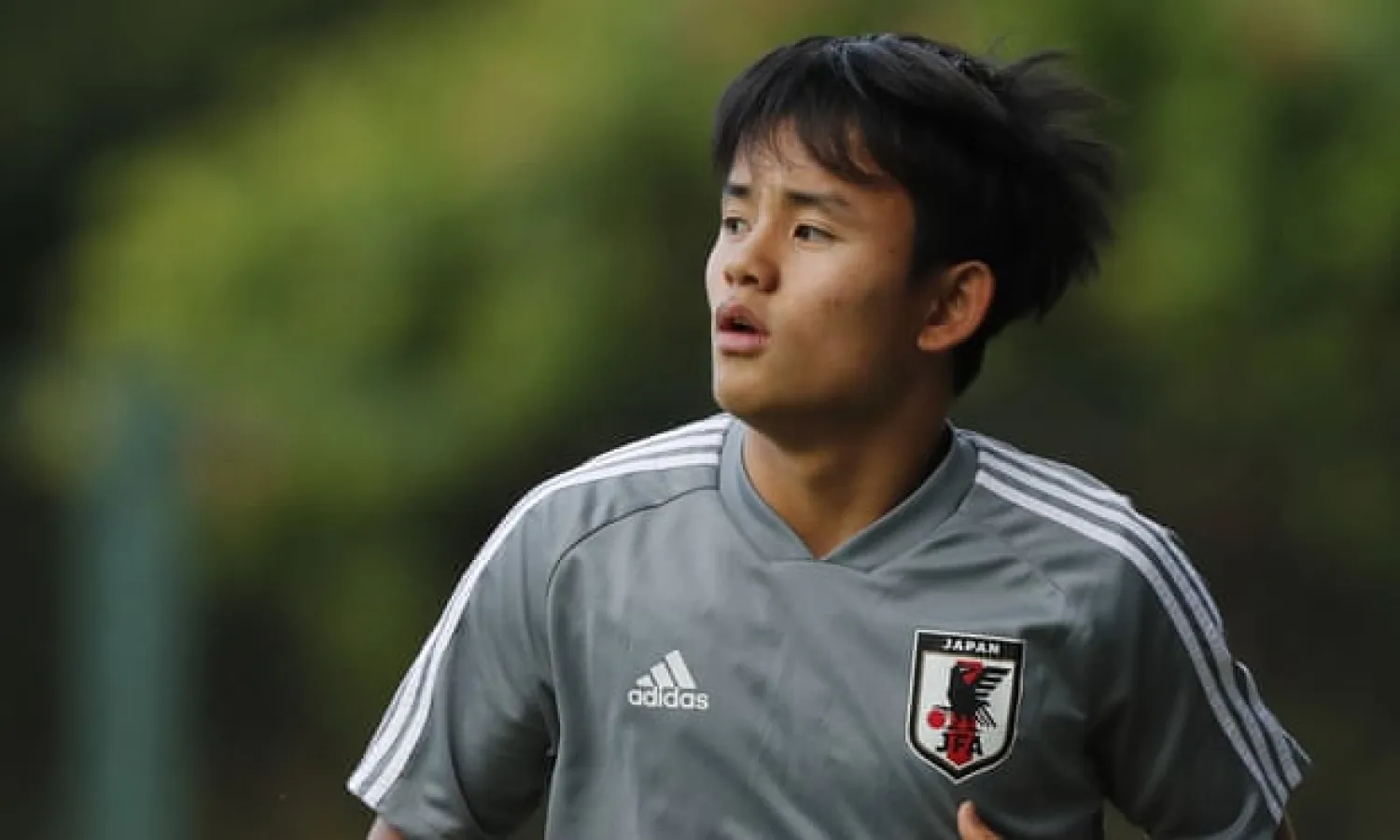

How Real Madrid Snatched Takefusa Kubo From Under the Noses of Barcelona

 Japan’s Takefusa Kubo is one of the hottest properties in world football. Photograph: Nelson Antoine/AP
Japan’s Takefusa Kubo is one of the hottest properties in world football. Photograph: Nelson Antoine/AP
TT

How Real Madrid Snatched Takefusa Kubo From Under the Noses of Barcelona

 Japan’s Takefusa Kubo is one of the hottest properties in world football. Photograph: Nelson Antoine/AP
Japan’s Takefusa Kubo is one of the hottest properties in world football. Photograph: Nelson Antoine/AP

Takefusa Kubo joined Barcelona when he was 10, spent four years at the club and was singled out as a future star but that future now belongs to their greatest rivals after Real Madrid announced the signing of the Japan international.

Just 18, Kubo was forced to leave Barça in 2015 after the club was investigated for breaking Fifa regulations on signing young players, returning to Japan and joining FC Tokyo’s youth system. Barcelona had hoped to bring the attacking midfielder back when he came of age but instead it is Madrid who have agreed a €2m deal with Tokyo and handed Kubo a six-year contract believed to be worth €1m a season. He will initially join the club’s B team, Castilla, but the plan is he will be incorporated into the first team in his second season.

Barcelona were unwilling to match the demands made by the player, who had also attracted interest from Paris Saint-Germain, and have sought to play down the damage but his decision to join Real Madrid was inevitably greeted by many as a defeat at the hands of their competitors. Although Madrid have not signed him from Barcelona, he was expected to end up at the Camp Nou, where he began.

The frustration is greater because of the manner in which Barcelona lost control of Kubo, who is now a senior international and in the Japan squad that has been invited to play at the Copa América. Kubo was one of a dozen players mentioned in the initial investigation over Barcelona breaking article 19 of Fifa’s regulations on international transfers, designed to protect under-18s. Barcelona protested against the verdict and lobbied for a change of policy but there have been no alterations and those protests did not prevent their punishment.

Josep Maria Bartomeu, the Barcelona president, recently told the Observer: “I spoke to Fifa and I told them that it doesn’t make sense that in every sport everywhere in the world you can give a bursary, a scholarship, to a kid to do sport, to give them the chance to go to a school to learn, except in football. I said: ‘Bloody hell, change it. You’re placing restrictions on someone’s right to personal development.’ There’s even a case for thinking that the ban goes against children’s rights, against the right they have to educate and develop.”

Barça were served with a two-year transfer ban and players were forced to return home. Among them were an American, a Cameroonian, two Dutch players, a Venezuelan, two French footballers, three Koreans and Kubo. Barcelona had expected him to return after a successful spell in Japan but instead he chose Madrid.

In the capital, it was presented as a victory over Barcelona. More significantly, it is part of a shift in policy – dictated by the financial reality of a shifting market place in which they no longer dominate – in which Real have spent the last few years seeking to sign the next generation of stars from Spain and the world.

The most well-known example was Martin Ødegaard, who joined Madrid four years ago aged 16 years and 36 days on a deal that, with incentives, was understood to be worth as much as €6m. Madrid beat competition from clubs across Europe, where the Norwegian been courted, to land him on a six-year deal. Considered by some the great talent of his generation, he signed up and played for Castilla but trained with the first team. But, despite pressure to promote him, he made only two first-team appearances before going out on loan. This July, aged 20, he will return, having spent time at the Dutch sides Heerenveen and then Vitesse, but his future at the club remains uncertain.

Ødegaard is not alone. Before him, when Real signed Casemiro in 2013, he initially joined Castilla, officially on loan, and there are others. The policy has been accelerated in he last two years. In January Madrid signed Brahim Diaz, 19, from Manchester City, while the Brazilians Vinicius Junior and Rodrygo Goes are only 18. Vinicius signed for €46m in May 2017, joining the club in July 2018. Rodrygo cost €45m in June 2018 and joins this summer. Theo Hernández (21), Jesus Vallejo (22), Álvaro Odriozola (23) and Andriy Lunin (20) all broadly fit this policy. Now Kubo joins them and not Barcelona.

The Guardian Sport



Second Season of ‘Kings League–Middle East' to Kick off in March in Riyadh 

The second season of the Kings League-Middle East will kick off in Riyadh on March 27. (Kings League-Middle East on X)
TT

Second Season of ‘Kings League–Middle East' to Kick off in March in Riyadh 

The second season of the Kings League-Middle East will kick off in Riyadh on March 27. (Kings League-Middle East on X)

The Kings League-Middle East announced that its second season will kick off in Riyadh on March 27.

The season will feature 10 teams, compared to eight in the inaugural edition, under a format that combines sporting competition with digital engagement and includes the participation of several content creators from across the region.

The Kings League-Middle East is organized in partnership with SURJ Sports Investments, a subsidiary of the Public Investment Fund (PIF), as part of efforts to support the development of innovative sports models that integrate football with digital entertainment.

Seven teams will return for the second season: DR7, ABO FC, FWZ, Red Zone, Turbo, Ultra Chmicha, and 3BS. Three additional teams are set to be announced before the start of the competition.

Matches of the second season will be held at Cool Arena in Riyadh under a single round-robin format, with the top-ranked teams advancing to the knockout stages, culminating in the final match.

The inaugural edition recorded strong attendance and wide digital engagement, with approximately a million viewers following the live broadcasts on television and digital platforms.


Shakhtar Boss Pays Ukrainian Racer $200,000 After Games Disqualification

Ukrainian President Volodymyr Zelenskiy holds helmet as he meets with a Ukrainian skeleton racer Vladyslav Heraskevych , who was disqualified from the Olympic skeleton competition over his "helmet of remembrance" depicting athletes killed since Russia's invasion and his father and coach, Mykhailo Heraskevych, amid Russia's attack on Ukraine, in Munich, Germany February 13, 2026. (Ukrainian Presidential Press Service/Handout via Reuters)
TT

Shakhtar Boss Pays Ukrainian Racer $200,000 After Games Disqualification

Ukrainian President Volodymyr Zelenskiy holds helmet as he meets with a Ukrainian skeleton racer Vladyslav Heraskevych , who was disqualified from the Olympic skeleton competition over his "helmet of remembrance" depicting athletes killed since Russia's invasion and his father and coach, Mykhailo Heraskevych, amid Russia's attack on Ukraine, in Munich, Germany February 13, 2026. (Ukrainian Presidential Press Service/Handout via Reuters)

The owner of ‌Ukrainian football club Shakhtar Donetsk has donated more than $200,000 to skeleton racer Vladyslav Heraskevych after the athlete was disqualified from the Milano Cortina Winter Games before competing over the use of a helmet depicting Ukrainian athletes killed in the war with Russia, the club said on Tuesday.

The 27-year-old Heraskevych was disqualified last week when the International Bobsleigh and Skeleton Federation jury ruled that imagery on the helmet — depicting athletes killed since Russia invaded Ukraine in 2022 — breached rules on athletes' expression at ‌the Games.

He ‌then lost an appeal at the Court ‌of ⁠Arbitration for Sport hours ⁠before the final two runs of his competition, having missed the first two runs due to his disqualification.

Heraskevych had been allowed to train with the helmet that displayed the faces of 24 dead Ukrainian athletes for several days in Cortina d'Ampezzo where the sliding center is, but the International Olympic Committee then ⁠warned him a day before his competition ‌started that he could not wear ‌it there.

“Vlad Heraskevych was denied the opportunity to compete for victory ‌at the Olympic Games, yet he returns to Ukraine a ‌true winner," Shakhtar President Rinat Akhmetov said in a club statement.

"The respect and pride he has earned among Ukrainians through his actions are the highest reward. At the same time, I want him to ‌have enough energy and resources to continue his sporting career, as well as to fight ⁠for truth, freedom ⁠and the remembrance of those who gave their lives for Ukraine," he said.

The amount is equal to the prize money Ukraine pays athletes who win a gold medal at the Games.

The case dominated headlines early on at the Olympics, with IOC President Kirsty Coventry meeting Heraskevych on Thursday morning at the sliding venue in a failed last-minute attempt to broker a compromise.

The IOC suggested he wear a black armband and display the helmet before and after the race, but said using it in competition breached rules on keeping politics off fields of play. Heraskevych also earned praise from Ukraine President Volodymyr Zelenskiy.


Speed Skating-Italy Clinch Shock Men’s Team Pursuit Gold, Canada Successfully Defend Women’s Title

 Team Italy with Davide Ghiotto, Andrea Giovannini, Michele Malfatti, celebrate winning the gold medal on the podium of the men's team pursuit speed skating race at the 2026 Winter Olympics, in Milan, Italy, Tuesday, Feb. 17, 2026. (AP)
Team Italy with Davide Ghiotto, Andrea Giovannini, Michele Malfatti, celebrate winning the gold medal on the podium of the men's team pursuit speed skating race at the 2026 Winter Olympics, in Milan, Italy, Tuesday, Feb. 17, 2026. (AP)
TT

Speed Skating-Italy Clinch Shock Men’s Team Pursuit Gold, Canada Successfully Defend Women’s Title

 Team Italy with Davide Ghiotto, Andrea Giovannini, Michele Malfatti, celebrate winning the gold medal on the podium of the men's team pursuit speed skating race at the 2026 Winter Olympics, in Milan, Italy, Tuesday, Feb. 17, 2026. (AP)
Team Italy with Davide Ghiotto, Andrea Giovannini, Michele Malfatti, celebrate winning the gold medal on the podium of the men's team pursuit speed skating race at the 2026 Winter Olympics, in Milan, Italy, Tuesday, Feb. 17, 2026. (AP)

An inspired Italy delighted the home crowd with a stunning victory in the Olympic men's team pursuit final as

Canada's Ivanie Blondin, Valerie Maltais and Isabelle Weidemann delivered another seamless performance to beat the Netherlands in the women's event and retain their title ‌on Tuesday.

Italy's ‌men upset the US who ‌arrived ⁠at the Games ⁠as world champions and gold medal favorites.

Spurred on by double Olympic champion Francesca Lollobrigida, the Italian team of Davide Ghiotto, Andrea Giovannini and Michele Malfatti electrified a frenzied arena as they stormed ⁠to a time of three ‌minutes 39.20 seconds - ‌a commanding 4.51 seconds clear of the ‌Americans with China taking bronze.

The roar inside ‌the venue as Italy powered home was thunderous as the crowd rose to their feet, cheering the host nation to one ‌of their most special golds of a highly successful Games.

Canada's women ⁠crossed ⁠the line 0.96 seconds ahead of the Netherlands, stopping the clock at two minutes 55.81 seconds, and

Japan rounded out the women's podium by beating the US in the Final B.

It was only Canada's third gold medal of the Games, following Mikael Kingsbury's win in men's dual moguls and Megan Oldham's victory in women's freeski big air.