


2-Month Idlib Campaign Nets Little for Syrian Regime

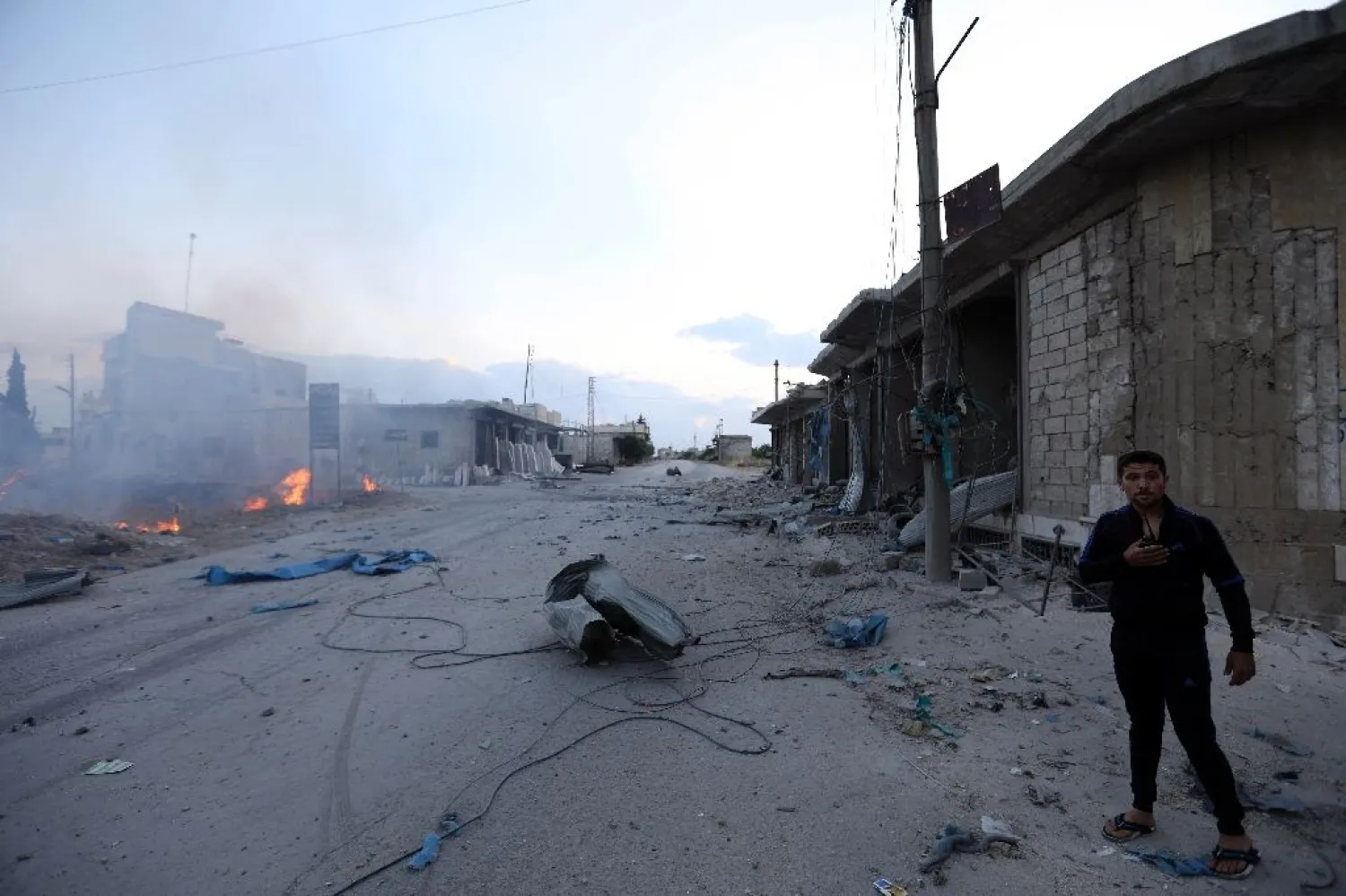
A man looks on at the site of a rocket attack by Syrian regime forces and their allies on the village of Kafr Nabl, south of Idlib. (AFP)
TT

2-Month Idlib Campaign Nets Little for Syrian Regime

A man looks on at the site of a rocket attack by Syrian regime forces and their allies on the village of Kafr Nabl, south of Idlib. (AFP)

Two months of intensive airstrikes by Syrian regime forces and their Russian allies, coupled with a fierce ground assault on opposition-controlled Idlib province, have killed hundreds of people and caused massive displacement while achieving little to no gain for regime leader Bashar Assad, said The Associated Press Saturday.

Despite the heavy bombardment, Assad's forces have been unable to make any significant advances against al-Qaida-linked militants and other extremist groups who dominate Idlib province, the last significant area held by opposition forces. Militant attacks have killed an average of more than a dozen soldiers and allied militiamen a day in recent weeks.

The struggling campaign underscores the limits of Syria's and Russia's airpower and inability to achieve a definitive victory in the country's long-running war, now in its eighth year.

With crucial military assistance from Russia and Iran, regime forces have in the past few years recovered most other opposition-held parts of the country with crushing offensives and long-running sieges. In each of those places, the opposition factions either surrendered or were forcibly exiled to Idlib, where they are now cornered with nowhere left to go. Bitter and desperate, they can only fight to the end.

Sam Heller, a Syria expert with the International Crisis Group who closely follows the situation in the opposition-controlled area, said, "Idlib's armed opposition may not be able to win an open battle for the northwest, but they can make a Syrian regime victory terribly costly, maybe intolerably so."

Politically, Idlib reflects the tug of war among international players supporting opposing sides of Syria's conflict, said the AP.

A ceasefire brokered last September by Russia, a key ally of Assad, and Turkey, which supports the opposition, collapsed on April 30 when the regime began its offensive following months of violations by both sides. Turkey, which hosts 3 million Syrian refugees, fears a full-blown regime offensive would cause a new wave of displaced people heading toward its border, but it has been unable — or some say, unwilling — to control the opposition in Idlib that it supports.

Crucially, Iran-backed fighters, including members of Lebanon's Hezbollah party whose participation has been key in previous battles, have not joined fight for Idlib, deeming the region a low priority, unlike more strategic areas bordering Iraq and Lebanon. Even Russia hasn't thrown all its weight into the fray and has continued to talk to Turkey about ways to reinstate the ceasefire.

Rather than a full-blown offensive to recover the province, which is packed with 3 million people, Assad's regime has for now restricted its assault to the edges of the province with the aim of reopening key highways crossing through opposition-held areas. But even that has proved futile as the opposition factions fight back aggressively.

According to the Syrian Observatory for Human Rights, a war monitor, 2,443 people have been killed since April 30. They include 629 civilians, among them 159 children. The dead also include 869 pro-regime fighters and troops as well as 945 opposition fighters, according to the Observatory. Many more have been wounded and many villages destroyed, with the United Nations saying the fighting has displaced more than 330,000 from their homes. Many of them now live in overcrowded tents near the border with Turkey.

Spearheading the offensive on Idlib and northern parts of the central province of Hama is the regime’s elite Tiger Force led by Brig. Gen. Suheil al-Hassan, a Russian-backed Syrian officer who took credit for some of the biggest regime victories in the eight-year conflict, said the AP.

But he has not succeeded in breaking Idlib's defenses and remains deadlocked. According to opposition activists, elite forces from the Republican Guards and the Fourth Division led by Assad's younger brother, Maher, have recently started taking part in the offensive.

Opposition activists say regime forces and their Russian allies have been targeting schools and medical centers, reportedly killing 10 medical staff since the offensive began, to make it difficult for the local population to stay. The tactic has been used by regime elsewhere in Syria. Airstrikes have also targeted paramedics, killing four ambulance workers in recent weeks, activists say.

The Idlib offensive began with regime forces capturing more than a dozen villages, including Qalaat al-Madiq and Kfar Nabudah, which are considered the militants' first line of defense of Idlib. Since then, Kfar Nabudah has changed hands several times. Opposition factions later took regime forces by surprise by launching an offensive and opening another front, in which they succeeded in capturing the villages of Madraset al-Dahra, Tel Milh and Jubain. Repeated regime attacks to retake the area were unsuccessful.

Mohammed al-Ali, a journalist based in Idlib province, said that two months into the offensive the regime now only controls the village of Qassabiyeh in Idlib as well as some dozen villages in northern Hama province and the town of Qalaat al-Madiq.

Al-Ali said one of the opposition's biggest successes was opening the new front, in which they cut a main road linking the central city of Hama with regime-held villages on the edge of Idlib.

"The opposition's steadfastness and regime's heavy losses made them fail to achieve advances similar to those they did at the start," he said of the regime offensive. He said anti-tank missiles were key in slowing the regime's offensive.

The battle could last for months and claim more lives unless Turkey, Iran and Russia reach a new deal for the region similar to last year's ceasefire. The faltering offensive could encourage Russia to reach such a deal with Turkey.

Turkey's presidential spokesman, Ibrahim Kalin, said Ankara is planning to host a summit between the leaders of the three nations in August to discuss Syria, mainly Idlib.

"The Syrian regime’s inability so far to make more headway in Idlib does not mean it cannot ultimately achieve victory nationwide," Heller, of Crisis Group, said. "It does show, however, that its military victory is contingent on politics that are bigger than just Syria."



Israel Clears Final Hurdle to Start Settlement Construction That Would Cut West Bank in Two

Construction cranes tower above a construction site in Givat HaMatos, an Israeli settlement suburb of Israeli-annexed east Jerusalem on January 2, 2026. (AFP)
TT

Israel Clears Final Hurdle to Start Settlement Construction That Would Cut West Bank in Two

Construction cranes tower above a construction site in Givat HaMatos, an Israeli settlement suburb of Israeli-annexed east Jerusalem on January 2, 2026. (AFP)

Israel has cleared the final hurdle before starting construction on a controversial settlement project near Jerusalem that would effectively cut the West Bank into two, according to a government tender. 

The tender, seeking bids from developers, would clear the way to begin construction of the E1 project. 

The anti-settlement monitoring group Peace Now first reported the tender. Yoni Mizrahi, who runs the group’s settlement watch division, said initial work could begin within the month. 

Settlement development in E1, an open tract of land east of Jerusalem, has been under consideration for more than two decades, but was frozen due to US pressure during previous administrations. 

The international community overwhelmingly considers Israeli settlement construction in the West Bank to be illegal and an obstacle to peace. 

The E1 project is especially contentious because it runs from the outskirts of Jerusalem deep into the occupied West Bank. Critics say it would prevent the establishment of a contiguous Palestinian state in the territory. 

Israeli Finance Minister Bezalel Smotrich, a far-right politician who oversees settlement policy, has long pushed for the plan to become a reality. 

“The Palestinian state is being erased from the table not with slogans but with actions,” he said in August, when Israel gave final approval to the plan. “Every settlement, every neighborhood, every housing unit is another nail in the coffin of this dangerous idea.” 

The tender, publicly accessible on the website for Israel’s Land Authority, calls for proposals to develop 3,401 housing units. Peace Now says the publication of the tender “reflects an accelerated effort to advance construction in E1.” 


Three Killed in Aleppo Attacks, Syrian Government, SDF Trade Blame

Syrian forces are seen during a military parade in Aleppo marking a year since the ouster of the Assad regime in December 2025. (Syrian Defense Ministry)
TT

Three Killed in Aleppo Attacks, Syrian Government, SDF Trade Blame

Syrian forces are seen during a military parade in Aleppo marking a year since the ouster of the Assad regime in December 2025. (Syrian Defense Ministry)

At least three people were killed and several others wounded in Syria's northern city of Aleppo, state news agency SANA said on Tuesday, citing Aleppo's health director, after deadly attacks for which Syrian government forces and the Kurdish-led Syrian Democratic Forces traded blame.

Syria's defense ministry said in a statement that the SDF had continued its "escalation" by targeting army positions and residential areas in Aleppo. The SDF denied its responsibility, saying that the ‌casualties were caused by "indiscriminate" ‌artillery and missile shelling by ‌factions ⁠aligned with ‌the Damascus government.

The violence came days after a meeting between senior officials from the SDF and the Damascus government on implementing a deal agreed nearly 10 months ago that aimed to fully integrate the semi-autonomous Kurdish region into the central Syrian government.

The agreement was ⁠meant to be implemented by the end of 2025, but ‌the two sides have made ‍little progress, each accusing ‍the other of stalling or acting in bad ‍faith.

The SDF is reluctant to give up autonomy it won as the main US ally during the war, which left it with control of ISIS prisons and rich oil resources.

Integrating the SDF into Syria's army would mend Syria's deepest remaining fracture, ⁠but failing to do so risks an armed clash that could derail the country's emergence from 14 years of war and potentially draw in Türkiye, which has threatened an incursion against Kurdish fighters it views as terrorists.

As progress falters, several rounds of fighting have broken out. On December 22, Syrian government forces and SDF agreed to de-escalate in the northern city of Aleppo, after a wave ‌of attacks that left at least two civilians dead and several wounded.


African Union Calls for Immediate Revocation of Somaliland’s Recognition by Israel

Somalis burn the Israel flag and an image depicting Israeli Prime Minister Benjamin Netanyahu during a demonstration, after Israel became the first country to formally recognize the self-declared Republic of Somaliland, at the Mogadishu Stadium in Warta Nabada district of Mogadishu, Somalia December 30, 2025. (Reuters)
TT

African Union Calls for Immediate Revocation of Somaliland’s Recognition by Israel

Somalis burn the Israel flag and an image depicting Israeli Prime Minister Benjamin Netanyahu during a demonstration, after Israel became the first country to formally recognize the self-declared Republic of Somaliland, at the Mogadishu Stadium in Warta Nabada district of Mogadishu, Somalia December 30, 2025. (Reuters)

The African Union's Political Affairs Peace and Security council called on Tuesday for the "immediate revocation" of Israel's recognition ‌of Somaliland.

Israeli ‌Foreign ‌Minister ⁠Gideon Sara ‌visited Somaliland on Tuesday on a trip that was denounced by Somalia, 10 ⁠days after Israel ‌formally recognized the ‍self-declared ‍republic as ‍an independent and sovereign state.

"The (AU) Council strongly condemns, in the strongest terms, the unilateral recognition of ⁠the so-called 'Republic of Somaliland' by Israel," it said in a post on X after a ministerial meeting.