


This Salzburg Palace Is More Than a Scene in ‘The Sound of Music’

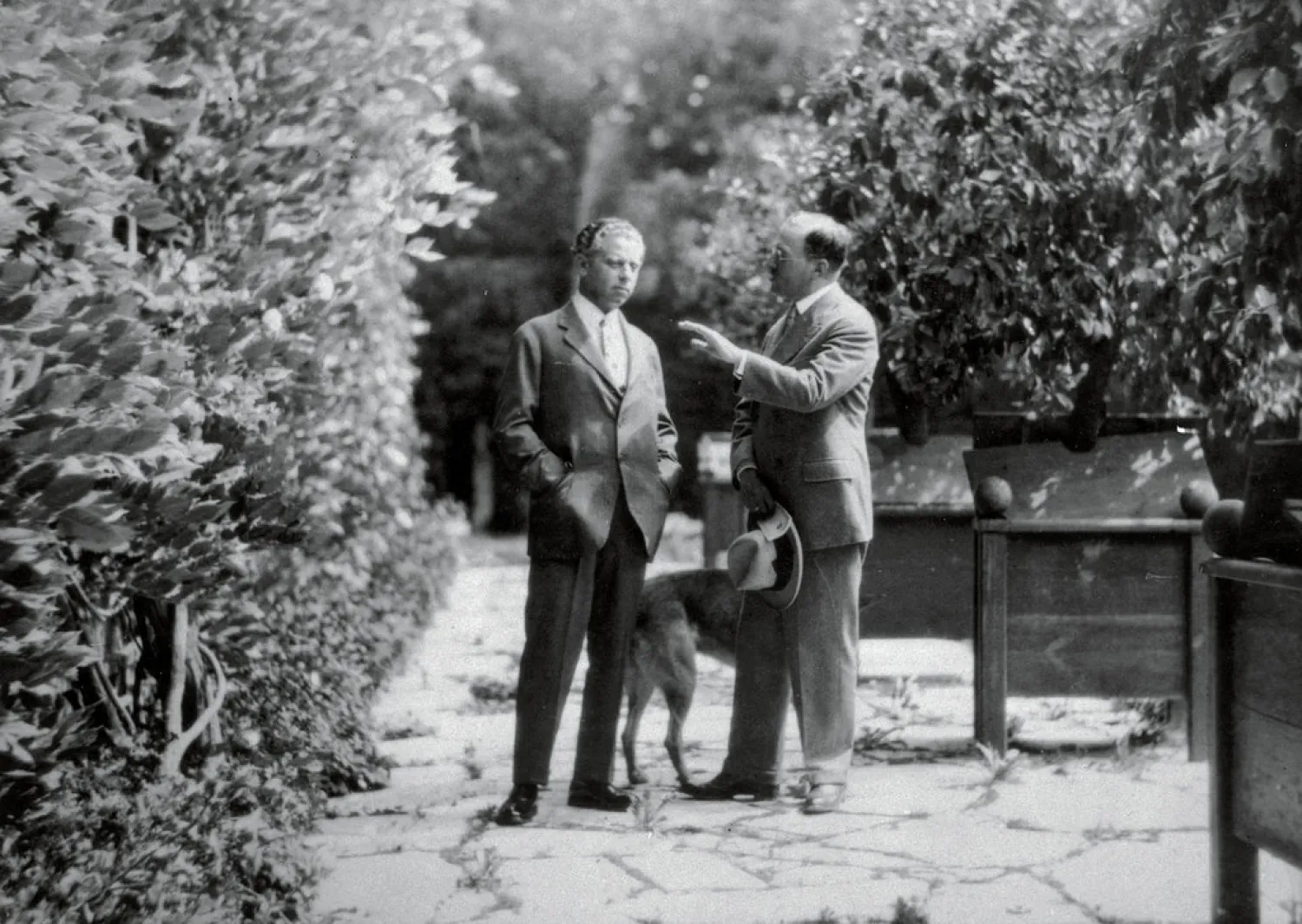
Max Reinhardt and Hugo von Hofmannsthal on the grounds of the Schloss Leopoldskron, circa 1920. The two men, along with Richard Strauss, created the Salzburg Festival.CreditImagno/Getty Images
TT

This Salzburg Palace Is More Than a Scene in ‘The Sound of Music’

Max Reinhardt and Hugo von Hofmannsthal on the grounds of the Schloss Leopoldskron, circa 1920. The two men, along with Richard Strauss, created the Salzburg Festival.CreditImagno/Getty Images

From central Salzburg, it is a short but scenic bike ride — with the Eastern Alps as a breathtaking backdrop — to the 18th-century rococo palace of Schloss Leopoldskron. While it may not look very notable from the road, from the lakeside it is a spectacular vision of manicured lawns, hedges and giant trees.

The palace has also served as a setting for famous moments in the region. The Salzburg Festival was conceived here almost 100 years ago. During World War II, the palace was taken over by the Nazis as a summer residence.

The rowboat scene in “The Sound of Music” was filmed here in 1964, on the adjacent Meierhof property, while the ornate Venetian room inside the palace was meticulously recreated on a soundstage in London as the ballroom in the film. In 2014, it was the setting for both Chanel’s December 2014 métier d’arts fashion show and Melinda Gates’ 50th birthday party.

But possibly its most important function is as the home of the Salzburg Global Seminar, a nonprofit organization that hosts programs on topics from climate change and health care to the role that the arts can play in community development.

This month, for example, the seminar is holding a two-and-a-half-week program titled “The Cost of Disbelief: Fracturing Societies and the Erosion of Trust,” where 75 journalists and media experts through presentations and workshops will examine the current role of media in a world where many now believe truth is subjective.

Since its founding by two Harvard students and an instructor in 1947 under the premise of being a “Marshall Plan for the mind,” luminaries have attended workshops and lectures and discussed some of society’s most difficult and pervasive questions. Past participants include Kofi Annan, the former United Nations secretary general; Hillary Clinton; Justice Ruth Bader Ginsburg; and Kristalina Georgieva, the World Bank’s chief executive.

The palace also operates as a high-end hotel that is owned by the seminar. Though the property is private, it is open to the public a few times a year, and it is the location for the Salzburger Landestheater’s “Shakespeare im Park” every summer.

Guests can stay in either the recently refurbished rooms in the Schloss or on the Meierhof property right next door. They can also see the horse statues that the Von Trapp children ran past on their way to greet their father in “The Sound of Music.”

“We are a well-kept secret in some respects, while in others we are becoming better known publicly,” said Stephen Salyer, the seminar’s president and chief executive. “We are trying to walk the line between keeping this place special, maintaining enough privacy for the conversations we want to have, and on the other, we are a nonprofit publicly oriented institution, so we want to welcome people from every walk of life.”

Construction on the family estate for Leopold Anton Freiherr von Firmian, the prince archbishop of Salzburg, started in 1736, and after his death, Count Laktanz — who was one of the first sponsors of Leopold Mozart and his son Wolfgang — moved in. Over the course of the 19th century, the home was owned by King Ludwig II of Bavaria and a well-known Salzburg banker, and later by two waiters who tried to run the palace as a hotel.

By the time Max Reinhardt, the Baden-born film and theater director, took over the Schloss in 1918, it was in a desperate state. He spent the next 20 years lovingly renovating everything from the Venetian room to the stunning Library and Marble Hall.

Mr. Reinhardt put on site-specific theater productions in the Schloss, and it became a place where writers, composers, actors and designers from Europe and abroad would converge for conversation and inspiration. It was in the Schloss where Mr. Reinhardt, the composer Richard Strauss and the poet Hugo von Hofmannsthal came up with the idea to create a music festival that they hoped would bring people together from across Europe who had been at war. (Mr. Reinhardt, who was Jewish, later fled to the United States after the annexation of Austria by the Nazis in 1938.)

“When I think of our institution, I think of cycles of power, persecution and renewal,” said Clare Shine, the seminar’s vice president and chief program officer. “So after the Victorian age of dilapidation of the Schloss, Max was an act of renewal at the end of the First World War. And then came the cycle again of persecution and the Nazis and the Schloss. And the act of founding the seminar was an act of renewal, courage and risk-taking.”

Over the years, the Salzburg Global Seminar (originally called the Salzburg Seminar in American Studies) has grown from one-off workshops to multiyear, multicomponent projects.

“When you are looking at a world that is increasingly complex, volatile, unequal, you want to be able to go deep into that complexity,” Ms. Shine said. “We work in interdisciplinary and inter-regional way, and by committing ourselves to say we are going to put a stake in the ground for five or 10 years around this particular area of transformation. That gives us the flexibility to bring disrupters, establishment figures, different types of partners together on an organically-evolving basis and that feeds right through in how we think about impact.”

After each seminar, a report is put together by participants (who become fellows). Fellows have produced work on everything from creating a Pan-African educational project on countering extremism to teaching coexistence and peace building through the arts. The institution’s archive was transferred to Harvard two years ago.

“What was transformative about the seminar was spending time getting to know other professionals in the field of arts and culture coming from all around the world, and gathering to reflect together,” Phloeun Prim, the executive director of Cambodian Living Arts, a cultural organization based in Phnom Penh, wrote in an email.

“There was so much more than talking — it wasn’t the typical conference where you go and listen, but you had to participate in a meaningful way.”

The New York Times


Does Fasting Stress You? Here’s the Role of Cortisol and How to Manage It

Deep breathing exercises, remembrance, and brief meditation before sleep may reduce stress markers (Pexels).
TT

Does Fasting Stress You? Here’s the Role of Cortisol and How to Manage It

Deep breathing exercises, remembrance, and brief meditation before sleep may reduce stress markers (Pexels).

Fasting during Ramadan is both a spiritual and a health practice that benefits the body and mind. Medical studies, however, show that fasting can sometimes raise levels of cortisol, the hormone commonly known as the stress hormone. Elevated cortisol may have noticeable effects on mood, including irritability, anxiety, and tension, making emotional regulation more challenging during long fasting hours.

Cortisol is released by the adrenal glands according to a natural daily rhythm, higher in the morning and lower in the evening. This rhythm, however, can be disrupted by poor sleep, dehydration, or physical and mental stress.

So how can cortisol levels be kept in balance during fasting? Here are key practical guidelines:

1. Prioritize sleep. It is central to hormonal balance. Sleep disruption increases stress and interferes with cortisol regulation. To minimize this effect:

Aim for a total of 7 to 8 hours of sleep, including nighttime rest and a short daytime nap if needed.

Keep sleep and wake times as consistent as possible.

Limit screen exposure for at least one hour before bedtime.

2. Break your fast in a balanced way to avoid blood sugar spikes. Research links blood sugar fluctuations to heightened stress responses. For that reason:

Start with fluids and a moderate amount of dates, followed by a meal that includes protein and fiber.

Avoid excessive simple sugars, which can cause a rapid rise and fall in blood glucose, triggering cortisol release.

3. Carbohydrates matter; do not eliminate them. While reducing refined sugars is beneficial, including moderate amounts of healthy carbohydrates - such as oats, whole-grain bread, potatoes, or fruit - at iftar and suhoor helps stabilize blood sugar gradually after fasting.

This balance helps prevent excessive cortisol release and reduces irritability, tension, and anxiety during fasting hours.

4. Maintain hydration between sunset and dawn. Dehydration places additional stress on the body. Health authorities recommend spreading fluid intake after iftar:

Drink water gradually between iftar and suhoor.

Limit caffeinated beverages, as they may interfere with sleep and increase stress.

5. Engage in moderate physical activity. Moderate movement supports healthy stress regulation:

Opt for light walking or stretching about two hours after iftar.

Avoid intense exercise during prolonged fasting hours.

6. Use relaxation techniques. Deep breathing, remembrance, and brief meditation before sleep may help lower stress markers.

US medical sources recommend daily relaxation practices lasting 5 to 10 minutes to support hormonal balance related to stress.

7. Be mindful of caffeine and sugar at night. Heavy coffee intake or frequent sweets during late Ramadan gatherings can disrupt sleep, affecting cortisol levels the following day. Keep your last cup of coffee before midnight and limit desserts to small portions.

8. Consult your doctor if you have a medical condition. If you have hormonal disorders, elevated blood sugar, or high blood pressure, medical guidance is important to adjust medications and dosing schedules during fasting.

Cortisol plays an essential role in energy regulation and the body’s stress response, but maintaining healthy levels depends on consistent sleep, balanced nutrition, adequate hydration, and moderate activity. With thoughtful planning during Ramadan, it is possible to support energy and focus throughout the month, rather than struggling with irritability, anger, and stress.


Jazan Marks Founding Day with 1,500 Banners and Regional Festivities

The region is set to host a diverse lineup of events, including national performances - SPA
TT

Jazan Marks Founding Day with 1,500 Banners and Regional Festivities

The region is set to host a diverse lineup of events, including national performances - SPA

The Jazan Municipality has finalized its preparations for Founding Day, decorating the region with over 1,500 banners and a comprehensive visual identity, SPA reported.

Streets, parks, and public squares across the city and its governorates have been transformed to reflect national pride and the joy of the local community.

In collaboration with various government departments, the region is set to host a diverse lineup of events, including national performances, folk arts, and heritage displays unique to Jazan.


Scottish Antiques Auction Selling Neck Shackles Accused of ‘Profiting from Slavery’

“I think it’s important not to upset and offend, but shock people into learning the whole truth,” the auctioneer, Marcus Salter, said. (Cheeky Auctions Tain)
TT

Scottish Antiques Auction Selling Neck Shackles Accused of ‘Profiting from Slavery’

“I think it’s important not to upset and offend, but shock people into learning the whole truth,” the auctioneer, Marcus Salter, said. (Cheeky Auctions Tain)

An antiques auction selling chains linked to the enslavement of African people in Zanzibar has been accused of “profiting from slavery,” according to The Guardian.

The shackles, dated to 1780 and valued at about £1,000, are among objects listed in the auction, called “Challenging History.”

The auctioneer Marcus Salter, of Cheeky Auctions in Tain, Ross, said he wanted to ensure history was confronted with the sale of the “sensitive artifact” and did not wish to offend.

“I think it’s important not to upset and offend, but shock people into learning the whole truth,” Salter said. “There are certain things we’re not allowed to sell at auction. We had to check with the platform we’re selling with that we could do this. They consider the slave chains to be a historical artefact, therefore we can.

But Labour MP Bell Ribeiro-Addy, who chairs the all-party parliamentary group for Afrikan reparations, said trading in such items meant people were “continuing to profit from the slave trade.”

She said, “If they were to be put in a museum I would understand, but buying and selling them like oddities is the same thing that people do when it comes to human remains– treating them as collector’s items, something to be fetishized rather than items that should be looked at in horror.”

Salter said he was selling the chains for a dealer whose father had owned them for 50 years, adding: “No matter what happens there’s going to be money made out of it from somewhere.”

He claimed if the item was donated to a museum, it could be “put into storage and never seen again”, and that slavery-linked mahogany was sold and used without controversy.

In 2024, the Antiques Roadshow expert Ronnie Archer-Morgan refused to value an ivory bangle linked to enslavement.

Caecilia Dance, an associate at London law firm Wedlake Bell, has advised on the restitution of Nazi-looted art. Dance said she could not comment on the auction, but that there was “no specific law against” trading objects linked to slavery.

She added that “public interest stewardship” – donation, sale, or long-term loan to a museum with relationships with affected communities – would be the “ideal management pathway” for an item linked to slavery.
