


On Pigeon Patrol, Rufus the Hawk Rules the Skies Over Wimbledon

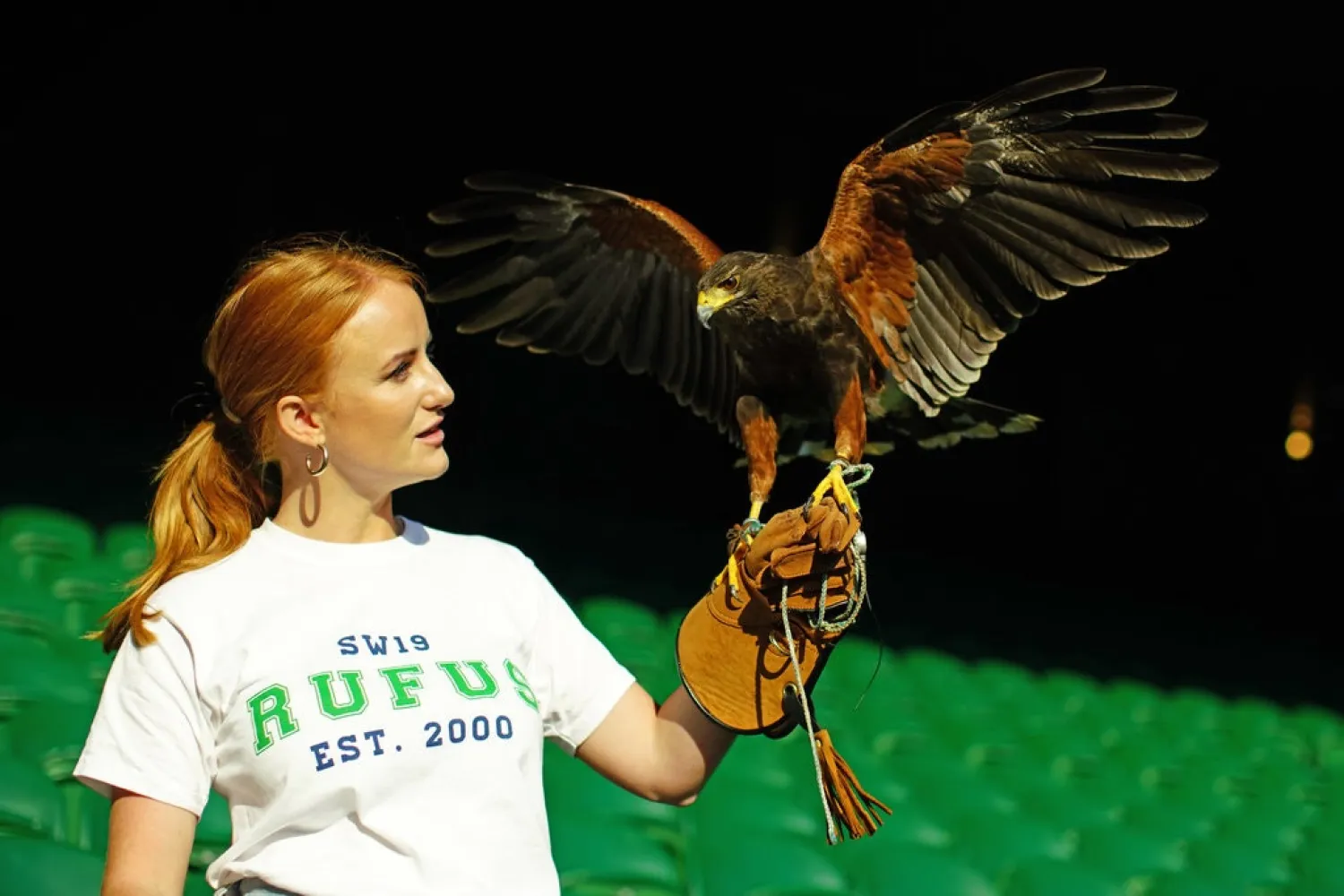
Imogen Davis, another handler, said Rufus once stayed in the Centre Court rafters overnight.CreditJane Stockdale for The New York Times
TT

On Pigeon Patrol, Rufus the Hawk Rules the Skies Over Wimbledon

Imogen Davis, another handler, said Rufus once stayed in the Centre Court rafters overnight.CreditJane Stockdale for The New York Times

Roger Federer is serving for the Wimbledon title. He tosses the ball and cranes his neck.

Plop. A gift from a pigeon, right on the forehead.

Luckily, something like that hasn’t happened. At least not yet, not during a big match in recent memory.

For that, Wimbledon can thank a brown and chestnut bird of prey with keen eyes, a four-foot wingspan and bone-crushing talons. His name is Rufus the Hawk, and he plays a crucial role at the world’s oldest tennis tournament.

Every day, in the early morning, well before the matches begin, Rufus soars the skies over the All England Club, on the prowl for pigeons.

Without him, Wimbledon just might descend into aviary chaos. Pigeons could reign supreme, not just in the air, but also in the rafters, on the rooftops and across the grass courts.

The place is perfect for pigeons. “All of the grass seeds, all of the nooks and crannies, and the food waste from the fans,” Wayne Davis, one of Rufus’s handlers, said. Without Rufus, he reckoned, pigeons would number in the hundreds.

“Feral pigeons breed year round,” he said. “If you have just one pair breeding in the rafters at Centre Court, you would end up by the end of the year with about 40 more birds. You could have Roger Federer serving and clouds of pigeons wafting about.

“And pigeon poop, too, of course.”

Flocks of pigeons became a growing problem in the late 1990s, a threat to the prim fastidiousness that Wimbledon prizes above all. That was when the All England Club telephoned Davis and his family-run Avian Environmental Consult­ants.

Another of their birds was the first to patrol Wimbledon. Then Rufus the Hawk took over. He has become an English icon.

From dawn to dusk, he soars, on the prowl for pigeons. He doesn’t kill them. He toys with them, barreling from above, twisting, turning, squawking and nipping at their wings, announcing to all that the skies over Wimbledon belong to him.

“The pigeons learned he was in charge,” Davis said. “Other than a few stragglers, they stopped coming around like they did before. He scares them away.”

Rufus would have been a fearsome predator in the wild. Although he weighs just 1 pound 6 ounces, he cuts a much larger figure with his confident bearing and cascade of feathers.

He can spread his talons almost as wide as a person’s hand, and he can see 10 times better than any human. He can focus on a pigeon from a mile way.

Davis and his daughter, Imogen, feed him by hand because his weight is important. At less than a pound and a half, he can become too hungry and might have a pigeon for lunch. Maybe in front of the royal box.

They have taught him to come when they whistle.

Most often, he does.

On one occasion three years ago, however, Imogen Davis had to chase him down at a nearby golf course. He took off again, across a road, then out of sight. She followed the jingle of his small bronze bell, attached to a talon.

She found him in the middle of a pond, standing in a thicket of weeds, hovering over a freshly killed duck. She couldn’t let him eat it. A full tummy would mean he wouldn’t come home until he was hungry again.

She waded through muck and lily pads, then through waist-high water. When she trooped back to Wimbledon, past crowds lined up to watch tennis in their finery, she had Rufus in her clutches.

One time, he vanished overnight.

Wayne Davis had left the bird in the family camper, parked outside an apartment they stay at during tournaments. Davis tucked him into the black cage that is his bedroom, and cracked a camper window just enough for ventilation. In the morning, Rufus and his cage were gone.

Someone had broken in and stolen him.

“My heart sank,” Imogen Davis said. She, her parents and her siblings had bought Rufus from a breeder when he was 16 weeks old, and he had become a member of the family.

“It was terrible,” she said. “There were a lot of tears.”

By then, Rufus had celebrity status, even a Twitter handle. The theft of Rufus the Hawk became headline news.

“Game, set and snatched,” wrote The Daily Mail.

The police said to expect someone to be in touch, demanding a ransom.

Three days went by. Then, from a phone booth, someone telephoned the Royal Society for the Prevention of Cruelty to Animals. No one knows for sure what had transpired — maybe Rufus had gotten away from the birdnappers, or maybe they decided to simply give him up — but he had been spotted in a park.

The animal welfare charity picked him up. Rufus went back to work. He hasn’t missed a day since.

Imogen Davis said Rufus has taught her important lessons. Like the morning he flew into the Centre Court rafters and decided to stay there.

Two hours passed. Then five. Then 10. He still wouldn’t budge. “Luckily it wasn’t during the actual tournament,” she said, a nod to the fact that Rufus polices Wimbledon year round. She and her mother, Donna, wrapped themselves in towels and spent the night on Centre Court.

“We didn’t sleep in the royal box,” Imogen Davis said. “We didn’t sleep at all.”

The next day, Rufus came down.

The lesson was a lot like Zen: Rufus never gets ruffled. He does things in his own good time.

Has he ever, in his own good time, decided to perch in the Center Court rafters during a match?

No, Davis said. She chuckled. “But if he did, he would just stay perched up there, saying, ‘I don’t know who Roger Federer is.’”

The New York Times


Shakhtar Boss Pays Ukrainian Racer $200,000 After Games Disqualification

Ukrainian President Volodymyr Zelenskiy holds helmet as he meets with a Ukrainian skeleton racer Vladyslav Heraskevych , who was disqualified from the Olympic skeleton competition over his "helmet of remembrance" depicting athletes killed since Russia's invasion and his father and coach, Mykhailo Heraskevych, amid Russia's attack on Ukraine, in Munich, Germany February 13, 2026. (Ukrainian Presidential Press Service/Handout via Reuters)
TT

Shakhtar Boss Pays Ukrainian Racer $200,000 After Games Disqualification

Ukrainian President Volodymyr Zelenskiy holds helmet as he meets with a Ukrainian skeleton racer Vladyslav Heraskevych , who was disqualified from the Olympic skeleton competition over his "helmet of remembrance" depicting athletes killed since Russia's invasion and his father and coach, Mykhailo Heraskevych, amid Russia's attack on Ukraine, in Munich, Germany February 13, 2026. (Ukrainian Presidential Press Service/Handout via Reuters)

The owner of ‌Ukrainian football club Shakhtar Donetsk has donated more than $200,000 to skeleton racer Vladyslav Heraskevych after the athlete was disqualified from the Milano Cortina Winter Games before competing over the use of a helmet depicting Ukrainian athletes killed in the war with Russia, the club said on Tuesday.

The 27-year-old Heraskevych was disqualified last week when the International Bobsleigh and Skeleton Federation jury ruled that imagery on the helmet — depicting athletes killed since Russia invaded Ukraine in 2022 — breached rules on athletes' expression at ‌the Games.

He ‌then lost an appeal at the Court ‌of ⁠Arbitration for Sport hours ⁠before the final two runs of his competition, having missed the first two runs due to his disqualification.

Heraskevych had been allowed to train with the helmet that displayed the faces of 24 dead Ukrainian athletes for several days in Cortina d'Ampezzo where the sliding center is, but the International Olympic Committee then ⁠warned him a day before his competition ‌started that he could not wear ‌it there.

“Vlad Heraskevych was denied the opportunity to compete for victory ‌at the Olympic Games, yet he returns to Ukraine a ‌true winner," Shakhtar President Rinat Akhmetov said in a club statement.

"The respect and pride he has earned among Ukrainians through his actions are the highest reward. At the same time, I want him to ‌have enough energy and resources to continue his sporting career, as well as to fight ⁠for truth, freedom ⁠and the remembrance of those who gave their lives for Ukraine," he said.

The amount is equal to the prize money Ukraine pays athletes who win a gold medal at the Games.

The case dominated headlines early on at the Olympics, with IOC President Kirsty Coventry meeting Heraskevych on Thursday morning at the sliding venue in a failed last-minute attempt to broker a compromise.

The IOC suggested he wear a black armband and display the helmet before and after the race, but said using it in competition breached rules on keeping politics off fields of play. Heraskevych also earned praise from Ukraine President Volodymyr Zelenskiy.


Speed Skating-Italy Clinch Shock Men’s Team Pursuit Gold, Canada Successfully Defend Women’s Title

 Team Italy with Davide Ghiotto, Andrea Giovannini, Michele Malfatti, celebrate winning the gold medal on the podium of the men's team pursuit speed skating race at the 2026 Winter Olympics, in Milan, Italy, Tuesday, Feb. 17, 2026. (AP)
Team Italy with Davide Ghiotto, Andrea Giovannini, Michele Malfatti, celebrate winning the gold medal on the podium of the men's team pursuit speed skating race at the 2026 Winter Olympics, in Milan, Italy, Tuesday, Feb. 17, 2026. (AP)
TT

Speed Skating-Italy Clinch Shock Men’s Team Pursuit Gold, Canada Successfully Defend Women’s Title

 Team Italy with Davide Ghiotto, Andrea Giovannini, Michele Malfatti, celebrate winning the gold medal on the podium of the men's team pursuit speed skating race at the 2026 Winter Olympics, in Milan, Italy, Tuesday, Feb. 17, 2026. (AP)
Team Italy with Davide Ghiotto, Andrea Giovannini, Michele Malfatti, celebrate winning the gold medal on the podium of the men's team pursuit speed skating race at the 2026 Winter Olympics, in Milan, Italy, Tuesday, Feb. 17, 2026. (AP)

An inspired Italy delighted the home crowd with a stunning victory in the Olympic men's team pursuit final as

Canada's Ivanie Blondin, Valerie Maltais and Isabelle Weidemann delivered another seamless performance to beat the Netherlands in the women's event and retain their title ‌on Tuesday.

Italy's ‌men upset the US who ‌arrived ⁠at the Games ⁠as world champions and gold medal favorites.

Spurred on by double Olympic champion Francesca Lollobrigida, the Italian team of Davide Ghiotto, Andrea Giovannini and Michele Malfatti electrified a frenzied arena as they stormed ⁠to a time of three ‌minutes 39.20 seconds - ‌a commanding 4.51 seconds clear of the ‌Americans with China taking bronze.

The roar inside ‌the venue as Italy powered home was thunderous as the crowd rose to their feet, cheering the host nation to one ‌of their most special golds of a highly successful Games.

Canada's women ⁠crossed ⁠the line 0.96 seconds ahead of the Netherlands, stopping the clock at two minutes 55.81 seconds, and

Japan rounded out the women's podium by beating the US in the Final B.

It was only Canada's third gold medal of the Games, following Mikael Kingsbury's win in men's dual moguls and Megan Oldham's victory in women's freeski big air.


Lindsey Vonn Back in US Following Crash in Olympic Downhill 

Milano Cortina 2026 Olympics - Alpine Skiing - Women's Downhill 3rd Official Training - Tofane Alpine Skiing Centre, Belluno, Italy - February 07, 2026. Lindsey Vonn of United States in action during training. (Reuters)
TT

Lindsey Vonn Back in US Following Crash in Olympic Downhill 

Milano Cortina 2026 Olympics - Alpine Skiing - Women's Downhill 3rd Official Training - Tofane Alpine Skiing Centre, Belluno, Italy - February 07, 2026. Lindsey Vonn of United States in action during training. (Reuters)

Lindsey Vonn is back home in the US following a week of treatment at a hospital in Italy after breaking her left leg in the Olympic downhill at the Milan Cortina Games.

“Haven’t stood on my feet in over a week... been in a hospital bed immobile since my race. And although I’m not yet able to stand, being back on home soil feels amazing,” Vonn posted on X with an American flag emoji. “Huge thank you to everyone in Italy for taking good care of me.”

The 41-year-old Vonn suffered a complex tibia fracture that has already been operated on multiple times following her Feb. 8 crash. She has said she'll need more surgery in the US.

Nine days before her fall in Cortina d'Ampezzo, Italy, Vonn ruptured the ACL in her left knee in another crash in Switzerland.

Even before then, all eyes had been on her as the feel-good story heading into the Olympics for her comeback after nearly six years of retirement.
