
Rights Group Slams Mismanagement of Water Crisis in Basra

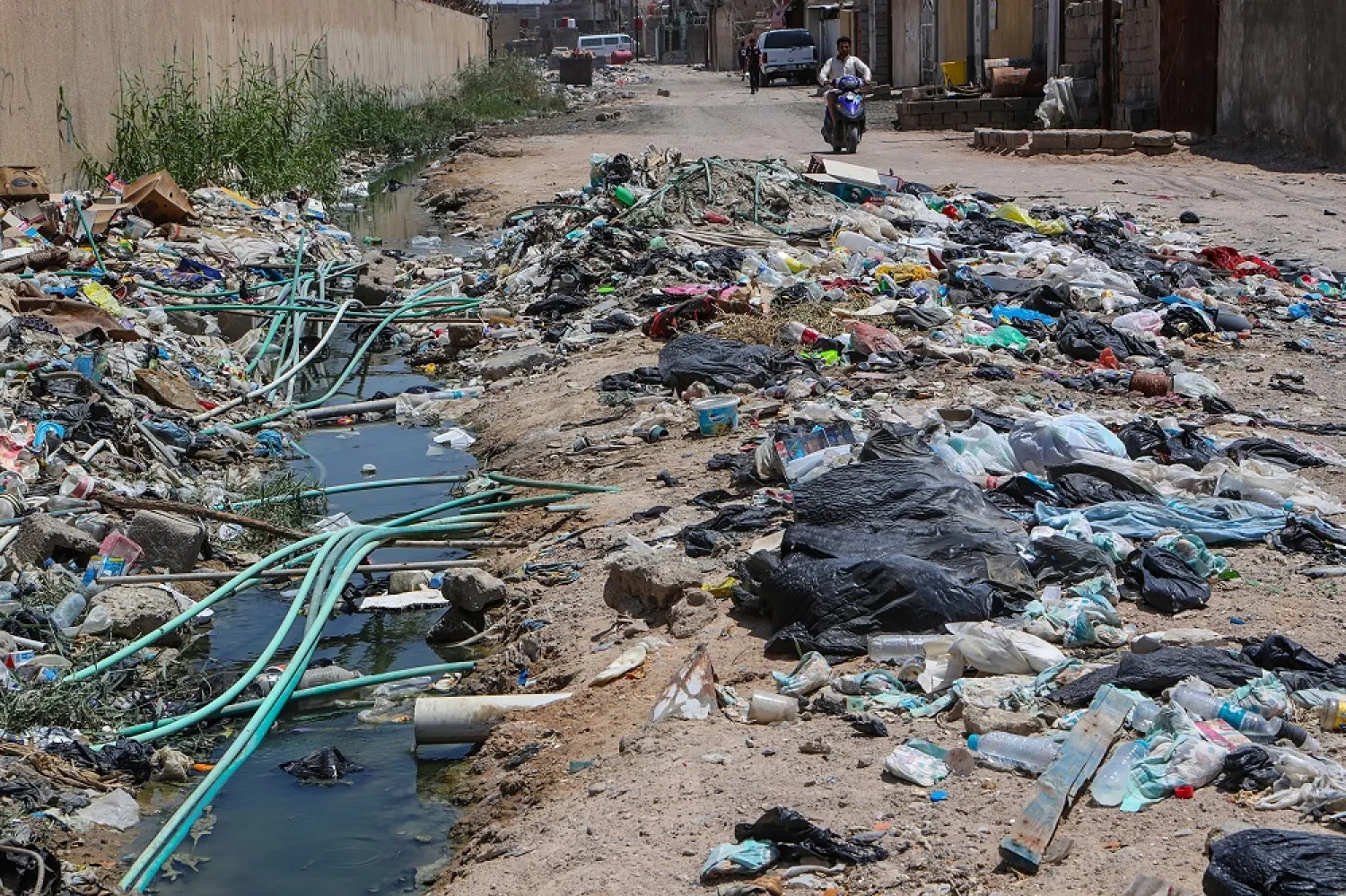
In this July, 20, 2019 photo, potable water pipes mix with sewage at a garbage dump in Basra, southeast of Baghdad, Iraq. (AP)
TT

Rights Group Slams Mismanagement of Water Crisis in Basra

In this July, 20, 2019 photo, potable water pipes mix with sewage at a garbage dump in Basra, southeast of Baghdad, Iraq. (AP)

Human Rights Watch painted a bleak image on Monday of the water crisis plaguing the southern Iraqi region of Basra.

In a report of over a 100 pages, it accused Iraqi authorities of doing little to address the underlying conditions causing the water shortages and pollution crisis, warning of outbreaks of water-borne diseases and continued economic hardship for the governorate's 4 million people.

HRW found the generally poor state of water quality was likely compounded by algae that rapidly spread last year in the Shatt al-Arab waterway that runs through Basra and provides it with its primary water source.

It indicated that the algae, pollution and high salination could together have sparked the mass health crisis.

"These combined failures violate Basra residents' rights to water, sanitation, health, information, and property guaranteed under international and national law," it said.

"The government urgently needs to act," Belkis Wille of HRW told a press conference in Baghdad, where the organization released its report on Basra's water crisis. "The people of Iraq have a right to know what is in their environment and how to keep safe."

The report, entitled "Basra is Thirsty: Iraq's Failure to Manage the Water Crisis," said a full year after Basra's violent protests, authorities continue to allow activities that pollute the province's water resources despite the health risks to residents.

Promised government projects to improve water quality have failed to materialize due to mismanagement and corruption, it said, and warned of outbreaks of water-borne diseases if the problems are left unaddressed.

The report relies on dozens of interviews with residents of Basra, experts and government officials as well as analysis of satellite imagery.

Those images revealed evidence of oil spills and algal bloom in the Shatt el-Arab and other waterways that contaminated the water which, when consumed, could cause abdominal pain, fever, vomiting and bloody diarrhea.

Basra's acute water problems have been going on for decades, leading to outbreaks of protests every summer. The protests turned into a full-blown crisis last year after thousands of people were hospitalized due to stomach ailments and skin rashes blamed on the water quality.

The contaminated water, along with other failing city services and soaring unemployment, also led to violent protests and rioting in Basra, Iraq's oil-exporting capital.

During a week of demonstrations, protesters set fire to government buildings and offices of Iranian-backed factions that they blame for mismanagement and profiteering while residents struggle with poverty.

After years of meager rains, Iraq had seen its wettest winter in a generation, restoring freshwater marshes in southern Iraq and bringing welcome relief to the local population. The deluge of the winter months has slightly decreased salinity in Basra's drinking water, as the revived rivers flushed the salt away and filled the marshes with fresh water.

But residents told The Associated Press the government has done nothing to address the problems.

Waste water flows into the river and potable water pipes mix with sewage at a garbage dump in Basra. Although they cite a slight improvement in the water flowing through their taps, residents still use bottled water for drinking and cooking.


Lebanon: Security Forces Continue Crackdown on Individuals Carrying Unauthorized Arms

Mourners gather around the Hezbollah-draped coffins of people killed in Israeli airstrikes on Baalbek, during their funeral in the city of Baalbek, in Bekaa valley, Lebanon, 05 March 2026. EPA/WAEL HAMZEH
TT

Lebanon: Security Forces Continue Crackdown on Individuals Carrying Unauthorized Arms

Mourners gather around the Hezbollah-draped coffins of people killed in Israeli airstrikes on Baalbek, during their funeral in the city of Baalbek, in Bekaa valley, Lebanon, 05 March 2026. EPA/WAEL HAMZEH

A judicial source said 23 people, including Hezbollah members and civilians, have been arrested so far following a government decision to ban military actions by the party.

The arrests have been made across Lebanon after individual weapons, machine guns, and various types of military equipment were found in their possession.

The detainees are being questioned by army intelligence and the military police, under the supervision of the government commissioner to the military court, Judge Claude Ghanem, the source told Asharq Al-Awsat.

Investigations with five suspects have concluded and they have been referred to the military judiciary ahead of legal proceedings.

The shift extends beyond the number of arrests to the procedures themselves. Before the government ban, courts often limited action to confiscating the weapon and leaving the armed individual under investigation or releasing him after a pledge not to repeat the violation.

That approach has now changed. Authorities confiscate the weapon and detain the person regardless of identity or political affiliation, which is a clear sign of official determination to enforce the government decision without exception, including for Hezbollah members.

Despite the tougher stance, the identity of those launching rockets and drones toward Israel remains unknown. Security agencies are working to identify those responsible for the launches, which constitute a direct breach of the cabinet decision.

No arrests have been announced in connection with rocket or drone launches so far, security sources told Asharq Al-Awsat. Arrests linked to the transportation of weapons, however, are occurring daily as part of a wide security plan covering all regions.

In recent hours, security agencies apprehended individuals transporting a Kornet anti-tank missile, a destructive weapon capable of striking armored targets with precision.

The seizures reflect growing official and public concern, highlighting the scale of the security challenge and the pressure on authorities to enforce the government’s strict decision.

Most of those detained were stopped while traveling with convoys of displaced people from the south and the Bekaa. Security sources said the presence of armed individuals among displaced civilians poses a risk to the safety of shelters and raises concern among host communities.

Authorities fear such individuals could be targeted by Israeli strikes inside shelters, while tensions could also arise with host communities in Beirut, Mount Lebanon and other areas.

Judicial and security agencies have intensified coordination at the highest levels. Sources from both sides say investigations are exploring every possible lead that could expose networks involved in transporting weapons or launching rockets.

The military prosecution is closely monitoring the preliminary investigations but is carefully reviewing reports before filing charges, the judicial source said.

Launching judicial proceedings requires evidence strong enough to support suspicions, a process that can delay the announcement of results and the full number of arrests.


Israel Far-right Minister Warns Beirut Suburb Faces Devastation Like Gaza

Fires erupt from buildings damaged in an early morning Israeli strike on Beirut's southern suburbs on March 3, 2026. (Photo by AFP)
TT

Israel Far-right Minister Warns Beirut Suburb Faces Devastation Like Gaza

Fires erupt from buildings damaged in an early morning Israeli strike on Beirut's southern suburbs on March 3, 2026. (Photo by AFP)

Israel's far-right Finance Minister Bezalel Smotrich warned Thursday that a southern Beirut suburb, a stronghold of Hezbollah, will face devastation similar to Gaza after the Israeli military told residents to evacuate.

"Very soon Dahiyeh will resemble Khan Yunis," Smotrich said, referring to a southern Gaza city which has been heavily damaged by Israeli bombardments during the two-year war with Hamas, AFP reported.

"Hezbollah made a mistake, and it will pay a heavy price. We are striking at the head of the octopus in Iran, and at the same time we will sever Hezbollah's arm," he said in a video statement as he visited Israel's northern border.


HRW Says Israel's Lebanon Evacuation Risks Violating Laws of War

Smoke rises after an Israeli strike on Beirut's southern suburbs, following an escalation between Hezbollah and Israel, amid the US-Israeli conflict with Iran, Lebanon, March 4, 2026. REUTERS/Khalil Ashawi
TT

HRW Says Israel's Lebanon Evacuation Risks Violating Laws of War

Smoke rises after an Israeli strike on Beirut's southern suburbs, following an escalation between Hezbollah and Israel, amid the US-Israeli conflict with Iran, Lebanon, March 4, 2026. REUTERS/Khalil Ashawi

Human Rights Watch said on Thursday that the Israeli military's call for residents of vast areas of southern Lebanon to evacuate raised "serious risks of violations of the laws of war".

Lebanon was drawn into the Middle East war when Iran-backed Hezbollah began firing rockets at Israel with Israel conducting air strikes across the country and its troops pushing into border towns.

On Thursday, Israel renewed its warning to residents of hundreds of square kilometres (miles) of southern Lebanon to evacuate because of military action, AFP reported.

"Calling on everyone who lives south of the Litani (River) to evacuate immediately raises serious legal and humanitarian red flags and fears for the safety of civilians," said Ramzi Kaiss, Lebanon researcher at Human Rights Watch.

"How are older people, the sick and people with disabilities going to be able to evacuate immediately? And how will their safety be guaranteed as they leave?" he said in a statement from the rights group.

HRW said "the sweeping nature" of Israel's call raised "concerns that their purpose is not to protect civilians", adding that the area was home to hundreds of thousands of people.

The evacuation call "raises serious risks of violations of the laws of war", it added.

Lebanese authorities said dozens of people have been killed and tens of thousands displaced from their homes since Monday.