

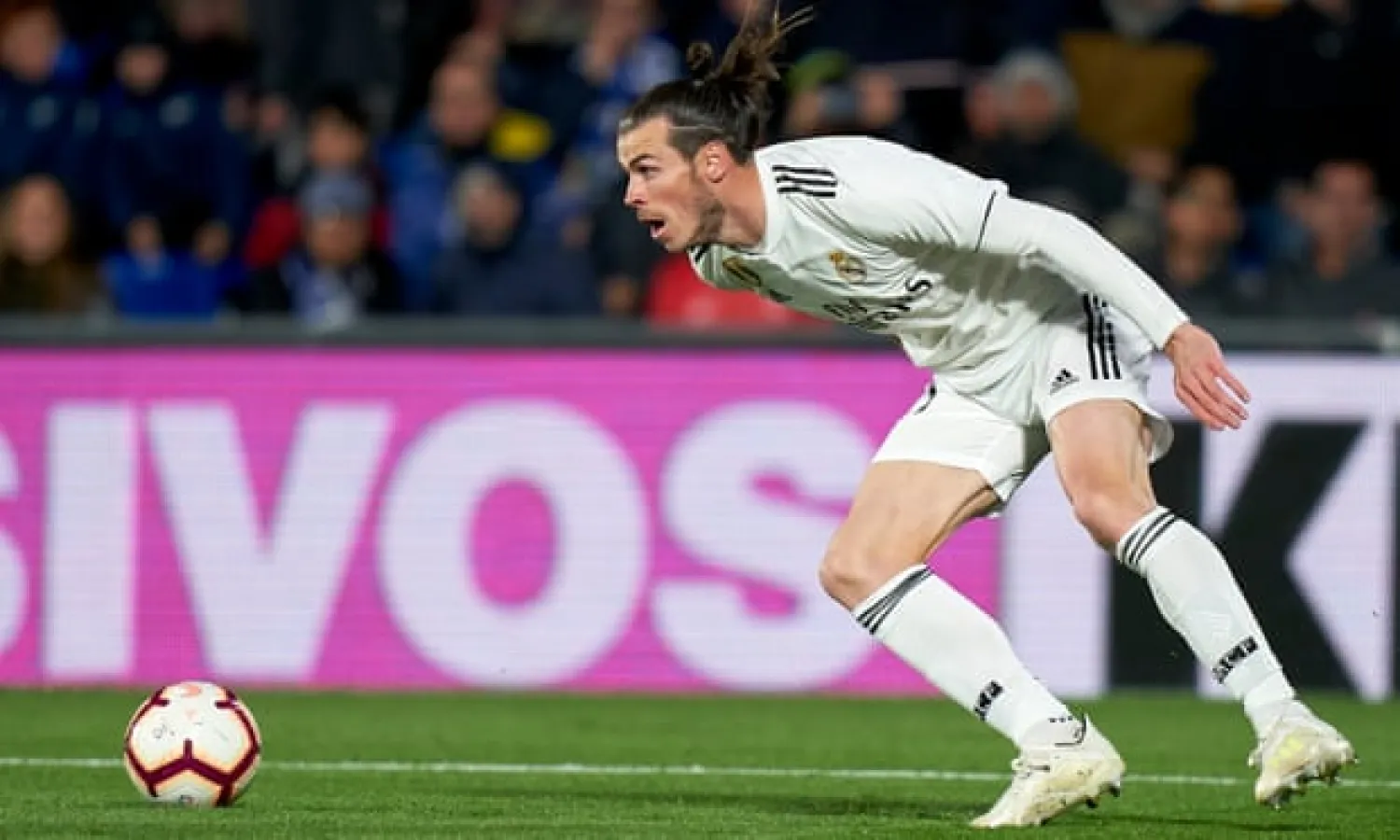

Gareth Bale Could Be a Real Madrid Cult Hero so Why Has It Gone so Wrong?

 Gareth Bale has almost never been played by Real Madrid in the role in which he impressed them to earn a move there. Photograph: Quality Sport Images/Getty Images
Gareth Bale has almost never been played by Real Madrid in the role in which he impressed them to earn a move there. Photograph: Quality Sport Images/Getty Images
TT

Gareth Bale Could Be a Real Madrid Cult Hero so Why Has It Gone so Wrong?

 Gareth Bale has almost never been played by Real Madrid in the role in which he impressed them to earn a move there. Photograph: Quality Sport Images/Getty Images
Gareth Bale has almost never been played by Real Madrid in the role in which he impressed them to earn a move there. Photograph: Quality Sport Images/Getty Images

On the one hand, the massive imbalances of wealth within football are a terrible thing. On the other, they can lead to deliciously ludicrous morality tales. The hero is lured to a faraway kingdom by promises of unimaginable wealth and other heroes to hero around with. The hero heroes but perhaps not as heroically as some would like. Then the king decides he wants a new hero and that means this hero must leave. But this hero enjoys his luxurious life and does not want to go anywhere where there may be fewer other heroes to hero with and where the pillows may be less silken and the fairways less lush. Impasse ensues.

This could be about Neymar and Paris Saint-Germain but it is about Gareth Bale and Real Madrid – and the fact the pattern repeats with such contrasting personalities suggests the problem is systemic rather than being about individuals. The culture of superclubs has led to a cult of superplayers and the problem with superplayers is that only superclubs and Chinese franchises can afford them. When one tires of the other, there are very few places for the superplayer to go.

Even after the cruciate injury suffered by Marco Asensio this week, Bale probably will end up leaving Real this summer, with it reported on Friday night that he is close to joining Chinese Super League side Jiangsu Suning on a £1m per week contract. Bale is currently sitting on a deal worth £600,000 per week for the next three years. But none of that explains the bitterness that now exists between Bale on one side and Real’s manager, Zinedine Zidane, and fans on the other.

The argument that Bale has not integrated into Spanish life feels a little hollow. There are plenty of players who struggle with a new language who have been successful. And so what if he plays a lot of golf? There are many more damaging extracurricular activities that a footballer could indulge. Complaints about lifestyle tend to be symptomatic of a deeper dissatisfaction.

Yet, on the face of it, Bale’s time at Real has been a success. There have been injuries – 72 games missed through 17 separate problems in his six years at the Bernabéu – but he has still managed 133 league starts. More than that, he has scored vital goals – three in Champions League finals, two of them vital game-changing strikes, and one of them arguably the greatest goal scored in a major final.

Perhaps it is true Bale never quite got going in Spain, that there have been flashes and hints rather than sustained excellence, but equally there is more than enough material there to build a cult hero. There was enough for Real to offer him a six-year deal worth in excess of £150m in October 2016.

The problem has perhaps been twofold: expectation and the absurd incoherence that so often afflicts Florentino Pérez’s content generator. Bale arrived in 2013 for a world-record fee as the designated successor to the previous holder of that accolade, Cristiano Ronaldo. But not only was he never the new Ronaldo, the old Ronaldo turned out to be nowhere near obsolescence as it had appeared.

That created an immediate tactical problem. Bale had excelled in his final season at Tottenham cutting in from the left but that was the space occupied by Ronaldo. Bale ended up playing mainly on the right, an awkward accommodation that immediately raised the question of why a club would pay world-record fees for two players who wanted to play in the same position.

As Ronaldo aged and stripped back his role back, so the opportunities for Bale to play as he had at Spurs became increasingly limited. What he needed was a 4-3-3 with a centre-forward who got out of the way, creating space for him to accelerate into. What he got was a 4-4-2 that generated much of its width from full-back and demanded a more patient technical style from its midfielders.

In six years, Real have spent around £300m on Bale in transfer fee and wages and yet have almost never played him in the role in which he impressed them.

Which is not necessarily to paint Bale as a victim, particularly if there is substance to the rumours Zidane’s increasingly militant stance has been prompted by Bale’s truculence in the latter part of last season. It is not as though Bale seized the opportunity when Ronaldo had finally cleared out of the way. Equally, while he cannot be blamed for insisting his contract be honoured, there is something a little depressing that that seems more of a priority than using his talents at the highest possible level for the handful of seasons that remain for him as a player. It is surely not how the Bale of that famous childhood photo, clad in his Real replica shirt, grinning awkwardly and raising his fingers in a victory sign, hoped it would turn out.

Fundamentally, though, this is a problem of Real’s making: if you treat players like commodities, you cannot be surprised if they come to regard themselves as value-creation machines.

The situation could be sad but really it is just silly: what actually, other than the dignity of the game, the dreams of children and the sense of sport as a noble pursuit in and of itself, has been lost?

The Guardian Sport


Shakhtar Boss Pays Ukrainian Racer $200,000 After Games Disqualification

Ukrainian President Volodymyr Zelenskiy holds helmet as he meets with a Ukrainian skeleton racer Vladyslav Heraskevych , who was disqualified from the Olympic skeleton competition over his "helmet of remembrance" depicting athletes killed since Russia's invasion and his father and coach, Mykhailo Heraskevych, amid Russia's attack on Ukraine, in Munich, Germany February 13, 2026. (Ukrainian Presidential Press Service/Handout via Reuters)
TT

Shakhtar Boss Pays Ukrainian Racer $200,000 After Games Disqualification

Ukrainian President Volodymyr Zelenskiy holds helmet as he meets with a Ukrainian skeleton racer Vladyslav Heraskevych , who was disqualified from the Olympic skeleton competition over his "helmet of remembrance" depicting athletes killed since Russia's invasion and his father and coach, Mykhailo Heraskevych, amid Russia's attack on Ukraine, in Munich, Germany February 13, 2026. (Ukrainian Presidential Press Service/Handout via Reuters)

The owner of ‌Ukrainian football club Shakhtar Donetsk has donated more than $200,000 to skeleton racer Vladyslav Heraskevych after the athlete was disqualified from the Milano Cortina Winter Games before competing over the use of a helmet depicting Ukrainian athletes killed in the war with Russia, the club said on Tuesday.

The 27-year-old Heraskevych was disqualified last week when the International Bobsleigh and Skeleton Federation jury ruled that imagery on the helmet — depicting athletes killed since Russia invaded Ukraine in 2022 — breached rules on athletes' expression at ‌the Games.

He ‌then lost an appeal at the Court ‌of ⁠Arbitration for Sport hours ⁠before the final two runs of his competition, having missed the first two runs due to his disqualification.

Heraskevych had been allowed to train with the helmet that displayed the faces of 24 dead Ukrainian athletes for several days in Cortina d'Ampezzo where the sliding center is, but the International Olympic Committee then ⁠warned him a day before his competition ‌started that he could not wear ‌it there.

“Vlad Heraskevych was denied the opportunity to compete for victory ‌at the Olympic Games, yet he returns to Ukraine a ‌true winner," Shakhtar President Rinat Akhmetov said in a club statement.

"The respect and pride he has earned among Ukrainians through his actions are the highest reward. At the same time, I want him to ‌have enough energy and resources to continue his sporting career, as well as to fight ⁠for truth, freedom ⁠and the remembrance of those who gave their lives for Ukraine," he said.

The amount is equal to the prize money Ukraine pays athletes who win a gold medal at the Games.

The case dominated headlines early on at the Olympics, with IOC President Kirsty Coventry meeting Heraskevych on Thursday morning at the sliding venue in a failed last-minute attempt to broker a compromise.

The IOC suggested he wear a black armband and display the helmet before and after the race, but said using it in competition breached rules on keeping politics off fields of play. Heraskevych also earned praise from Ukraine President Volodymyr Zelenskiy.


Speed Skating-Italy Clinch Shock Men’s Team Pursuit Gold, Canada Successfully Defend Women’s Title

 Team Italy with Davide Ghiotto, Andrea Giovannini, Michele Malfatti, celebrate winning the gold medal on the podium of the men's team pursuit speed skating race at the 2026 Winter Olympics, in Milan, Italy, Tuesday, Feb. 17, 2026. (AP)
Team Italy with Davide Ghiotto, Andrea Giovannini, Michele Malfatti, celebrate winning the gold medal on the podium of the men's team pursuit speed skating race at the 2026 Winter Olympics, in Milan, Italy, Tuesday, Feb. 17, 2026. (AP)
TT

Speed Skating-Italy Clinch Shock Men’s Team Pursuit Gold, Canada Successfully Defend Women’s Title

 Team Italy with Davide Ghiotto, Andrea Giovannini, Michele Malfatti, celebrate winning the gold medal on the podium of the men's team pursuit speed skating race at the 2026 Winter Olympics, in Milan, Italy, Tuesday, Feb. 17, 2026. (AP)
Team Italy with Davide Ghiotto, Andrea Giovannini, Michele Malfatti, celebrate winning the gold medal on the podium of the men's team pursuit speed skating race at the 2026 Winter Olympics, in Milan, Italy, Tuesday, Feb. 17, 2026. (AP)

An inspired Italy delighted the home crowd with a stunning victory in the Olympic men's team pursuit final as

Canada's Ivanie Blondin, Valerie Maltais and Isabelle Weidemann delivered another seamless performance to beat the Netherlands in the women's event and retain their title ‌on Tuesday.

Italy's ‌men upset the US who ‌arrived ⁠at the Games ⁠as world champions and gold medal favorites.

Spurred on by double Olympic champion Francesca Lollobrigida, the Italian team of Davide Ghiotto, Andrea Giovannini and Michele Malfatti electrified a frenzied arena as they stormed ⁠to a time of three ‌minutes 39.20 seconds - ‌a commanding 4.51 seconds clear of the ‌Americans with China taking bronze.

The roar inside ‌the venue as Italy powered home was thunderous as the crowd rose to their feet, cheering the host nation to one ‌of their most special golds of a highly successful Games.

Canada's women ⁠crossed ⁠the line 0.96 seconds ahead of the Netherlands, stopping the clock at two minutes 55.81 seconds, and

Japan rounded out the women's podium by beating the US in the Final B.

It was only Canada's third gold medal of the Games, following Mikael Kingsbury's win in men's dual moguls and Megan Oldham's victory in women's freeski big air.


Lindsey Vonn Back in US Following Crash in Olympic Downhill 

Milano Cortina 2026 Olympics - Alpine Skiing - Women's Downhill 3rd Official Training - Tofane Alpine Skiing Centre, Belluno, Italy - February 07, 2026. Lindsey Vonn of United States in action during training. (Reuters)
TT

Lindsey Vonn Back in US Following Crash in Olympic Downhill 

Milano Cortina 2026 Olympics - Alpine Skiing - Women's Downhill 3rd Official Training - Tofane Alpine Skiing Centre, Belluno, Italy - February 07, 2026. Lindsey Vonn of United States in action during training. (Reuters)

Lindsey Vonn is back home in the US following a week of treatment at a hospital in Italy after breaking her left leg in the Olympic downhill at the Milan Cortina Games.

“Haven’t stood on my feet in over a week... been in a hospital bed immobile since my race. And although I’m not yet able to stand, being back on home soil feels amazing,” Vonn posted on X with an American flag emoji. “Huge thank you to everyone in Italy for taking good care of me.”

The 41-year-old Vonn suffered a complex tibia fracture that has already been operated on multiple times following her Feb. 8 crash. She has said she'll need more surgery in the US.

Nine days before her fall in Cortina d'Ampezzo, Italy, Vonn ruptured the ACL in her left knee in another crash in Switzerland.

Even before then, all eyes had been on her as the feel-good story heading into the Olympics for her comeback after nearly six years of retirement.
