


Salame Offers Three-Point Plan to Bring Peace to Libya

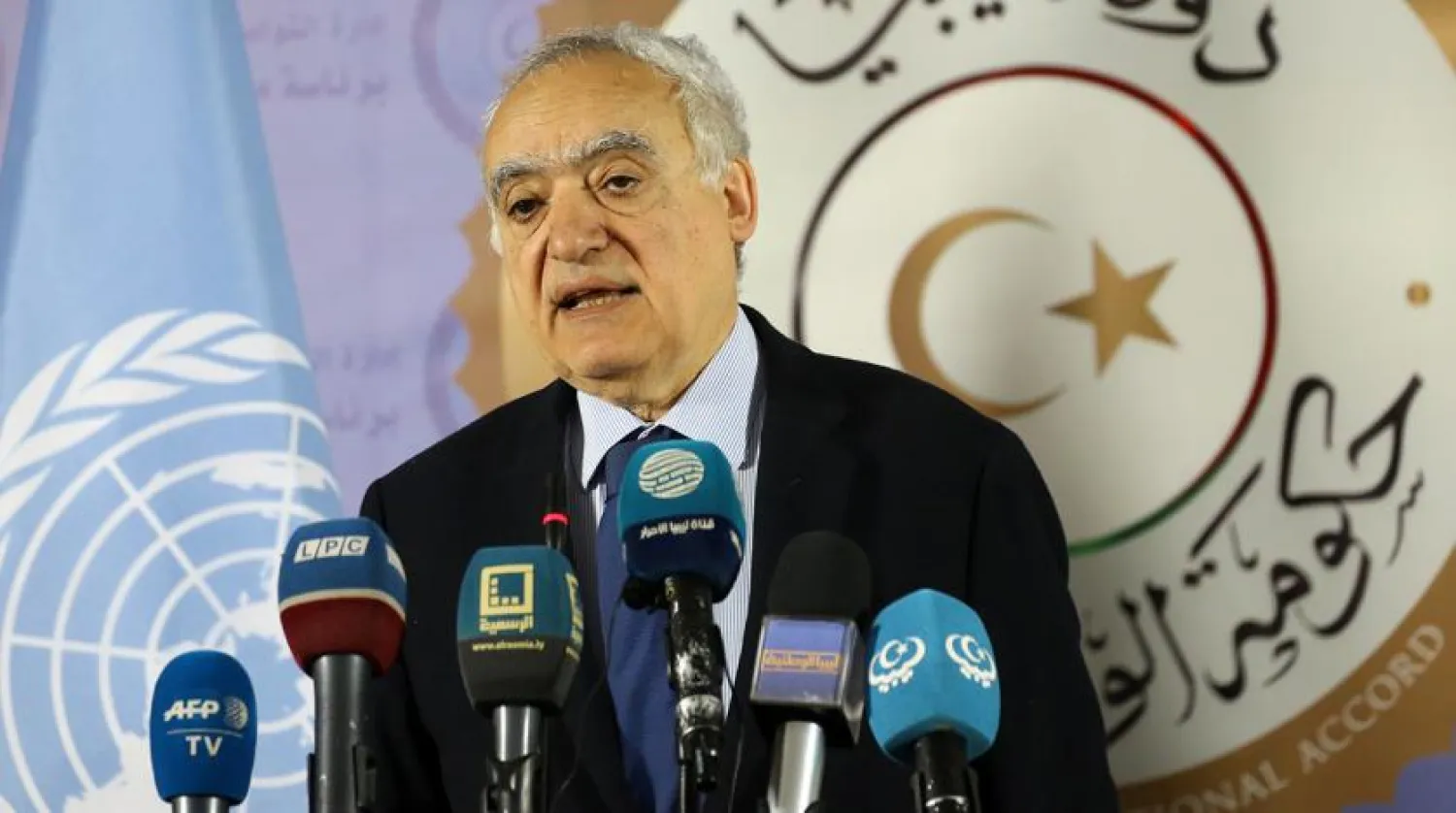
Ghassan Salame, UN special envoy for Libya and head of the UN Support Mission in Libya (UNSMIL) speaks during a press conference in the Libyan capital Tripoli on April 6, 2019. (Photo by Mahmud TURKIA / AFP)
TT

Salame Offers Three-Point Plan to Bring Peace to Libya

Ghassan Salame, UN special envoy for Libya and head of the UN Support Mission in Libya (UNSMIL) speaks during a press conference in the Libyan capital Tripoli on April 6, 2019. (Photo by Mahmud TURKIA / AFP)

UN Envoy to Libya Ghassan Salame offered a new three-point plan to bring warring parties in the country back to the political process. His plan includes a humanitarian truce beginning on August 10, on the occasion of Eid al-Adha, the convention of a new international meeting and holding a comprehensive national conference.

The plan’s steps have been lately discussed with the conflict’s key parties, especially Head of the Government of National Accord (GNA) Fayez al-Sarraj and Libyan National Army (LNA) Chief Marshal Khalifa Haftar.

Head of the UN Support Mission in Libya (UNSMIL) briefed Monday the Security Council members in New York via closed-circuit television from Tripoli.

He said the armed conflict in the country shows no signs of abating, with the war waged in Tripoli’s outskirts have left nearly 1,100 people dead, including 106 civilians.

“Hundreds of thousands of people have fled their homes in the capital and neighboring districts as a result of the fighting, tens of thousands crossing the border to Tunisia seeking safety for their families,” he stressed.

“More than 100,000 men, women and children are immediately exposed to the frontlines, and over 400,000 more in areas directly impacted by clashes,” Salame explained, adding that the war has worsened humanitarian conditions and hindered access to food, health and other life-saving services.

He mentioned the attacks were carried out between GNA and LNA forces, including the airstrikes at a GNA and LNA airbases in Misrata and Jufra.

Salame also mentioned an increase in recruitment and use of foreign mercenaries, alongside the use of heavy weapons and ground attacks, stressing that forces on both sides have failed to observe their obligations under international humanitarian law.

“The most tragic example of indiscriminate attacks was the airstrike that hit a migrant detention center in Tajoura on July 2, killing 53 and injuring at least 87, including children.”

“What is even more appalling is that the precise coordinates of the Tajoura detention center and other such centers were shared by the UN with the parties following a previous incident in May.”

“To make matters worse following UN supported efforts to move the migrants to more secure locations,” he said, “authorities have in recent days deposited more than 200 migrants back into the bombed facility.”

In the course of the current fighting, serious violations of international human rights and humanitarian law by all parties have been committed, Salame noted, adding that residential areas have been hit by indiscriminate shelling and targeted airstrikes.

“I am particularly worried to see that health workers and facilities are repeatedly targeted, with 19 ambulances and four health facilities struck, many medical doctors and health workers killed including five on Sunday and others wounded.”

Impunity should not prevail especially for those who attack hospitals and ambulances, the UN envoy stressed, noting that protecting civilians and humanitarian workers requires sanctions against those committing crimes.



Türkiye, Hamas Discuss Gaza Ceasefire Deal’s Second Phase, Turkish Source Says

Palestinian children play next to tents in a makeshift camp for displaced people set up on the beach in Gaza City, Tuesday, Dec. 16, 2025. (AP)
TT

Türkiye, Hamas Discuss Gaza Ceasefire Deal’s Second Phase, Turkish Source Says

Palestinian children play next to tents in a makeshift camp for displaced people set up on the beach in Gaza City, Tuesday, Dec. 16, 2025. (AP)

Turkish Foreign Minister Hakan Fidan on Wednesday ​met with Hamas political bureau officials in Ankara to discuss the ceasefire in Gaza and advancing the ‌agreement to ‌its ‌second ⁠phase, ​a ‌Turkish Foreign Ministry source said according to Reuters.

The source said the Hamas officials told Fidan that they had fulfilled ⁠their requirements as ‌part of the ‍ceasefire ‍deal, but that Israel's ‍continued targeting of Gaza aimed to prevent the agreement from ​moving to the next phase.

The Hamas members ⁠also said humanitarian aid entering Gaza was not sufficient, and that goods like medication, equipment for housing, and fuel were needed, the source ‌added.


Israel Says It Killed Hamas Financial Officer in Gaza

Buildings destroyed during Israeli ground and air operations stand in the Gaza Strip, as seen from southern Israel, Thursday, Dec. 18, 2025. (AP)
TT

Israel Says It Killed Hamas Financial Officer in Gaza

Buildings destroyed during Israeli ground and air operations stand in the Gaza Strip, as seen from southern Israel, Thursday, Dec. 18, 2025. (AP)

The Israeli army said Wednesday that it had identified a Hamas financial official it killed two weeks ago in a strike in the Gaza Strip.

Abdel Hay Zaqut, a financial official in Hamas's armed wing, on December 13 in the same strike that killed military commander Raed Saad, seen by Israel as one of the architects of Hamas's October 7, 2023 attack.

The Israeli army's Arabic-language spokesperson, Avichay Adraee, said on Wednesday that Zaqut was killed while he was in a vehicle alongside Raed Saad in "a joint operation by the Israeli army and the Shin Bet", Israel's internal security agency.

Zaqut "belonged to the financial department of the armed wing" of Hamas, Adraee wrote on X.

"Over the past year, Zaqut was responsible for collecting and transferring tens of millions of dollars to Hamas's armed wing with the aim of continuing the fight against the State of Israel," he said.

Hamas's leader for the Gaza Strip, Khalil al-Hayya, confirmed on December 14 the death of Saad and "his companions", though he did not name Zaqut.

The Israeli army said Saad headed the weapons production headquarters of Hamas's military wing and oversaw the group's build-up of capabilities.

Since October 10, a fragile truce has been in force in the Gaza Strip, although Israel and Hamas accuse each other of violations.

The war began with Hamas's 2023 attack on Israel, which resulted in the deaths of more than 1,200 people, most of them civilians, according to an AFP tally based on official figures.

Israel's retaliatory campaign has killed more than 70,000 people in the Gaza Strip, according to the health ministry in the Hamas-run territory, a figure the UN deems is credible.


Lebanon Central Bank Governor Expresses Reservations Over Draft Law on Deposit Recovery

 Lebanese Prime Minister Nawaf Salam heads a cabinet meeting in Beirut, Lebanon December 23, 2025. (Reuters)
Lebanese Prime Minister Nawaf Salam heads a cabinet meeting in Beirut, Lebanon December 23, 2025. (Reuters)
TT

Lebanon Central Bank Governor Expresses Reservations Over Draft Law on Deposit Recovery

 Lebanese Prime Minister Nawaf Salam heads a cabinet meeting in Beirut, Lebanon December 23, 2025. (Reuters)
Lebanese Prime Minister Nawaf Salam heads a cabinet meeting in Beirut, Lebanon December 23, 2025. (Reuters)

Lebanon’s Central Bank governor has expressed some reservations over a draft law allowing depositors to gradually recover funds ​frozen in the banking system since a financial collapse in 2019, a move critical to reviving the economy.

Karim Souaid described the proposed timetable for the cash component of deposit repayments as "somewhat ambitious" in a statement on Tuesday.

He suggested ‌it may ‌be adjusted without hindering ‌the depositors' ⁠rights ​guarantee "regular, ‌uninterrupted, and complete payments over time".

He also urged the cabinet to conduct a careful review of the draft law , calling for clarifications to ensure fairness and credibility before it is submitted to parliament.

The central ⁠bank governor said the draft required further refinement, ‌including clearer provisions to guarantee equitable ‍treatment of depositors ‍and to reinforce the state’s commitments ‍under the law.

The 2019 financial collapse - the result of decades of unsustainable financial policies, waste and corruption - led the state to default ​on its sovereign debt and sank the Lebanese pound.

The draft law marks ⁠the first time Beirut has put forward legislation aimed at addressing a vast funding shortfall - estimated at $70 billion in 2022 but now believed to be higher.

Prime Minister Nawaf Salam on Monday urged ministers to swiftly approve the draft legislation.

The cabinet discussed the law on Monday and Tuesday and is set to continue discussions ‌on Friday.