

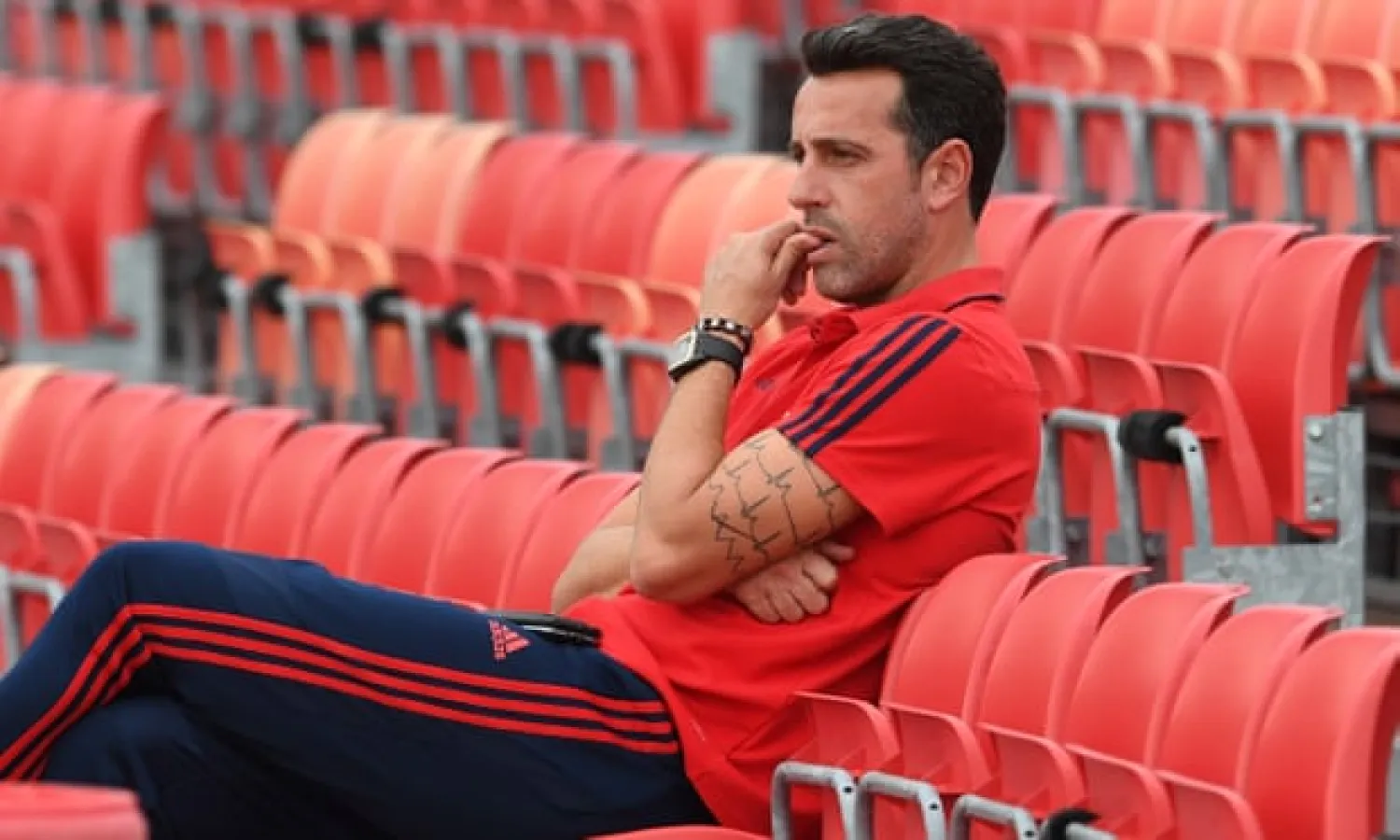

How Edu Can Bring Success to Arsenal Again

 Edu’s considered style brought mixed results in his homeland but there is hope that he may repeat the success he enjoyed at Arsenal as a player. Photograph: David Price/Arsenal FC via Getty Images
Edu’s considered style brought mixed results in his homeland but there is hope that he may repeat the success he enjoyed at Arsenal as a player. Photograph: David Price/Arsenal FC via Getty Images
TT

How Edu Can Bring Success to Arsenal Again

 Edu’s considered style brought mixed results in his homeland but there is hope that he may repeat the success he enjoyed at Arsenal as a player. Photograph: David Price/Arsenal FC via Getty Images
Edu’s considered style brought mixed results in his homeland but there is hope that he may repeat the success he enjoyed at Arsenal as a player. Photograph: David Price/Arsenal FC via Getty Images

Edu was reading Robert Kiyosaki’s Rich Dad, Poor Dad when Gilberto Silva said to him: “You will become a manager in the future. You have the perfect profile.” Almost two decades later his then-Arsenal teammate’s prophecy has been proved right. Edu has returned to the club as technical director tasked with restoring the success he enjoyed there as a player, including as a member of 2003-04’s Invincibles.

Edu may not be a manager in the traditional English sense but his management and executive skills have earned him three technical director roles since he gave up playing. The midfielder retired while with Corinthians in December 2010 and three months later received an unexpected invitation to take that position at the Brazilian club.

“He didn’t know what to do after he stopped playing football,” says Duílio Monteiro Alves, one of the directors who invited Edu to work for the São Paulo side. “However, he had all the qualities to become a great director. He is very different: polite, speaks many languages and has great experience in Europe. It was the best choice.”

The first months were testing, though. Corinthians had great players such as Ronaldo and Roberto Carlos but had been eliminated from the Copa Libertadores a month earlier after a painful defeat by the Colombian club Tolima. One of his first aims was to restore calm to the dressing room and explain to the squad how he would operate.

“When he took over he was very clear,” recalls Chicão, the club’s former defender and captain. “He said that he was a director but he would remain a friend to the players, that he would work hard to bring peace to our team. We couldn’t bring these problems on to the pitch. He promised this and did it.”

Edu formed a great partnership with the coach, Tite. Together they won the Copa Libertadores, Brazilian championship, Club World Cup, Paulista championship and the Recopa. It earned the pair promotion to the national team in 2016, working alongside Sylvinho, a former colleague of Edu’s at Arsenal, and Matheus Bachi, Tite’s son.

“Edu knows how to delegate roles,” says Bachi. “The first time I worked with him he asked me to write a report. I did it very well and from then I earned his trust. We were a team. We had a staff to analyse any potential talents for Corinthians. He read the reports, studied all the players and then gave a list to Tite to decide who to sign. Everyone had their input into the decision.”

Mauri Lima, a Corinthians goalkeeper coach under Edu, was also impressed. “He was the best at organising everything in the background and creating a good atmosphere for our players to shine. When he won the Club World Cup in 2012 with Corinthians I called him to congratulate him on his amazing work. At Corinthians we worked together for six years. He oversaw a revolution. I’ve never seen a bad relationship between him and any coach. He has the confidence of the president, players and all members of staff.”

When Edu left Corinthians to take up the role with Brazil, he was criticised by Andrés Sanchez, the club’s president. Sanchez, when questioned by the Observer about his stance, says: “I don’t talk about him. Let him be happy.”

The friendship ended when Edu’s new job was announced a few days after he had denied he was negotiating a deal with the Brazilian football federation, the CBF.

As a coordinator for the CBF, Edu was less successful. Brazil’s youth teams underperformed, eliminated early in the South American Under-17 and Under-20 championships in 2019 despite being full of talented prospects. Two years ago the Under-20s failed to qualify for the World Cup. Before Edu the youth teams could call on three technical scouts, whereas now there is one professional. For one year under his control the Under-20s did not have a coach.

For the senior team the problems started with the organisation for the 2018 World Cup. Selecting Brazil’s training base in Sochi created a problem because of the long distances to each match. During the group stage Brazil clocked up 7,000km, more than three times that of Argentina.

Edu was widely criticised for seeming to pander to their star player, Neymar. At the end of the World Cup Edu said: “It isn’t easy to be Neymar. It’s very hard. He is a little boy. Sorry, he is an athlete. He is an athlete that deserves my praise.” He added: “I feel pity for him in some moments, because what this boy suffers isn’t easy.”

Rogério Caboclo, the CBF president, lost confidence in Edu and the switch to Arsenal was timely for both parties. To many the challenge for Edu at the Emirates is harder than at Corinthians and with Brazil, because of the state of the Premier League club. For the third year in a row Arsenal have failed to qualify for the Champions League and they conspicuously lack the financial power of rivals.

Yet in Edu’s native Brazil there are key figures in the game who believe he can help create an environment to improve Arsenal. The former Corinthians president Roberto de Andrade says: “Edu knows the business very well, the game and everything around it. I think he can do something different. In Brazil it’s harder than working in England. Like Arsenal we didn’t have so much money and he helped us to form a great team.”

Gilberto agrees but calls for patience. “It’s worrying when you can’t compete with other clubs for good players but Arsenal need to sign around three or four players,” he says. “A big difference from the national team, he will now face daily pressure. You play every week and you are tested every day. But little by little he will adapt.”

Edu’s appointment has the approval of Arsène Wenger, and Gilberto sees similarities with his former manager. “Arsène doesn’t like to rush decisions. He had his own style, he took care of everything. All was very measured, despite having so many things to consider. I see the same in Edu. He is very careful and calculates every step. I think he will have success at Arsenal.”

The job reunites Edu with Unai Emery, the pair having worked together at Valencia in 2008-09. The club then had David Villa, David Silva, Marchena and Raúl Albiol but Edu was one of the most important voices. “He is a real leader,” says the former Valencia goalkeeper Renan. “Because of his history and daily attitude, he has that impact .”

The Guardian Sport


Shakhtar Boss Pays Ukrainian Racer $200,000 After Games Disqualification

Ukrainian President Volodymyr Zelenskiy holds helmet as he meets with a Ukrainian skeleton racer Vladyslav Heraskevych , who was disqualified from the Olympic skeleton competition over his "helmet of remembrance" depicting athletes killed since Russia's invasion and his father and coach, Mykhailo Heraskevych, amid Russia's attack on Ukraine, in Munich, Germany February 13, 2026. (Ukrainian Presidential Press Service/Handout via Reuters)
TT

Shakhtar Boss Pays Ukrainian Racer $200,000 After Games Disqualification

Ukrainian President Volodymyr Zelenskiy holds helmet as he meets with a Ukrainian skeleton racer Vladyslav Heraskevych , who was disqualified from the Olympic skeleton competition over his "helmet of remembrance" depicting athletes killed since Russia's invasion and his father and coach, Mykhailo Heraskevych, amid Russia's attack on Ukraine, in Munich, Germany February 13, 2026. (Ukrainian Presidential Press Service/Handout via Reuters)

The owner of ‌Ukrainian football club Shakhtar Donetsk has donated more than $200,000 to skeleton racer Vladyslav Heraskevych after the athlete was disqualified from the Milano Cortina Winter Games before competing over the use of a helmet depicting Ukrainian athletes killed in the war with Russia, the club said on Tuesday.

The 27-year-old Heraskevych was disqualified last week when the International Bobsleigh and Skeleton Federation jury ruled that imagery on the helmet — depicting athletes killed since Russia invaded Ukraine in 2022 — breached rules on athletes' expression at ‌the Games.

He ‌then lost an appeal at the Court ‌of ⁠Arbitration for Sport hours ⁠before the final two runs of his competition, having missed the first two runs due to his disqualification.

Heraskevych had been allowed to train with the helmet that displayed the faces of 24 dead Ukrainian athletes for several days in Cortina d'Ampezzo where the sliding center is, but the International Olympic Committee then ⁠warned him a day before his competition ‌started that he could not wear ‌it there.

“Vlad Heraskevych was denied the opportunity to compete for victory ‌at the Olympic Games, yet he returns to Ukraine a ‌true winner," Shakhtar President Rinat Akhmetov said in a club statement.

"The respect and pride he has earned among Ukrainians through his actions are the highest reward. At the same time, I want him to ‌have enough energy and resources to continue his sporting career, as well as to fight ⁠for truth, freedom ⁠and the remembrance of those who gave their lives for Ukraine," he said.

The amount is equal to the prize money Ukraine pays athletes who win a gold medal at the Games.

The case dominated headlines early on at the Olympics, with IOC President Kirsty Coventry meeting Heraskevych on Thursday morning at the sliding venue in a failed last-minute attempt to broker a compromise.

The IOC suggested he wear a black armband and display the helmet before and after the race, but said using it in competition breached rules on keeping politics off fields of play. Heraskevych also earned praise from Ukraine President Volodymyr Zelenskiy.


Speed Skating-Italy Clinch Shock Men’s Team Pursuit Gold, Canada Successfully Defend Women’s Title

 Team Italy with Davide Ghiotto, Andrea Giovannini, Michele Malfatti, celebrate winning the gold medal on the podium of the men's team pursuit speed skating race at the 2026 Winter Olympics, in Milan, Italy, Tuesday, Feb. 17, 2026. (AP)
Team Italy with Davide Ghiotto, Andrea Giovannini, Michele Malfatti, celebrate winning the gold medal on the podium of the men's team pursuit speed skating race at the 2026 Winter Olympics, in Milan, Italy, Tuesday, Feb. 17, 2026. (AP)
TT

Speed Skating-Italy Clinch Shock Men’s Team Pursuit Gold, Canada Successfully Defend Women’s Title

 Team Italy with Davide Ghiotto, Andrea Giovannini, Michele Malfatti, celebrate winning the gold medal on the podium of the men's team pursuit speed skating race at the 2026 Winter Olympics, in Milan, Italy, Tuesday, Feb. 17, 2026. (AP)
Team Italy with Davide Ghiotto, Andrea Giovannini, Michele Malfatti, celebrate winning the gold medal on the podium of the men's team pursuit speed skating race at the 2026 Winter Olympics, in Milan, Italy, Tuesday, Feb. 17, 2026. (AP)

An inspired Italy delighted the home crowd with a stunning victory in the Olympic men's team pursuit final as

Canada's Ivanie Blondin, Valerie Maltais and Isabelle Weidemann delivered another seamless performance to beat the Netherlands in the women's event and retain their title ‌on Tuesday.

Italy's ‌men upset the US who ‌arrived ⁠at the Games ⁠as world champions and gold medal favorites.

Spurred on by double Olympic champion Francesca Lollobrigida, the Italian team of Davide Ghiotto, Andrea Giovannini and Michele Malfatti electrified a frenzied arena as they stormed ⁠to a time of three ‌minutes 39.20 seconds - ‌a commanding 4.51 seconds clear of the ‌Americans with China taking bronze.

The roar inside ‌the venue as Italy powered home was thunderous as the crowd rose to their feet, cheering the host nation to one ‌of their most special golds of a highly successful Games.

Canada's women ⁠crossed ⁠the line 0.96 seconds ahead of the Netherlands, stopping the clock at two minutes 55.81 seconds, and

Japan rounded out the women's podium by beating the US in the Final B.

It was only Canada's third gold medal of the Games, following Mikael Kingsbury's win in men's dual moguls and Megan Oldham's victory in women's freeski big air.


Lindsey Vonn Back in US Following Crash in Olympic Downhill 

Milano Cortina 2026 Olympics - Alpine Skiing - Women's Downhill 3rd Official Training - Tofane Alpine Skiing Centre, Belluno, Italy - February 07, 2026. Lindsey Vonn of United States in action during training. (Reuters)
TT

Lindsey Vonn Back in US Following Crash in Olympic Downhill 

Milano Cortina 2026 Olympics - Alpine Skiing - Women's Downhill 3rd Official Training - Tofane Alpine Skiing Centre, Belluno, Italy - February 07, 2026. Lindsey Vonn of United States in action during training. (Reuters)

Lindsey Vonn is back home in the US following a week of treatment at a hospital in Italy after breaking her left leg in the Olympic downhill at the Milan Cortina Games.

“Haven’t stood on my feet in over a week... been in a hospital bed immobile since my race. And although I’m not yet able to stand, being back on home soil feels amazing,” Vonn posted on X with an American flag emoji. “Huge thank you to everyone in Italy for taking good care of me.”

The 41-year-old Vonn suffered a complex tibia fracture that has already been operated on multiple times following her Feb. 8 crash. She has said she'll need more surgery in the US.

Nine days before her fall in Cortina d'Ampezzo, Italy, Vonn ruptured the ACL in her left knee in another crash in Switzerland.

Even before then, all eyes had been on her as the feel-good story heading into the Olympics for her comeback after nearly six years of retirement.
