


Juventus's Star Signings Mask Unease While Inter and Napoli Can Challenge

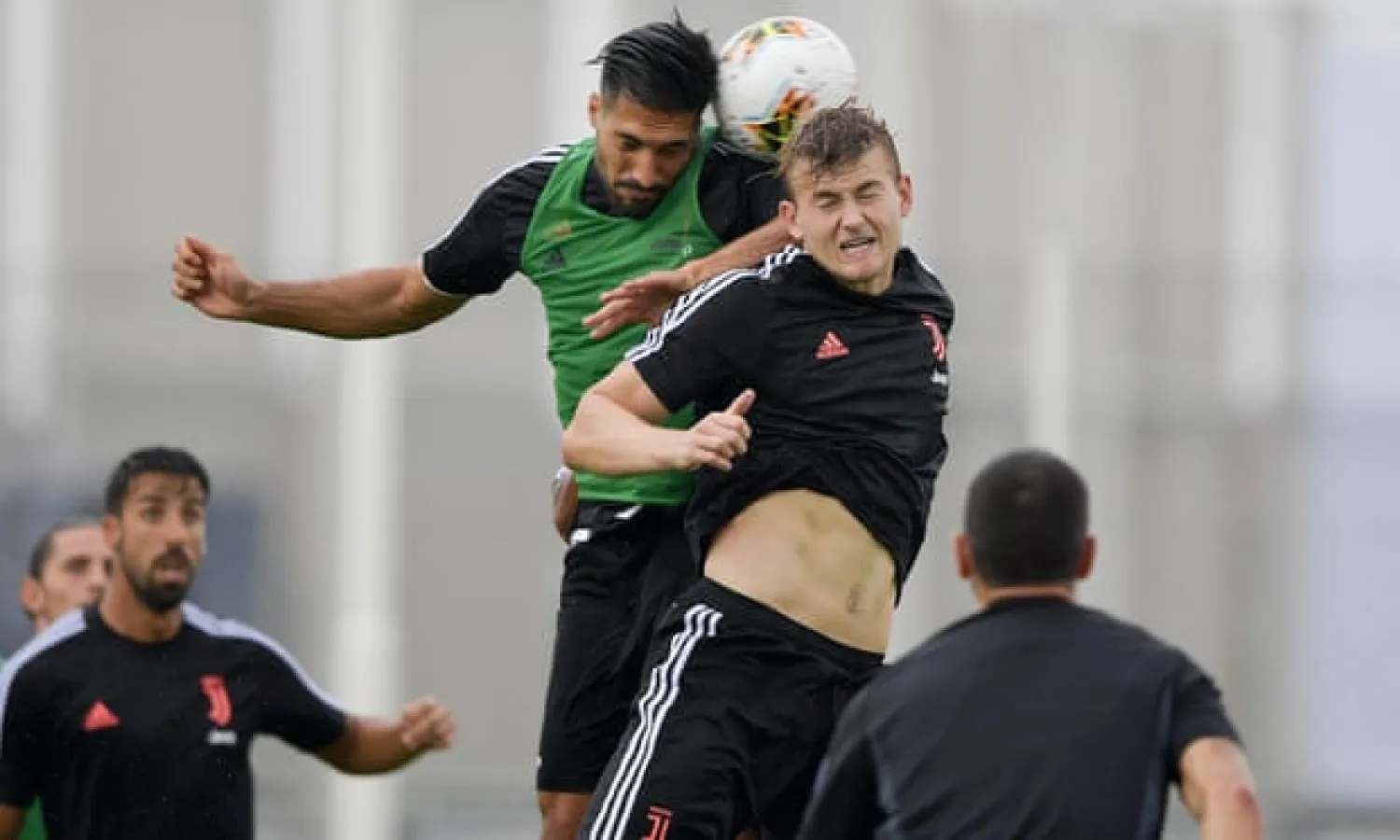
 Matthijs de Ligt goes up for an aerial challenge with Emre Can in training. The Dutch defender is the marquee signing of the summer but Juve have an unwieldy squad. Photograph: Daniele Badolato - Juventus FC/Juventus FC via Getty Images
Matthijs de Ligt goes up for an aerial challenge with Emre Can in training. The Dutch defender is the marquee signing of the summer but Juve have an unwieldy squad. Photograph: Daniele Badolato - Juventus FC/Juventus FC via Getty Images
TT

Juventus's Star Signings Mask Unease While Inter and Napoli Can Challenge

 Matthijs de Ligt goes up for an aerial challenge with Emre Can in training. The Dutch defender is the marquee signing of the summer but Juve have an unwieldy squad. Photograph: Daniele Badolato - Juventus FC/Juventus FC via Getty Images
Matthijs de Ligt goes up for an aerial challenge with Emre Can in training. The Dutch defender is the marquee signing of the summer but Juve have an unwieldy squad. Photograph: Daniele Badolato - Juventus FC/Juventus FC via Getty Images

Italian football’s summer break began in much the same way as the season had ended: with Juventus way out in front. By 1 July they had concluded the free agent signings of Aaron Ramsey and Adrien Rabiot. Then they did something far more audacious: signing Matthijs de Ligt from Ajax for €75m.

Even for a club that signed Cristiano Ronaldo one year previously, it felt like a landmark deal. When did an Italian side last win a bidding war for one of European football’s most coveted young talents? At 19 years old, De Ligt had already started in a Champions League semi-final, a Europa League final and a Nations League final – not to mention winning a domestic double in the Netherlands. The centre-back was expected to land in Barcelona, Madrid, Munich or Paris. Instead, he came to Turin.

As De Ligt put pen to paper, the gap between Juventus and their domestic rivals looked as wide as it has at any point during this eight-year stretch of consecutive Serie A titles. A team that finished 11 points clear of second place last season, and 21 ahead of third, had strengthened even further. How was anyone supposed to keep up?

Five weeks later, however, the picture does not look so clear. Such additions were supposed to be offset by subtractions. Two days out from the start of the season, too few sales have been completed, leaving the new manager, Maurizio Sarri, with a bloated and unwieldy playing squad.

“We need to cut six players from our Champions League list – and that puts us in difficulty,” he acknowledged this month. “It’s an embarrassing and difficult situation. We risk having to leave some really high-level players off the list.”

Ramsey and Rabiot join a midfield group in which Miralem Pjanic, Emre Can, Blaise Matuidi, Rodrigo Bentancur and Sami Khedira were already competing for places. Khedira, at least, was presumed to be on his way out after a lacklustre 2018-19 campaign, but insisted in an interview with Kicker this week that he intends to stay put.

Up front, Ronaldo’s potential supporting cast includes Paulo Dybala, Gonzalo Higuaín, Mario Mandzukic, Douglas Costa, Federico Bernardeschi and Juan Cuadrado. Sarri’s efforts to build something coherent from that group has been complicated by not knowing which will still be available to him beyond the end of this month.

Pre-season friendlies should always be taken with a pinch of salt, but performances have not been impressive. Preparations were disrupted further after Sarri contracted pneumonia. Juventus have said he will not be well enough to sit on the bench for the season opener against Parma or the second match against Napoli.

It is easy to imagine a scenario in which fans might turn on Sarri if Juventus were to drop points early. The club’s decision to hand the reins to a former rival, who had never won a major trophy before his Europa League triumph at Chelsea this May, was unpopular with many from the start.

There are reasons to believe that the competition will be stiffer in Serie A this season as well. The manager who launched Juventus’s winning cycle has returned to the peninsula on a mission to end it. Antonio Conte told GQ Italia that he would not have accepted the Internazionale job unless he believed there was at least a chance to depose his former club as champions.

His top transfer targets have been delivered. Not everyone is sold on Inter’s recruitment of Romelu Lukaku – and potentially Alexis Sánchez – to lead the line, but Conte has wanted to work with the Belgian ever since he was in charge of Juventus. Nicolò Barella and Stefano Sensi will bring a much-needed injection of dynamism to midfield and Diego Godín can provide leadership to an already sturdy defence.

The enduring presence of Mauro Icardi, however, gives Inter an unwanted distraction of their own. The striker has been told in no uncertain terms that he is not part of the club’s plans, yet if no buyer can be found in the next fortnight Conte may have to reintegrate him.

Napoli had presented themselves as potential suitors for Icardi, but are expected to abandon their interest unless he offers them some encouragement soon. Regardless, the Partenopei might be a greater threat than Inter to Juventus retaining the Scudetto.

The addition of Kostas Manolas, to play alongside Kalidou Koulibaly, means that last year’s runners-up boast the best centre-back tandem in the division. Behind them, it is reasonable to expect the 22-year-old goalkeeper Alex Meret to continue his improvement. The team that concede the fewest goals have finished top of Serie A in each of the past 12 seasons.

Napoli will have more options going forward, too, with the arrival of Hirving Lozano. And although Carlo Ancelotti has not won a Scudetto as recently as Conte, he knows a thing or two about what is required. “Second place is not enough any more,” he told reporters recently. “Now we need to win something.”

It is hard to imagine Atalanta, with their more modest resources, crashing the title race, but they may not be easily dislodged from the top four. Gianluca Mancini’s sale to Roma has been their only major departure, while Luis Muriel offers a different option up front.

The Giallorossi themselves will be fascinating to watch under Paulo Fonseca, whose high press and vertical approach served him so well at Shakhtar Donetsk. Pau López can only be an upgrade over Robin Olsen in goal, and Edin Dzeko surprised many by deciding to sign a new contract after all.

Milan also have a new manager, Marco Giampaolo, as well as a refreshed squad. It might seem odd to cite the arrival of two players from relegated Empoli as a cause for optimism, but Rade Krunic scored five goals and set up seven more from central midfield last season. Ismaël Bennacer was named player of the tournament at this summer’s Africa Cup of Nations.

Lazio have had a quieter transfer window, though Manuel Lazzari is a quality addition on the right. Torino, largely unchanged from last season, landed a tough draw against Wolves in their Europa League qualifier, but may yet surprise if they can make an asset of their continuity.

There are plenty of fascinating subplots to keep an eye on, as Franck Ribéry teams up with Kevin-Prince Boateng at Fiorentina, Radja Nainggolan returns to Cagliari and Mario Balotelli comes back to Serie A. The striker told reporters that his mother started crying when he told her that he was signing for Brescia – his hometown club.

Balotelli hopes the move will help him win back a place in the Italy team before the 2020 European Championship. First, though, he will have to find his place in a side that already boasts a prolific No 9, Alfredo Donnarumma (no relation to Gianluigi), who scored 25 goals last season to fire the team to promotion.

If Balotelli succeeds, it could become one of the great romantic stories in European football this season. If not, then it may all end, as it started, in tears.

The Guardian Sport


Madrid’s Mendy Suffers Another Injury Setback

Real Madrid's Ferland Mendy receives medical attention during the Spanish La Liga soccer match between RCD Espanyol and Real Madrid, in Barcelona, Catalonia, Spain, 03 May 2026. (EPA)
TT

Madrid’s Mendy Suffers Another Injury Setback

Real Madrid's Ferland Mendy receives medical attention during the Spanish La Liga soccer match between RCD Espanyol and Real Madrid, in Barcelona, Catalonia, Spain, 03 May 2026. (EPA)

Injury-plagued Real Madrid defender Ferland Mendy has suffered a thigh injury, with Spanish media reporting on Monday that he will be sidelined for several months.

Left-back Mendy was replaced after just 14 minutes of Sunday's 2-0 win over Espanyol, which delayed Barcelona winning the La Liga title.

The France international will undergo surgery in the coming hours after suffering his 16th injury since joining Madrid from Lyon in 2019.

"Following tests carried out today on our player Ferland Mendy... he has been diagnosed with a rectus femoris tendon injury in his right leg," Madrid said in a statement.

Mendy made his last France appearance in June 2024 and was unlikely to be in contention for a place in Didier Deschamps's World Cup squad.


Asharq Al-Awsat Reveals Saudi FA Financials With SAR 88 Million Surplus

Asharq Al-Awsat Reveals Saudi FA Financials With SAR 88 Million Surplus
TT

Asharq Al-Awsat Reveals Saudi FA Financials With SAR 88 Million Surplus

Asharq Al-Awsat Reveals Saudi FA Financials With SAR 88 Million Surplus

The Saudi Arabian Football Federation is set to approve its consolidated financial statements for the period from July 1, 2024 to December 31, 2025, at its general assembly meeting scheduled for May 18 in Riyadh. The move reflects the close of the financial cycle and entry into the formal approval phase.

Asharq Al-Awsat has obtained detailed figures from those statements through its sources. Total revenue reached SAR 2.599 billion (about $693.1 million), compared with expenditures of SAR 2.511 billion (around $669.6 million), generating a surplus of SAR 88.4 million (approximately $23.6 million). The outcome points to balanced finances despite elevated spending levels.

Competition-related spending topped the expenditure categories at SAR 717 million (about $191.2 million). This figure covers the organization of domestic competitions as well as hosting regional, continental, and international tournaments. It also includes club support and prize money totaling SAR 246 million (around $65.6 million), underscoring the scale of investment in domestic competitions.

For national teams, the federation reported spending of roughly SAR 467 million (about $124.5 million), while allocations for referees reached SAR 210 million (around $56 million), reflecting a clear push to strengthen technical and organizational standards and develop officiating and training camps.

On the human resources front, total salaries and incentives for federation staff and all Saudi national teams, men’s and women’s (19 teams), amounted to SAR 543 million (about $144.8 million).

In terms of operating revenue, sponsorship agreements, broadcasting rights, and matchday income generated SAR 256 million (around $68.3 million). Meanwhile, travel and transportation costs for federation personnel and national teams totaled SAR 229 million (about $61.1 million), a category tied to the domestic and international scope of activities.

As for the general assembly agenda, it includes announcing the session and confirming its formation in line with the statutes, approving the agenda, and delivering the president’s address. This will be followed by the appointment of three delegates to review the meeting minutes, the designation of independent auditors, and ratification of the previous meeting’s minutes.

The assembly will also review the president’s report on activities since the last meeting, before presenting the external auditor’s report and approving the consolidated financial statements, including the statement of financial position and activities report.

Members will then vote on proposed amendments to regulations and standing orders, culminating in the appointment of an independent external auditor based on a board recommendation, in a session with a distinctly regulatory and financial focus that will shape the next phase.


Top Tennis Players Slam Roland Garros Prize Money, Citing a Shrinking Share of Tournament Revenue

Tennis - Madrid Open - Park Manzanares, Madrid, Spain - April 28, 2026 Belarus' Aryna Sabalenka reacts during her quarterfinal match against Hailey Baptiste of the US. (Reuters)
TT

Top Tennis Players Slam Roland Garros Prize Money, Citing a Shrinking Share of Tournament Revenue

Tennis - Madrid Open - Park Manzanares, Madrid, Spain - April 28, 2026 Belarus' Aryna Sabalenka reacts during her quarterfinal match against Hailey Baptiste of the US. (Reuters)

A group of leading players including Novak Djokovic, Jannik Sinner, Aryna Sabalenka and Coco Gauff have expressed “their deep disappointment” at the level on prize money at Roland Garros amid a lingering dispute with Grand Slam tournament organizers.

The clay-court Grand Slam event starts later this month in western Paris. The players said they have other demands that have not been addressed by officials, including better representation, health and pensions.

The players' call came after French Open organizers announced last month the Roland Garros prize money has increased by about 10% for an overall pot of 61.7 million euros ($72.1 million), with the total amount up 5.3 million euros from last year.

“Players’ share of Roland Garros tournament revenue has declined from 15.5% in 2024 to 14.9% projected in 2026,” the group of players responded in a statement on Monday.

Play begins on May 24 at Roland Garros. Men’s and women’s singles champions each receive 2.8 million euros and the runners-up 1.4 million euros. Semifinalists earn 750,000 euros and first round losers get 87,000 euros. Men’s and women’s doubles winners pocket 600,000 euros and the mixed doubles champions get 122,000 euros.

But the statement said “the underlying figures tell a very different story,” claiming that players receive a declining share of the value they contribute to generate.

“According to tournament officials, Roland Garros generated 395 million euros in revenue in 2025, a 14% year-on-year increase, yet prize money rose by just 5.4%, reducing players’ share of revenue to 14.3%,” they said. “With estimated revenues of over 400 million euros for this year’s tournament, prize money as a percentage of revenue will likely still be less than 15%, far short of the 22% that players have requested to bring the Grand Slams into line with the ATP and WTA Combined 1000 events.”

French Open organizers did not immediately respond to a request for comments.

The same group of 20 players had already signed a letter sent to the heads of the four Grand Slam tournaments last year, seeking more prize money and a greater say in what they called “decisions that directly impact us.”

They said in their latest statement they remain “united in their desire to see meaningful progress, both in terms of fair financial distribution and in how the sport is governed.”

They insisted they have not received any response to their proposals on welfare, including pension and long-term health, adding that no progress has been made “on fair and transparent player representation within Grand Slam decision-making.”

“While other major international sports are modernizing governance, aligning stakeholders, and building long-term value, the Grand Slams remain resistant to change,” they said. “The absence of player consultation and the continued lack of investment in player welfare reflect a system that does not adequately represent the interests of those who are central to the sport’s success.”
