


Google Glass May Have an Afterlife as a Device to Teach Autistic Children

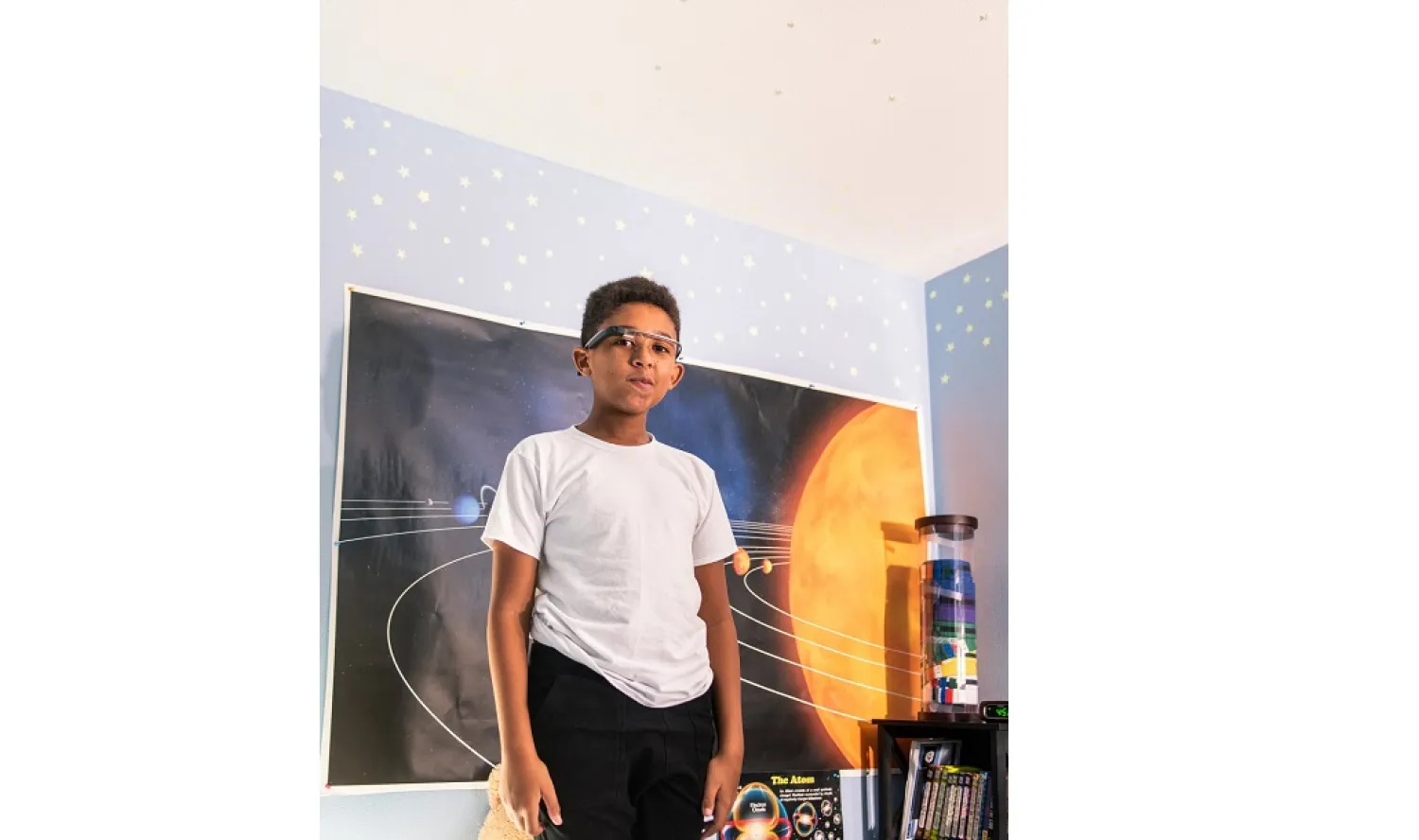
Esaïe Prickett wearing Google Glass at home in Morgan Hill, Calif. He and his family tested the device in a clinical trial.CreditCreditCayce Clifford for The New York Times
TT

Google Glass May Have an Afterlife as a Device to Teach Autistic Children

Esaïe Prickett wearing Google Glass at home in Morgan Hill, Calif. He and his family tested the device in a clinical trial.CreditCreditCayce Clifford for The New York Times

When Esaïe Prickett sat down in the living room with his mother, father and four older brothers, he was the only one wearing Google Glass.

As Esaïe, who was 10 at the time and is 12 now, gazed through the computerized glasses, his family made faces — happy, sad, surprised, angry, bored — and he tried to identify each emotion. In an instant, the glasses told him whether he was right or wrong, flashing tiny digital icons that only he could see.

Esaïe was 6 when he and his family learned he had autism. The technology he was using while sitting in the living room was meant to help him learn how to recognize emotions and make eye contact with those around him. The glasses would verify his choices only if he looked directly at a face.

He and his family tested the technology for several weeks as part of a clinical trial run by researchers at Stanford University in and around the San Francisco Bay Area. Recently detailed in The Journal of the American Medical Association, Pediatrics, the trial fits into a growing effort to build new technologies for children on the autism spectrum, including interactive robots and computerized eyewear.

The Stanford study’s results show that the methods have promise and indicate that they could help children like Esaïe understand emotions and engage in more direct ways with those around them. They could also measure changes in behavior, something that has historically been difficult to do.

Experts believe that other new technologies may help in similar ways. Talking digital assistants like Amazon’s Alexa, for example, could help children who misuse their pronouns. But even as these ideas spread, researchers warn that they will require rigorous testing before their effects are completely understood.

Catalin Voss started building software for Google Glass in 2013, not long after Google unveiled the computerized eyewear amid much hullabaloo from the national media. An 18-year-old Stanford freshman at the time, Mr. Voss began building an application that could automatically recognize images. Then he thought of his cousin, who had autism.

Growing up, Mr. Voss’s cousin practiced recognizing facial expressions while looking into a bathroom mirror. Google Glass, Mr. Voss thought, might improve on this common exercise. Drawing on the latest advances in computer vision, his software could automatically read facial expressions and keep close track of when someone recognized an emotion and when they did not.

“I was trying to build software that could recognize faces,” Mr. Voss said. “And I knew that there were people who struggled with that.”

At the time, the brief moment Google Glass spent in the national spotlight was already coming to an end. Google stopped selling the device to consumers amid concerns that its built-in camera would compromise personal privacy.

But Google Glass lived on as something to be used by researchers and businesses, and Mr. Voss, now a Ph.D. student, spent the next several years developing his application with Dennis Wall, a Stanford professor who specializes in autism research, and others at the university.

Their clinical trial, conducted over two years with 71 children, is one of the first of its kind. It spanned everything from severe forms of autism, including children with speech impairments and tactile sensitivities, to much milder forms. Children who used the software in their homes showed a significant gain on the Vineland Adaptive Behavior Scales, a standard tool for tracking the behavior of those on the autism spectrum, Mr. Voss said.

The gain was in line with improvements by children who received therapy in dedicated clinics through more traditional methods. The hope is that Mr. Voss’s application and similar methods can help more children in more places, without regular visits to clinics.

“It is a way for families to, on some level, provide their own therapy,” Mr. Voss said.

Jeffrey Prickett, Esaïe’s father, said he had been drawn to the study because he had known it would appeal to his son, who enjoys using iPad apps and watching DVD movies.

“He does fine interacting with people,” Mr. Prickett said. “But he does better interacting with technology.”

Mr. Prickett found it hard to judge whether the Google device helped his son recognize emotions, but he saw a marked improvement in Esaïe’s ability to make eye contact.

Heather Crowhurst, who lives near Sacramento, said she had experienced something similar with her 8-year-old son, Thomas, who also participated in the trial. But Thomas was not entirely captivated with the digital therapy. “It was kind of boring,” he said.

The concern with such studies is that they rely on the observations of parents who are helping their children use the technology, said Catherine Lord, a clinical psychologist at the University of California, Los Angeles, who specializes in the diagnosis and treatment of autism. The parents are aware of the technological intervention, so their observations may not be reliable.

Still, the Stanford team considers its study a first step toward wider use of this and other technologies in autism. It has licensed the technology to Cognoa, a Silicon Valley start-up founded by Dr. Wall. The company hopes to commercialize the method once it receives approval from the Food and Drug Administration, which oversees the use of medical devices in the United States. That may still be years away.

Other companies are taking a different approach. Brain Power, a start-up in Massachusetts that has built similar software for Google Glass, is selling its technology to local schools. The company considers it a teaching tool, not a medical device.

Patrick Daly, the assistant superintendent of the school district in North Reading, Mass., is testing Brain Power’s technology after watching its effect on his 9-year-old son, who is on the spectrum. The district intends to test the technology over the next few years.

Previously, the district tried to teach similar skills through iPad computer tablets. Mr. Daly sees Google Glass as a big improvement.

“It can actually maintain eye contact,” he said. “They are not looking down while they try to learn an emotion.”

Robokind, a start-up in Dallas, applies the same philosophy to different hardware. The company spent the past several years designing a robot that attempts to teach many of the same skills as technologies built for digital eyewear. Called Milo, the doll-like, two-foot-tall robot mimics basic emotions and tries to make eye contact with students. It also asks questions and tries to engage students in simple conversations.

Robokind has sold hundreds of the robots to schools for testing. Each one costs $12,000, plus more than $3,500 for additional software.

In some ways, such a device is a poor substitute for real human interaction. But the strength of this and other technologies is that they can repeat tasks time and again, without getting tired or bored or angry. They can also measure behavior in precise ways, said Pam Feliciano, the scientific director of the nonprofit Simons Foundation Powering Autism Research.

For these reasons, Ms. Feliciano also sees promise in Amazon’s Alexa. Her 14-year-old son is on the spectrum and struggles with his pronouns. He sometimes calls himself “you,” not “I.”

Her task is to correct him each time he makes a mistake. But she’s human and gets tired. She does not always remember. A device like Alexa could help, she said, provided that researchers can show it is reliable and effective.

“The technologies are there,” she said. “It is just a matter of the right technologists working with the right clinicians.”

The New York Times


Times Square to Feature Patriotic Crystal Ball for New Year's Eve, Kicking Off US's 250th Birthday

FILE - The 7-foot tall "2026" numerals are displayed at an illumination ceremony in Times Square, Thursday, Dec. 18, 2025, in New York. (AP Photo/Adam Gray, File)
TT

Times Square to Feature Patriotic Crystal Ball for New Year's Eve, Kicking Off US's 250th Birthday

FILE - The 7-foot tall "2026" numerals are displayed at an illumination ceremony in Times Square, Thursday, Dec. 18, 2025, in New York. (AP Photo/Adam Gray, File)

After the crystal ball drops on New Year’s Eve in New York City, it will rise again, sparkling in red, white and blue to usher in 2026 and kick off months of celebrations for the nation’s upcoming 250th birthday.

The patriotic touches at this year's Times Square gathering, including a second confetti drop, will offer an early glimpse of what’s ahead: hundreds of events and programs, big and small, planned nationwide to mark the signing of the Declaration of Independence in 1776.

“I’m telling you right now, whatever you’re imagining, it’s going to be much more than that,” said America250 Chair Rosie Rios, who oversees the bipartisan commission created by Congress in 2016 to organize the semiquincentennial anniversary. “It’s going to be one for the ages, the most inspirational celebration this country and maybe the world has ever seen.”

According to The Associated Press, Rios and her group worked with the Times Square Alliance business district and One Times Square, the building from where the ball is dropped, to make the changes to this year's ceremonies.

They're also planning a second ball drop event on July 3, the eve of the nation's birthday, “in the same beautiful style that Times Square knows how to do it," Rios said.

It will mark the first time in 120 years there will be ball drop in Times Square that doesn't occur on New Year's Eve, she said.

A New Year’s Eve ball was first dropped in Times Square in 1907. Built by a young immigrant metalworker named Jacob Starr, the 700-pound (318-kilogram), 5-foot- (1.5-meter-) diameter ball was made of iron and wood and featured 100 25-watt light bulbs. Last year, the Constellation Ball, the ninth and largest version, was unveiled. It measured about 12 feet (3.7 meters) in diameter and weighs nearly 12,000 pounds (5,400 kilograms).

The only years when no ball drop occurred were 1942 and 1943, when the city instituted a nightly “dimout” during World War II to protect itself from attacks. Crowds instead celebrated the new year with a moment of silence followed by chimes rung from the base of One Times Square.

This year, the stroke of midnight will also mark the official launch of America Gives, a national service initiative created by America250. Organizers hope to make 2026 the largest year of volunteer hours ever aggregated in the country.

On the following day, America250 will participate in the New Years Day Rose Parade in Pasadena, California, with a float themed “Soaring Onward Together for 250 Years." It will feature three larger-than-life bald eagles representing the country’s past, present and future.

“We want to ring in this new year from sea to shining sea. What better way to think about it than going from New York to California,” Rios said. “This has to be community-driven, this has be grassroots. We’re going from Guam to Alaska, from Fairbanks to Philadelphia, and everything in between.”

President Donald Trump has also announced the “Freedom 250” initiative to coordinate additional events for the 250th anniversary.

Rios said she sees the wide range of celebrations and programs planned for the coming months, from large fireworks displays and statewide potluck suppers to student contests and citizen oral histories, as an opportunity to unite a politically divided nation.

“If we can find something for everyone ... having those menus of options that people can pick and choose how they want to participate," she said. “That’s how we’re going to get to engaging 350 million Americans.”


Elusive Wild Cat Feared Extinct Rediscovered in Thailand

This handout picture taken with a camera trap and released on December 26, 2025, by Thailand's Department of National Parks, Wildlife and Plant Conservation (DNP) and Panthera Thailand shows a recently rediscovered flat-headed cat in southern Thailand's Princess Sirindhorn Wildlife Sanctuary. (AFP / Thailand's Department of National Parks, Wildlife and Plant Conservation (DNP) / Panthera Thailand)
TT

Elusive Wild Cat Feared Extinct Rediscovered in Thailand

This handout picture taken with a camera trap and released on December 26, 2025, by Thailand's Department of National Parks, Wildlife and Plant Conservation (DNP) and Panthera Thailand shows a recently rediscovered flat-headed cat in southern Thailand's Princess Sirindhorn Wildlife Sanctuary. (AFP / Thailand's Department of National Parks, Wildlife and Plant Conservation (DNP) / Panthera Thailand)

An elusive wild cat long feared extinct in Thailand has been rediscovered three decades after the last recorded sighting, conservation authorities and an NGO said Friday.

Flat-headed cats are among the world's rarest and most threatened wild felines. Their range is limited to Southeast Asia and they are endangered because of dwindling habitat.

The domestic cat-sized feline with its distinctive round and close-set eyes was last spotted in a documented sighting in Thailand in 1995.

But an ecological survey that began last year, using camera traps in southern Thailand's Princess Sirindhorn Wildlife Sanctuary, recorded 29 detections, according to the country's Department of National Parks, Wildlife and Plant Conservation and wild cat conservation organization Panthera.

"The rediscovery is exciting, yet concerning at the same time," veterinarian and researcher Kaset Sutasha of Kasetsart University told AFP, noting that habitat fragmentation has left the species increasingly "isolated".

It was not immediately clear how many individuals the detections represent, as the species lacks distinctive markings so counting is tricky.

But the findings suggest a relatively high concentration of the species, Panthera conservation program manager Rattapan Pattanarangsan told AFP.

The footage included a female flat-headed cat with her cub -- a rare and encouraging sign for a species that typically produces only one offspring at a time.

Nocturnal and elusive, the flat-headed cat typically lives in dense wetland ecosystems such as peat swamps and freshwater mangroves, environments that are extremely difficult for researchers to access, Rattapan said.

Globally, the International Union for Conservation of Nature estimates that around 2,500 adult flat-headed cats remain in the wild, classifying the species as endangered.

In Thailand, it has long been listed as "possibly extinct".

Thailand's peat swamp forests have been heavily fragmented, largely due to land conversion and agricultural expansion, said Kaset, who was not involved in the ecological survey but has researched wild cats for years.

The animals also face mounting threats from disease spread by domestic animals, and they struggle to reproduce across isolated areas.

While the rediscovery offers hope, it is only a "starting point" for future conservation efforts, he said.

"What comes after this is more important -- how to enable them to live alongside us sustainably, without being threatened."


Hooked on the Claw: How Crane Games Conquered Japan’s Arcades

This picture taken on June 6, 2024 shows a claw crane game shop in Akihabara district of Tokyo. (AFP)
TT

Hooked on the Claw: How Crane Games Conquered Japan’s Arcades

This picture taken on June 6, 2024 shows a claw crane game shop in Akihabara district of Tokyo. (AFP)

As school and work wrap up, crowds fill Tokyo's many bustling arcade halls -- not to battle it out in fighting games, but to snag plush toys from claw machines.

In one of these gaming hubs in the Japanese capital's Ikebukuro district, aisles of crane games stretch as far as the eye can see.

The crown jewels of the arcade industry, they occupy the building's first two floors, relegating video games to the basement and upper levels.

"Crane games are keeping the sector afloat," said Morihiro Shigihara, an industry expert and former arcade manager.

"Arcade operators, machine manufacturers, and even prize suppliers depend on this business," he told AFP.

Some 80 percent of the 22,000 arcades Japan had in 1989 have shut down, but revenues have held up thanks to claw machines, according to the Japan Amusement Industry Association.

Their share of revenue has climbed since 1993 from 20 percent to more than 60 percent, the association said.

Suzuna Nogi, a 20-year-old student, visits these arcades at least twice a week in search of "big plushies" on which she can spend up to 3,000 yen ($19) at 100 yen per try.

"What I like best is the sense of accomplishment," she said, even though there is no guarantee of success.

Nogi added that she enjoys "the thrill of not knowing whether you'll manage to grab something or not".

The sensitivity of the claw arms is adjusted by operators "based on the cost of the prizes and revenue targets", Shigihara said.

"You can also make the game easier to compete with a nearby arcade."

- From cigarettes to candy -

This year, the industry is officially celebrating the 60th anniversary of these construction crane-inspired machines in Japan.

But they have actually been around since before World War II, said Benoit Bottos, who wrote his doctoral dissertation on the subject at Japan's Chuo University.

Older models, installed in cafes or bowling alleys, sometimes offered lighters and cigarettes, but those prizes quickly gave way to children's candy.

In the late 1980s, the machines began to gain traction, notably with game company Sega's 1985 invention of the "UFO Catcher", which switched up the older version that forced players to lean in and look down.

"The old ones were a bit dark. So we opted for a brighter, showcase-like style where you can see the prizes right in front of you," said Takashi Sasaya, a Sega executive.

But the real stroke of genius "was putting plush toys in the claw games", said Bottos.

Manufacturing giants like Sega or Bandai, involved in both video games and toys, then began negotiating licenses for anime and manga characters, with Sega notably securing Disney rights.

"That largely explains the success of these machines," said Bottos, who describes them as "somewhere between a vending machine, a game of chance and a game of skill".

- 'Transformation' -

The success of claw games also feeds on Japan's booming fan culture of "oshikatsu", with many people devoting more and more time and money to supporting their favorite idol.

Part of asserting their fan identity involves collecting character merchandise.

"I love Pokemon, so I often come looking for plush toys and merch from the franchise," said professional Pokemon card player Akira Kurasaki, showing off nails decorated with his most beloved characters.

Arcade operators have taken this enthusiasm to heart, tailoring their prize selections to the demographics of their neighborhood and organizing events around certain characters.

"New prizes are introduced almost every day," said Sasaya, the Sega executive.

The hegemony of claw machines has also gone hand in hand with a gradual transformation of urban hangouts.

Arcades -- seen in the 1970s and 1980s as dark, male-dominated places linked to crime -- "tried to attract a new audience" of women and families, Bottos said.

"The crane game is emblematic of that transformation."
