


The Story of the Most Famous Israeli Spy on Netflix

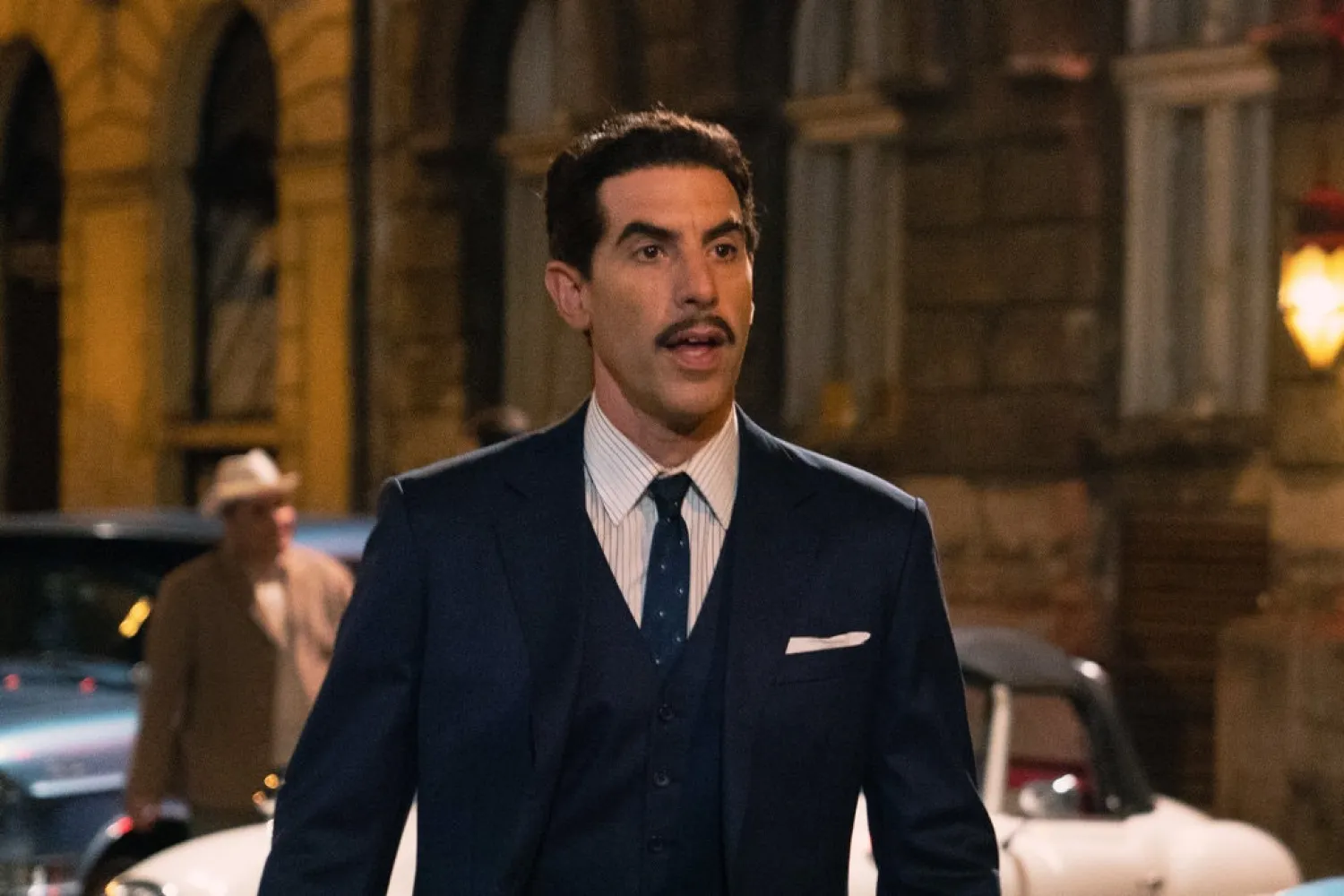
Sacha Baron Cohen trades ambush comedy for espionage in “The Spy.” Photo: Netflix
TT

The Story of the Most Famous Israeli Spy on Netflix

Sacha Baron Cohen trades ambush comedy for espionage in “The Spy.” Photo: Netflix

It’s easier to imagine the British comedian Sacha Baron Cohen, best known as bombastic cringe humor icons like Ali G and Borat Sagdiyev, playing a subtle dramatic role once you know that the character in question, in the Netflix mini-series “The Spy,” is also an undercover performer.

The Israeli producer Gideon Raff (“Homeland”) created the nervy six-episode thriller, which debuted Friday. Baron Cohen plays Eli Cohen (no relation), the real-life Israeli spy who worked for the Mossad in the early 1960s, gathering information about Syria’s military plans while posing as Kamel Amin Thaabet, a patriotic Syrian shipping magnate. Like Baron Cohen, the creator of ambush comedies like “Da Ali G Show,” “Borat” and “Bruno,” Eli Cohen got results by going deep into character.

“I saw Eli Cohen, as he was written in the show, as an extreme version of myself,” Baron Cohen said recently. “The stakes were higher for him, because the price of failure is imprisonment and execution. Eli Cohen was, in that sense, the greatest method actor of the last century.”

In a phone interview, Baron Cohen also talked about singing in musicals, starting riots, doing his own stunts and being typecast as “a Jewish actor,” even after creating one of the most openly anti-Semitic characters in Hollywood history. These are edited excerpts from that conversation.

Cohen and Thaabet are both motivated by love for their respective countries. How did you get into a patriotic head space?

I try to see the world through the characters’ eyes. Cohen joined the Mossad 15 years after all Jewry became aware of the horrors of Auschwitz, and that two out of three Jews in Europe had been slaughtered. That was fresh in the minds of anyone who joined the Mossad, because they were risking their lives for their families.

So to understand Eli Cohen’s motivation, I learned more about Israeli history at that time, and why the Mossad treated the Syrians like an existential threat: The Mossad thought that if they didn’t get a spy embedded in Damascus, Israel would be destroyed. There are many military historians who believe that the intelligence that Eli Cohen gathered while in Syria actually won the Six-Day War for Israel.

After “Borat,” you were ironically offered several roles as Jewish characters. What was that like?

There were two Jewish characters that I was developing for film roles with Steven Spielberg, including [the Yippie activist] Abbie Hoffman, who I am still playing in a film that Aaron Sorkin is going to direct. But yes, I used to be reluctant to play anyone Jewish, because I didn’t want to be typecast as the Jewish actor. There are other Jews in Hollywood besides me. But somehow, people thought of me as “a Jewish actor” even after I played Borat, the most outwardly anti-Semitic character probably since Leni Riefenstahl directed movies.

I had also been offered different versions of the Eli Cohen story, but they didn’t happen for various reasons. Finally, a number of years ago, I read Gideon’s script, and I couldn’t put it down. So I gave up this position of avoiding Jewish or Israeli roles.

In “The Spy,” Cohen eventually realizes that he’s behaving like Thaabet, even when he’s not trying to be in character. You’re known for going deep into character for your comedies. Does it take time to leave those personas behind?

There’s a cage fight scene at the end of “Bruno.” I’d been debriefed by my lawyer about a number of legal requirements, for fear of me getting arrested. One of those requirements was that I could not incite a riot or any violence because I was crossing a state line, so inciting a riot would be a federal offense. Unfortunately, in the middle of this scene, I got carried away and challenged any willing audience member to a fight, which is exactly what the lawyer asked me not to do. This was an audience of 10,000 rednecks, some of whom had just left jail on parole, and had swastikas tattooed on their heads. Somebody rather large in the audience ran up, jumped into the cage with me, and proceeded to attack me.

Making that challenge was an idiotic thing for me to do, but in that moment, the character was responding, not me. In other words: I acted like an idiot.

Why do you go — and stay — so far within characters like Bruno and Borat?

Because if somebody sees through the character, either the scene ends or the police are called. It can, very occasionally, turn violent. So I learned that I could never drop character. When I was playing Ali G, I remained Ali G. That was the result of a steep learning curve: One day, an interviewee walked in on me while I was out of character, and he complained to [Channel 4’s executives].

So when I’m in a scene as Eli Cohen, I am pretending like a kid would be, reacting to things that I’m hearing as if I’m Eli Cohen.

There are scenes in “The Spy” where it looks like you, not a stunt double, are the one scaling buildings and sneaking across slanted rooftops.

That was me!

Does doing your own stunts help you to stay in character?

It’s pure ego, really. I did prepare for the role though, because I was completely out of shape, and Gideon wanted me to do, among other things, a couple of sex scenes. And I said, “Listen, in my experience, when the audience sees me having sex in a scene, they’re in hysterical laughter. So unless you want ‘The Spy’ to be a comedy, I would skip it.” And he said, “No, I want you to do things you haven’t done before.”

I had to go through a pretty rigorous physical training with a Moroccan colonel to get in shape for the role in about four weeks. Part of my training was learning a form of [the Israeli martial art] Krav Maga that members of the Mossad would have known in the ’60s. And unfortunately, they cut out all those scenes from the show!

I read that when you were a prep school student in Britain, you felt that acting or performing as a comedian was an embarrassing career choice. Is that true?

Yes. It was embarrassing to admit to other people that I wanted to be a comedian, because I was essentially telling people that I thought I was funny. That’s as embarrassing as someone saying, “I want to be a model.” You risk people saying “You’re far too ugly to become a model.”

So I really kept my ambition to perform hidden, though I ended up going to Cambridge in order to join the Cambridge Footlights drama club. I was denied entry for three years, but joined up in year four. I did a number of dramatic productions — “Cyrano de Bergerac,” “Fiddler on the Roof,” “Tamburlaine the Great” — so I had to learn how to act. That ended up being useful later in my career.

But the idea of making a living from acting or being a comic was absurd. When I was growing up, nobody knew anyone who was an actor! So the idea of being successful in Hollywood was ludicrous. At that point, no British comedian had a strong presence [in America] since Monty Python, so there was this prevailing assumption that British comedy would never travel across the Atlantic. That’s obviously a patronizing viewpoint, but it informed many early reviews of my work.

When “Da Ali G Show” came out, there were newspaper billboards around London saying “‘Ali G Show’ bombs in America.” The show had received a number of Emmy nominations, but some British journalists didn’t believe that Americans would understand what they saw as British humor. So yes, the idea that I, a teenager in Northwest London, could become a comedian and that would be my job was ludicrous.

But you have been an outrageous success, in every sense of the word. How did your family react to some of your more outlandish work?

I only realized that my grandmother was going to the “Bruno” premiere at Grauman’s Chinese Theater hours before the screening. I realized that there were scenes in the film that were too extreme for my grandmother, so I called up [the distributors at Universal Pictures] and said: “Listen, you have to remove these three scenes from the movie.”

The distributors freaked out and asked me: “What do you mean? We’re screening it tonight! The premiere’s tonight!”

And I said, “You have to do it, my grandma’s watching the movie!”

I bumped into one of the distributors a few years later. He said that the last 12 hours before the “Bruno” premiere were the worst of his life, because he had to go into the projection booth and cut out anything my grandmother would have found offensive.

Also: I only heard that Michael Jackson had died as we were driving to the screening. I thought to myself “Thank god we don’t have any jokes about Michael Jackson.” And then we realized that there actually is a Michael Jackson joke in the film.

So we sent one of the editors into the projection booth and he cut out the scene with scissors, and somehow managed to glue the print back together before the premiere. That was back in the days of celluloid; fortunately, it’s more digital now.

You mentioned some of your university musicals and you’ve starred in musical films like “Les Misérables” and “Sweeney Todd.” Would you ever want to perform in a stage musical now?

Yes, I love doing musicals. I even snuck in some musical numbers into the early “Ali G Show.” Musicals are my embarrassing passion; they give me joy.

(The New York Times)


Trump Urges 2028 Astronaut Moon Landing in Sweeping Space Policy Order

FILE PHOTO: US President Donald Trump poses on the red carpet for the 2025 Kennedy Center Honors at the John F. Kennedy Center for the Performing Arts in Washington, D.C., US, December 7, 2025. REUTERS/Jeenah Moon/File Photo
TT

Trump Urges 2028 Astronaut Moon Landing in Sweeping Space Policy Order

FILE PHOTO: US President Donald Trump poses on the red carpet for the 2025 Kennedy Center Honors at the John F. Kennedy Center for the Performing Arts in Washington, D.C., US, December 7, 2025. REUTERS/Jeenah Moon/File Photo

President Donald Trump enshrined the US goal to put humans back on the moon by 2028 and defend space from weapon threats in a sweeping executive order issued on Thursday, the first major space policy move of his administration's second term.

The order, issued hours after billionaire private astronaut and former SpaceX customer Jared Isaacman was sworn in as NASA's 15th administrator, also reorganized national space policy coordination under Trump's chief science adviser, Michael Kratsios, Reuters reported.

Titled "ENSURING AMERICAN SPACE SUPERIORITY," the order calls on the Pentagon and US intelligence agencies to create a space security strategy, urges efficiency among private contractors and seeks demonstrations of missile-defense technologies under Trump's Golden Dome program.

It appeared to ‌cancel the White ‌House's top space policy-coordinating body, the National Space Council, a ‌panel ⁠of cabinet members that ‌the president revived during his first term and has considered axing this year.

But an adminitration official said it would not be cancelled and suggested it would live on under the White House's Office of Technology Policy with a different structure in which the president, rather than the vice president, would be chairman.

The goal to land humans on the moon by the end of Trump's second term in 2028 bears resemblance to the president's 2019 directive in his first term to make a lunar return by 2024, putting the ⁠moon at the center of US space exploration policy with a timeline many in the industry regarded as unrealistic. Development and testing ‌delays with NASA’s Space Launch System and SpaceX’s Starship gradually pushed ‍that landing target date back.

NASA's goal had been ‍2028 under former president Barack Obama.

A 2028 astronaut moon landing would be ‍the first of many planned under NASA's Artemis effort to build a long-term presence on the lunar surface. The US is in competition with China, which is targeting 2030 for its first crewed moon landing. The order on Thursday called for "establishment of initial elements of a permanent lunar outpost by 2030," reinforcing NASA's existing goal to develop long-term bases with nuclear power sources.

At the start of his second term, Trump had repeatedly talked about sending missions to Mars as Elon Musk, a major donor ⁠who has made sending humans to the Red Planet a priority for his company SpaceX, served a stint as a close adviser and powerful government efficiency czar. But lawmakers in Congress this year have slowly put the moon back in focus, pressuring then-NASA nominee Isaacman to stick with the agency's moon program on which billions of dollars have been spent.

The White House, in a government efficiency push led by Musk, slashed NASA's workforce by 20% and has sought to cut the agency's 2026 budget by roughly 25% from its usual $25 billion, imperiling dozens of space-science programs that scientists and some officials regard as priorities.

Isaacman, who plans to give his first agency-wide address to NASA employees on Friday, has said he believes the space agency should try to target both the moon and Mars simultaneously while prioritizing a lunar return in ‌order to beat China.

The 2028 moon-landing target depends heavily on the development progress of SpaceX's giant Starship lander, which has been criticized by NASA's former acting administrator for moving too slowly.


Rare Diamond Changes Lives of Two Indian Friends

Satish Khatik and Sajid Mohammed found a 15.34-carat gem-quality diamond in Panna (Amit Rathaur)
TT

Rare Diamond Changes Lives of Two Indian Friends

Satish Khatik and Sajid Mohammed found a 15.34-carat gem-quality diamond in Panna (Amit Rathaur)

On a recent winter morning in Panna, a diamond mining region in central India, two childhood friends made a discovery that they think could change their lives forever.

Satish Khatik and Sajid Mohammed stumbled upon a large, glistening rock on a plot of land they had leased just weeks earlier, according to BBC India.

When they took the stone to the city's official diamond evaluator, they learnt they had found a 15.34-carat gem-quality diamond - one of the finest varieties of natural diamonds that exist.

“The estimated market price of the stone is around five to six million rupees [$55,000 - $66,000] and it will be auctioned soon,” Anupam Singh, the diamond evaluator, told BBC Hindi.

The government holds quarterly auctions, drawing buyers from across India and abroad to bid for the diamonds.

“Estimated prices depend on the dollar rate and benchmarks set by the Rapaport report,” Singh said. Rapaport is widely regarded as a leading authority on independent diamond and jewelry market analysis.

Khatik and Mohammed say they are over the moon. “We can now get our sisters married,” they said.

Khatik, 24, who runs a meat shop and Mohammed, 23 who sells fruits, come from poor backgrounds and are the youngest sons in their families.

For generations, their families have been trying their luck at finding diamonds, which is a common quest among the district's residents.

Panna, which is in Madhya Pradesh state, is among India's least developed districts - its residents face poverty, water scarcity and unemployment.

While most mines are run by the federal government, state authorities lease small plots to locals each year at nominal rates. With few job opportunities in the city, residents hope for a prized find to improve their fortunes - but most come up empty-handed.

Mohammed said his father and grandfather had dug through these plots for decades but discovered nothing more that “dust and slivers of quartz.”

His father Nafees said that the “gods have finally rewarded their hard work and patience.”

They leased a plot in search of diamonds partly out of desperation, as their meagre incomes could not keep pace with rising household costs - let alone pay for a wedding, Mohammed told the BBC.


SpaceX Loses Contact with Starlink Satellite after Mishap

FILE PHOTO: SpaceX logo and Elon Musk silhouette are seen in this illustration taken, December 19, 2022. REUTERS/Dado Ruvic/Illustration/File Photo
TT

SpaceX Loses Contact with Starlink Satellite after Mishap

FILE PHOTO: SpaceX logo and Elon Musk silhouette are seen in this illustration taken, December 19, 2022. REUTERS/Dado Ruvic/Illustration/File Photo

SpaceX's Starlink said one of its satellites experienced an anomaly in space on Wednesday that created a "small number" of debris and cut off communications with the spacecraft at 418 km (259.73 miles) in altitude, a rare kinetic accident in orbit for the satellite internet giant.

"The satellite is largely intact, tumbling, and will reenter the Earth's atmosphere and fully demise within weeks," Starlink said in a post on X.

The company said it was working with the US Space Force and NASA to monitor the debris pieces, the number of which SpaceX did not say.

Space Force's space-tracking unit did not immediately return a Reuters request for comment on the number of trackable debris, which could pose risks for other active satellites in orbit.

With the Starlink satellite still somewhat intact, the event seemed smaller in scale than other orbital mishaps such as the breakup of an Intelsat satellite that created more than 700 pieces, or the breakup of a Chinese rocket body last year.
