


Unable to Vote, Palestinians Shrug off Israel's Elections

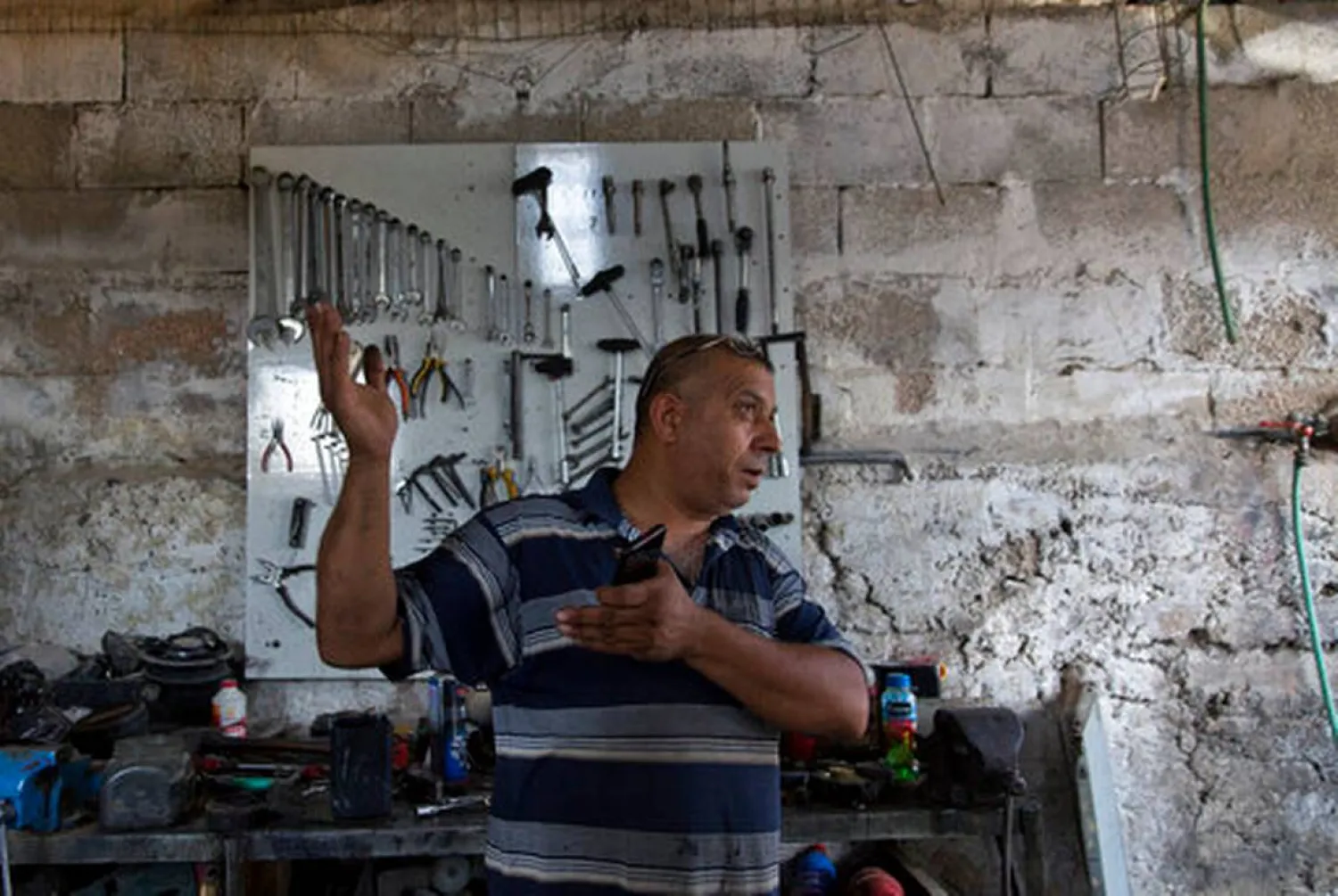
In this Wednesday, Sept. 11, 2019 photo, Palestinian Barhoum Saleh gives an interview at his roadside mechanic shop, near the West Bank Israeli settlement of Elkana, west of Qalqiliya. Saleh is among the 2.5 million Palestinians in the West Bank who have no voice in choosing Israel's next government and no control over whether it decides to annex part or all of the occupied territory, as Prime Minister Benjamin Netanyahu has vowed to do. (AP Photo/Nasser Nasser)
TT

Unable to Vote, Palestinians Shrug off Israel's Elections

In this Wednesday, Sept. 11, 2019 photo, Palestinian Barhoum Saleh gives an interview at his roadside mechanic shop, near the West Bank Israeli settlement of Elkana, west of Qalqiliya. Saleh is among the 2.5 million Palestinians in the West Bank who have no voice in choosing Israel's next government and no control over whether it decides to annex part or all of the occupied territory, as Prime Minister Benjamin Netanyahu has vowed to do. (AP Photo/Nasser Nasser)

Barhoum Saleh's town is surrounded by Jewish settlements, the sign above his roadside mechanic shop is in Hebrew, most of his customers are Israeli and he needs an Israeli permit to visit the beach a half hour's drive away.

But unlike his Jewish neighbors, he can't vote in next week's elections.

Saleh is among the 2.5 million Palestinians in the West Bank who have no voice in choosing Israel's next government and no control over whether it decides to annex part or all of the occupied territory, as Prime Minister Benjamin Netanyahu has vowed to do. With the peace process having sputtered to a halt a decade ago, they also have little hope of getting a state of their own anytime soon.

Saleh, who is not particularly political, just wishes it was easier to take his kids to the beach.

Israelis who get their cars serviced at his shop describe their trips: one drove down to Egypt's Sinai, another vacationed in Thailand. But while they can travel in and out of the West Bank freely, Saleh must apply for a permit to enter Israel - and they are not given for family vacations. So, a few years back, he took his family to neighboring Jordan and its Red Sea port of Aqaba, several hours away.

"My kids were astonished when they saw the sea," he recalls, smiling at the memory. "They said, what's that?"

The movement restrictions apply to all Palestinians in the West Bank, even those, like Saleh, who live near major settlement blocs that Israel expects to keep in any peace agreement. His shop is just down the road from Elkana, the settlement where Netanyahu kicked off his campaign by vowing to annex parts of the West Bank.

Palestinians here say they have good relations with Israelis, including settlers, who patronize their businesses. But they have little interest in Israel's elections and expect nothing to change.

Maraei Maraei runs a hardware store in the West Bank village of Mas'ha, which is separated from the Elkana settlement by a wall and a closed metal gate. Elkana's settlers can vote, while residents of Mas'ha cannot. Still, he shrugs off the talk of annexation.

"It would be hard for them to annex this area because there are too many of us," he said. "They want land without people."

The question of what to do with the West Bank, which Israel captured in the 1967 war and would be the heartland of any future Palestinian state, once dominated Israeli elections.

Right-wing candidates argued that Judea and Samaria, the biblical name they use for the West Bank, was an integral part of Israel. Candidates on the left said the failure to create a Palestinian state there would eventually lead to a one-state outcome in which Palestinians would outnumber Jews and demand the right to vote, spelling the end of Israel as a Jewish and democratic state.

But that debate has faded in recent years , and has hardly featured in the campaign ahead of the Sept. 17 vote. Netanyahu's main rivals have dismissed his talk of annexation as a campaign stunt but have not opposed it on the merits.

They have also vowed to be much tougher toward Hamas, the militant group ruling the Gaza Strip, accusing Netanyahu of being too soft in the face of Palestinian rocket fire. His main rival, former army chief of staff Benny Gantz, has boasted about his role in the 2014 war, saying he sent parts of Gaza back to the "stone age."

"When it comes to these big issues that affect Palestinians, we haven't seen that there's any difference," said Diana Buttu, a former legal adviser to the Palestinian negotiating team. "Both of them believe in settlement construction, both of them believe in this concept of greater Israel and both of them believe in being hard on Palestinians."

Israel's Arab citizens, who make up 20% of the population and largely identify with the Palestinians, are eligible to vote. But it's unclear whether they will turn out in large enough numbers to make a difference, or whether a Jewish coalition would partner with them.

Ayman Odeh, leader of the main Arab faction in Israel's parliament, has said he would consider joining a government led by Gantz depending on his political agenda, including his seriousness about pursuing peace with the Palestinians.

Under the Oslo accords, the Palestinians were granted limited autonomy and allowed to vote in their own elections. But the peace process, meant to be temporary, has been at a standstill for years. The Palestinian Authority's powers are greatly limited, and it hasn't held presidential or parliamentary elections since 2006 because of the rivalry with Hamas.

A poll released this week by the Jerusalem Media and Communication Center, in partnership with the German foundation Friedrich-Ebert-Stiftung, found that more than 40% of Palestinians believe the Israeli elections will have a negative impact, with another 25% saying they would have no impact at all. Fewer than 20% thought the impact would depend on the outcome. The poll surveyed 1,200 people in the West Bank and Gaza and had a margin of error of plus or minus 3 percentage points.

"The general sense is that regardless of who is in power, much of the same will unfold on the ground here," said Tareq Baconi, an analyst with the Crisis Group, an international think tank. "But certainly there is a belief that with (Netanyahu) the mask is off, and the international community cannot hide behind the fig leaf of a peace process anymore."

Some Palestinians say they prefer Netanyahu, with his strident nationalism, to a center-left government that they say would cloak the same policies in the guise of a peace process. Netanyahu's close ties to President Donald Trump have delivered major gains for the Israeli right, including US recognition of Jerusalem as Israel's capital, but have alienated many of Israel's traditional supporters in the US, including many Democrats and Jewish Americans.

"I think it serves us better, as a Palestinian, to have an exposed Israeli leadership, kind of like what we have today," said Sam Bahour, an Ohio-born Palestinian entrepreneur who runs a West Bank consulting firm. "I think third states are going to have to intervene, and those third states only recently have seen Israel and the US for what they really are."



Gaza Ceasefire Enters Phase Two Despite Unresolved Issues

 Palestinians walk amid buildings destroyed by Israeli air and ground operations in Gaza City Thursday, Jan. 15, 2026. (AP)
Palestinians walk amid buildings destroyed by Israeli air and ground operations in Gaza City Thursday, Jan. 15, 2026. (AP)
TT

Gaza Ceasefire Enters Phase Two Despite Unresolved Issues

 Palestinians walk amid buildings destroyed by Israeli air and ground operations in Gaza City Thursday, Jan. 15, 2026. (AP)
Palestinians walk amid buildings destroyed by Israeli air and ground operations in Gaza City Thursday, Jan. 15, 2026. (AP)

A US-backed plan to end the war in Gaza has entered its second phase despite unresolved disputes between Israel and Hamas over alleged ceasefire violations and issues unaddressed in the first stage.

The most contentious questions remain Hamas's refusal to publicly commit to full disarmament, a non-negotiable demand from Israel, and Israel's lack of clarity over whether it will fully withdraw its forces from Gaza.

The creation of a Palestinian technocratic committee, announced on Wednesday, is intended to manage day-to-day governance in post-war Gaza, but it leaves unresolved broader political and security questions.

Below is a breakdown of developments from phase one to the newly launched second stage.

- Gains and gaps in phase one -

The first phase of the plan, part of a 20-point proposal unveiled by US President Donald Trump, began on October 10 and aimed primarily to stop the fighting in the Gaza Strip, allow in aid and secure the return of all remaining living and deceased hostages held by Hamas and allied Palestinian armed groups.

All hostages have since been returned, except for the remains of one Israeli, Ran Gvili.

Israel has accused Hamas of delaying the handover of Gvili's body, while Hamas has said widespread destruction in Gaza made locating the remains difficult.

Gvili's family had urged mediators to delay the transition to phase two.

"Moving on breaks my heart. Have we given up? Ran did not give up on anyone," his sister, Shira Gvili, said after mediators announced the move.

Israeli Prime Minister Benjamin Netanyahu said efforts to recover Gvili's remains would continue but has not publicly commented on the launch of phase two.

Hamas has accused Israel of repeated ceasefire violations, including air strikes, firing on civilians and advancing the so-called "Yellow Line," an informal boundary separating areas under Israeli military control from those under Hamas authority.

Gaza's Hamas-run health ministry said Israeli forces had killed 451 people since the ceasefire took effect.

Israel's military said it had targeted suspected fighters who crossed into restricted zones near the Yellow Line, adding that three Israeli soldiers were also killed by fighters during the same period.

Aid agencies say Israel has not allowed the volume of humanitarian assistance envisaged under phase one, a claim Israel rejects.

Gaza, whose borders and access points remain under Israeli control, continues to face severe shortages of food, clean water, medicine and fuel.

Israel and the United Nations have repeatedly disputed figures on the number of aid trucks permitted to enter the Palestinian territory.

- Disarmament, governance in phase two -

Under the second phase, Gaza is to be administered by a 15-member Palestinian technocratic committee operating under the supervision of a so-called "Board of Peace," to be chaired by Trump.

"The ball is now in the court of the mediators, the American guarantor and the international community to empower the committee," Bassem Naim, a senior Hamas leader, said in a statement on Thursday.

Mediators Egypt, Türkiye and Qatar said Ali Shaath, a former deputy minister in the Ramallah-based Palestinian Authority, had been appointed to lead the committee.

Shaath, in an interview, said the committee would rely on "brains rather than weapons" and would not coordinate with armed groups.

US Middle East envoy Steve Witkoff said phase two aims for the "full demilitarization and reconstruction of Gaza," including the disarmament of all unauthorized armed factions.

Witkoff said Washington expected Hamas to fulfill its remaining obligations, including the return of Gvili's body, warning that failure to do so would bring "serious consequences".

The plan also calls for the deployment of an International Stabilization Force to help secure Gaza and train vetted Palestinian police units.

For Palestinians, the central issue remains Israel's full military withdrawal from Gaza - a step included in the framework but for which no detailed timetable has been announced.

With fundamental disagreements persisting over disarmament, withdrawal and governance, diplomats say the success of phase two will depend on sustained pressure from mediators and whether both sides are willing - or able - to move beyond long-standing red lines.


Lebanon Charges Four Accused of Kidnapping for Israel’s Mossad

A handout photo from Israeli television made available on July 13, 2008, shows a photograph of Ron Arad, an Israeli Air Force navigator who was captured after his fighter jet was shot down in Lebanon in 1986. (Handout / AFP)
TT

Lebanon Charges Four Accused of Kidnapping for Israel’s Mossad

A handout photo from Israeli television made available on July 13, 2008, shows a photograph of Ron Arad, an Israeli Air Force navigator who was captured after his fighter jet was shot down in Lebanon in 1986. (Handout / AFP)

Four people accused of a kidnapping in Lebanon for Israel's Mossad spy agency last month have been charged, a judicial official said on Thursday, after a retired security officer whose brother was linked to an Israeli airman's disappearance went missing.

Israel has apprehended suspects in Lebanon before and Mossad is accused of regularly attempting to contact Lebanese people to facilitate its operations, while Lebanon has arrested dozens of people on suspicion of collaborating with Israel over the years.

Lebanese authorities believe the agency known for espionage operations outside of Israel's borders was behind the disappearance of retired security officer Ahmad Shukr last month.

Shukr, whose brother Hassan is suspected of involvement in the 1986 capture of Israeli air force navigator Ron Arad, disappeared in the Bekaa region of eastern Lebanon.

Authorities have arrested and charged one Lebanese man and charged three more who remain at large.

The four were charged with "communicating with and working for Mossad within Lebanon in exchange for money, and carrying out the kidnapping of Ahmad Shukr", a judicial official told AFP on condition of anonymity.

The three are "a Lebanese woman, a Lebanese-French man, and a Syrian-Swedish man," the official said.

The Israeli airman Ron Arad, whose plane went down in southern Lebanon during the country's civil war between 1975 and 1990, is now presumed dead and his remains were never returned.

Hassan Shukr was killed in 1988 in a battle between Israeli forces and local fighters, including from the Iran-backed Hezbollah group, a source close to the family told AFP last month, requesting anonymity.


Israeli Strikes Kill Five in Gaza, Say Local Health Authorities

 Makeshift tents shelter displaced Palestinians stand among buildings destroyed by Israeli air and ground operations in Gaza City Thursday, Jan. 15, 2026. (AP)
Makeshift tents shelter displaced Palestinians stand among buildings destroyed by Israeli air and ground operations in Gaza City Thursday, Jan. 15, 2026. (AP)
TT

Israeli Strikes Kill Five in Gaza, Say Local Health Authorities

 Makeshift tents shelter displaced Palestinians stand among buildings destroyed by Israeli air and ground operations in Gaza City Thursday, Jan. 15, 2026. (AP)
Makeshift tents shelter displaced Palestinians stand among buildings destroyed by Israeli air and ground operations in Gaza City Thursday, Jan. 15, 2026. (AP)

Two Israeli airstrikes killed five people, including a 16-year-old, in Deir al-Balah on Thursday, said local health authorities.

The Israeli military did not immediately respond to a Reuters request for comment on the incident.

It was not immediately clear what triggered the attacks, which were in areas outside the control of Israeli forces in the strip.

More than 400 Palestinians ‌and three Israeli ‌soldiers have been reported ‌killed ⁠since a ‌fragile ceasefire took effect in October.

Israel has razed buildings and ordered residents out of more than half of Gaza where its troops remain. Nearly all of the territory's more than 2 million people now live in ⁠makeshift homes or damaged buildings in a sliver of ‌territory where Israeli troops have withdrawn ‍and Hamas has ‍reasserted control.

The United Nations children agency ‍said on Tuesday that over 100 children have been killed in Gaza since the ceasefire, including victims of drone and quadcopter attacks.

Israel and Hamas have traded blame for violations of the ceasefire and remain far apart ⁠from each other on key issues, despite the United States announcing the second phase of the ceasefire on Wednesday.

Israel launched its operations in Gaza in the wake of an attack by Hamas-led fighters on October, 2023 which killed 1,200 people, according to Israeli tallies. Israel's assault has killed 71,000 people, according to health authorities in the strip, ‌and left much of Gaza in ruins.