

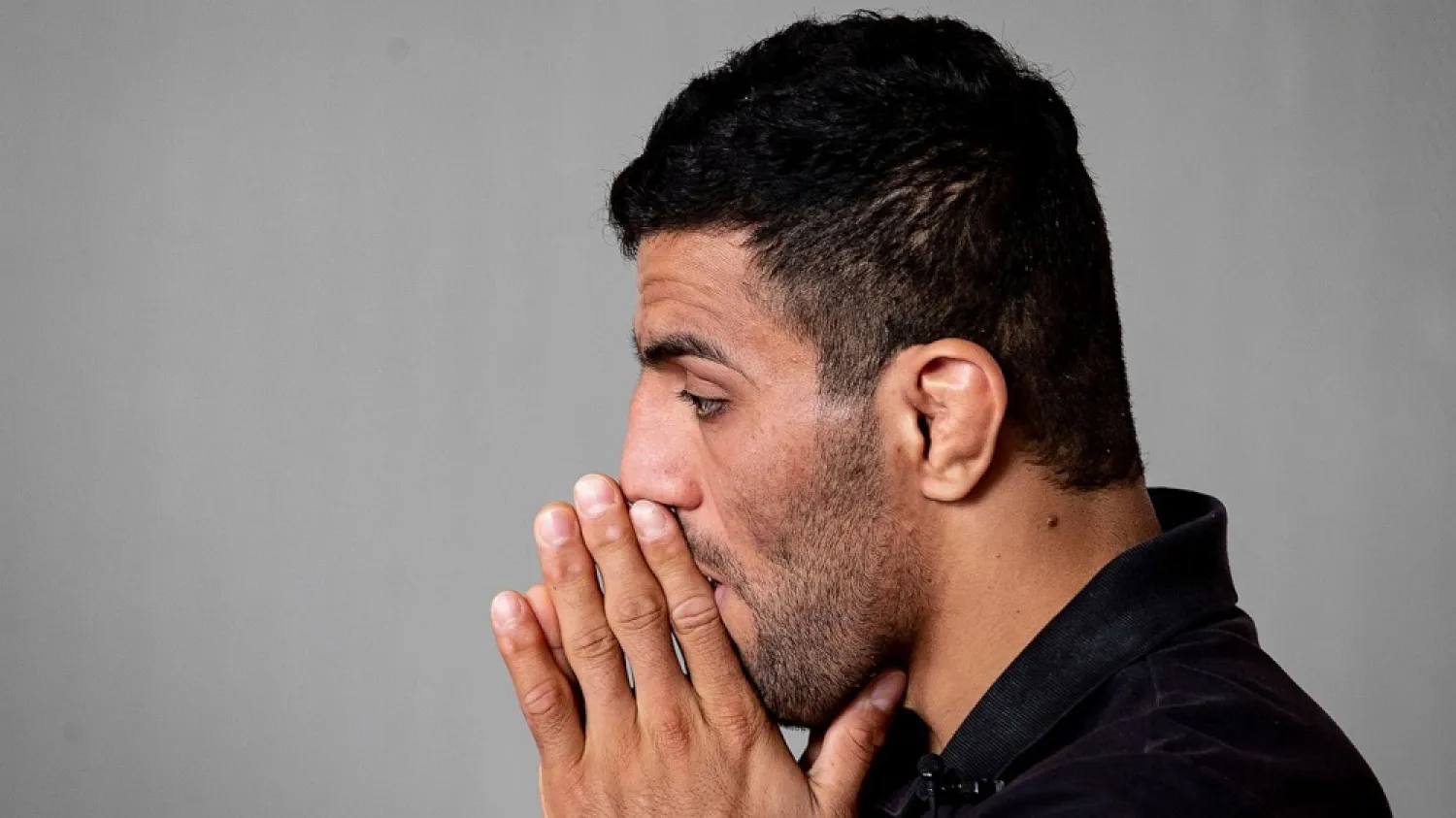

Judo Champion who Defied Iran's Rules Now in Hiding

Saeid Mollaei. (AP)
Saeid Mollaei. (AP)
TT

Judo Champion who Defied Iran's Rules Now in Hiding

Saeid Mollaei. (AP)
Saeid Mollaei. (AP)

Saeid Mollaei has been in hiding since he left the Iranian judo team last month, saying he had been ordered to withdraw from the world championships on political grounds.

Now he's training for next year's Olympics without a guarantee he can compete.

Mollaei was the defending world champion, and Israel's Sagi Muki his biggest rival for the gold medal. There was one problem — Iran has a policy of boycotting all competitions against Israelis, even if that means an athlete's training was all for nothing.

Mollaei told The Associated Press he was ordered to lose a preliminary bout against a Russian in order to cover up the reason for his withdrawal. When he refused and won, he received more intimidating calls from senior officials.

"For once, I decided to live as a free man for myself, and prove to the world that I am a brave man," Mollaei said in a recent interview in Germany, where he's living in an undisclosed location.

"I did this for my human soul. For myself. I wanted to practice and compete with freedom, with peace of mind," said Mollaei, speaking in Persian. "I didn't want to worry about whom to compete with and whom not to compete with. I'll compete with anyone, to honor the Olympic charter."

In the end, Mollaei lost a bronze-medal bout and didn't face Muki, who won gold. The International Judo Federation, which is supporting Mollaei, said he received demands to withdraw from an Iranian deputy sports minister, embassy staff and the head of the Iranian Olympic Committee.

Mollaei's likeliest route to the 2020 Tokyo Olympics is now the International Olympic Committee's team for refugees. The IJF is helping him but said he will need refugee status from the United Nations.

So far, adapting to life in Germany is hard.

"Even the clothes you can see on me (are gifts). I had nothing when arrived in Germany. I just decided to come and I came," he said. "I had a lot of gifts from friends and this is how I live now, with the help of a few friends and the IJF. I'm still waiting to see what will happen later, how I can compete, but obviously from the very beginning of my arrival here in Germany I started my training. Where and how I will compete later, I don't know yet."

Mollaei said he has not asked for asylum in Germany. Instead, he is living on a visa issued when he competed in German club events, and is cautious about security.

Powerfully built, with broad shoulders, Mollaei speaks softly and chooses his words carefully.

"Even when I want to contact my family I do it through a friend in Tehran because my family is under surveillance and I can't talk about many issues," he said. "I don't have much contact with any of my friends."

Mollaei told the AP he had been given similar orders to avoid Israeli competitors on three previous occasions. The last time was in February, when he failed to appear for the medal ceremony at a competition in France because it would mean sharing the podium with Muki.

Iranian officials have said Mollaei was somehow manipulated into leaving the team, and that he would be welcomed if he returned home.

He is skeptical, pointing to an Iranian letter to the IJF in May pledging to comply with Olympic non-discrimination rules. At the time, it was hailed as a signal Iran would end its sports boycott of Israel.

"I can assure you that they didn't comply with the Olympic Charter. So how can we trust them?" Mollaei said of Iran's sports officials.

Mollaei's break with the Iranian authorities comes at a time when activists are using sports to defy government demands.

Female Iranian activists have campaigned for years to be allowed to attend sports stadiums, particularly for men's soccer games, and staged protests at last year's World Cup in Russia. Last week, Iranian news outlets reported 29-year-old soccer fan Sahar Khodayari had died after setting herself on fire upon learning she could spend six months in prison for trying to sneak into a game.

Mollaei expressed sympathy for Khodayari and other female campaigners.

"I wondered why this happened, why Iranian women can't freely live like other girls, and enjoy sports and enjoy watching sports," he said. "I don't know what's going on, and why such difficulties should only happen to Iranians and the Iranian sport community.

"I don't know what to say. I'm just sad and disappointed. I just hope that one day the girls and athletes in my country can live freely and can enjoy life."



Shakhtar Boss Pays Ukrainian Racer $200,000 After Games Disqualification

Ukrainian President Volodymyr Zelenskiy holds helmet as he meets with a Ukrainian skeleton racer Vladyslav Heraskevych , who was disqualified from the Olympic skeleton competition over his "helmet of remembrance" depicting athletes killed since Russia's invasion and his father and coach, Mykhailo Heraskevych, amid Russia's attack on Ukraine, in Munich, Germany February 13, 2026. (Ukrainian Presidential Press Service/Handout via Reuters)
TT

Shakhtar Boss Pays Ukrainian Racer $200,000 After Games Disqualification

Ukrainian President Volodymyr Zelenskiy holds helmet as he meets with a Ukrainian skeleton racer Vladyslav Heraskevych , who was disqualified from the Olympic skeleton competition over his "helmet of remembrance" depicting athletes killed since Russia's invasion and his father and coach, Mykhailo Heraskevych, amid Russia's attack on Ukraine, in Munich, Germany February 13, 2026. (Ukrainian Presidential Press Service/Handout via Reuters)

The owner of ‌Ukrainian football club Shakhtar Donetsk has donated more than $200,000 to skeleton racer Vladyslav Heraskevych after the athlete was disqualified from the Milano Cortina Winter Games before competing over the use of a helmet depicting Ukrainian athletes killed in the war with Russia, the club said on Tuesday.

The 27-year-old Heraskevych was disqualified last week when the International Bobsleigh and Skeleton Federation jury ruled that imagery on the helmet — depicting athletes killed since Russia invaded Ukraine in 2022 — breached rules on athletes' expression at ‌the Games.

He ‌then lost an appeal at the Court ‌of ⁠Arbitration for Sport hours ⁠before the final two runs of his competition, having missed the first two runs due to his disqualification.

Heraskevych had been allowed to train with the helmet that displayed the faces of 24 dead Ukrainian athletes for several days in Cortina d'Ampezzo where the sliding center is, but the International Olympic Committee then ⁠warned him a day before his competition ‌started that he could not wear ‌it there.

“Vlad Heraskevych was denied the opportunity to compete for victory ‌at the Olympic Games, yet he returns to Ukraine a ‌true winner," Shakhtar President Rinat Akhmetov said in a club statement.

"The respect and pride he has earned among Ukrainians through his actions are the highest reward. At the same time, I want him to ‌have enough energy and resources to continue his sporting career, as well as to fight ⁠for truth, freedom ⁠and the remembrance of those who gave their lives for Ukraine," he said.

The amount is equal to the prize money Ukraine pays athletes who win a gold medal at the Games.

The case dominated headlines early on at the Olympics, with IOC President Kirsty Coventry meeting Heraskevych on Thursday morning at the sliding venue in a failed last-minute attempt to broker a compromise.

The IOC suggested he wear a black armband and display the helmet before and after the race, but said using it in competition breached rules on keeping politics off fields of play. Heraskevych also earned praise from Ukraine President Volodymyr Zelenskiy.


Speed Skating-Italy Clinch Shock Men’s Team Pursuit Gold, Canada Successfully Defend Women’s Title

 Team Italy with Davide Ghiotto, Andrea Giovannini, Michele Malfatti, celebrate winning the gold medal on the podium of the men's team pursuit speed skating race at the 2026 Winter Olympics, in Milan, Italy, Tuesday, Feb. 17, 2026. (AP)
Team Italy with Davide Ghiotto, Andrea Giovannini, Michele Malfatti, celebrate winning the gold medal on the podium of the men's team pursuit speed skating race at the 2026 Winter Olympics, in Milan, Italy, Tuesday, Feb. 17, 2026. (AP)
TT

Speed Skating-Italy Clinch Shock Men’s Team Pursuit Gold, Canada Successfully Defend Women’s Title

 Team Italy with Davide Ghiotto, Andrea Giovannini, Michele Malfatti, celebrate winning the gold medal on the podium of the men's team pursuit speed skating race at the 2026 Winter Olympics, in Milan, Italy, Tuesday, Feb. 17, 2026. (AP)
Team Italy with Davide Ghiotto, Andrea Giovannini, Michele Malfatti, celebrate winning the gold medal on the podium of the men's team pursuit speed skating race at the 2026 Winter Olympics, in Milan, Italy, Tuesday, Feb. 17, 2026. (AP)

An inspired Italy delighted the home crowd with a stunning victory in the Olympic men's team pursuit final as

Canada's Ivanie Blondin, Valerie Maltais and Isabelle Weidemann delivered another seamless performance to beat the Netherlands in the women's event and retain their title ‌on Tuesday.

Italy's ‌men upset the US who ‌arrived ⁠at the Games ⁠as world champions and gold medal favorites.

Spurred on by double Olympic champion Francesca Lollobrigida, the Italian team of Davide Ghiotto, Andrea Giovannini and Michele Malfatti electrified a frenzied arena as they stormed ⁠to a time of three ‌minutes 39.20 seconds - ‌a commanding 4.51 seconds clear of the ‌Americans with China taking bronze.

The roar inside ‌the venue as Italy powered home was thunderous as the crowd rose to their feet, cheering the host nation to one ‌of their most special golds of a highly successful Games.

Canada's women ⁠crossed ⁠the line 0.96 seconds ahead of the Netherlands, stopping the clock at two minutes 55.81 seconds, and

Japan rounded out the women's podium by beating the US in the Final B.

It was only Canada's third gold medal of the Games, following Mikael Kingsbury's win in men's dual moguls and Megan Oldham's victory in women's freeski big air.


Lindsey Vonn Back in US Following Crash in Olympic Downhill 

Milano Cortina 2026 Olympics - Alpine Skiing - Women's Downhill 3rd Official Training - Tofane Alpine Skiing Centre, Belluno, Italy - February 07, 2026. Lindsey Vonn of United States in action during training. (Reuters)
TT

Lindsey Vonn Back in US Following Crash in Olympic Downhill 

Milano Cortina 2026 Olympics - Alpine Skiing - Women's Downhill 3rd Official Training - Tofane Alpine Skiing Centre, Belluno, Italy - February 07, 2026. Lindsey Vonn of United States in action during training. (Reuters)

Lindsey Vonn is back home in the US following a week of treatment at a hospital in Italy after breaking her left leg in the Olympic downhill at the Milan Cortina Games.

“Haven’t stood on my feet in over a week... been in a hospital bed immobile since my race. And although I’m not yet able to stand, being back on home soil feels amazing,” Vonn posted on X with an American flag emoji. “Huge thank you to everyone in Italy for taking good care of me.”

The 41-year-old Vonn suffered a complex tibia fracture that has already been operated on multiple times following her Feb. 8 crash. She has said she'll need more surgery in the US.

Nine days before her fall in Cortina d'Ampezzo, Italy, Vonn ruptured the ACL in her left knee in another crash in Switzerland.

Even before then, all eyes had been on her as the feel-good story heading into the Olympics for her comeback after nearly six years of retirement.