


Israel President Invites Rivals to Break Elections Deadlock

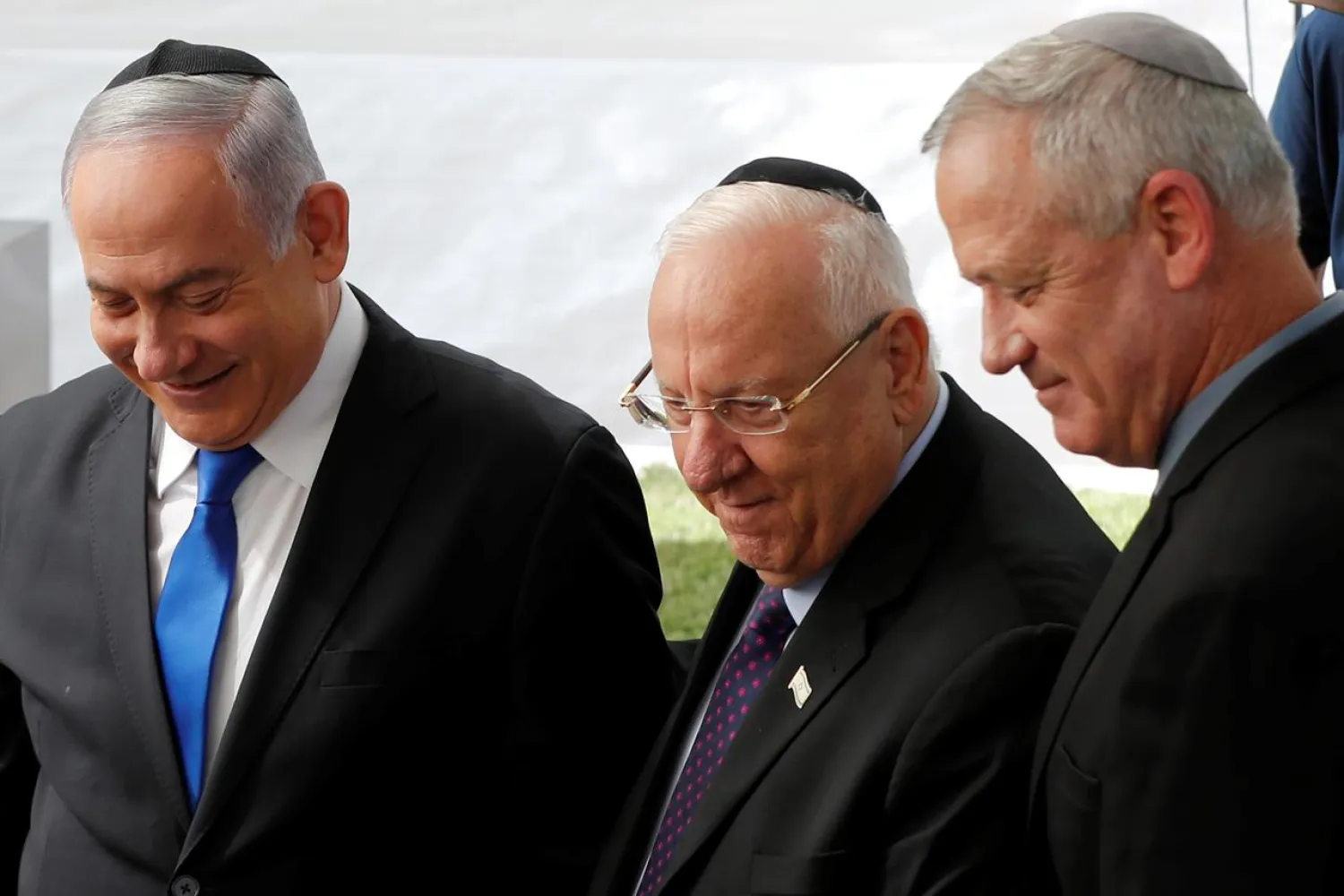
Israeli PM Benjamin Netanyahu, President Reuven Rivlin and Benny Gantz of the Blue and White party at the memorial for late President Shimon Peres in Jerusalem, September 22, 2019. (Reuters)
TT

Israel President Invites Rivals to Break Elections Deadlock

Israeli PM Benjamin Netanyahu, President Reuven Rivlin and Benny Gantz of the Blue and White party at the memorial for late President Shimon Peres in Jerusalem, September 22, 2019. (Reuters)

Israel's president invited the two main victors from the country's neck-and-neck election to meet Monday, seeking to break a deadlock that has complicated his task of trying to choose the country's next prime minister.

While formally maintaining only a ceremonial role, President Reuven Rivlin must choose the candidate he believes is best positioned to form a majority coalition in parliament. But last week's do-over election was inconclusive, with neither Prime Minister Benjamin Netanyahu's conservative Likud party nor the centrist Blue and White led by former army chief Benny Gantz having a clear path to forming a government.

"There is one thing that the people are largely united over and that is the desire that there won't be third elections," Rivlin said, according to The Associated Press.

The likeliest outcome is a unity government between the two rivals. Both sides have said they support the idea, but they disagree over who will head it, and Gantz has vowed not to sit with Netanyahu so long as he faces a likely indictment over a number of corruption scandals.

Rivlin on Monday wrapped up his second and final day of consultations with each party in parliament. Based on their recommendations, he must now select the candidate he deems has the best chance of forming a stable coalition.

He is set to make his decision by Wednesday.

In most elections, one of the major parties, along with smaller allies, controls a parliamentary majority. But that did not happen this time. Maverick politician Avigdor Lieberman, whose Yisrael Beitenu party controls eight seats, has refused to endorse either side and is pushing for a unity deal.

Rivlin's office announced that he would summon both Netanyahu and Gantz for a meeting later Monday.

Rivlin will likely pick the candidate with the most recommendations, who will then have 28 days to try to cobble together a government. If the first candidate chosen fails within that time, the second is given the opportunity. If he too doesn't manage, the country could head to an unprecedented third election in less than a year.

In Rivlin's first round of talks on Sunday, the Joint Arab List threw its support behind Gantz, the first time the Arab parties had recommended a candidate since 1992. Arab leaders said the decision was aimed at toppling Netanyahu, whose anti-Arab rhetoric has infuriated and offended Arabs in Israel during his decade in power. The backing promised to give Gantz slightly more support.

But on Monday, three Arab lawmakers said they were withdrawing their recommendations for Gantz, trimming his support to below Netanyahu's.

So far, a total of 55 lawmakers have recommended Netanyahu for prime minister, while 54 have endorsed Gantz. The prime minister needs at least 61 seats to have a parliamentary majority.

Last week's repeat election produced no clear majority, with Blue and White receiving 33 seats in Israel's 120-member parliament and Netanyahu's Likud garnering 31 seats. Both sides therefore must seek the support of other parties.

The vote last week was a never-before held second election, which was triggered after Netanyahu was unable to forge a coalition following April elections and then dissolved parliament.

Netanyahu had hoped to secure a narrow majority of hard-line and religious parties that would grant him immunity from prosecution on charges that could include bribery, breach of trust and fraud. But now that possibility appears to be off the table.

Israeli law does not require a sitting premier to resign if indicted. But if he is charged, as is widely expected, he will come under heavy pressure to step down.

Netanyahu faces a hearing next month on the charges and indictments could follow soon thereafter.



Far-Right Polish MP Draws Outrage with Swastika on Israeli Flag

Polish Far-right Confederation party MP Konrad Berkowicz dsiplays an Israeli flag marked with a swastika in the Sejm in Warsaw, Poland, 14 April 2026. (EPA)
TT

Far-Right Polish MP Draws Outrage with Swastika on Israeli Flag

Polish Far-right Confederation party MP Konrad Berkowicz dsiplays an Israeli flag marked with a swastika in the Sejm in Warsaw, Poland, 14 April 2026. (EPA)

A far-right Polish lawmaker displayed a paper Israeli flag emblazoned with a swastika in parliament, accusing the country of "genocide" in the Middle East, with Israel slamming his actions as "antisemitic horror".

"Israel is in the process of committing a genocide of exceptional cruelty before our very eyes," Konrad Berkowicz told lawmakers, comparing the country to a "new Third Reich".

Berkowicz, a member of the far-right nationalist Konfederacja (Confederation) opposition party, then brandished the paper flag, with the Nazi symbol replacing the Star of David at its center.

Parliamentarians reacted with outrage in a country that was the site of many of the concentration camps built by Nazi Germany during the Holocaust, in which six million European Jews were killed.

Berkowicz's actions prompted shouts of anger in the chamber, while the parliament speaker called the display of the swastika "unjustified".

The speaker later announced he was preparing a motion to impose penalties on Berkowicz for "presenting Nazi symbols in the chamber".

The Israeli embassy in Poland condemned Berkowicz's actions, calling them an "antisemitic horror" and demanding Polish authorities "act upon this disgrace".

The incident came on the same day the annual "March of the Living," held on the grounds of the former Nazi death camp Auschwitz commemorating Holocaust victims, took place.

Auschwitz was the largest of the extermination camps built by Nazi Germany in occupied Poland and has become a symbol of the Holocaust.

"As Holocaust Survivors march in Auschwitz today, this vile anti-Jewish act is especially appalling," the Israeli embassy wrote in a statement on X.

Berkowicz also accused the Israeli army of using white phosphorous bombs in the Middle East, describing in detail the severe injuries, suffering, and deaths of "tens of thousands of women and children" by such weapons.

Human Rights Watch has accused Israel of "illegally" using white phosphorous in Southern Lebanon after launching an offensive against Hezbollah.

Israel has said it "could not confirm" the allegations.

Berkowicz's actions prompted an immediate reaction from the United States ambassador to Poland, himself a follower of Orthodox Judaism.

"SHAME SHAME SHAME on YOU!! Maybe even you have noticed that we Jews aren't so easy to push around anymore, are we?" Ambassador Tom Rose wrote on his personal X account.

"We stand with our friends and we know how to fight and defeat our enemies!!!" he added.

Earlier Tuesday, Rose had also participated in the "March of the Living".

One million Jews and more than 100,000 non-Jews died at Auschwitz between 1940 and 1945.


Lavrov Blasts Efforts to ‘Contain’ Russia, China on Beijing Visit

In this handout picture provided by the Russian Foreign Ministry on April 14, 2026, Russian Foreign Minister Sergei Lavrov and Chinese Foreign Minister Wang Yi shake hands during a meeting in Beijing. (Handout / Russian Foreign Ministry / AFP)
TT

Lavrov Blasts Efforts to ‘Contain’ Russia, China on Beijing Visit

In this handout picture provided by the Russian Foreign Ministry on April 14, 2026, Russian Foreign Minister Sergei Lavrov and Chinese Foreign Minister Wang Yi shake hands during a meeting in Beijing. (Handout / Russian Foreign Ministry / AFP)

Russian Foreign Minister Sergei Lavrov criticized efforts he said were aimed at "containing" Russia and China on Tuesday during a visit to Beijing, where he also discussed with his Chinese counterpart plans for a meeting "within the year" between Vladimir Putin and Xi Jinping.

Lavrov was given a red-carpet welcome after he arrived in the Chinese capital, photographs released by the Russian foreign ministry showed.

He later met his Chinese counterpart Wang Yi, who he was seen shaking hands with in a picture posted on social media by Russian foreign ministry spokeswoman Maria Zakharova.

Beijing and Moscow are close economic and political partners, and the relationship has deepened further since Russia's invasion of Ukraine in 2022.

Lavrov warned of "some very, very dangerous games going on" in East Asian geopolitical hotspots that included Taiwan, the disputed South China Sea and the nuclear-armed Korean peninsula, according to quotes from the meeting with Wang published by state-run RIA Novosti.

Beijing claims Taiwan as part of its territory and is sharply critical of US military assistance the self-ruled island receives.

In comments apparently referring to the United States and its allies, Lavrov said "they are trying to dismantle (regional cooperation) by creating small-format, bloc-based structures aimed at containing both the People's Republic of China and the Russian Federation".

"Our vast continent as a whole demands constant attention," he said.

Wang and Lavrov "conducted in-depth exchanges on the US-Iran conflict, the Asia-Pacific situation, the Ukraine crisis" and other issues during their meeting, the Chinese foreign ministry said in a statement without providing details.

"The two sides coordinate and support one another on the international stage, demonstrating to the whole world that amid adversity, a righteous path remains, and that under changes, there lies greater responsibility," Wang said.

Lavrov and Wang also "communicated and synced up preparations for a meeting between the two heads of state within the year", according to the Chinese readout.

China is hosting this week a string of leaders of countries that have been affected by the US-Israeli war on Iran and its economic fallout, including Vietnam's To Lam and Abu Dhabi's Crown Prince Mohamed bin Zayed Al Nahyan.

Wang and Lavrov agreed during a call on April 5 that Beijing and Moscow would work together to de-escalate tensions in the Middle East.


US Says Six Vessels Turned Back by Iran Port Blockade

A ship is seen off the coast of Ras al-Khaimah, the day after the failure of US-Iran peace talks on April 13, 2026. (AFP)
TT

US Says Six Vessels Turned Back by Iran Port Blockade

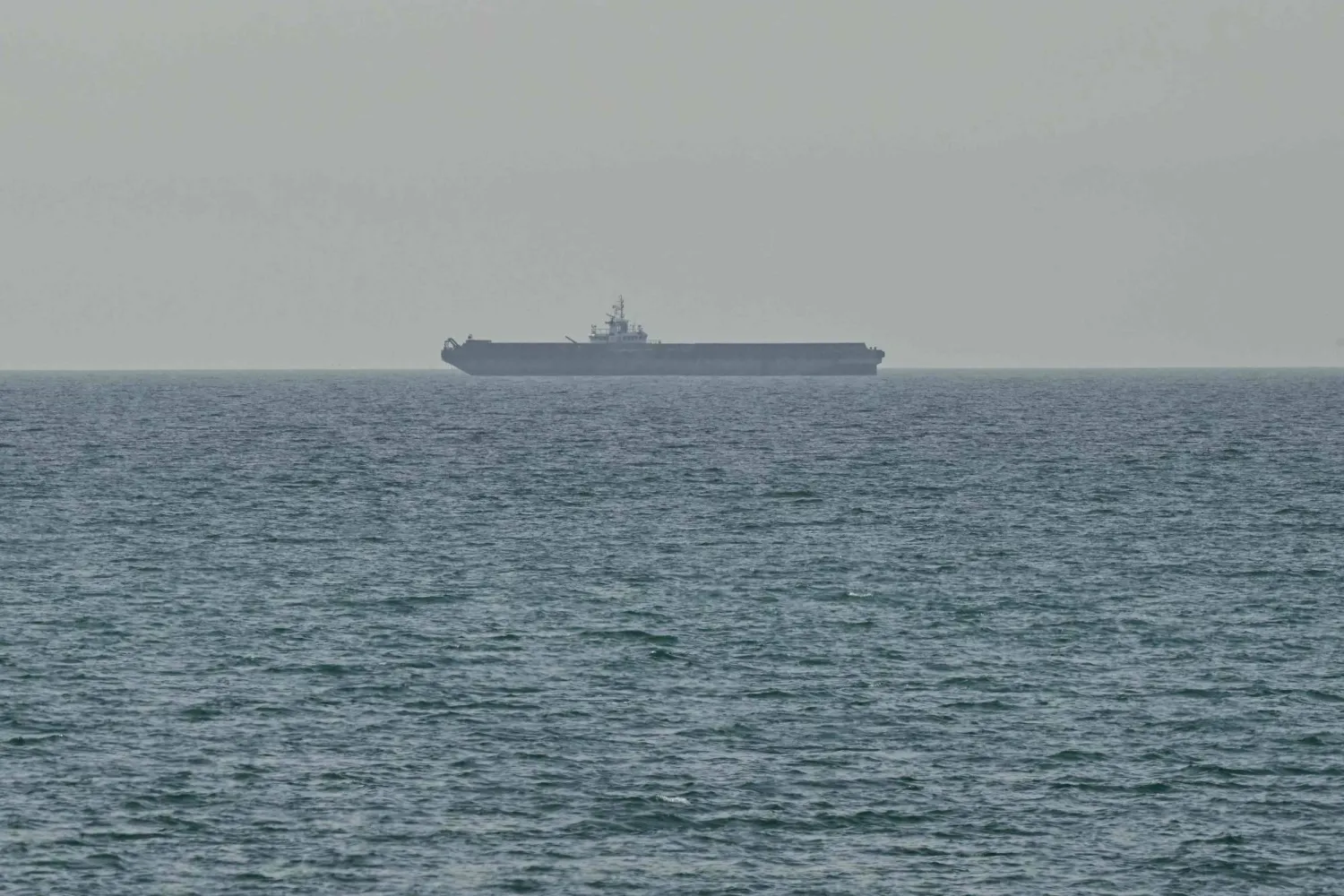
A ship is seen off the coast of Ras al-Khaimah, the day after the failure of US-Iran peace talks on April 13, 2026. (AFP)

The US military said Tuesday that it successfully stopped six ships from sailing out of Iranian ports during the first 24 hours of a naval blockade against the country. 

Central Command (CENTCOM) -- which is responsible for American forces in the Middle East -- said more than 10,000 US troops, over a dozen warships, and dozens of aircraft are taking part in the mission. 

"During the first 24 hours, no ships made it past the US blockade and six merchant vessels complied with direction from US forces to turn around to re-enter an Iranian port on the Gulf of Oman," CENTCOM said in a post on X. 

"The blockade is being enforced impartially against vessels of all nations entering or departing Iranian ports and coastal areas, including all Iranian ports on the Arabian Gulf and Gulf of Oman," it added. 

But despite CENTCOM's assertion that no vessels made it through the blockade, tracking information from maritime data provider Kpler showed at least two ships sailing from Iranian ports crossed the Strait of Hormuz on Monday. 

Tehran's forces effectively closed the strait after the start of the US-Israeli air campaign against Iran on February 28, and the US on Sunday announced its own blockade after peace talks with Iran failed.