


How Mohamed Salah Inspired Me to Become a Muslim

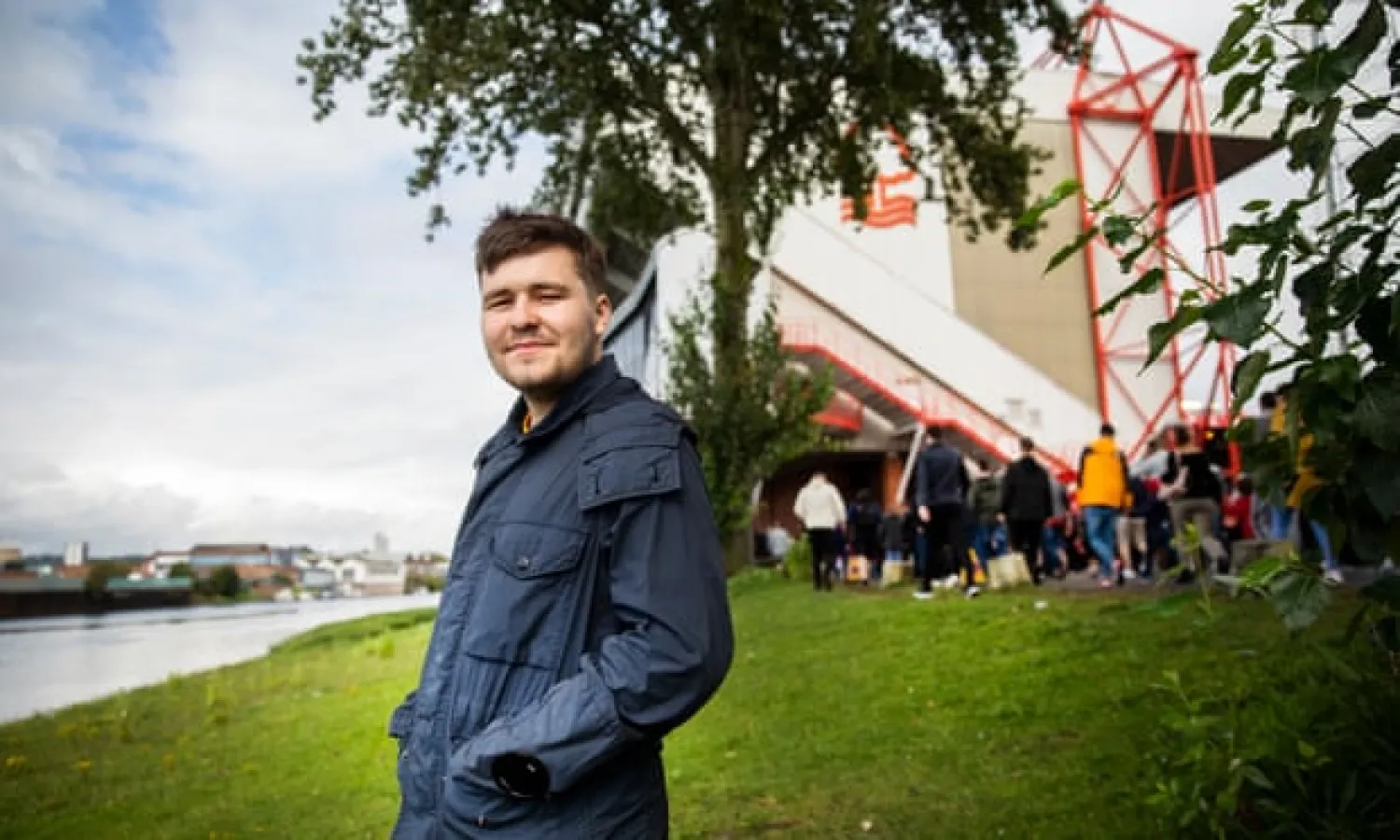
 Ben Bird, a season-ticket holder at Nottingham Forest, writes: ‘Mohamed Salah was the first Muslim I could relate to.’ Photograph: Fabio De Paola/The Guardian
Ben Bird, a season-ticket holder at Nottingham Forest, writes: ‘Mohamed Salah was the first Muslim I could relate to.’ Photograph: Fabio De Paola/The Guardian
TT

How Mohamed Salah Inspired Me to Become a Muslim

 Ben Bird, a season-ticket holder at Nottingham Forest, writes: ‘Mohamed Salah was the first Muslim I could relate to.’ Photograph: Fabio De Paola/The Guardian
Ben Bird, a season-ticket holder at Nottingham Forest, writes: ‘Mohamed Salah was the first Muslim I could relate to.’ Photograph: Fabio De Paola/The Guardian

Mohamed Salah really and honestly inspired me. I’m a Nottingham Forest season-ticket holder, I can be myself but because I made the declaration of faith I’m a Muslim. I’m still me and that’s what I took from Mohamed Salah. I’d love to meet him, just to shake his hand and say “Cheers” or “Shukran”.

I don’t think my mates quite believe that I’m a Muslim because I’ve not really changed. I just think my heart is better. I’m really trying to change on match days. Normally it’s pub, put a bet on, then after the game back to the pub and realise you’ve lost a lot of money. It’s hard when you’re used to such a culture and it’s part of football for a lot of people.

I’m embarrassed to say this but my opinions on Islam used to be that the religion, the culture and the people were backward; that they didn’t integrate and wanted to take over. I always looked at Muslims like the elephant in the room. I had a hatred of Muslims.

When I was in sixth form it was a period where I think I needed someone to blame for my misfortunes. Unfortunately Muslims got the brunt of it and I quickly discovered right-wing media pages. They sort of groomed me by sending me long propaganda pieces and suchlike.

Even though I had these horrible ideas of Islam, I would never say them to a Muslim. At this point I didn’t know any Muslims. My degree in Middle Eastern Studies at the University of Leeds changed everything.

We had to do a dissertation and I wanted to do something a bit different. I remember my dyslexia tutor telling me: “What about Mohamed Salah’s song?” I was aware of it and I thought it was fantastic but I hadn’t considered it in those terms.

I finally got the question: “Mohamed Salah, a gift from Allah. Is the performance of Mohamed Salah igniting a conversation that combats Islamapobia within the media and political spheres?”

The Liverpool fans’ song – to the tune of Dodgy’s hit Good Enough – includes the line “If he scores another few then I’ll be Muslim too”, and I literally took that to heart.

I was a typical white-boy student who went to a different city, would get absolutely hammered and lived the student life. My degree was the first time I learned about Islam in an academic way.

University gave me the opportunity to meet a lot of students from Arab countries. I thought they were evil people but they’re the nicest people I’ve met. The conceptions I had about Arab countries completely dissolved.

Mohamed Salah was the first Muslim I could relate to. It’s the way he lives his life, how he talks to people. The other week he posed for a picture with a Liverpool fan who suffered a broken nose chasing after him. I know some other footballers would do that but you expect it now from Salah.

At university I interviewed Egyptian students and when they found out my research was about “Mohamed Salah, a gift from Allah” – which is also another Liverpool song – they would talk to me for hours about how great he is and what he’s done for their country. One million Egyptians spoiled their ballots and voted for him to be president last year.

One of the Egyptians I talked to told me that Salah encompasses what being a Muslim is, following Islam correctly. He believed that Salah is making people love Muslims again.

That really resonated with me. When Salah scores I think he’s scoring for the faith. When he won the Champions League I said to my friend that was a victory for Islam. After each of his goals Salah practises the sujood (prostration) and exposes a very Islamic symbol to the world. How many people watch the Premier League every week? Millions globally.

Salah showed me that you can be normal and a Muslim, if that’s the right phrase. You can be yourself. He’s a great player and is respected by the football community and his politics, his religion, don’t matter – and to me that’s what football can do.

When people read the Quran, or read about Islam, they see something different that is not always portrayed in the media. I’m new to the Islamic community and I’m still learning. It is hard. It’s a lifestyle change.

What would I say to the Ben of old? I’d give him a smack, to be honest, and I’d say: ‘How dare you think like that about a people that are so diverse. You need to start talking to people. You need to start asking the questions.’ We live in a multicultural, multifaith, multinational society.

Last season Chelsea fans were singing “Salah is a bomber”. That’s the first time on my social media that I had a right go. I was livid because I’m for football banter but you know when things are just not true.

Now, I’d say to Muslim kids: ‘Don’t be afraid to go to a football match.’ I think that’s an issue we have to look at from both sides. I was afraid of being segregated. I don’t want to lose my mates because I look at them as brothers to me. Now I’ve got a fifth of the world’s population as brothers and sisters.

The community has to branch out, play football, go to football. It’s up to us to realise that we’re in this together. And the best spokesman for that could be Mohamed Salah.

The Guardian Sport


Shakhtar Boss Pays Ukrainian Racer $200,000 After Games Disqualification

Ukrainian President Volodymyr Zelenskiy holds helmet as he meets with a Ukrainian skeleton racer Vladyslav Heraskevych , who was disqualified from the Olympic skeleton competition over his "helmet of remembrance" depicting athletes killed since Russia's invasion and his father and coach, Mykhailo Heraskevych, amid Russia's attack on Ukraine, in Munich, Germany February 13, 2026. (Ukrainian Presidential Press Service/Handout via Reuters)
TT

Shakhtar Boss Pays Ukrainian Racer $200,000 After Games Disqualification

Ukrainian President Volodymyr Zelenskiy holds helmet as he meets with a Ukrainian skeleton racer Vladyslav Heraskevych , who was disqualified from the Olympic skeleton competition over his "helmet of remembrance" depicting athletes killed since Russia's invasion and his father and coach, Mykhailo Heraskevych, amid Russia's attack on Ukraine, in Munich, Germany February 13, 2026. (Ukrainian Presidential Press Service/Handout via Reuters)

The owner of ‌Ukrainian football club Shakhtar Donetsk has donated more than $200,000 to skeleton racer Vladyslav Heraskevych after the athlete was disqualified from the Milano Cortina Winter Games before competing over the use of a helmet depicting Ukrainian athletes killed in the war with Russia, the club said on Tuesday.

The 27-year-old Heraskevych was disqualified last week when the International Bobsleigh and Skeleton Federation jury ruled that imagery on the helmet — depicting athletes killed since Russia invaded Ukraine in 2022 — breached rules on athletes' expression at ‌the Games.

He ‌then lost an appeal at the Court ‌of ⁠Arbitration for Sport hours ⁠before the final two runs of his competition, having missed the first two runs due to his disqualification.

Heraskevych had been allowed to train with the helmet that displayed the faces of 24 dead Ukrainian athletes for several days in Cortina d'Ampezzo where the sliding center is, but the International Olympic Committee then ⁠warned him a day before his competition ‌started that he could not wear ‌it there.

“Vlad Heraskevych was denied the opportunity to compete for victory ‌at the Olympic Games, yet he returns to Ukraine a ‌true winner," Shakhtar President Rinat Akhmetov said in a club statement.

"The respect and pride he has earned among Ukrainians through his actions are the highest reward. At the same time, I want him to ‌have enough energy and resources to continue his sporting career, as well as to fight ⁠for truth, freedom ⁠and the remembrance of those who gave their lives for Ukraine," he said.

The amount is equal to the prize money Ukraine pays athletes who win a gold medal at the Games.

The case dominated headlines early on at the Olympics, with IOC President Kirsty Coventry meeting Heraskevych on Thursday morning at the sliding venue in a failed last-minute attempt to broker a compromise.

The IOC suggested he wear a black armband and display the helmet before and after the race, but said using it in competition breached rules on keeping politics off fields of play. Heraskevych also earned praise from Ukraine President Volodymyr Zelenskiy.


Speed Skating-Italy Clinch Shock Men’s Team Pursuit Gold, Canada Successfully Defend Women’s Title

 Team Italy with Davide Ghiotto, Andrea Giovannini, Michele Malfatti, celebrate winning the gold medal on the podium of the men's team pursuit speed skating race at the 2026 Winter Olympics, in Milan, Italy, Tuesday, Feb. 17, 2026. (AP)
Team Italy with Davide Ghiotto, Andrea Giovannini, Michele Malfatti, celebrate winning the gold medal on the podium of the men's team pursuit speed skating race at the 2026 Winter Olympics, in Milan, Italy, Tuesday, Feb. 17, 2026. (AP)
TT

Speed Skating-Italy Clinch Shock Men’s Team Pursuit Gold, Canada Successfully Defend Women’s Title

 Team Italy with Davide Ghiotto, Andrea Giovannini, Michele Malfatti, celebrate winning the gold medal on the podium of the men's team pursuit speed skating race at the 2026 Winter Olympics, in Milan, Italy, Tuesday, Feb. 17, 2026. (AP)
Team Italy with Davide Ghiotto, Andrea Giovannini, Michele Malfatti, celebrate winning the gold medal on the podium of the men's team pursuit speed skating race at the 2026 Winter Olympics, in Milan, Italy, Tuesday, Feb. 17, 2026. (AP)

An inspired Italy delighted the home crowd with a stunning victory in the Olympic men's team pursuit final as

Canada's Ivanie Blondin, Valerie Maltais and Isabelle Weidemann delivered another seamless performance to beat the Netherlands in the women's event and retain their title ‌on Tuesday.

Italy's ‌men upset the US who ‌arrived ⁠at the Games ⁠as world champions and gold medal favorites.

Spurred on by double Olympic champion Francesca Lollobrigida, the Italian team of Davide Ghiotto, Andrea Giovannini and Michele Malfatti electrified a frenzied arena as they stormed ⁠to a time of three ‌minutes 39.20 seconds - ‌a commanding 4.51 seconds clear of the ‌Americans with China taking bronze.

The roar inside ‌the venue as Italy powered home was thunderous as the crowd rose to their feet, cheering the host nation to one ‌of their most special golds of a highly successful Games.

Canada's women ⁠crossed ⁠the line 0.96 seconds ahead of the Netherlands, stopping the clock at two minutes 55.81 seconds, and

Japan rounded out the women's podium by beating the US in the Final B.

It was only Canada's third gold medal of the Games, following Mikael Kingsbury's win in men's dual moguls and Megan Oldham's victory in women's freeski big air.


Lindsey Vonn Back in US Following Crash in Olympic Downhill 

Milano Cortina 2026 Olympics - Alpine Skiing - Women's Downhill 3rd Official Training - Tofane Alpine Skiing Centre, Belluno, Italy - February 07, 2026. Lindsey Vonn of United States in action during training. (Reuters)
TT

Lindsey Vonn Back in US Following Crash in Olympic Downhill 

Milano Cortina 2026 Olympics - Alpine Skiing - Women's Downhill 3rd Official Training - Tofane Alpine Skiing Centre, Belluno, Italy - February 07, 2026. Lindsey Vonn of United States in action during training. (Reuters)

Lindsey Vonn is back home in the US following a week of treatment at a hospital in Italy after breaking her left leg in the Olympic downhill at the Milan Cortina Games.

“Haven’t stood on my feet in over a week... been in a hospital bed immobile since my race. And although I’m not yet able to stand, being back on home soil feels amazing,” Vonn posted on X with an American flag emoji. “Huge thank you to everyone in Italy for taking good care of me.”

The 41-year-old Vonn suffered a complex tibia fracture that has already been operated on multiple times following her Feb. 8 crash. She has said she'll need more surgery in the US.

Nine days before her fall in Cortina d'Ampezzo, Italy, Vonn ruptured the ACL in her left knee in another crash in Switzerland.

Even before then, all eyes had been on her as the feel-good story heading into the Olympics for her comeback after nearly six years of retirement.
