

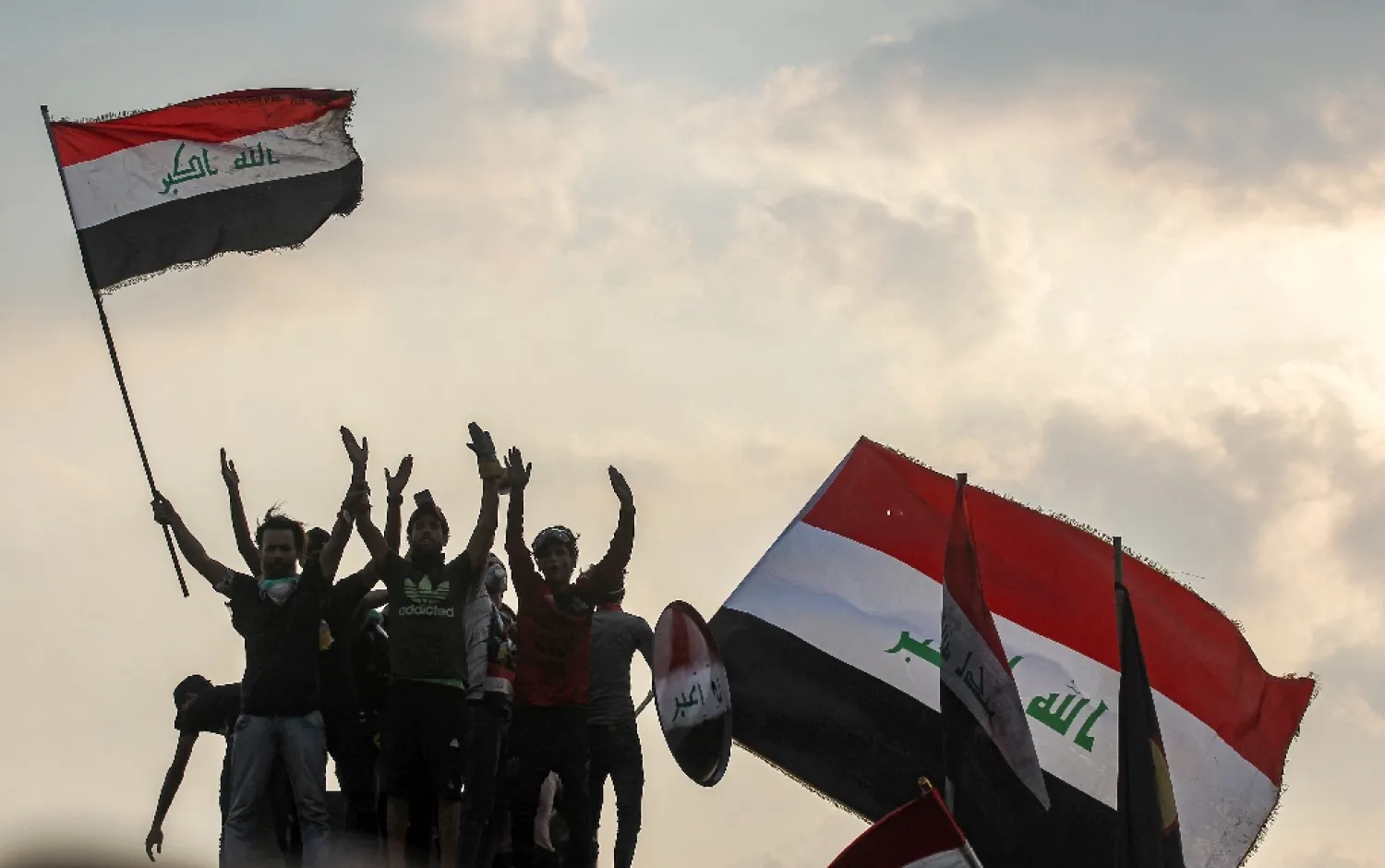

Iraq PM's Future on the Line as Demonstrators Smell Change

Iraqi protestors are demanding a total overhaul of a political system they see as corrupt | AFP
TT

Iraq PM's Future on the Line as Demonstrators Smell Change

Iraqi protestors are demanding a total overhaul of a political system they see as corrupt | AFP

The future of Iraq's embattled premier was in the hands of his onetime parliamentary backers Wednesday, as they deliberated over his ouster after mass anti-government protests that have left over 240 dead.

Massive rallies broke out in Iraq's capital and south this month against corruption and unemployment, spiralling into angry calls for a total overhaul of the political system.

By Wednesday, demonstrators were waiting to see whether the first fruit of their struggle -- the ouster of Prime Minister Adel Abdel Mahdi -- was finally within reach.

"Isn't it the people who have the power? Isn't it the people who put them all there?" asked protestor Athir Malek, 39.

He had come from Diwaniyah, 200 kilometers (130 miles) further south, to join the biggest rallies so far in Baghdad's Tahrir Square, where celebration was in the air.

Youssef, 33 expressed optimism late Tuesday as he spent his sixth straight night in the square.

"They said we wouldn't be able to do anything. But even if we change one name, now we have a voice," he said.

Parliament has demanded that the premier appear "immediately" for questioning amid speculation he will face a no-confidence vote.

But protestor Malek retained some skepticism.

"They'll replace Abdel Mahdi with someone else just like him," he told AFP.

Abdel Mahdi, 78, came to power last year through a tenuous partnership between populist cleric Moqtada al-Sadr and powerful paramilitary chief Hadi al-Ameri. But the kingmakers' alliance has since drifted apart.

The protests exposed more clearly than ever the rift between Ameri and Sadr's powerful Saeroon bloc, the biggest in parliament, which has backed the demonstrators.

The Hashed al-Shaabi paramilitary force's political arm Fatah, headed by Ameri, is the second-biggest bloc and has so far backed the government.

Several Hashed offices were torched in southern Iraq last week, further straining ties between the two.

- 'Back to square one' -

But Sadr extended a hand to Ameri late Tuesday, inviting him to coordinate on a no-confidence vote in Abdel Mahdi and using Twitter to urge the premier to "Get out!"

Hours later, Ameri announced he and Sadr would "work together to achieve the people's demands" -- hinting he may agree to a vote on the premier's future.

Sadr took to Twitter again Wednesday to pile on the pressure, warning that failing to oust Abdel Mahdi would "turn Iraq into Syria or Yemen," both engulfed in bloody wars.

While the premier's departure would be seen as a "victory" for demonstrators, it would "give protests a break but not break them," said Maria Fantappie, an Iraq analyst at the International Crisis Group.

Demonstrators have demanded deep-rooted reforms, including a new constitution, a reworked electoral law and mass resignations from a government they see as corrupt.

Fantappie cautioned that "even an election with the same election law would bring same figures into parliament and the same process as last year in selecting the prime minister, which puts you once again at square one."

As rumors swirled that Abdel Mahdi's days were numbered, people rallied at central Baghdad's Tahrir Square for a seventh consecutive day on Wednesday.

Despite violence that has left more than 240 people dead and more than 8,000 wounded, they have defied orders to clear the streets.

The largest numbers yet -- tens of thousands -- flooded Tahrir overnight amid blaring horns, fireworks and loud Iraqi music.

Demonstrators have shrugged off a litany of government reform plans and piled the pressure on Iraq's entrenched political class, saying they want to "weed them all out".

"They should all quit and we should have a national salvation government," said Alaa Khdeir, 63.

- 'Take back everything' -

Since the US-led invasion that toppled dictator Saddam Hussein in 2003, Iraq's political system has been gripped by clientelism, corruption and sectarianism.

That means getting a job in government -- by far the country's biggest employer -- is often secured with bribes or connections. The country is ranked by Transparency International as the 12th most corrupt in the world.

Anger at the state of affairs had been swelling among the youth, who make up 60 percent of Iraq's nearly 40 million people.

Youth unemployment stands at 25 percent, while one in five live below the poverty line, despite the vast oil wealth of OPEC's second-largest crude producer.

Inequality has been a major rallying cry for protestors.

An initial six-day wave of demonstrations broke out on October 1 but was met with violence that left 157 people dead, mostly protesters in Baghdad.

The demonstrations resumed on October 24, with clashes breaking out in the south and heavy use of tear gas canisters in Baghdad, leaving another 85 dead.



Egypt’s Prime Minister and FM Head to Washington for Trump Peace Council Meeting

Egyptian Foreign Minister Badr Abdelatty speaks during a joint press conference with Kenyan Prime Cabinet Secretary/Cabinet Secretary for Foreign Diaspora Affairs Musalia Mudavadi in Nairobi, Kenya, Monday, Feb. 16, 2026. (AP)
TT

Egypt’s Prime Minister and FM Head to Washington for Trump Peace Council Meeting

Egyptian Foreign Minister Badr Abdelatty speaks during a joint press conference with Kenyan Prime Cabinet Secretary/Cabinet Secretary for Foreign Diaspora Affairs Musalia Mudavadi in Nairobi, Kenya, Monday, Feb. 16, 2026. (AP)

Egypt's Prime Minister Mostafa Madbouly headed to Washington on Tuesday ‌to ‌participate in ‌the inaugural ⁠meeting of a "Board of Peace" established by US President Donald ⁠Trump, the ‌cabinet ‌said.

Madbouly is ‌attending ‌on behalf of President Abdel ‌Fattah al-Sisi and is accompanied by ⁠Foreign ⁠Minister Badr Abdelatty.

Foreign Minister Gideon Saar will represent Israel at the inaugural meeting, his office said on Tuesday.

Hamas, meanwhile, called on the newly-formed board to pressure Israel to halt what it described as ongoing violations of the ceasefire in Gaza.

The Board of Peace, of which Trump is the chairman, was initially designed to oversee the Gaza truce and the territory's reconstruction after the war between Hamas and Israel.

But its purpose has since morphed into resolving all sorts of international conflicts, triggering fears the US president wants to create a rival to the United Nations.

Saar will first attend a ministerial level UN Security Council meeting in New York on Wednesday, and on Thursday he "will represent Israel at the inaugural session of the board, chaired by Trump in Washington DC, where he will present Israel's position", his office said in a statement.

It was initially reported that Prime Minister Benjamin Netanyahu might attend the gathering, but his office said last week that he would not.

Ahead of the meeting, Hamas spokesman Hazem Qassem told AFP that the Palestinian movement urged the board's members "to take serious action to compel the Israeli occupation to stop its violations in Gaza".

"The war of genocide against the Strip is still ongoing -- through killing, displacement, siege, and starvation -- which have not stopped until this very moment," he added.

He also called for the board to work to support the newly formed Palestinian technocratic committee meant to oversee the day-to-day governance of post-war Gaza "so that relief and reconstruction efforts in Gaza can commence".

Announcing the creation of the board in January, Trump also unveiled plans to establish a "Gaza Executive Board" operating under the body.

The executive board would include Turkish Foreign Minister Hakan Fidan and Qatari diplomat Ali Al-Thawadi.

Netanyahu has strongly objected to their inclusion.

Since Trump launched his "Board of Peace" at the World Economic Forum in Davos in January, at least 19 countries have signed its founding charter.


Palestinian Child Dies After Stepping on Mine in West Bank

Israeli troops conduct a military raid in the village of Al-Yamoun, west of Jenin, West Bank, 17 February 2026. (EPA)
TT

Palestinian Child Dies After Stepping on Mine in West Bank

Israeli troops conduct a military raid in the village of Al-Yamoun, west of Jenin, West Bank, 17 February 2026. (EPA)

A Palestinian child died after stepping on a mine near an Israeli military camp in the occupied West Bank on Tuesday, the Palestinian Red Crescent said, with an Israeli defense ministry source confirming the death.

"Our crews received the body of a 13-year-old child who was killed after a mine exploded in one of the old camps in Jiftlik in the northern Jordan Valley," the Red Crescent said in a statement.

A source at COGAT, the Israeli defense ministry's agency in charge of civilian matters in the Palestinian territories, confirmed the death to AFP and identified the boy as Mohammed Abu Dalah, from the village of Jiftlik.

Israel's military had previously said in a statement that three Palestinians were injured "as a result of playing with unexploded ordnance", without specifying their ages.

It added that the area of the incident, Tirzah, is "a military camp in the area of the Jordan Valley", near Jiftlik and close to the Jordanian border.

"This area is a live-fire zone and entry into it is prohibited," the military said.

Jiftlik village council head Ahmad Ghawanmeh told AFP that three children, the oldest of whom was 16, were collecting herbs near the military base when they detonated a mine.

Jiftlik as well as the nearby Tirzah base are located in the Palestinian territory's Area C, which falls under direct Israeli control.

Israel has occupied the West Bank since 1967.

Much of the area near the border with Jordan -- which Israel signed a peace deal with in 1994 -- remains mined.

In January, Israel's defense ministry said it had begun demining the border area as part of construction works for a new barrier it says aims to stem weapons smuggling.


Hezbollah Rejects Disarmament Plan and Government’s Four-Month Timeline

29 July 2024, Iran, Tehran: Then Hezbollah deputy leader Sheikh Naim Qassem is pictured during a meeting in Tehran. (Iranian Presidency/dpa)
TT

Hezbollah Rejects Disarmament Plan and Government’s Four-Month Timeline

29 July 2024, Iran, Tehran: Then Hezbollah deputy leader Sheikh Naim Qassem is pictured during a meeting in Tehran. (Iranian Presidency/dpa)

Hezbollah rejected on Tuesday the Lebanese government's decision to grant the army at least four months to advance the second phase of a nationwide disarmament plan, saying it would not accept what it sees as a move serving Israel.

Lebanon's cabinet tasked the army in August 2025 with drawing up and beginning to implement a plan to bring all armed groups' weapons under state control, a bid aimed primarily at disarming Hezbollah after its devastating ‌war with ‌Israel in 2024.

In September 2025 the cabinet formally ‌welcomed ⁠the army's plan to ⁠disarm the Iran-backed Shiite party, although it did not set a clear timeframe and cautioned that the military's limited capabilities and ongoing Israeli strikes could hinder progress.

Hezbollah Secretary-General Sheikh Naim Qassem said in a speech on Monday that "what the Lebanese government is doing by focusing on disarmament is a major mistake because this issue serves the goals of Israeli ⁠aggression".

Lebanon's Information Minister Paul Morcos said during a press ‌conference late on Monday after ‌a cabinet meeting that the government had taken note of the army's monthly ‌report on its arms control plan that includes restricting weapons in ‌areas north of the Litani River up to the Awali River in Sidon, and granted it four months.

"The required time frame is four months, renewable depending on available capabilities, Israeli attacks and field obstacles,” he said.

Hezbollah lawmaker Hassan ‌Fadlallah said, "we cannot be lenient," signaling the group's rejection of the timeline and the broader approach to ⁠the issue of ⁠its weapons.

Hezbollah has rejected the disarmament effort as a misstep while Israel continues to target Lebanon, and Shiite ministers walked out of the cabinet session in protest.

Israel has said Hezbollah's disarmament is a security priority, arguing that the group's weapons outside Lebanese state control pose a direct threat to its security.

Israeli officials say any disarmament plan must be fully and effectively implemented, especially in areas close to the border, and that continued Hezbollah military activity constitutes a violation of relevant international resolutions.

Israel has also said it will continue what it describes as action to prevent the entrenchment or arming of hostile actors in Lebanon until cross-border threats are eliminated.