


A Squash Mystery in Egypt: Is there Something in the Nile?

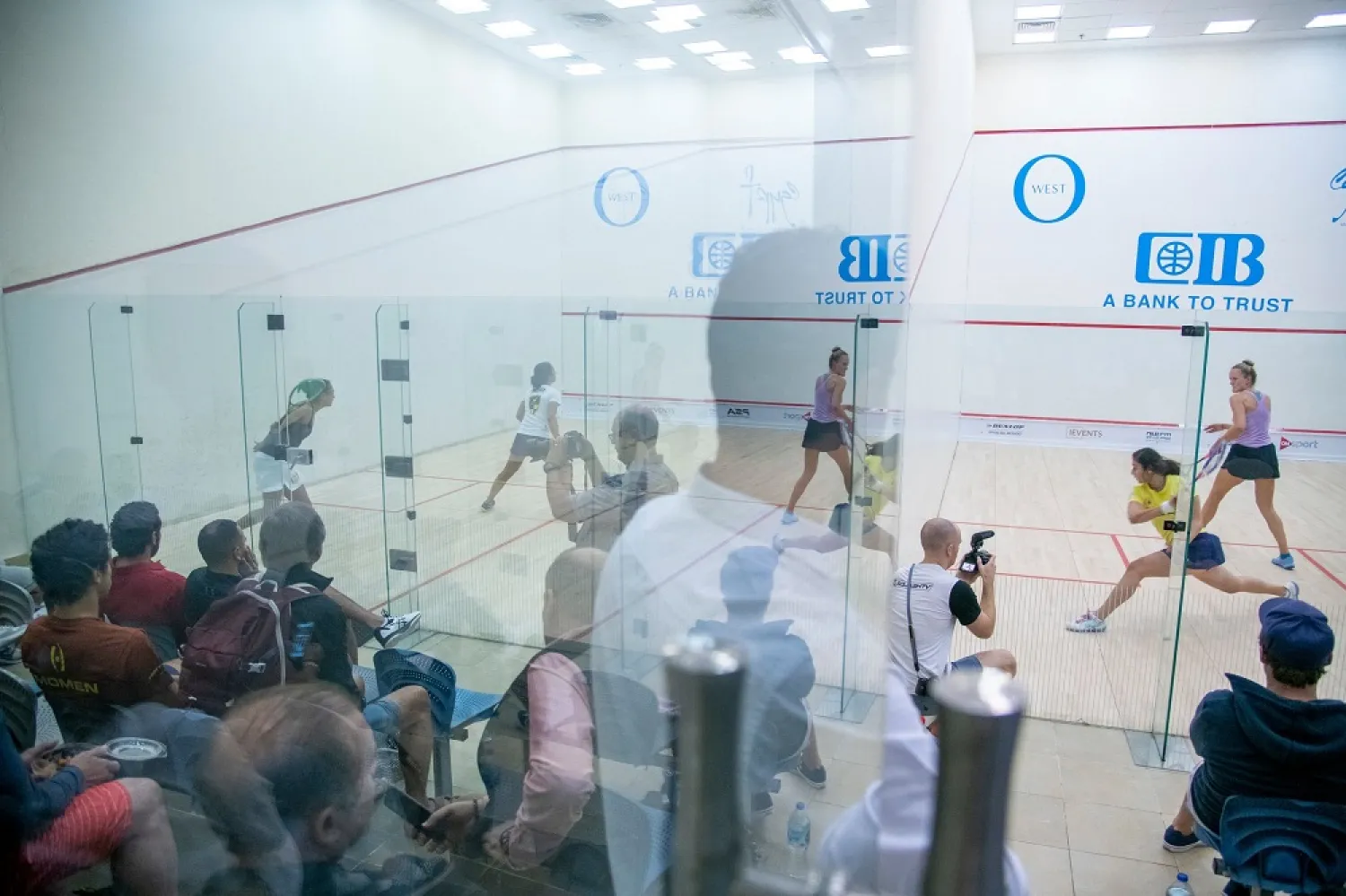
Second-ranked Nour El Sherbini, in yellow, played on a court next to El Welily in the first round of the women’s world championship. (The New York Times)
TT

A Squash Mystery in Egypt: Is there Something in the Nile?

Second-ranked Nour El Sherbini, in yellow, played on a court next to El Welily in the first round of the women’s world championship. (The New York Times)

It is one of the most compelling mysteries in sports.

Twenty years ago, Egypt could point to a handful or two of great squash players in its history, and the last time it had produced a worldbeater was in the mid-60s, when A.A. AbouTaleb won the British Open three years in a row.

Today, if victory were cake, these people would be gluttons. The top four men in the world rankings are Egyptian, and five more are in the top 20. Since 2003, an Egyptian has won the men’s world championship 10 times.

The dominance of the Egyptian women may be even more impressive, given how few played the game at the turn of the century. Four of the top five female squash players are Egyptian, including the world No. 1, Raneem El Welily, and reinforcements are on the way: The girls’ junior national team has won the world championship seven years running.

“I get asked all the time, ‘What is the big secret?’” El Welily said in a recent interview. “I tell them that is the million-dollar question. No one really knows. But there are a few theories.”

This week, those theories were revisited as Egypt demonstrated its squash prowess in a quintessentially Egyptian setting. The Professional Squash Association held its women’s world championship, with the matches at night in an outdoor glass court set up in front of the Great Pyramid of Giza.

Studied in detail, Egypt’s squash hegemony offers lessons in how any country can compete in any individual sport, with the right combination of history, culture and geography. In 1996, a breakout performance by a 19-year-old started a craze. The best athletes in Egypt were drawn by squash’s new cachet, which was bolstered when top American universities and prep schools started recruiting here. It helps that the pros are clustered in two cities, which makes it easy for young players to watch and learn from the greats.

Success begets success, and now Egypt’s biggest problem is a lagging supply of courts to meet demand. Omar El Borolossy, a former No. 14, said there were more than 2,000 players ages 5 to 10 among his academy and two other squash clubs he is familiar with in Cairo.

“That’s enough to dominate squash for the next 20 years,” he said.

Much about Egypt’s playbook could be gleaned during a visit to Cairo last month, at a three-day match attended by six of the best squash clubs in the country. Among the men’s players were Ali Farag, the world No. 1; Tarek Momen, who is No. 3; and Karim Abdel Gawad, No. 4. On the women’s side were El Welily; Nour El Sherbini, No. 2; Nour El Tayeb, No. 3; and Nouran Gohar, No. 5.

There was no money on the line, no trophy up for grabs. There wasn’t even much of an audience. It was like a game of pickup basketball in which LeBron James, Elena Delle Donne and other greats from the NBA and the WNBA. got together to play, largely in private.

One of the players was an American, Sabrina Sobhy, who is ranked 61st. She was so amazed by the dominance of Egyptian squash players that in August she relocated to Cairo.

“I came to crack the code,” she said during pre-match stretching.

She quickly learned the most obvious part of Egyptian squash exceptionalism: concentrated quality. The United States has far more squash players — about 1.7 million, according US Squash, the sport’s national governing body — and roughly 3,500 courts.

Egypt has about 400 courts and fewer than 10,000 players, say players and coaches. But the finest Egyptian players are bunched in about 10 clubs in two cities, Cairo and Alexandria, which are about a three-hour drive apart.

For aspiring players, proximity to greatness “is like a performance-enhancing drug,” said Daniel Coyle, author of “The Talent Code,” which chronicles talent outbreaks in different sports and countries. “These young players get to see how the greats play, train, eat.”

But how did Egypt produce so much talent in the first place?

Some history. Squash was born at Harrow, a private school in England, early in the 19th century, and was exported to colonies through clubs built for British officers. (To this day, Egyptian players score and referee their matches in English.) For years, the sport was a niche product in Egypt, until 1996, when young Ahmed Barada tore through the draw as a wild card at the inaugural Al-Ahram International, the first time a tournament was held beside the Great Pyramid of Giza.

Barada lost in the final, but his on-court aggression and hunky good looks, set against that ancient backdrop, made him a national hero. “A Star Is Born,” read a front-page headline in Al-Ahram, the newspaper that organized the tournament. It helped that one of his most vocal supporters was the president at the time, Hosni Mubarak, a squash player and enthusiast himself.

Barada won the Al-Ahram in 1998 and ultimately reached No. 2 in the world rankings. He retired from the game in 2001, a year after he was stabbed near his home in Cairo, an unsolved crime. He recorded an album of pop songs, then starred in a romantic comedy called “Girl’s Love.” Today, he is an executive at a gold mining company who revels in the aftermath of his days on the court.

“Everyone wanted to be like me,” he said in a phone interview. “Those tournaments were on television, so people who’d never heard of squash were suddenly watching it. And there were 5,000 people in the stands.”

One of those people was El Welily, who was 8 at the time. Coyle refers to Barada’s breakout as “an ignition event” — an improbable athletic achievement that inspires others.

In 2003, Egypt had its first squash world champion in decades. It was Amr Shabana, a calisthenic lefty who combined unparalleled speed with put-away shots as startling as magic tricks. He won the title three more times. Starting in 2006, an Egyptian has been the top-ranked male player nine and a half of the last 13 years.

It helped Egyptian squash that as it rose, rivals declined, in part because children in other countries where squash is popular, like Britain, had more options.

Since 2008, Britain has won 75 gold medals in three summer Olympics, in sports as varied as boxing, diving, tennis, field hockey, sailing, swimming, taekwondo and track and field. Egypt has won none. (Squash has never been an Olympic sport, to the boundless irritation of fans.)

For 20 years, squash has been the second most prestigious sport in Egypt, behind football. So for Alexandria-born El Sherbini, 23, who has won three women’s world championships — she is known here as Miracle Girl — a squash career was all but inevitable.

Egyptians have also changed how squash is played. For decades, the game’s default strategy centered on wearing down an opponent through lengthy rallies. It’s a methodical, attrition-based approach that takes time, which Egyptians apparently don’t have in abundance.

“Have you seen the way we drive?” said El Tayeb, the women’s world No. 3, during a break after a match.

Egyptian squash is dynamic and unstructured, with out-of-nowhere drop shots and deceptive flicks of the wrist. Time and again, players and coaches described their attitude toward the game as “undisciplined,” by which they mean it is improvised and unscientific. Most would rather play a match than hone a skill through repetitive drilling.

El Tayeb and fellow professionals are not chasing riches, at least by the standards of more popular professional sports. The average professional squash player earns about $100,000 a year, and the top player earned about $280,000 in all of 2018, according to the website Improve Squash. That’s roughly what tennis players earned for reaching the round of 16 at the United States Open in 2019.

But squash has plenty of social capital, and it is often a path to a spot at a top American university or prep school. There are four Egyptian players at Harvard. Behind many of the best young players in Egypt are parents hoping their children will get the finest education.

“Egyptian mothers are like our secret weapon,” said Amir Wagih, a former member of Egypt’s national team and a full-time coach.

The New York Times


Guardiola: Man City Ready for Title Push with Injured Players Set to Return

Manchester City manager Pep Guardiola greets supporters after winning the English Premier League match between Manchester City FC and West Ham United, in Manchester, Britain, 20 December 2025.  EPA/ALEX DODD
Manchester City manager Pep Guardiola greets supporters after winning the English Premier League match between Manchester City FC and West Ham United, in Manchester, Britain, 20 December 2025. EPA/ALEX DODD
TT

Guardiola: Man City Ready for Title Push with Injured Players Set to Return

Manchester City manager Pep Guardiola greets supporters after winning the English Premier League match between Manchester City FC and West Ham United, in Manchester, Britain, 20 December 2025.  EPA/ALEX DODD
Manchester City manager Pep Guardiola greets supporters after winning the English Premier League match between Manchester City FC and West Ham United, in Manchester, Britain, 20 December 2025. EPA/ALEX DODD

Manchester City manager Pep Guardiola is looking forward to the return of some key players from injury as he looks to push for multiple major titles, including the Premier League, he told the club's official website.

Reuters quoted Guardiola as saying that he would rather be on top of the table in the Premier League, but is happy with City being within touching distance of leaders Arsenal.

City, who visit Nottingham Forest for ⁠a Premier League clash on Saturday, are two points below Arsenal in the English top-flight. In the Champions League, fourth-placed City are five points below Arsenal, but remain on track for a direct entry in the round of 16 ⁠with a top-eight finish.

“I’d prefer to be 10 points clear of everyone, but it is what it is. Arsenal’s doing really well but we are there... we’re still in the end of December," Guardiola said in an interview published on Friday.

"The Champions League, we are up there, and Premier League we are there, semi-finals of the (League Cup), we start the FA ⁠Cup soon. Some important players are coming back, so let's (see) step by step, game by game what's going to happen."

Midfielder Rodri, who has not played since early November due to a hamstring injury, may be available for the Forest trip, Guardiola said.

“Rodri is much, much better. Available or not, we’ll decide today," the manager said.

“(Jeremy) Doku and John (Stones) still aren’t there but soon they’ll be back."


Liverpool's Slot Hails Ekitike Impact at Both Ends of the Pitch

Liverpool's French striker #22 Hugo Ekitike strikes a pose as he celebrates scoring their second goal for 0-2 during the English Premier League football match between Tottenham Hotspur and Liverpool at the Tottenham Hotspur Stadium in London, on December 20, 2025. (Photo by JUSTIN TALLIS / AFP)
TT

Liverpool's Slot Hails Ekitike Impact at Both Ends of the Pitch

Liverpool's French striker #22 Hugo Ekitike strikes a pose as he celebrates scoring their second goal for 0-2 during the English Premier League football match between Tottenham Hotspur and Liverpool at the Tottenham Hotspur Stadium in London, on December 20, 2025. (Photo by JUSTIN TALLIS / AFP)

Liverpool manager Arne Slot has hailed the transformation of Hugo Ekitike from backup striker to goal machine as the France international spearheads the club's climb back up the Premier League table.

The reigning champions endured a nightmare slump, losing nine of 12 games across all competitions, but have clawed their way to fifth place with Ekitike leading the revival with eight league goals -- including five in his last three games.

The 23-year-old's summer arrival was overshadowed by the record signing of Alexander Isak. But with the Swedish striker sidelined for two months with a leg break and Mohamed Salah away at the Africa Cup of Nations, Ekitike has become indispensable.

"He showed a lot of hard work to get to this fitness level where ⁠he is at the moment," Slot said ahead of Saturday's home game against bottom side Wolverhampton Wanderers.

"It sometimes took us -- me -- a bit of convincing that this all is actually needed to become stronger but he always did it, not always with a smile on his face but he has worked really hard to get fitter on and off the pitch,” Reuters quoted him as saying.

Slot revealed it took considerable persuasion ⁠to get his striker to embrace defensive duties, particularly at set-pieces.

"I've tried to convince him as well, the better you defend a set-piece the bigger chance you have to score at the other end, because if you are 0-0 it is easier to score a goal than if you are 1-0 down," Slot added.

"It may sound strange but it is what it does with the energy levels of the other team. For us and him to score goals, it is important we don't concede from set-pieces.

"He is ready to go into the program we are facing now but he is not the only number nine ⁠I have. Federico Chiesa can play in that position as well."

Liverpool's set-piece struggles are stark as they have shipped 11 goals while scoring just three at the other end, but Slot remains unfazed.

“Players are getting fitter and fitter, not only the ones we brought in but also the ones who missed out in pre-season. They are getting used to each other. I think the best is still to come for this team," he said.

“If you look at what has happened in the first half (of the season) then I am not so surprised where we are. If you look at our set-piece balance, there is not one team in the world that is minus eight in set pieces and is still joint-fourth in the league."


Jota’s Sons to Join Mascots When Liverpool Face Wolves at Anfield

 Jota died ‌in ⁠a ​car ‌crash alongside his younger brother in July in northwestern Spain. (AFP)
Jota died ‌in ⁠a ​car ‌crash alongside his younger brother in July in northwestern Spain. (AFP)
TT

Jota’s Sons to Join Mascots When Liverpool Face Wolves at Anfield

 Jota died ‌in ⁠a ​car ‌crash alongside his younger brother in July in northwestern Spain. (AFP)
Jota died ‌in ⁠a ​car ‌crash alongside his younger brother in July in northwestern Spain. (AFP)

Diogo Jota's two sons will join ​the mascots at Anfield when Liverpool face Wolverhampton Wanderers in the Premier League on Saturday, the club confirmed on Friday.

Portuguese forward Jota, who played for both ‌Premier League ‌clubs, died ‌in ⁠a ​car ‌crash alongside his younger brother in July in northwestern Spain. He was 28.

Jota joined Wolves on loan from Atletico Madrid in 2017 and made ⁠a permanent move to the club ‌the following year. ‍He then ‍signed a five-year deal in ‍2020 with Liverpool, where he won the league title earlier this year.

Saturday's match marks the ​first time Liverpool and Wolves have met since Jota's ⁠death.

Jota's wife Rute Cardoso and her two sons, Dinis and Duarte, were present for the Premier League home openers for both Liverpool and Wolves in August.

Liverpool also permanently retired his jersey number 20 following his death.
