

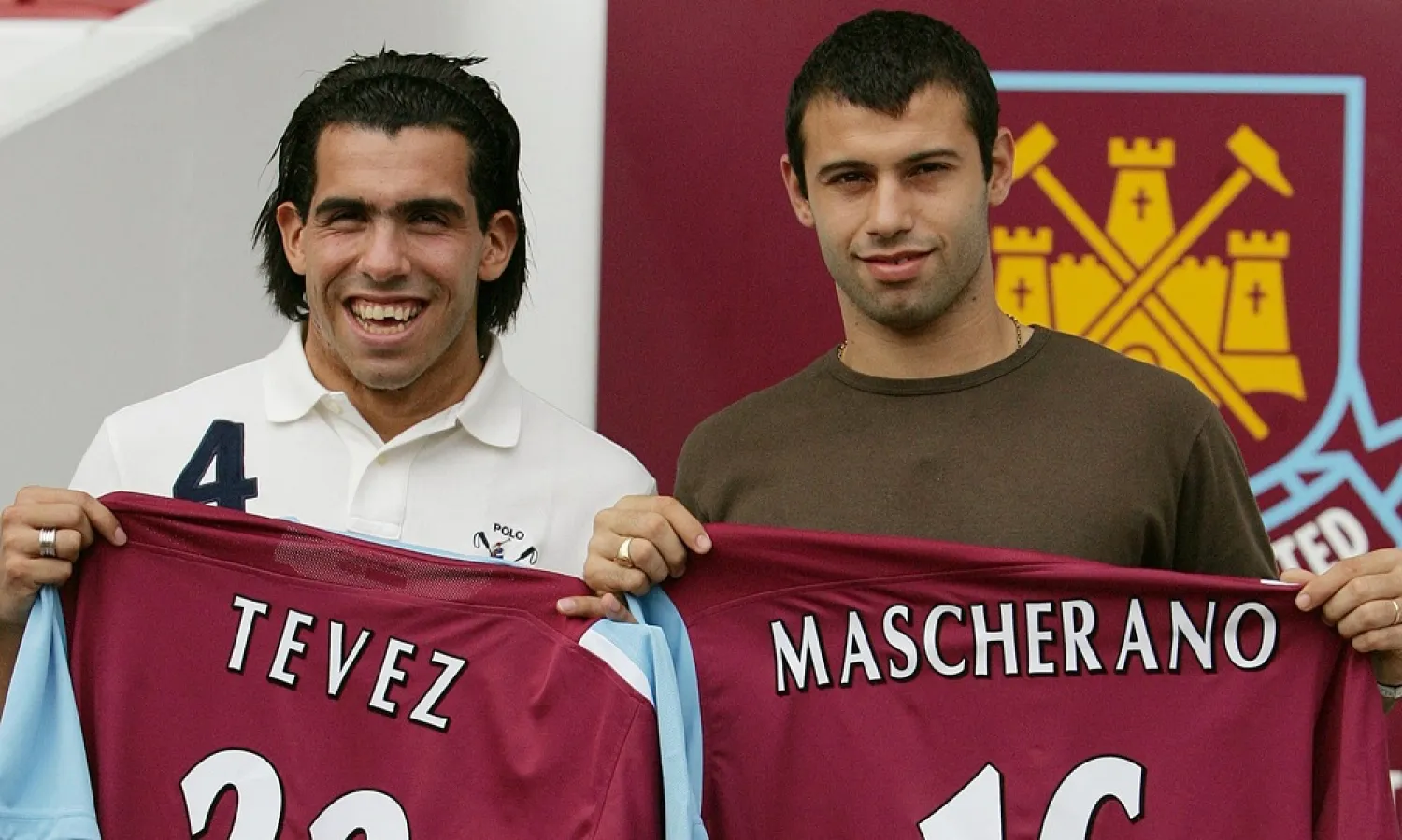

Signings of Tevez and Mascherano Nearly Burst West Ham’s Bubble

The September 2006 arrival of Carlos Tevez and Javier Mascherano was supposed to be a coup for West Ham, but the controversial transfer proved to be a mixed blessing for the Hammers. (AP)
TT

Signings of Tevez and Mascherano Nearly Burst West Ham’s Bubble

The September 2006 arrival of Carlos Tevez and Javier Mascherano was supposed to be a coup for West Ham, but the controversial transfer proved to be a mixed blessing for the Hammers. (AP)

People who were there remember Alan Pardew’s disbelief quickly turning into ecstasy. It was August 2006, almost four months after Pardew’s young West Ham side had come within a whisker of beating Liverpool in the FA Cup final, and the final day of the transfer window was about to take a turn for the surreal in east London.

At first it seemed like a prank, the idea that two of the hottest talents in South America were about to join West Ham, and Pardew’s response was predictable when the idea was put to him. “Don’t be ridiculous,” he said. “It’s never going to happen.” Only, it was. One of the most controversial transfers in the history of English football progressed at dizzying speed and by the end of the day Carlos Tevez and Javier Mascherano had left the São Paulo club Corinthians for West Ham.

“I remember watching it on Sky Sports News,” Matthew Etherington, who played for West Ham between 2003 and 2009, says. “None of us expected it. We thought: ‘Maybe this is the way the club’s going.’ We didn’t know how the deal was structured at the time.”

Sheffield United, who visit the London Stadium last month, have not forgotten. They have faced West Ham once since the bitter row over the Mascherano and Tevez deal, winning a League Cup tie at Upton Park in August 2014, and have not forgotten an independent Premier League commission handing the east London club a record £5.5m fine instead of a points deduction for breaking third-party ownership rules when they signed the Argentinian duo.

An FA tribunal would later find in United’s favor, arguing that Tevez’s role was crucial in West Ham staying up, and the Hammers ended up paying the Blades £20m in compensation following an out-of-court settlement.

However, while the coverage down the years has largely focused on United being cheated out of a Premier League place, something lost in the conversation is how West Ham’s dream turned into a nightmare. Far from helping them challenge the elite, signing Tevez and Mascherano almost got them relegated, caused long-term financial problems and disturbed dressing-room harmony. Mascherano played seven forgettable games before joining Liverpool during the January window and it took Tevez 1,142 minutes to score a goal.

It was one of the strangest seasons in West Ham’s history. Pardew had won the Championship play-offs in 2005 and for a while he was the perfect leader for a youthful, boisterous group. If Bobby Zamora arrived early to nick the manager’s parking space at the training ground, it was seen as part of the fun. After a while, however, off-field issues began to affect the squad’s discipline.

West Ham enjoyed their first season back in the Premier League, finishing ninth and reaching the FA Cup final. Their hearts would be broken by Steven Gerrard’s last-minute equalizer for Liverpool, who won it on penalties. “It took a lot out of everybody,” Etherington says.

Nothing was the same after Gerrard’s thunderbolt. Dean Ashton, the team’s best striker, broke an ankle shortly before the season started and some players had grown cocky. There were doubts over Nigel Reo-Coker’s attitude after stories linking the midfielder with Arsenal and Manchester United. He was pally with Anton Ferdinand, Hayden Mullins, Marlon Harewood and Zamora, all of whom had been central to the side’s rise. When Tevez and Mascherano arrived, the latter took Mullins’s place in midfield. “Hayden definitely didn’t react in a negative way but it did upset the apple cart at the time,” Etherington says. “It was a good, young team with a sprinkling of experience and quality. Were two high-profile signings like that needed?”

The so-called economic rights of Tevez and Mascherano were owned by four companies represented by Kia Joorabchian, who was expected to buy West Ham. A belief grew that Tevez and Mascherano were anticipating a change of manager. Pardew had been fatally undermined and the team knew it. Teddy Sheringham, one of West Ham’s few experienced players, privately remarked that they were in trouble.

Results nosedived. West Ham went out of the Uefa Cup in the first round and were knocked out of the League Cup by Chesterfield. As for the Argentinians, Tevez was unfit and out of his comfort zone in a new country, while Mascherano was struggling with the pace of the Premier League. “Mascherano was brilliant in training,” Etherington says. “Tevez took some time to adjust to life in London. In training he didn’t seem that dedicated. Mascherano adjusted really well. He was doing English lessons from day one. Tevez just had an interpreter with him all the time. He had no interest at the time to bed into the culture.”

Tevez was actually doing extra drills with Zamora after training but the situation showed no sign of improving. Chances went begging and he became so frustrated that he stormed out of Upton Park after being substituted during a win over Sheffield United. Pardew let the rest of the squad decide Tevez’s punishment: they made him train in a Brazil shirt.

An £85m takeover had been completed by then – but not by Joorabchian. Terry Brown had sold up to Bjorgolfur Gudmundsson, an Icelandic billionaire who installed Eggert Magnusson as chairman.

On December 3, Mascherano made his final appearance for West Ham, coming on in the 84th minute of a 2-0 defeat at Everton. He was at fault for the second goal, summing up his time at the club.

Three days later West Ham were beaten at home by Wigan Athletic, after which Pardew was called into Magnusson’s office and told that the board were fully behind him. Yet Pardew’s charm had worn off and he was sacked within a week, a 4-0 loss at Bolton proving the final straw. “I texted Pardew and said I felt the players had let him down,” Etherington says. “We lost our way and I felt the players had a lot to do with that, not so much the manager. People believed their own hype. We took our eye off the ball, me included.”

Gudmundsson was rarely seen at Upton Park but Magnusson was panicking. He appointed Alan Curbishley, an experienced pragmatist. The former Charlton manager had an unforgettable first game, beating the eventual champions, Manchester United, at Upton Park, but it was a temporary high.

West Ham followed the win with three draws and nine defeats. Curbishley, who was reluctant to use Tevez at first, was aghast at his squad’s attitude. There was talk of a gambling culture within the club. “We were probably enjoying ourselves a bit too much,” one former player admits.

Curbishley ripped into his players after a 6-0 defeat at Reading on New Year’s Day, criticizing their flash lifestyles and fast cars, which led to them being dubbed the Baby Bentley brigade. “He was very forthright, which sometimes isn’t the best thing to do,” Etherington adds. “He called players out. It was a bold move. Was it right? I’d say no but eventually we got our act together.”

Curbishley spent in January, signing Luis Boa Morte, Calum Davenport, Lucas Neill, Nigel Quashie and Matthew Upson. Kepa Blanco also joined on loan from Sevilla. Upson had dropped everything to join West Ham from Birmingham on deadline day. The center-back did not even have his boots with him. His agent had to buy a pair from a shop near Upton Park. No wonder Upson limped off on his debut, a 1-0 defeat by Aston Villa. Injuries meant he only played another 11 minutes before the season was over.

Everything was going wrong and West Ham looked relegated after a 4-3 home defeat by Tottenham. They were 10 points off 17th with eight games left. A teenage Mark Noble, finally given a chance in midfield, wept after the final whistle.

Yet something changed that afternoon: Tevez scored his first goal, bending in a free-kick from 25 yards. West Ham ended their winless run two weeks later, coming from behind to win at Blackburn. Tevez won and scored a penalty and Zamora scored a winner that would not have made it past VAR. The striker’s shot failed to cross the line because it hit Tevez, who was offside.

West Ham built on their moment of fortune and the argument that they were a one-man team, utterly reliant on Tevez, overlooked vital contributions from other players. Ferdinand struck up a good partnership with James Collins in central defense. Noble excelled. Robert Green had the game of his life when another Zamora goal saw West Ham win at Arsenal in April, making save after save.

Neill’s leadership was also invaluable. “Lucas had a big say in our revival, more than the manager I’d say,” Etherington says. “Carlos got the headlines but there were other factors that led to us staying up. That’s what people forget.”

That is lost on Neil Warnock’s Sheffield United, who moved 10 points clear of West Ham after beating them 3-0 at home on 14 April. Yet United froze and West Ham rallied. A Zamora stunner brought them a 1-0 win over Everton. Boa Morte, Benayoun and Harewood scored in a 3-0 win at Wigan. Momentum had swung their way and they were out of the bottom three after winning their penultimate game, a double from Tevez defeating Bolton.

West Ham only needed to draw at Old Trafford to shift the focus to Bramall Lane, where Sheffield United and Wigan were both in danger of going down. One of them needed a favor from Manchester United.

Yet Manchester United had already won the league and the FA Cup final against Chelsea was less than a week away. Alex Ferguson’s team still included Wayne Rooney, though, and he introduced Ryan Giggs, Cristiano Ronaldo and Paul Scholes in the second half. West Ham spent most of the game defending. The champions battered Curbishley’s side, who stole a win when Tevez clipped home on the stroke of half-time.

At Bramall Lane, meanwhile, Warnock’s team stumbled against Wigan, who stayed up thanks to a penalty from David Unsworth. The Blades were down and Tevez was off to join Manchester United. “By the end he spoke a little English,” Etherington says. “The interpreter was still with him, standing by the training pitch and helping with the manager’s instructions.” Tevez had done his talking on the pitch.

The Guardian Sport


Sinner Sees off Popyrin to Reach Doha Quarters

 Italy's Jannik Sinner greets the fans after defeating Australia's Alexei Popyrin in their men's singles match at the Qatar Open tennis tournament in Doha on February 18, 2026. (AFP)
Italy's Jannik Sinner greets the fans after defeating Australia's Alexei Popyrin in their men's singles match at the Qatar Open tennis tournament in Doha on February 18, 2026. (AFP)
TT

Sinner Sees off Popyrin to Reach Doha Quarters

 Italy's Jannik Sinner greets the fans after defeating Australia's Alexei Popyrin in their men's singles match at the Qatar Open tennis tournament in Doha on February 18, 2026. (AFP)
Italy's Jannik Sinner greets the fans after defeating Australia's Alexei Popyrin in their men's singles match at the Qatar Open tennis tournament in Doha on February 18, 2026. (AFP)

Jannik Sinner powered past Alexei Popyrin in straight sets on Wednesday to reach the last eight of the Qatar Open and edge closer to a possible final meeting with Carlos Alcaraz.

The Italian, playing his first tournament since losing to Novak Djokovic in the Australian Open semi-finals last month, eased to a 6-3, 7-5 second-round win in Doha.

Sinner will play Jakub Mensik in Thursday's quarter-finals.

Australian world number 53 Popyrin battled gamely but failed to create a break-point opportunity against his clinical opponent.

Sinner dropped just three points on serve in an excellent first set which he took courtesy of a break in the sixth game.

Popyrin fought hard in the second but could not force a tie-break as Sinner broke to grab a 6-5 lead before confidently serving it out.

World number one Alcaraz takes on Frenchman Valentin Royer in his second-round match later.


Ukraine's Officials to Boycott Paralympics over Russian Flag Decision

Milano Cortina 2026 Winter Olympics - Skeleton - Interview with Ukraine Youth and Sports minister Matvii Bidnyi - N H Hotel, Milan, Italy - February 12, 2026 Ukraine Youth and Sports Minister Matvii Bidnyi speaks after the disqualification of Ukrainian skeleton racer Vladyslav Heraskevych from the Winter Games. REUTERS/Kevin Coombs
TT

Ukraine's Officials to Boycott Paralympics over Russian Flag Decision

Milano Cortina 2026 Winter Olympics - Skeleton - Interview with Ukraine Youth and Sports minister Matvii Bidnyi - N H Hotel, Milan, Italy - February 12, 2026 Ukraine Youth and Sports Minister Matvii Bidnyi speaks after the disqualification of Ukrainian skeleton racer Vladyslav Heraskevych from the Winter Games. REUTERS/Kevin Coombs

Ukrainian officials will boycott the Paralympic Winter Games, Kyiv said Wednesday, after the International Paralympic Committee allowed Russian athletes to compete under their national flag.

Ukraine also urged other countries to shun next month's Opening Ceremony in Verona on March 6, in part of a growing standoff between Kyiv and international sporting federations four years after Russia invaded.

Six Russians and four Belarusians will be allowed to take part under their own flags at the Milan-Cortina Paralympics rather than as neutral athletes, the Games' governing body confirmed to AFP on Tuesday.

Russia has been mostly banned from international sport since Moscow invaded Ukraine. The IPC's decision triggered fury in Ukraine.

Ukraine's sports minister Matviy Bidny called the decision "outrageous", and accused Russia and Belarus of turning "sport into a tool of war, lies, and contempt."

"Ukrainian public officials will not attend the Paralympic Games. We will not be present at the opening ceremony," he said on social media.

"We will not take part in any other official Paralympic events," he added.

Ukrainian Foreign Minister Andriy Sybiga said he had instructed Kyiv's ambassadors to urge other countries to also shun the opening ceremony.

"Allowing the flags of aggressor states to be raised at the Paralympic Games while Russia's war against Ukraine rages on is wrong -- morally and politically," Sybiga said on social media.

The EU's sports commissioner Glenn Micallef said he would also skip the opening ceremony.

- Kyiv demands apology -

The IPC's decision comes amid already heightened tensions between Ukraine and the International Olympic Committee, overseeing the Winter Olympics currently underway.

The IOC banned Ukrainian skeleton racer Vladyslav Heraskevych for refusing to ditch a helmet depicting victims of the war with Russia.

Ukraine was further angered that the woman chosen to carry the "Ukraine" name card and lead its team out during the Opening Ceremony of the Games was revealed to be Russian.

Media reports called the woman an anti-Kremlin Russian woman living in Milan for years.

"Picking a Russian person to carry the nameplate is despicable," Kyiv's foreign ministry spokesman Georgiy Tykhy said at a briefing in response to a question by AFP.

He called it a "severe violation of the Olympic Charter" and demanded an apology.

And Kyiv also riled earlier this month at FIFA boss Gianni Infantino saying he believed it was time to reinstate Russia in international football.

- 'War, lies and contempt' -

Valeriy Sushkevych, president of the Ukrainian Paralympic Committee told AFP on Tuesday that Kyiv's athletes would not boycott the Paralympics.

Ukraine traditionally performs strongly at the Winter Paralympics, coming second in the medals table four years ago in Beijing.

"If we do not go, it would mean allowing Putin to claim a victory over Ukrainian Paralympians and over Ukraine by excluding us from the Games," said the 71-year-old in an interview.

"That will not happen!"

Russia was awarded two slots in alpine skiing, two in cross-country skiing and two in snowboarding. The four Belarusian slots are all in cross-country skiing.

The International Paralympic Committee (IPC) said earlier those athletes would be "treated like (those from) any other country".

The IPC unexpectedly lifted its suspension on Russian and Belarusian athletes at the organisation's general assembly in September.


'Not Here for Medals', Nakai Says after Leading Japanese Charge at Olympics

Ami Nakai of Japan competes during the women's short program figure skating at the 2026 Winter Olympics, in Milan, Italy, Tuesday, Feb. 17, 2026. (AP Photo/Ashley Landis)
TT

'Not Here for Medals', Nakai Says after Leading Japanese Charge at Olympics

Ami Nakai of Japan competes during the women's short program figure skating at the 2026 Winter Olympics, in Milan, Italy, Tuesday, Feb. 17, 2026. (AP Photo/Ashley Landis)

Ami Nakai entered her first Olympics insisting she was not here for medals — but after the short program at the Milano Cortina Games, the 17-year-old figure skater found herself at the top, ahead of national icon Kaori Sakamoto and rising star Mone Chiba.

Japan finished first, second, and fourth on Tuesday, cementing a formidable presence heading into the free skate on Thursday. American Alysa Liu finished third.

Nakai's clean, confident skate was anchored by a soaring triple Axel. She approached the moment with an ease unusual for an Olympic debut.

"I'm not here at this Olympics with the goal of achieving a high result, I'm really looking forward to enjoying this Olympics as much as I can, till the very last moment," she said.

"Since this is my first Olympics, I had nothing to lose, and that mindset definitely translated into my results," she said.

Her carefree confidence has unexpectedly put her in medal contention, though she cannot imagine herself surpassing Sakamoto, the three-time world champion who is skating the final chapter of her competitive career. Nakai scored 78.71 points in the short program, ahead of Sakamoto's 77.23.

"There's no way I stand a chance against Kaori right now," Nakai said. "I'm just enjoying these Olympics and trying my best."

Sakamoto, 25, who has said she will retire after these Games, is chasing the one accolade missing from her resume: Olympic gold.

Having already secured a bronze in Beijing in 2022 and team silvers in both Beijing and Milan, she now aims to cap her career with an individual title.

She delivered a polished short program to "Time to Say Goodbye," earning a standing ovation.

Sakamoto later said she managed her nerves well and felt satisfied, adding that having three Japanese skaters in the top four spots "really proves that Japan is getting stronger". She did not feel unnerved about finishing behind Nakai, who also bested her at the Grand Prix de France in October.

"I expected to be surpassed after she landed a triple Axel ... but the most important thing is how much I can concentrate on my own performance, do my best, stay focused for the free skate," she said.

Chiba placed fourth and said she felt energised heading into the free skate, especially after choosing to perform to music from the soundtrack of "Romeo and Juliet" in Italy.

"The rankings are really decided in the free program, so I'll just try to stay calm and focused in the free program and perform my own style without any mistakes," said the 20-year-old, widely regarded as the rising all-rounder whose steady ascent has made her one of Japan's most promising skaters.

All three skaters mentioned how seeing Japanese pair Riku Miura and Ryuichi Kihara deliver a stunning comeback, storming from fifth place after a shaky short program to capture Japan's first Olympic figure skating pairs gold medal, inspired them.

"I was really moved by Riku and Ryuichi last night," Chiba said. "The three of us girls talked about trying to live up to that standard."
