


Iran Starts Injecting Uranium Gas into Centrifuges at Fordow, Alarming France, Russia

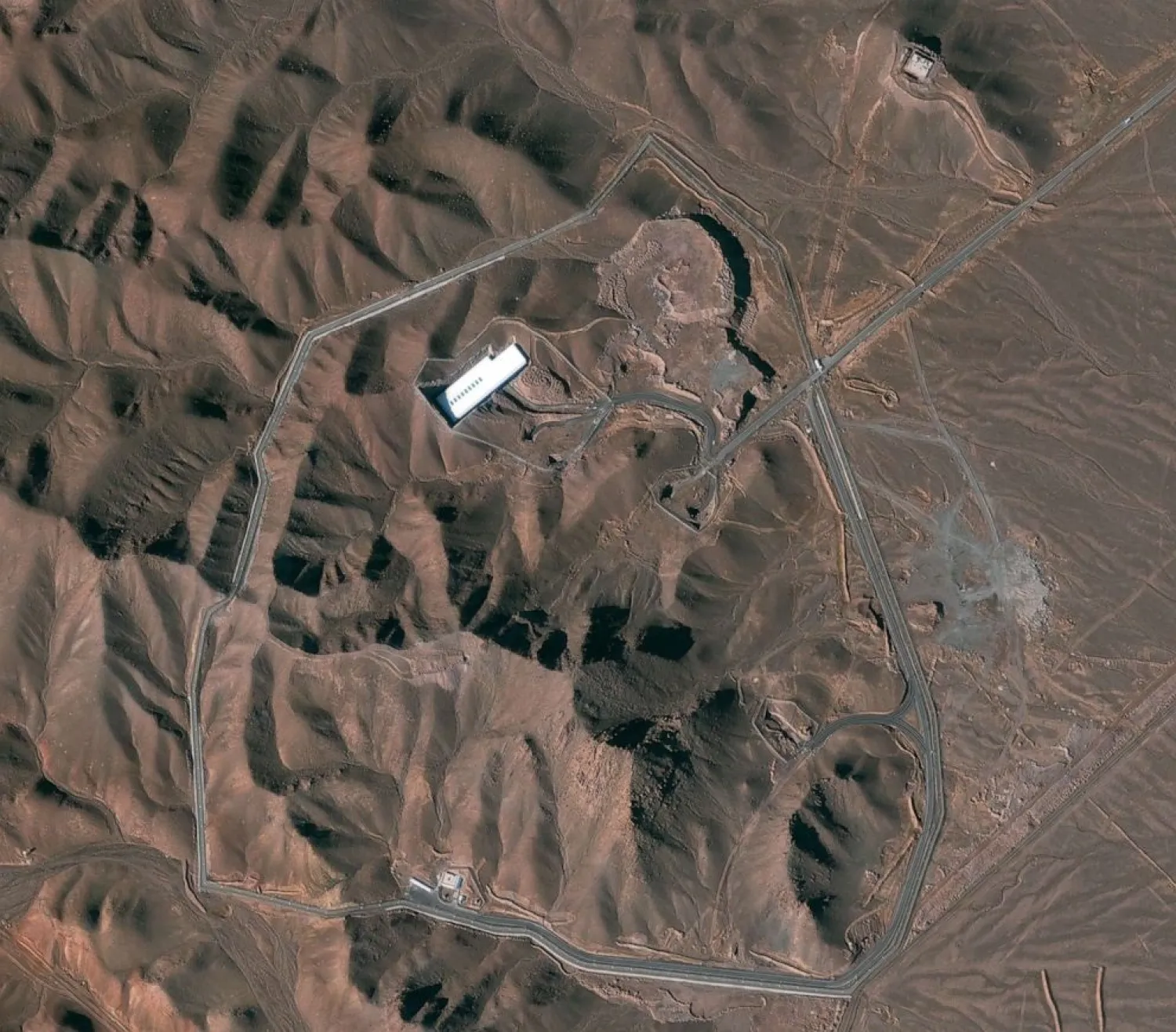
A satellite image of the Fordow facility in Iran, January 30, 2013. (Getty Images)
TT

Iran Starts Injecting Uranium Gas into Centrifuges at Fordow, Alarming France, Russia

A satellite image of the Fordow facility in Iran, January 30, 2013. (Getty Images)

Iran has stepped up activity at its underground Fordow nuclear plant, state TV said on Wednesday, a move France said showed for the first time that Tehran explicitly planned to quit a deal with world powers that curbed its disputed nuclear work.

In another development that could also aggravate tensions between Iran and the West, diplomats said Iran briefly held an inspector for the UN nuclear watchdog and seized her travel documents, with some describing this as harassment.

The incident involving an International Atomic Energy Agency inspector appeared to be the first of its kind since Tehran’s landmark deal with major powers was struck in 2015, imposing restraints on its uranium enrichment program in return for the lifting of international sanctions.

Iran’s decision to inject uranium gas into centrifuges at Fordow, a move that further distances Iran from the accord, was described by Moscow as extremely alarming. Iran once hid Fordow from the IAEA until its exposure by Western spies in 2009.

“With the presence of inspectors from the International Atomic Energy Agency, Iran started injecting (uranium) gas into centrifuges in Fordow,” TV reported.

A central aim of the agreement was to extend the time Tehran would need to assemble a nuclear weapon, if it chose to do so, to a year from about 2-3 months. Iran has repeatedly denied any such intention.

The 2015 deal bans Fordow from producing nuclear material. But, with feedstock gas entering its centrifuges, the facility - built inside a mountain - will move from the permitted status of research plant to being an active nuclear site.

A spokesman for Iran’s Atomic Energy Organization, Behrouz Kamalvandi, told state TV later that the injection of uranium gas would start at midnight (2030 GMT). He said the centrifuges there would enrich uranium up to 4.5% fissile purity. Ninety percent purity is required for bomb-grade fuel.

President Hassan Rouhani, an architect of the 2015 deal, blamed Washington for Iran’s rolling back of its commitments, saying Fordow would soon fully resume uranium enrichment work.

“Iran’s fourth step in reducing its commitments under the JCPOA (the 2015 nuclear deal) by injecting gas to 1,044 centrifuges begins today. Thanks to US policy and its allies, Fordow will soon be back to full operation,” Rouhani tweeted.

Last year, US President Donald Trump exited the deal, saying it was flawed to Iran’s advantage. Washington has since renewed and intensified sanctions on Iran, slashing its economically vital crude oil sales by more than 80 percent.

‘Profound shift’

Speaking in China, French President Emmanuel Macron called Iran’s latest move “grave”, saying it explicitly signaled Iran’s intent for the first time to leave the deal.

“I think that for the first time, Iran has decided in an explicit and blunt manner to leave the JCPOA, which marks a profound shift,” said Macron, who has been at the forefront of efforts by European signatories to salvage the deal after the United States withdrew.

When asked whether Paris would support triggering a dispute mechanism enshrined in the deal, Macron said technical and ministerial meetings would be held to discuss the wider implications of Iran’s actions.

In Moscow, Russian Foreign Minister Sergei Lavrov said events unfolding around the nuclear deal were deeply disturbing and called on Iran to stick to the terms of the deal.

But he added that Moscow understood why Tehran was cutting back on its commitments, and blamed the situation on the US decision to pull out of the pact.

Responding to Washington’s “maximum pressure” policy, Iran has bypassed the restrictions of the deal step-by-step - including by breaching both its cap on stockpiled enriched uranium and on the fissile level of enrichment.

“Iran has taken its fourth step to decrease its nuclear commitments to the deal in reaction to the increased US pressure and inactivity of European parties to the deal to save it,” Iranian state TV added.

Speeding up enrichment

Iranian authorities said on Tuesday that Tehran will enrich uranium to 5% at Fordow, which will further complicate the chances of saving an accord that European powers, Russia and the European Union have urged Iran to respect.

The agreement capped the level of purity to which Iran can enrich uranium at 3.67% - suitable for civilian power generation and far below the 90% threshold of nuclear weapons grade.

On Monday, Iran said it had accelerated enrichment by doubling the number of advanced IR-6 centrifuges in operation, adding that it was working on “a prototype called the IR-9, which works 50 times faster than IR-1 centrifuges”.

In Vienna, the UN nuclear watchdog said IAEA inspectors remained on the ground in Iran and would report back on relevant activities.

The incident involving the IAEA inspector is due to be discussed at a special meeting of the agency’s 35-nation Board of Governors on Thursday. “The agency wants to show how seriously they are taking this. It is a potentially damaging precedent,” one Western official said.



Türkiye Says Greece-Chevron Activity off Crete Unlawful 

A Chevron gas station sign is pictured at one of their retain gas stations in Cardiff, California October 9, 2013. REUTERS/Mike Blake/File Photo
TT

Türkiye Says Greece-Chevron Activity off Crete Unlawful 

A Chevron gas station sign is pictured at one of their retain gas stations in Cardiff, California October 9, 2013. REUTERS/Mike Blake/File Photo

Türkiye said on Thursday it opposed Greece's "unilateral activities" in energy fields south of Crete with a consortium led by US major Chevron as a violation of international law and good neighbourly relations.

Athens responded that its policies abide international law.

The Chevron-led consortium signed exclusive lease agreements on Monday to look for natural gas off southern Greece, expanding US presence in the eastern Mediterranean.

"We oppose this unlawful activity, which is being attempted in violation of the 2019 Memorandum of Understanding on Maritime Jurisdiction between Libya and our country," the Turkish Defense Ministry said at a press briefing.

It said the activity, while not directly impacting Türkiye's continental shelf, also violated Libya's maritime jurisdiction that was declared to the United Nations in May last year.

"We continue to provide the necessary support to the Libyan authorities to take action against these unilateral and unlawful activities by Greece," the ministry said.

A 2019 agreement signed by Türkiye and Libya set out maritime boundaries in the Mediterranean Sea. It was rejected by Greece as it ignored the presence of the Greek island of Crete between the coasts of Türkiye and Libya. The Chevron deal doubles the amount of Greek maritime acreage available for exploration and is the second in months involving a US energy major, as the European Union seeks to phase out supplies from Russia and the US seeks to replace them.

Asked about the Turkish objections later on Thursday, Greek government spokesman Pavlos Marinakis told a press briefing that Athens followed an "active policy" and "exercises its rights in accordance with international law and respects international law steadfastly - and I think no one questions that, period."

There was no immediate comment from Chevron.

Neighbors and NATO members Türkiye and Greece have been at odds over a range of issues for decades, primarily maritime boundaries and rights in the Aegean, an area widely believed to hold energy resources and with key implications for airspace and military activity.

A 2023 declaration on friendly relations prompted a thaw between the sides and leaders have voiced a desire to address remaining issues.


Andrew Mountbatten-Windsor Arrested on Suspicion of Misconduct in Public Office

FILE - Britain’s Andrew Mountbatten-Windsor, formerly known as Prince Andrew, looks round as he leaves after attending the Easter Matins Service at St. George's Chapel, Windsor Castle, England, April 20, 2025. (AP Photo/Kirsty Wigglesworth, File)
TT

Andrew Mountbatten-Windsor Arrested on Suspicion of Misconduct in Public Office

FILE - Britain’s Andrew Mountbatten-Windsor, formerly known as Prince Andrew, looks round as he leaves after attending the Easter Matins Service at St. George's Chapel, Windsor Castle, England, April 20, 2025. (AP Photo/Kirsty Wigglesworth, File)

UK police arrested Andrew Mountbatten-Windsor on Thursday on suspicion of misconduct in public office.

The Thames Valley Police, an agency that covers areas west of London, including Mountbatten-Windsor’s former home, said it was “assessing” reports that the former Prince Andrew sent trade reports to convicted sex offender Jeffrey Epstein in 2010. The assessment followed the release of millions of pages of documents connected to a US investigation of Epstein.

The police force did not name Mountbatten-Windsor, as is normal under UK law. But when asked if he had been arrested, the force pointed to a statement saying that they had arrested a man in his 60s. Mountbatten-Windsor is 66.

“Following a thorough assessment, we have now opened an investigation into this allegation of misconduct in public office,’’ the statement said. “It is important that we protect the integrity and objectivity of our investigation as we work with our partners to investigate this alleged offence."

“We understand the significant public interest in this case, and we will provide updates at the appropriate time,” the statement added.

Pictures circulated online appearing to show unmarked police cars at Wood Farm on the Sandringham Estate in Norfolk, with plainclothes officers appearing to gather outside the home of Mountbatten-Windsor.


Georgia Arrests Two Foreigners Trying to Purchase Uranium

FILE PHOTO: A block with the symbol, atomic number and mass number of Uranium (U) element, in this illustration taken January 21, 2026. REUTERS/Dado Ruvic/Illustration/File Photo
TT

Georgia Arrests Two Foreigners Trying to Purchase Uranium

FILE PHOTO: A block with the symbol, atomic number and mass number of Uranium (U) element, in this illustration taken January 21, 2026. REUTERS/Dado Ruvic/Illustration/File Photo

Georgia has ‌detained two people who attempted to purchase $3 million worth of uranium and a cache of a radioactive isotope found in nuclear weapons testing programs, the national security service said on Thursday.

Two foreign nationals from unspecified countries were arrested in the city of Kutaisi, the State Security Service said in a statement.

"They were planning to ‌illegally purchase ‌nuclear material uranium and radioactive ‌substance ⁠Cesium 137 for $3 ⁠million and illegally transport it to the territory of another country," Reuters quoted it as saying.

It said other foreigners had been arriving in Georgia in recent weeks with the aim of purchasing and transporting the nuclear and ⁠radioactive materials, without elaborating further.

The ‌statement did ‌not specify the quantity of materials the individuals were ‌attempting to procure. There were ‌no details on the substances' origin or potential destination.

Cesium 137 is a radioactive isotope present primarily in the aftermath of nuclear weapons testing ‌and nuclear power plant accidents such as the Chernobyl disaster in ⁠then-Soviet ⁠Ukraine in 1986.

The security of nuclear materials was one of the biggest concerns after the 1991 fall of the Soviet Union, of which Georgia was part. There have been several serious incidents involving the illicit trade in nuclear materials in Georgia over recent decades.

Most recently, three Chinese citizens were arrested in the capital Tbilisi for attempting to purchase two kilograms of "nuclear material" uranium.